Voting at 16, Term Limits, and a 32% Office Vacancy Rate: Rockville’s October 5 Agenda
Rockville’s Mayor and Council meets Monday, October 5, 2026 beginning at 5:30 p.m., with two issues likely to have long-term consequences: a substantial rewrite of the city’s election rules and a review of Rockville’s economic-development performance (warning: the first hour will be devoted to ten proclamations). The agenda also includes proposed Charter amendments that would lower the municipal voting age, establish a minimum age for elected officials, and impose consecutive-term limits. (City of Rockville)
Rockville’s Election Code Heads Toward a Major Rewrite
The Mayor and Council will introduce a substantial rewrite of Chapter 8 of the City Code, which governs municipal elections. The proposal addresses election administration, campaign finance, reporting and enforcement, voter assistance, electioneering, and responsibilities of the Board of Supervisors of Elections. Staff says the revisions respond partly to issues identified during the 2023 election and incorporate subsequent recommendations and Council direction. Public hearings are tentatively planned for October 26 and November 2. (Earlier background: “Historic Preservation, Election Rules, and State Priorities”)
Among the most significant changes:
- Individual contributions would be limited to $1,200 per candidate or campaign committee per election cycle, with the limit periodically adjusted for inflation. Contributions over $100 would have to be made by check or electronically.
- Transfers between candidate or campaign committees could reach $5,000, substantially more than the normal individual contribution limit.
- Campaign treasurers would be explicitly responsible for managing and recording contributions and expenditures, and candidates or committee members could not make expenditures without the treasurer’s knowledge.
- Late campaign reports could generate escalating penalties of $200, $300, and eventually $450 per day, up to a maximum of $7,500.
- The Board of Supervisors of Elections would have clearer authority to verify candidate eligibility, investigate possible violations, request documents, and issue notices of violation.
- Electioneering would be prohibited within 50 feet of vote-center entrances and exits and outdoor ballot drop boxes, and obstructing access to a drop box would be prohibited.
Election Reform Should Make It Easier to Run for Office, Too

Rockville is revising Chapter 8 of the City Code, which governs municipal elections. Much of the discussion understandably focuses on election integrity: campaign contributions, disclosure, independent expenditures, enforcement, and the rules governing political committees.
But there is another test the Mayor and Council should apply to the proposed ordinance:
Could a first-time candidate running a $2,000 volunteer campaign comply confidently with these rules without hiring an attorney or experienced campaign treasurer?
That is not a hypothetical concern. Rockville’s own 2025 Election Review concluded that the existing code needed substantial revision in part so candidates could understand the rules “without having to hire an attorney to decipher the language.” It also recommended clearer explanations, an election handbook, and simpler navigation for candidates and voters.
Continue reading →Historic Preservation, Election Rules, and State Priorities on Rockville Council’s September 14 Agenda
Rockville’s Mayor and Council meets Monday, September 14, 2026 beginning at 5:30 p.m. The first hour will be devoted largely to community recognitions and proclamations. The heavier policy work begins around 7 p.m., with the first significant Council actions scheduled for roughly 7:20 to 7:25 p.m. Several items deserve particular attention because they could shape Rockville well beyond Monday night.
Will Rockville Preserve 24 Martins Lane?
The most immediate decision concerns 24 Martins Lane, a property associated with the historically Black Haiti/Martins Lane community. The Mayor and Council will first hold a public hearing and then are scheduled to vote on whether to place the property in Rockville’s Historic District Overlay Zone. The Historic District Commission voted 4-1 to recommend designation, finding that the property met five of the city’s historic-designation criteria. The Planning Commission later found the designation consistent with the Comprehensive Plan.
The history here matters. The Haiti/Martins Lane community is one of Rockville’s oldest Black neighborhoods, with roots extending to about 1830, when free Black landowner Samuel Martin settled in the area. The neighborhood’s name reflects a broader African American identification with Haiti, whose successful revolution against slavery and declaration of independence in 1804 made it a powerful symbol of Black freedom and self-determination in the nineteenth century. The city’s analysis also identifies the property as representative of Rockville’s Black heritage and of early vernacular residential construction.
The timing also matters because demolition is contemplated. Historic designation would not freeze the property in time, but it would require Historic District Commission review of future exterior alterations and changes to the site. This is the kind of decision that forces Rockville to weigh several legitimate interests at once: preserving African American history, respecting private property, accommodating future development, and deciding what parts of the city’s physical history should remain visible.
Rockville’s Election Rules Are Heading Toward a Rewrite
Later in the evening, the Mayor and Council will hold a worksession on a substantial rewrite of Chapter 8 of the City Code, which governs municipal elections. This discussion is part of a much longer reconsideration of how Rockville conducts its elections. In 2022, the city’s Charter Review Commission recommended a range of changes, including term limits, representative districts, lowering the voting age, allowing noncitizen residents to vote in municipal elections, and exploring ranked-choice voting. The Mayor and Council initially considered placing ranked-choice voting before voters along with several of those questions in 2023, but it did not appear on the final ballot. Instead, voters considered four nonbinding questions on voting age, noncitizen voting, term limits, and representative districts.
Continue reading →Mayor and Council to Discuss 68% Increase in Car Thefts

At its Monday, February 26, 2024 meeting, the Rockville Mayor and Council will discuss 2024 state legislation and community engagement plans. On the Consent Agenda (items approved without discussion) are a transportation grant agreement and purchasing of three different types of trucks, among others. The Mayor and Council will also receive reports on police statistics and recognize the Richard Montgomery High School Girls Varsity Volleyball Team on winning the state 4A Championship.
For the first time, the Rockville City Police Department (RCPD) shared its annual statistics on crime and their report states that “thefts of automobiles and thefts from automobiles remain one of the highest reported criminal offenses in the region and across the nation. The RCPD noted an increase in theft of automobiles by 69 from 2022 to 2023, an increase of 68%. Thefts from automobiles were up by 19 from 2022 to 2023, an increase of 2%. The most noteworthy change in crime reporting was Carjackings. Carjackings have been on the rise, locally, regionally, and nationally.” Furthermore, “Montgomery County Department of Police re-deployed personnel assigned to the Rockville District to other areas of Montgomery County. This has left parts of the city that once had dual police coverage between the RCPD and the Montgomery County Department of Police to be policed solely by the RCPD.” That resulted in a significant increase in calls for help to RCPD and a significant reduction in response time (“on average, for every additional 1,000 calls dispatched to police per month, officers arrive nine minutes slower”). More on pages 12-20.
The City Council will discuss legislation being introduced at the state level and which they will support or oppose. Under discussion are SB484: Housing Expansion and Affordability; SB537: Restrictions on Cannabis Licensee Locations; SB 783/HB 1435: Renewable Energy (Net Energy Metering Aggregation, Solar Renewable Energy Credits, and Taxes on Solar Energy Generating); HB 601/SB 442: Prohibiting Street Racing and Exhibition Driving; and HB 1306 Taxing Food and Beverages. These bills are complex and continually revised, so if you have an interest, read the staff report for a summary and recommendations (pages 190-200) or contact Senator Kagan or Delegates Palakovich-Carr, Vogel, and Spiegel.
Potential topics for the March 4, 2024 meeting is a presentation on the FY2025 budget and approval of taxes and fees.
The Mayor and Council are conducting hybrid meetings. If you wish to submit comments in writing for Community Forum or Public Hearings, please email the comments to MayorAndCouncil@RockvilleMD.gov by no later than 10:00 a.m. on the date of the meeting.
More details in the 205-page agenda packet are available at https://www.rockvillemd.gov/AgendaCenter/ViewFile/Agenda/_02262024-7117.
Random Rockville Reports: January 28, 2024
Playing Musical Chairs and Three-Card Monte in Rockville City Hall
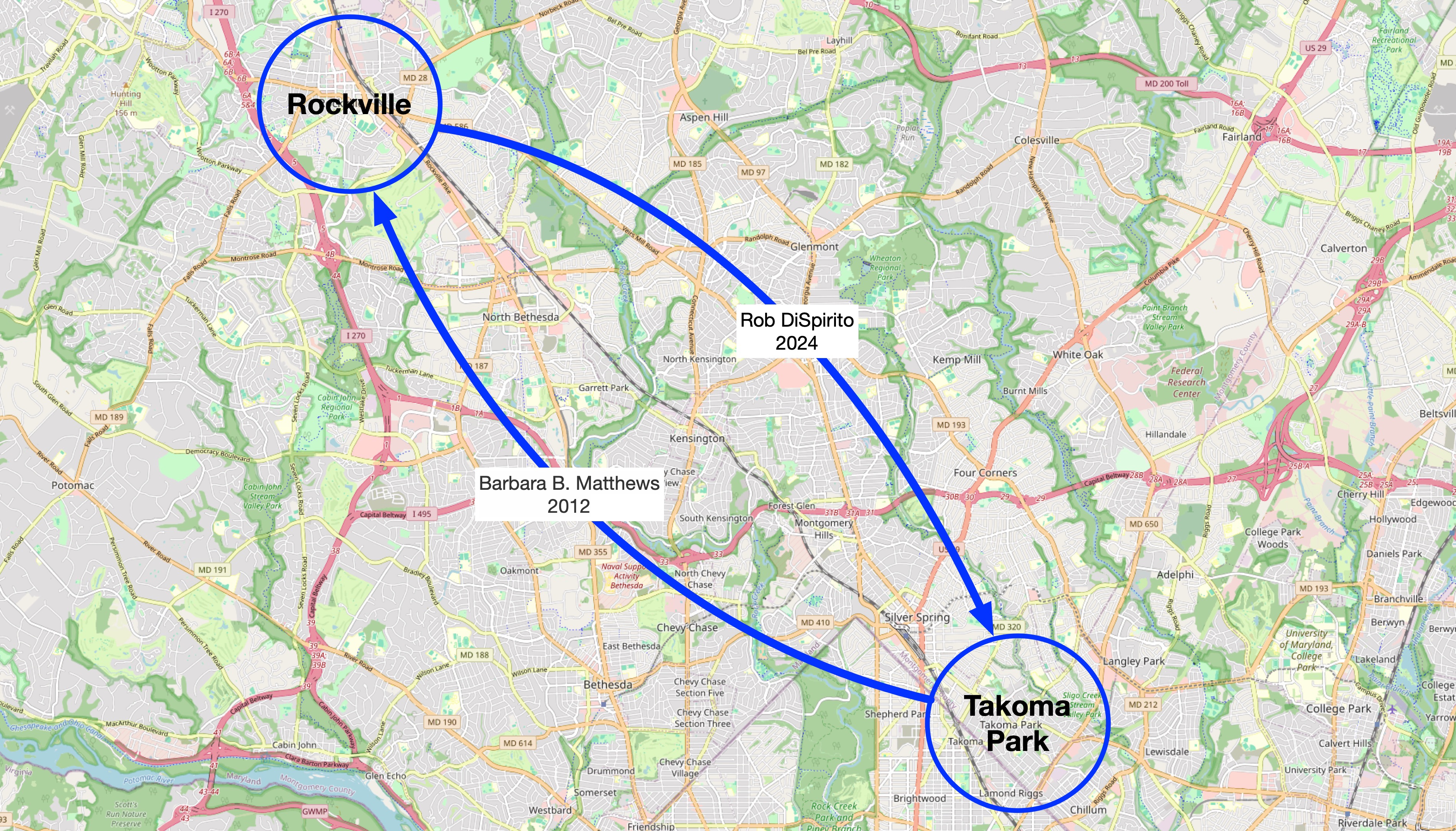
The Takoma Park City Council hired Robert DiSpirito as their new City Manager effective January 22, 2024. DiSpirito was City Manager of Rockville for seven years and by coincidence, his predecessor was Barbara Mathews, who was previously the City Manager of Takoma Park. They were also both hired and fired by the Rockville Mayor and Council, which both times included Mayor Bridget Newton and Councilmember Beryl Feinberg.
DiSpirito’s departure continues to be an embarrassment of poor management by the Mayor and Council. When he resigned at the conclusion of a Closed Session (aka “secret meeting”) of the Mayor and Council on August 17, he also received a $307,093 severance package (typically resignations don’t include severance). But figuring out what was going on was kept secret illegally for several months. According to Maryland’s Open Meetings Act, the Mayor and Council must provide minutes of a closed session at its next open session (3-306), which would have been September 11 but they failed to share the minutes. It wasn’t until October 23, 2023 (three regular meetings later) that the Mayor and Council approved the August 17 minutes (Agenda, page 218), keeping the public uninformed for more than two months. Furthermore, they played a trick in the meeting minutes. The Mayor and Council approved the official minutes of the September 11 meeting as if they included the Closed Session minutes of August 17 (watch the video of September 11 meeting and you’ll see the August 17 meeting was not discussed)–but it actually didn’t happen until October 23. Hmm, looks like the Mayor and Council is playing three-card monte with the public. Clearly, the Mayor and Council violated the Open Meetings Act but also acted unethically in the preparation of their official records.
More Pedestrians Struck in Rockville Than Reported
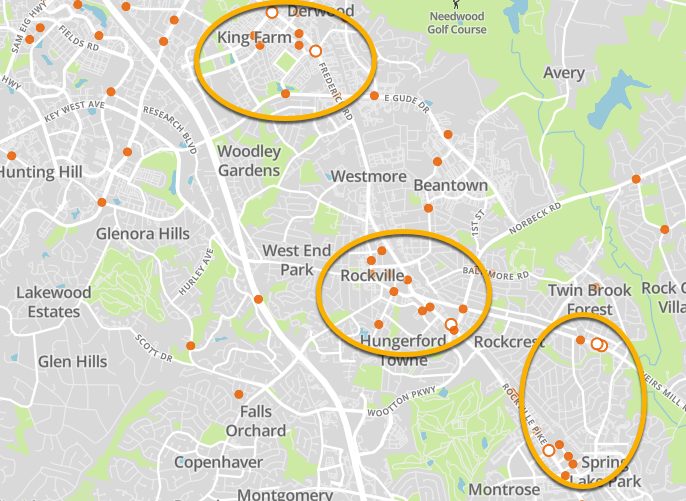
The recent death of a 70-year old pedestrian struck by two vehicles at Atlantic Avenue and Viers Mill Road prompted me to see if this a growing problem in Rockville. Data collected by Montgomery County suggests that many more pedestrians were injured or killed in Rockville in 2023 than the eight reported at the most recent Mayor and Council meeting. Not sure the cause of the discrepancy, but county data shows the greatest numbers of incidents occur in and near King Farm, downtown Rockville, and Twinbrook. Although these high incident areas all share major highways (MD Route 355 and 586), pedestrian injuries and deaths also occurred on smaller streets in these neighborhoods, which conflicts with the City’s conclusions. Both the City of Rockville and Montgomery County have adopted Vision Zero, but they don’t seem to be working from the same data. Should pedestrian safety be a higher priority for Rockville’s Transportation and Mobility Commission?


