At its Monday, November 2, 2026, meeting, the Rockville Mayor and Council will consider changes to municipal elections, financial assistance for two affordable housing developments, and projects to improve transportation and pedestrian safety. The meeting begins at 5:30 p.m., with public hearings on election reforms scheduled for 7:30 p.m.
Preview of the November 2, 2026 Rockville Council Meeting
Election Reform: Voting at 16 and Term Limits
Public Hearings | 7:30 p.m.
Rockville residents will have an opportunity to comment on proposed changes to the city’s election laws, including allowing 16- and 17-year-olds to vote in municipal elections and limiting elected officials to four consecutive four-year terms (16 years!). Candidates would still need to be at least 18 years old. Other amendments would update campaign finance rules, enforcement procedures, and the responsibilities of the Board of Supervisors of Elections. A second public hearing is scheduled for November 9, with a possible Council vote on November 16.
Analysis: Lowering the voting age could encourage young residents to become involved in local government and establish voting habits early in life. However, opponents may question whether teenagers have sufficient experience and independence to make informed electoral decisions. Term limits could encourage new candidates and prevent incumbents from retaining office indefinitely, but they could also deprive the city of experienced leadership and reduce voters’ choices. Administrative improvements could strengthen election oversight, although implementation may increase costs. The proposed reforms deserve careful consideration because they would fundamentally change Rockville’s electoral system.
Affordable Housing: Two Proposals, Different Financial Challenges
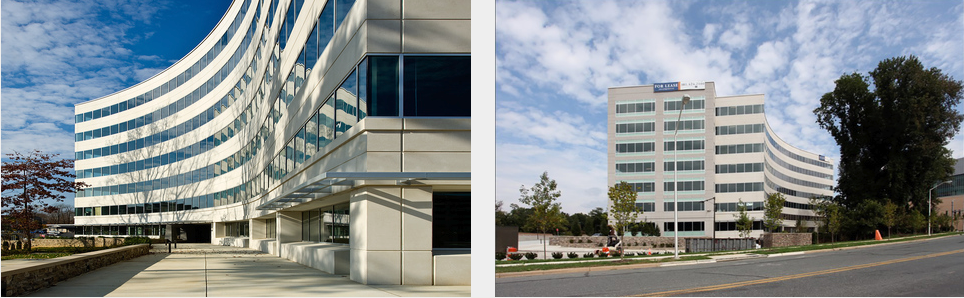
Twinbrook Place: $1.5 Million City Loan for 125 Affordable Apartments
Action Item | 8:20 p.m.
The Council will consider providing a $1.5 million loan from the Housing Opportunities Fund to convert an underused office building at 12501 Ardennes Avenue into 125 affordable apartments. All units would serve households earning no more than 80% of the area median income, including 48 units for households earning 50% or less. The proposed loan carries a 3% annual interest rate over 40 years. The city would also cover up to $330,000 in development fees.
Analysis: Converting an existing office building into housing offers several advantages: it reuses an existing structure, avoids displacing residents, and creates apartments near Metro and other services. The project also demonstrates how Rockville could respond to changing demand for commercial office space. However, only six apartments would have three bedrooms, limiting its usefulness for larger families. The financial arrangement also warrants scrutiny. The developer requested $1.875 million, while staff recommends $1.5 million plus fee assistance. With principal repayment deferred for 40 years, the city is committing substantial resources for decades. The Council should ensure that the financing is sustainable and the affordability restrictions remain enforceable.
Scarborough Square: Refinancing to Preserve Affordable Housing
Consent Agenda | 7:25 p.m.
The Council will consider changing the repayment priority of an existing $1.2 million city loan to Scarborough Square Townhomes and Apartments, a 121-unit rental community owned by Rockville Housing Enterprises through an affiliated entity. The city previously provided a $1.2 million loan and $600,000 grant to preserve 61 apartments for lower-income households. The proposed agreement would give a new NeighborWorks mortgage priority over the city’s loan, allowing the property owner to refinance existing debt on more favorable terms.
Analysis: Preserving affordable housing is generally less disruptive than constructing new apartments, and refinancing could reduce borrowing costs and provide greater financial stability. However, Scarborough Square’s financing history raises questions about its long-term sustainability. The property was acquired for $40 million in 2022 and has subsequently relied on short-term loans, extensions, additional public financing, and changes in ownership interests. By subordinating its loan, the city would accept a lower repayment priority if the borrower defaults. Although the city expects repayment when the development secures longer-term financing, that outcome is not guaranteed. This proposal deserves careful public scrutiny, particularly because it is on the consent agenda and could be approved without discussion.
Transportation and Traffic Safety
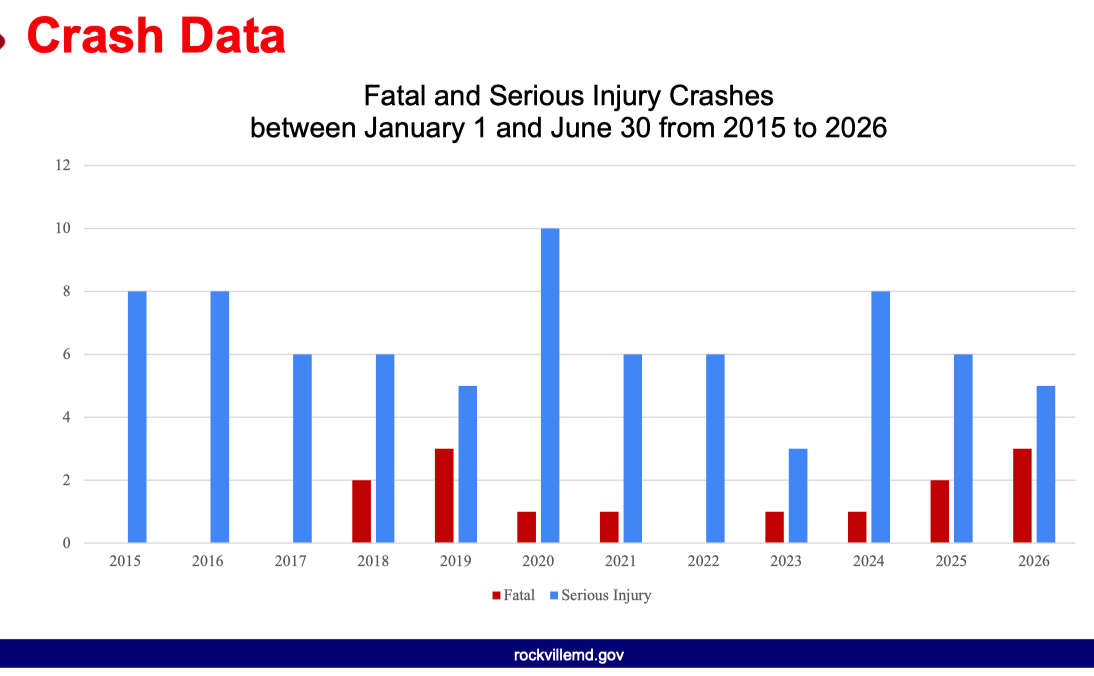
Vision Zero: Rockville Continues to Experience Fatal and Serious Traffic Crashes
Presentation | 7:05 p.m.
Rockville will receive its semiannual update on Vision Zero, the city’s commitment to eliminating fatal and serious traffic crashes by 2030. During the first six months of 2026, the city recorded 437 crashes, compared with 418 during the same period in 2025. Three crashes were fatal, including two involving pedestrians, and five resulted in serious injuries. Although staff continues working on sidewalks, intersections, bicycle infrastructure, and traffic calming, no additional Vision Zero action items were fully completed during the reporting period.
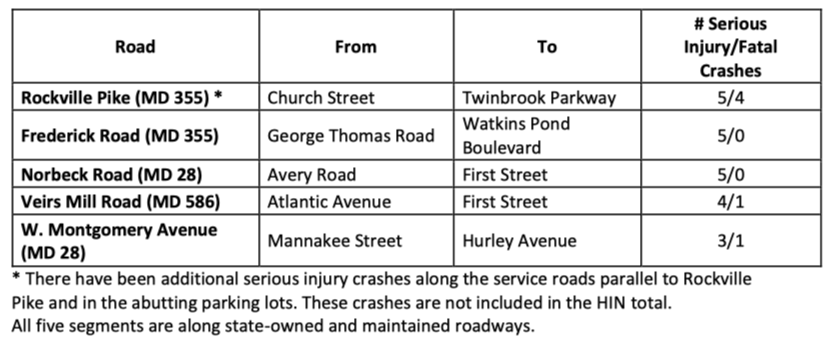
Analysis: Rockville’s commitment to improving traffic safety is important, particularly for pedestrians and bicyclists. The city has identified five high-injury road segments, including portions of Rockville Pike, Frederick Road, Norbeck Road, Veirs Mill Road, and West Montgomery Avenue. All five are state-maintained roads, limiting the city’s ability to make improvements independently. While ongoing engineering projects and public education efforts are strengths, the continued occurrence of fatal and serious crashes raises questions about whether existing strategies are sufficient. With just four years remaining until the 2030 deadline, the Council should focus on measurable reductions in crashes, completion of high-priority projects, and stronger coordination with the Maryland State Highway Administration.
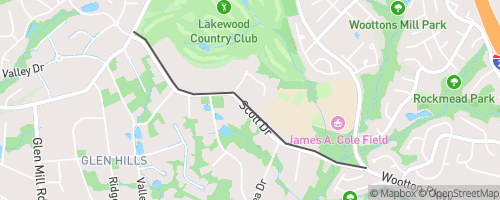
Scott and Veirs Drive: A New Shared-Use Path
Consent Agenda | 7:25 p.m.
The Council will consider an agreement with the Maryland State Highway Administration to design a 1.2-mile shared-use path along Scott Drive and Veirs Drive between Glen Mill Road and Wootton Parkway. The path would connect Rockville with the North Potomac area, providing another route for pedestrians and bicyclists. The design phase is expected to cost approximately $426,541, supported by a $200,000 federal grant and $226,541 in city funds. Construction funding is not included in this agreement.
Analysis: The project could improve connections between neighborhoods and make walking and bicycling safer and more convenient. Federal assistance reduces the city’s design costs, and a shared-use path could support Rockville’s broader transportation and sustainability goals. However, the ultimate construction cost and schedule remain uncertain. The Council should consider how the proposed path connects to existing sidewalks and bicycle routes, whether it will provide practical access to destinations, and how construction will be funded before committing to the next phase.
Rockville Senior Center: New Entrance from West Gude Drive
Consent Agenda | 7:25 p.m.
The city is developing a new entrance to the Rockville Senior Center from West Gude Drive at Piccard Drive. Because the entrance would cross an easement containing a major underground natural gas pipeline, the city must obtain approval from Williams Gas and reimburse the company for construction inspections. The Council will consider authorizing the necessary agreements, including $25,455 in inspection expenses already included in the project’s budget.
Analysis: The new entrance could improve access to the Senior Center, particularly for older residents and visitors arriving by car. Coordinating with the pipeline operator is necessary to protect public safety and avoid damage to critical infrastructure. The immediate financial impact is relatively modest and already budgeted, although the Council should continue monitoring the overall project’s costs and schedule.
How to Participate
The November 2 meeting includes a Community Forum at approximately 6:45 p.m., when residents can address the Mayor and Council on matters of concern. Two public hearings on election reforms are scheduled to begin at 7:30 p.m. Speakers generally receive three minutes.
Residents can submit written comments or register to speak virtually by emailing mayorandcouncil@rockvillemd.gov before 10 a.m. on the day of the meeting. Those attending in person may sign up to speak at the entrance to the Council Chamber.
The meeting will be broadcast live on Rockville 11 and streamed on the city’s website.
This analysis was prepared with the assistance of ChatGPT to review and summarize the City’s agenda materials and related reports (303 pages!). I selected the issues to highlight, evaluated their significance, and reviewed and edited the final post.


