Question 3: What This Mailer Doesn’t Tell You
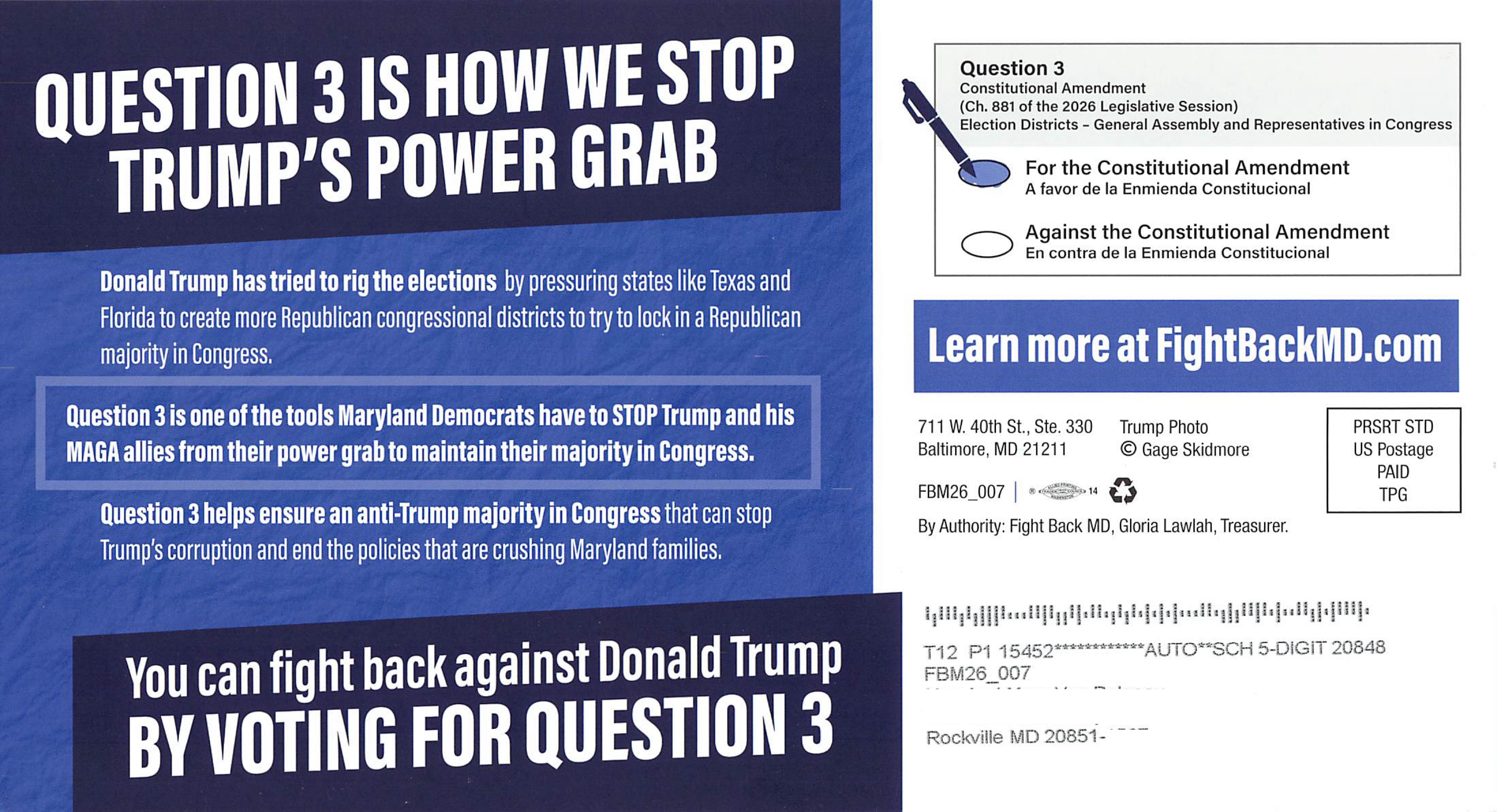
Today I received a campaign mailer urging Maryland voters to vote for Question 3, the constitutional amendment concerning congressional redistricting. The front says, in large letters, “QUESTION 3 IS HOW WE STOP TRUMP’S POWER GRAB.” It argues that Republican-led states such as Texas and Florida have redrawn congressional districts to increase Republican power in Congress. Maryland Democrats, the mailer says, should “fight back” by voting for Question 3.
That certainly tells me why the group that sent the mailer wants Question 3 to pass. What it does not tell me is something more basic: What does Question 3 actually do?
That omission matters because voters are not being asked to approve a temporary political strategy. We are being asked to amend the Maryland Constitution.
What Question 3 actually changes
Today, the Maryland General Assembly draws Maryland’s congressional districts through legislation. Question 3 would not change that. Legislators in Annapolis would continue to decide where congressional district boundaries are drawn.
The important change involves the rules that can be used to judge those maps. Maryland’s Constitution contains standards for drawing legislative districts. Among other things, districts are supposed to be compact and contiguous, and lawmakers are supposed to pay attention to county and other political boundaries. A 2022 court ruling applied Maryland constitutional protections to a congressional redistricting plan and struck down the map adopted by the General Assembly. That ruling is an important part of the history behind Question 3.
If Question 3 passes, the Maryland Constitution would specifically say that certain districting requirements apply only to districts for the Maryland Senate and House of Delegates. It would also state that nothing in the Maryland Constitution provides criteria for the boundaries of congressional districts (Maryland State Board of Elections).
That is a significant change.
Continue reading →Rockville’s Housing Problem Isn’t Just Zoning: ADUs, Prefab Homes, and the Cost of Building

Rockville’s Mayor and Council meets Monday, October 12, 2026, with housing dominating much of the agenda. The city will review its homeownership assistance program, consider converting most of the Sheraton Hotel in King Farm into apartments, and spend an hour discussing how to make accessory dwelling units and other forms of small-scale housing easier to build. (Rockville Agenda 2026-10).
Taken together, these discussions point to a larger problem: Rockville has already made some important zoning changes to allow more housing, but legalizing housing does not necessarily make it affordable to build. The homeownership numbers explain why this matters.
A $774,000 Median Home
According to the city, the median sales price of a Rockville home during the first half of 2026 was $774,258. Under the assumptions used in the staff report, a household would need an annual income of about $222,880 to afford that home—more than $80,000 above Rockville’s median household income of $142,536. Rockville Agenda Packet 2026-10…
Rockville’s Homeownership Assistance Program is intended to help first-time and first-generation buyers, as well as city employees, with down payments and closing costs. Demand has been strong. The city spent all $437,252 available in FY2026, making 14 loans, and all $250,000 available for FY2027 has already been spent or reserved. New applicants are being placed on a waiting list. Thirteen of the first 14 borrowers purchased Moderately Priced Dwelling Units rather than market-rate homes.
That tells us something important. Down-payment assistance can help individual households, but it cannot by itself solve a housing market in which many middle-income households cannot afford prevailing prices.
Increasing supply therefore matters—but so does figuring out how to create housing at a cost people can actually afford.
ADUs Are Legal. Now Comes the Hard Part.
Monday’s most important housing discussion may be the Mayor and Council worksession on Accessory Dwelling Units and Small-Scale Development.
Continue reading →Voting at 16, Term Limits, and a 32% Office Vacancy Rate: Rockville’s October 5 Agenda
Rockville’s Mayor and Council meets Monday, October 5, 2026 beginning at 5:30 p.m., with two issues likely to have long-term consequences: a substantial rewrite of the city’s election rules and a review of Rockville’s economic-development performance (warning: the first hour will be devoted to ten proclamations). The agenda also includes proposed Charter amendments that would lower the municipal voting age, establish a minimum age for elected officials, and impose consecutive-term limits. (City of Rockville)
Rockville’s Election Code Heads Toward a Major Rewrite
The Mayor and Council will introduce a substantial rewrite of Chapter 8 of the City Code, which governs municipal elections. The proposal addresses election administration, campaign finance, reporting and enforcement, voter assistance, electioneering, and responsibilities of the Board of Supervisors of Elections. Staff says the revisions respond partly to issues identified during the 2023 election and incorporate subsequent recommendations and Council direction. Public hearings are tentatively planned for October 26 and November 2. (Earlier background: “Historic Preservation, Election Rules, and State Priorities”)
Among the most significant changes:
- Individual contributions would be limited to $1,200 per candidate or campaign committee per election cycle, with the limit periodically adjusted for inflation. Contributions over $100 would have to be made by check or electronically.
- Transfers between candidate or campaign committees could reach $5,000, substantially more than the normal individual contribution limit.
- Campaign treasurers would be explicitly responsible for managing and recording contributions and expenditures, and candidates or committee members could not make expenditures without the treasurer’s knowledge.
- Late campaign reports could generate escalating penalties of $200, $300, and eventually $450 per day, up to a maximum of $7,500.
- The Board of Supervisors of Elections would have clearer authority to verify candidate eligibility, investigate possible violations, request documents, and issue notices of violation.
- Electioneering would be prohibited within 50 feet of vote-center entrances and exits and outdoor ballot drop boxes, and obstructing access to a drop box would be prohibited.
Maryland Ballot 2026: Question 3 on Redistricting
Maryland voters will face an unusually complicated constitutional question this November concerning congressional redistricting. Question 3 does not itself redraw Maryland’s congressional districts. Instead, it would change the Maryland Constitution to clarify which state constitutional rules apply when congressional districts are drawn—and, just as importantly, which rules do not.
The history behind the amendment helps explain why it is controversial.
Maryland’s Constitution requires legislative districts to be contiguous, compact, and drawn with “due regard” for natural boundaries and the boundaries of political subdivisions. For many years, those provisions were generally treated as rules governing districts for the Maryland General Assembly. That understanding changed during litigation over the congressional map enacted after the 2020 census.
In 2022, retired Judge Lynne Battaglia ruled that those state constitutional requirements also applied to Maryland’s congressional districts. She struck down the General Assembly’s 2021 congressional map, finding, among other things, that it failed state constitutional standards concerning compactness and political boundaries. The General Assembly subsequently adopted a replacement congressional map.
Question 3 is, in significant part, a response to that 2022 decision. During a special session in August 2026, the General Assembly passed HB 2100, sponsored by House Speaker Joseline Peña-Melnyk. The measure passed the Senate 32–13 and was approved by the governor on August 5. Because it changes the Constitution, however, voters must approve it before it can take effect.
If adopted, Question 3 would make three principal changes.
- First, it would specify that Maryland’s constitutional requirements concerning compactness, contiguity, and political and natural boundaries apply to districts for the Maryland Senate and House of Delegates—not congressional districts.
- Second, it would state explicitly that nothing elsewhere in the Maryland Constitution, including the Declaration of Rights, supplies criteria for drawing congressional district boundaries.
- Third, it would allow the General Assembly to give the Supreme Court of Maryland original jurisdiction to hear challenges to congressional redistricting plans.
The argument for Question 3
Supporters describe the amendment principally as a clarification of constitutional law. Their argument is that Article III of the Maryland Constitution was designed to regulate districts for the General Assembly and that the 2022 court decision extended those provisions to congressional districts in a way that had not previously been understood. Under that view, Question 3 restores the historical distinction between state legislative redistricting and congressional redistricting and establishes clearer rules before the next round of mapmaking.
Continue reading →Election Reform Should Make It Easier to Run for Office, Too
Rockville is revising Chapter 8 of the City Code, which governs municipal elections. Much of the discussion understandably focuses on election integrity: campaign contributions, disclosure, independent expenditures, enforcement, and the rules governing political committees.
But there is another test the Mayor and Council should apply to the proposed ordinance:
Could a first-time candidate running a $2,000 volunteer campaign comply confidently with these rules without hiring an attorney or experienced campaign treasurer?
That is not a hypothetical concern. Rockville’s own 2025 Election Review concluded that the existing code needed substantial revision in part so candidates could understand the rules “without having to hire an attorney to decipher the language.” It also recommended clearer explanations, an election handbook, and simpler navigation for candidates and voters.
Continue reading →Historic Preservation, Election Rules, and State Priorities on Rockville Council’s September 14 Agenda
Rockville’s Mayor and Council meets Monday, September 14, 2026 beginning at 5:30 p.m. The first hour will be devoted largely to community recognitions and proclamations. The heavier policy work begins around 7 p.m., with the first significant Council actions scheduled for roughly 7:20 to 7:25 p.m. Several items deserve particular attention because they could shape Rockville well beyond Monday night.
Will Rockville Preserve 24 Martins Lane?
The most immediate decision concerns 24 Martins Lane, a property associated with the historically Black Haiti/Martins Lane community. The Mayor and Council will first hold a public hearing and then are scheduled to vote on whether to place the property in Rockville’s Historic District Overlay Zone. The Historic District Commission voted 4-1 to recommend designation, finding that the property met five of the city’s historic-designation criteria. The Planning Commission later found the designation consistent with the Comprehensive Plan.
The history here matters. The Haiti/Martins Lane community is one of Rockville’s oldest Black neighborhoods, with roots extending to about 1830, when free Black landowner Samuel Martin settled in the area. The neighborhood’s name reflects a broader African American identification with Haiti, whose successful revolution against slavery and declaration of independence in 1804 made it a powerful symbol of Black freedom and self-determination in the nineteenth century. The city’s analysis also identifies the property as representative of Rockville’s Black heritage and of early vernacular residential construction.
The timing also matters because demolition is contemplated. Historic designation would not freeze the property in time, but it would require Historic District Commission review of future exterior alterations and changes to the site. This is the kind of decision that forces Rockville to weigh several legitimate interests at once: preserving African American history, respecting private property, accommodating future development, and deciding what parts of the city’s physical history should remain visible.
Rockville’s Election Rules Are Heading Toward a Rewrite
Later in the evening, the Mayor and Council will hold a worksession on a substantial rewrite of Chapter 8 of the City Code, which governs municipal elections. This discussion is part of a much longer reconsideration of how Rockville conducts its elections. In 2022, the city’s Charter Review Commission recommended a range of changes, including term limits, representative districts, lowering the voting age, allowing noncitizen residents to vote in municipal elections, and exploring ranked-choice voting. The Mayor and Council initially considered placing ranked-choice voting before voters along with several of those questions in 2023, but it did not appear on the final ballot. Instead, voters considered four nonbinding questions on voting age, noncitizen voting, term limits, and representative districts.
Continue reading →Federal Cuts Are Reshaping Rockville’s Future
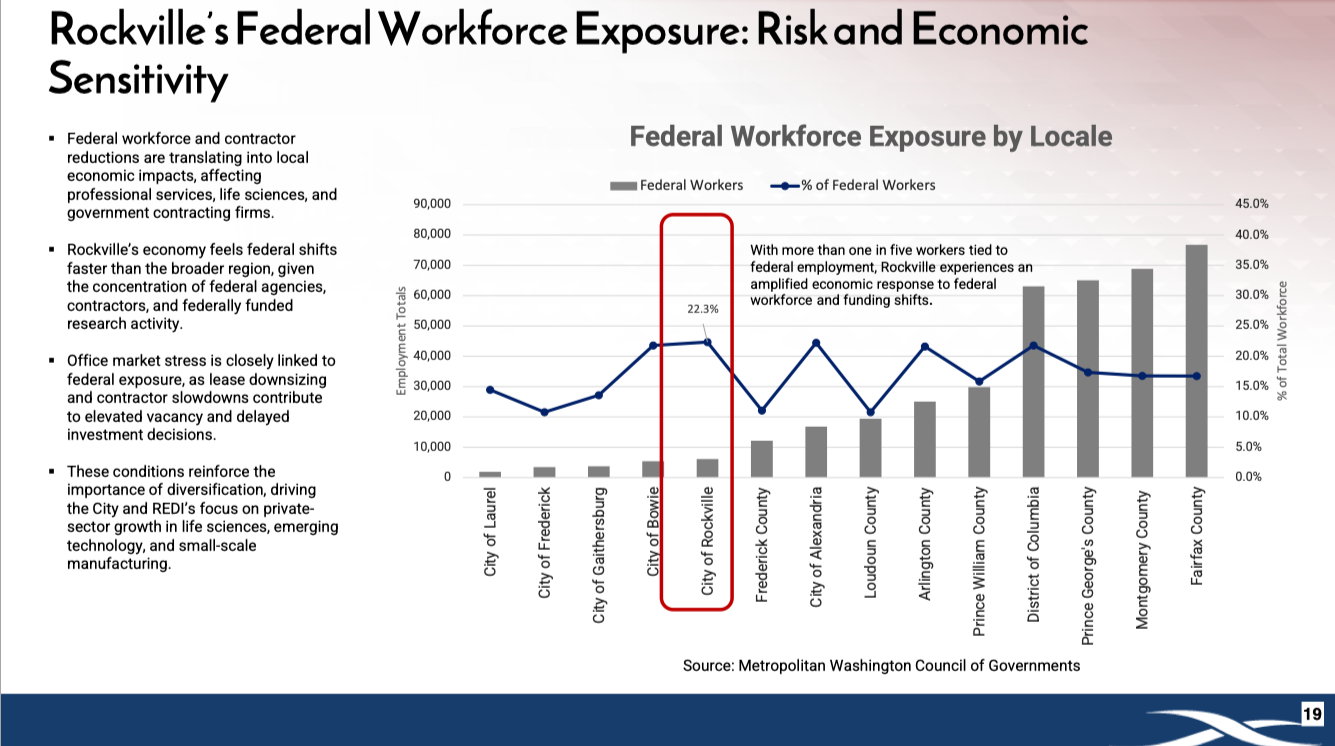
The Rockville Mayor and Council met on February 9, 2026, when Rockville Economic Development, Inc. (REDI) presented a major economic briefing about how federal policy changes are affecting the city. The full reports — including the Economic Impact presentation and supporting materials — are available in the Council agenda packet posted on the city website. Together they paint a clear picture: Rockville’s economy is stable today, but entering a period of structural transition.
City officials reviewed a detailed economic report showing Rockville is highly exposed to federal employment and contracting. Roughly one-fifth of local workers depend on federal jobs or funding. Layoffs and reduced contracting increased unemployment and softened consumer spending. Office vacancies remain high as contractors shrink their footprints, while housing listings have risen across the region. The economy is not collapsing — but it is shifting away from federal-driven growth toward a more uncertain private-sector future. Note: This post is based on the reports provided by REDI in the Council agenda packet; in a future post I hope to share the City Council’s reaction.
Economic Impact of Federal Changes
City officials reviewed new economic data showing Rockville’s unusually high dependence on federal employment and contracting. Layoffs and procurement slowdowns have nudged unemployment upward and softened local spending. Office vacancy remains elevated at 25% as federal contractors reduce space, and housing listings across the region have increased by 64% from 2024 to 2025. The report emphasized that Rockville is not entering a recession — instead, it is adjusting to a structural shift in how the federal government operates and how the regional workforce is organized.
Continue reading →Rockville Council to Consider Updates to Tree Preservation Rules

The Rockville Mayor and Council will meet on Monday, January 12, 2026, at 6:30 p.m. Key items include routine board and commission appointments, a community forum for public comment, and approval of several consent items, including a $309,000 vehicle purchase, the City’s FY 2025 financial reports, and an election-related agreement for a Drop Box at City Hall. The primary policy action is an ordinance updating the City’s Forest and Tree Preservation regulations to align with state law and improve administration. Looking ahead to the February 2 meeting, the Council will consider changes to the Green Building Code.
In 2026, I’m taking a fresh approach to covering Rockville’s mayor and council meetings. Rather than listing every agenda item all year long, I’ll focus on a few key issues that are affecting the community and provide short, clear summaries that highlight what really matters. If you want every detail, the City already does a great job sharing agendas by email, so I’ll leave that role to them.
This shift will let me spend more time taking a closer look at specific issues as they arise and explaining why they matter to residents and businesses. For example, I plan to pay closer attention to board and commission appointments, where the same members are often reappointed for decades—raising important questions about community participation and diverse perspectives. I’ll also listen carefully to council discussions to note who is actively shaping decisions and who is less engaged, information that can be useful to voters. Finally, I’ll broaden the lens beyond City Hall to explore other developments across Rockville and Montgomery County that affect daily life in our community.
Rockville’s New Website Improves Access to Services—But Not to Mayor and Council
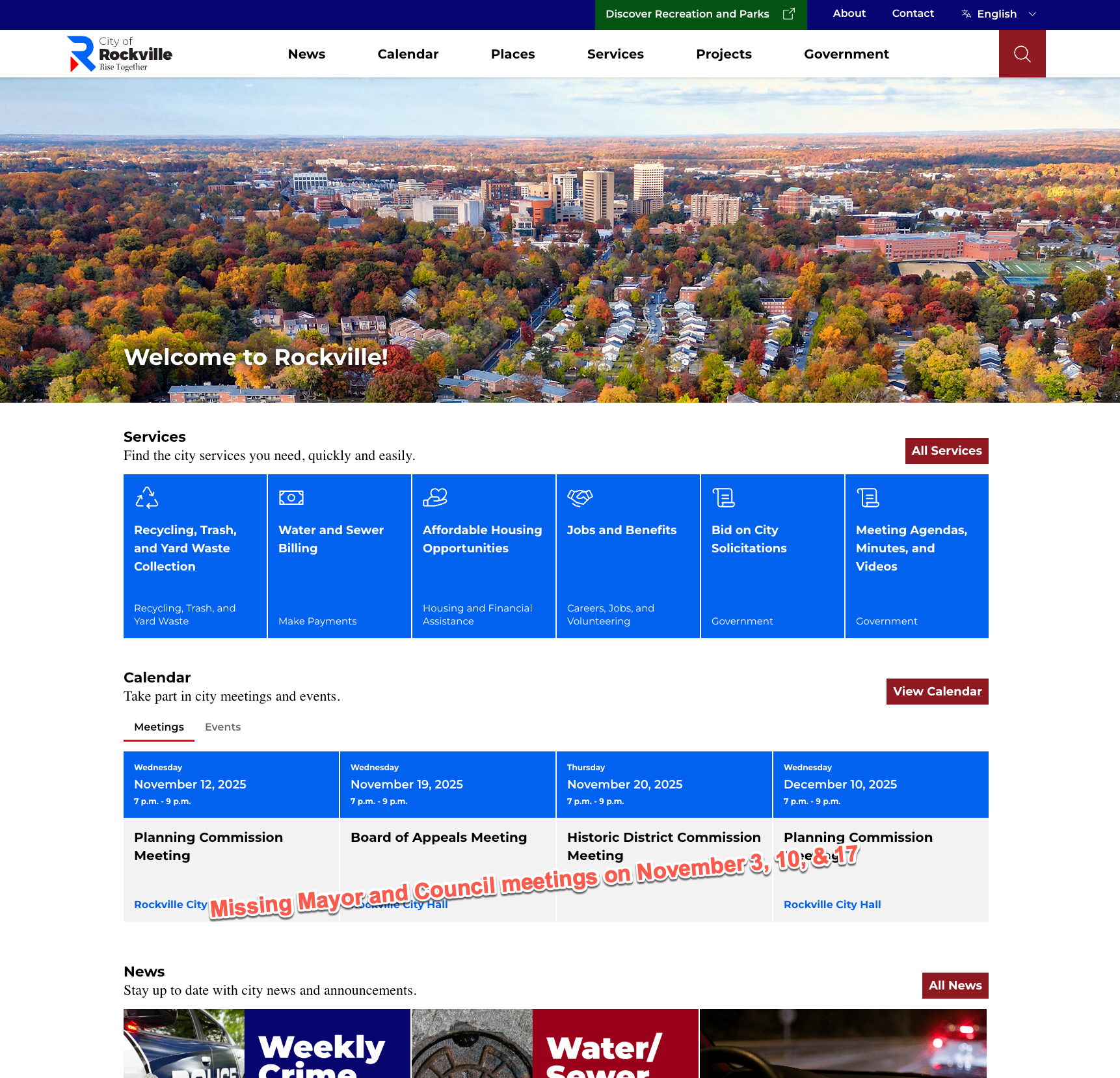
Rockville recently launched a redesigned city website with a fresh look and a more user-friendly layout. The home page now highlights key services—trash pickup, water billing, affordable housing, and city jobs—making it much easier for residents to find the information they use most often.
Unfortunately, the same can’t be said for the Mayor and Council page, which is far less intuitive and raises concerns about public access and transparency.
Continue reading →Council to Review Twinbrook School Plans, Legislative Priorities, and Arts Month
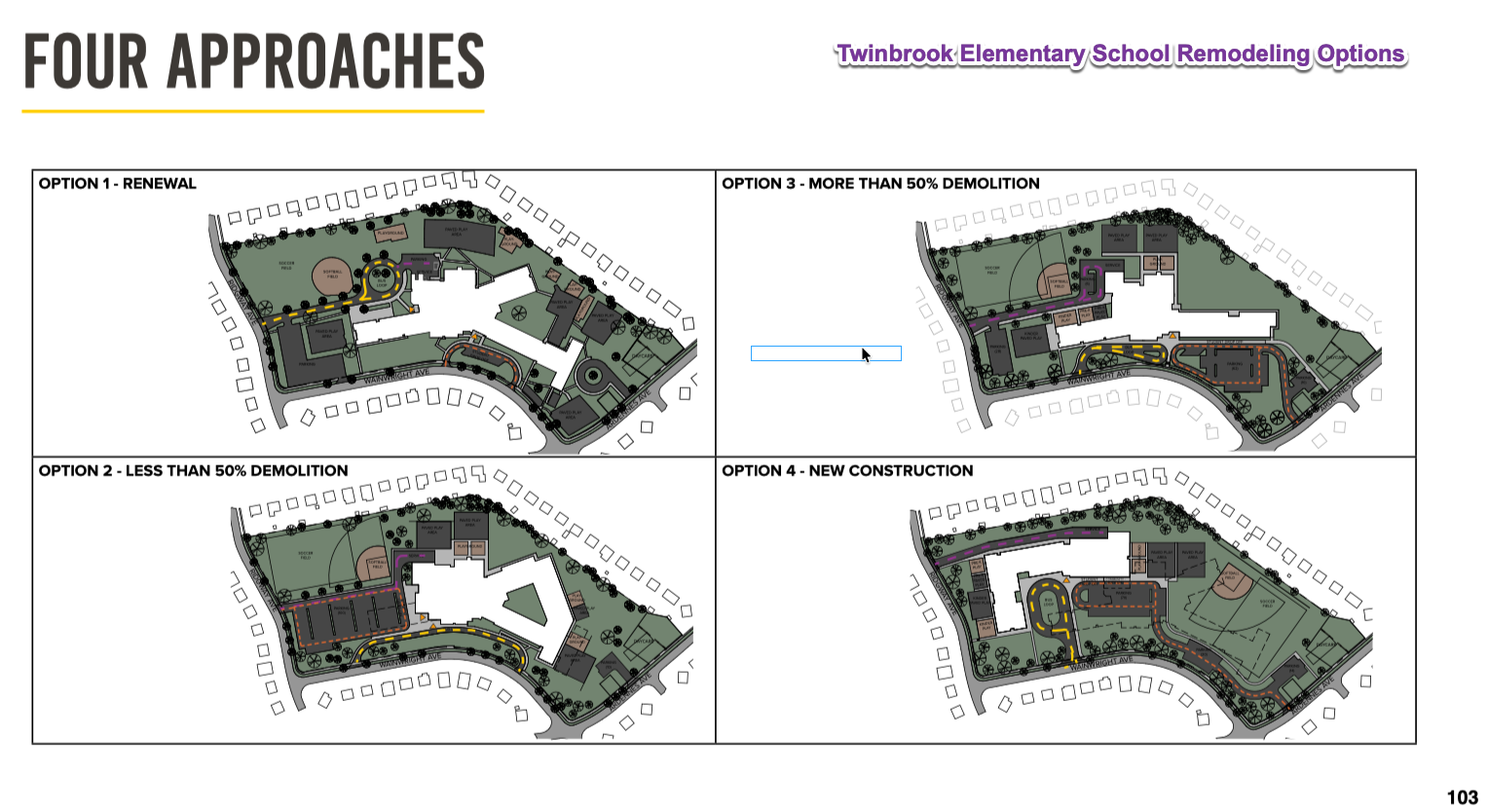
The Rockville Mayor and Council will meet on Monday, October 6, 2025, to discuss a wide range of topics—from arts and culture to historic preservation, state legislative priorities, and school planning. Several of these items directly affect Rockville neighborhoods, local businesses, and the city’s future development.
Proclamation: Arts and Humanities Month
(Agenda pages 32–37)
Rockville will declare October as Arts and Humanities Month, joining communities nationwide in recognizing the arts as vital to civic life and public well-being. The proclamation highlights the city’s ongoing commitment to culture through venues like the Glenview Mansion Art Gallery, the F. Scott Fitzgerald Theatre, and numerous workshops and performances throughout the month.
- This proclamation reinforces Rockville’s reputation as a cultural hub and affirms support for artists, nonprofits, and creative programming but symbolic proclamations rely on sustained investment to maintain visibility beyond the month’s events.
- Rockville can use this proclamation to advocate for local and state arts funding, strengthening its case for grants from the NEA or Maryland State Arts Council. Unfortunately, recent White House actions have curtailed or politicized programs at the National Endowment for the Arts, IMLS, and public media. Rockville’s consistent, nonpartisan approach to arts advocacy helps buffer local institutions against such national instability.
Historic District Commission FY25 Annual Report
(Agenda pages 65–82)
Continue reading →

