Voting at 16, Term Limits, and a 32% Office Vacancy Rate: Rockville’s October 5 Agenda
Rockville’s Mayor and Council meets Monday, October 5, 2026 beginning at 5:30 p.m., with two issues likely to have long-term consequences: a substantial rewrite of the city’s election rules and a review of Rockville’s economic-development performance (warning: the first hour will be devoted to ten proclamations). The agenda also includes proposed Charter amendments that would lower the municipal voting age, establish a minimum age for elected officials, and impose consecutive-term limits. (City of Rockville)
Rockville’s Election Code Heads Toward a Major Rewrite
The Mayor and Council will introduce a substantial rewrite of Chapter 8 of the City Code, which governs municipal elections. The proposal addresses election administration, campaign finance, reporting and enforcement, voter assistance, electioneering, and responsibilities of the Board of Supervisors of Elections. Staff says the revisions respond partly to issues identified during the 2023 election and incorporate subsequent recommendations and Council direction. Public hearings are tentatively planned for October 26 and November 2. (Earlier background: “Historic Preservation, Election Rules, and State Priorities”)
Among the most significant changes:
- Individual contributions would be limited to $1,200 per candidate or campaign committee per election cycle, with the limit periodically adjusted for inflation. Contributions over $100 would have to be made by check or electronically.
- Transfers between candidate or campaign committees could reach $5,000, substantially more than the normal individual contribution limit.
- Campaign treasurers would be explicitly responsible for managing and recording contributions and expenditures, and candidates or committee members could not make expenditures without the treasurer’s knowledge.
- Late campaign reports could generate escalating penalties of $200, $300, and eventually $450 per day, up to a maximum of $7,500.
- The Board of Supervisors of Elections would have clearer authority to verify candidate eligibility, investigate possible violations, request documents, and issue notices of violation.
- Electioneering would be prohibited within 50 feet of vote-center entrances and exits and outdoor ballot drop boxes, and obstructing access to a drop box would be prohibited.
Federal Cuts Are Reshaping Rockville’s Future
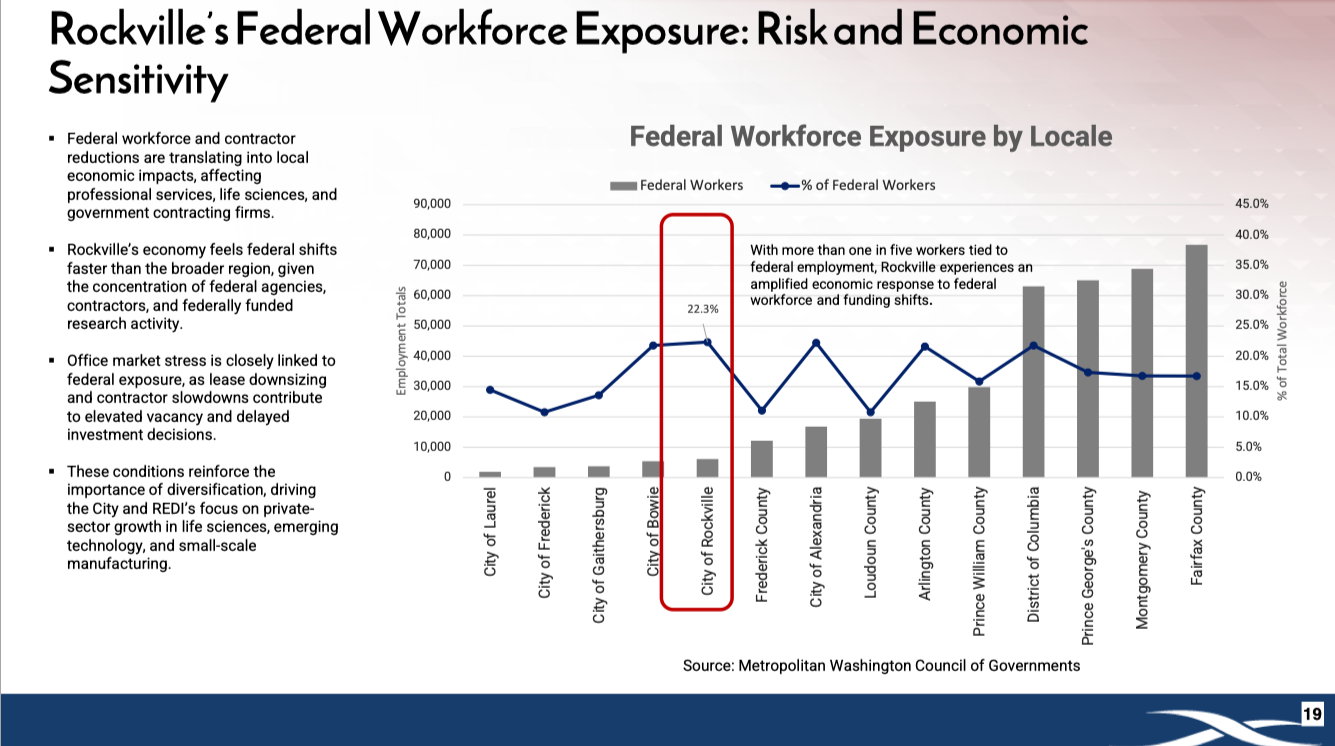
The Rockville Mayor and Council met on February 9, 2026, when Rockville Economic Development, Inc. (REDI) presented a major economic briefing about how federal policy changes are affecting the city. The full reports — including the Economic Impact presentation and supporting materials — are available in the Council agenda packet posted on the city website. Together they paint a clear picture: Rockville’s economy is stable today, but entering a period of structural transition.
City officials reviewed a detailed economic report showing Rockville is highly exposed to federal employment and contracting. Roughly one-fifth of local workers depend on federal jobs or funding. Layoffs and reduced contracting increased unemployment and softened consumer spending. Office vacancies remain high as contractors shrink their footprints, while housing listings have risen across the region. The economy is not collapsing — but it is shifting away from federal-driven growth toward a more uncertain private-sector future. Note: This post is based on the reports provided by REDI in the Council agenda packet; in a future post I hope to share the City Council’s reaction.
Economic Impact of Federal Changes
City officials reviewed new economic data showing Rockville’s unusually high dependence on federal employment and contracting. Layoffs and procurement slowdowns have nudged unemployment upward and softened local spending. Office vacancy remains elevated at 25% as federal contractors reduce space, and housing listings across the region have increased by 64% from 2024 to 2025. The report emphasized that Rockville is not entering a recession — instead, it is adjusting to a structural shift in how the federal government operates and how the regional workforce is organized.
Continue reading →

