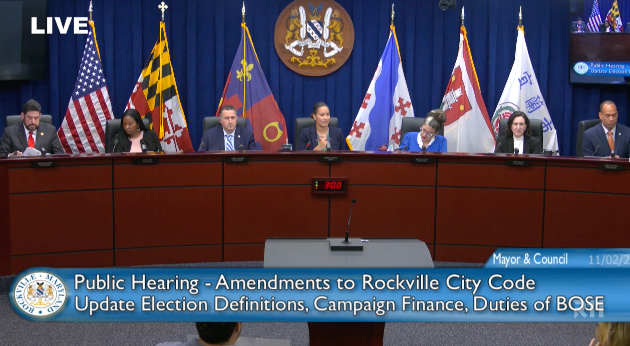
Rockville residents have another opportunity to weigh in on significant changes to the city’s elections at a public hearing on Monday, November 9, 2026, at 7 p.m. The proposals include allowing 16- and 17-year-olds to vote in municipal elections, establishing term limits for the Mayor and Council, and updating election procedures. A longer-term proposal would introduce ranked-choice voting and public campaign financing beginning in 2031.
The Mayor and Council held their first public hearings on November 2, when residents and advocates expressed sharply different views about lowering the voting age.
What Changes Are Being Proposed?
The Mayor and Council are considering amendments to Chapter 8 of the Rockville City Code, which governs municipal elections, along with three amendments to the City Charter.
The principal proposals include:
- Lowering the voting age to 16. Rockville residents ages 16 and 17 would be permitted to register and vote in municipal elections.
- Establishing term limits. The Mayor and Councilmembers would be limited to four consecutive four-year terms, or 16 consecutive years in office.
- Setting a minimum age for elected officials. Although 16- and 17-year-olds could vote, candidates for Mayor and Council would have to be at least 18 years old.
- Improving election administration. Changes would update campaign finance and enforcement provisions, clarify the responsibilities of the Board of Supervisors of Elections, add a third outdoor ballot drop box, and permit electronic petition signatures.
- Preparing for additional reforms in 2031. The proposed legislation outlines potential changes involving ranked-choice voting, public campaign financing, and rotating the order of candidates’ names on ballots. These would require further legislative and administrative action before implementation.
The proposals follow recommendations from Rockville’s Charter Review Commission and discussions with the Board of Supervisors of Elections. They also address administrative issues identified during the 2023 municipal election.
Residents Divided Over Lowering the Voting Age
Most of the public testimony on November 2 focused on whether 16- and 17-year-olds should be allowed to vote.
Brigitta Mullican, a longtime Twinbrook resident, strongly opposed the proposal. She reminded the Mayor and Council that approximately 69% of voters who participated in the city’s 2023 advisory referendum opposed lowering the voting age. She questioned whether teenagers should be permitted to vote when other laws distinguish minors from adults in matters such as contracts, financial obligations, and legal responsibilities.
Rick Mui, another Rockville resident, also opposed lowering the voting age. Drawing on his experience working with teenagers as a Naval Academy admissions representative and nonprofit volunteer, he expressed concerns about civic knowledge, maturity, and independent decision-making. He suggested that teenagers could become more involved in government through volunteering, civic education programs, and service on city boards and commissions without changing the voting age.
Other speakers argued that teenagers deserve a greater voice in decisions affecting their communities.
Georgiana, a Montgomery Blair High School sophomore who works for the City of Rockville, challenged assumptions that teenagers lack financial responsibility. She described managing her earnings and investments and argued that young people should have a say in decisions that will affect their futures. Although she does not live in Rockville, she encouraged the city to extend voting rights to 16- and 17-year-olds.
Another Montgomery Blair student, Kam Kerr, raised concerns about unsafe e-bike and scooter use by teenagers and asked how younger residents could influence city policies before they become eligible to vote. His comments highlighted the broader question of how Rockville can encourage civic participation among young people, regardless of their voting eligibility.
Michelle Whitaker, executive director of Ranked Choice Voting Maryland, said her organization had not taken a formal position on lowering the voting age but recognized its potential to establish lifelong habits of civic participation.
Support for Ranked-Choice Voting and Public Financing
Whitaker strongly supported the proposals for ranked-choice voting and public campaign financing. She pointed to Montgomery County’s experience with public financing, which she said encouraged more candidates to run by making it possible to build campaigns around smaller contributions from residents. Whitaker argued that ranked-choice voting would complement public financing by giving voters more opportunities to express their preferences when several candidates compete for office. Under ranked-choice voting, residents rank candidates in order of preference rather than selecting only one. Depending on the election rules, subsequent preferences can help determine the winner when no candidate receives sufficient first-choice support.
Whitaker also emphasized the importance of voter education, citing her organization’s experience working with Takoma Park, which has used ranked-choice voting for approximately two decades.
These proposals are envisioned for 2031 rather than the next municipal election in 2027.
What About the Other Charter Amendments?
Although the proposed term limits and minimum age for elected officials would also change Rockville’s Charter, neither received substantial attention during the November 2 oral testimony. Under the term-limit proposal, elected officials could serve no more than four consecutive four-year terms. The minimum-age amendment would establish that candidates must be at least 18 years old to serve as Mayor or a Councilmember.
These proposals raise separate questions about representation, experience, leadership opportunities, and the balance between voter choice and restrictions on eligibility for office.
Mayor Calls for More Public Information
At the conclusion of the hearing, Mayor Monique Ashton asked staff to improve the information available to residents about the proposals. She observed that the city’s public hearing materials highlighted the charter amendments but did not adequately explain several other changes, including ranked-choice voting, public financing, electronic petition signatures, and additional voting facilities. Ashton suggested preparing a more comprehensive fact sheet and providing links to the Charter Review Commission’s report and results of the 2023 advisory referendums. The city subsequently updated its public hearing notice on November 4 to include additional information and background documents.
Another Opportunity to Comment on November 9
The second round of public hearings will take place Monday, November 9, at 7 p.m., at Rockville City Hall, 111 Maryland Avenue. Residents may participate in person, virtually, or through written testimony.
To register in advance or submit written comments for consideration at the hearing, residents should complete the city’s Public Hearing Participation Form by 10 a.m. Monday, November 9. Residents attending in person may also sign up at the entrance to the Council chambers. Written comments received after the deadline will be forwarded to the Mayor and Council but will not be available to them during the hearing.
The Mayor and Council are scheduled to consider adopting the proposed election ordinance and charter amendments on November 16, 2026. If the charter amendments are adopted that evening, they would ordinarily take effect January 5, 2027. However, state law permits voters to petition for a referendum on the changes if a qualifying petition is submitted within the prescribed period.
Residents interested in the future of Rockville’s elections can review the proposed amendments and submit comments before the Council makes its decisions.
For more information, visit the City of Rockville’s public hearing notice or contact the City Clerk at cityclerk@rockvillemd.gov or 240-314-8280.
This analysis was prepared with the assistance of ChatGPT to review and summarize a transcription of public comments. I selected the issues to highlight, evaluated their significance, and reviewed and edited the final post.


