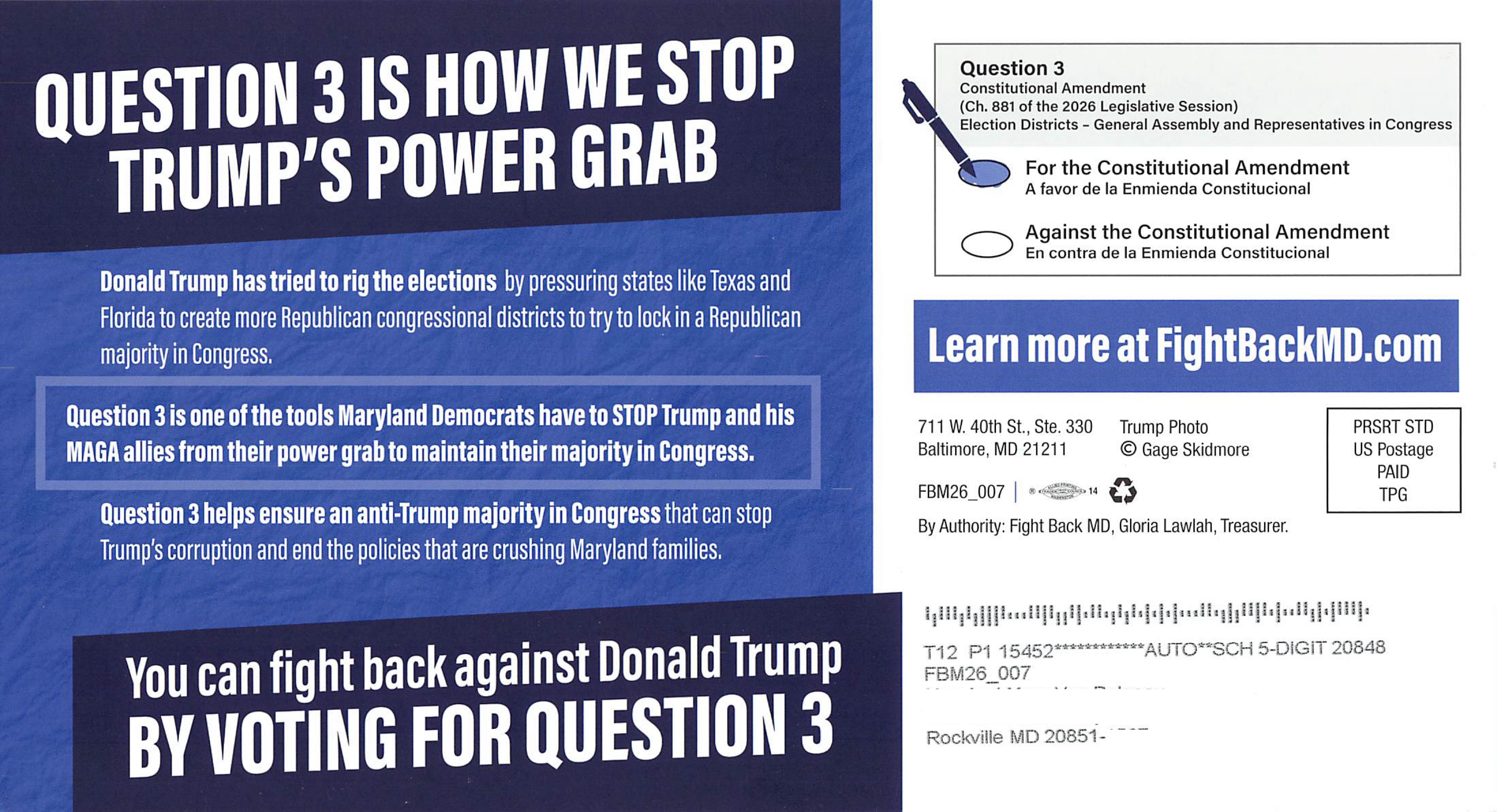
Today I received a campaign mailer urging Maryland voters to vote for Question 3, the constitutional amendment concerning congressional redistricting. The front says, in large letters, “QUESTION 3 IS HOW WE STOP TRUMP’S POWER GRAB.” It argues that Republican-led states such as Texas and Florida have redrawn congressional districts to increase Republican power in Congress. Maryland Democrats, the mailer says, should “fight back” by voting for Question 3.
That certainly tells me why the group that sent the mailer wants Question 3 to pass. What it does not tell me is something more basic: What does Question 3 actually do?
That omission matters because voters are not being asked to approve a temporary political strategy. We are being asked to amend the Maryland Constitution.
What Question 3 actually changes
Today, the Maryland General Assembly draws Maryland’s congressional districts through legislation. Question 3 would not change that. Legislators in Annapolis would continue to decide where congressional district boundaries are drawn.
The important change involves the rules that can be used to judge those maps. Maryland’s Constitution contains standards for drawing legislative districts. Among other things, districts are supposed to be compact and contiguous, and lawmakers are supposed to pay attention to county and other political boundaries. A 2022 court ruling applied Maryland constitutional protections to a congressional redistricting plan and struck down the map adopted by the General Assembly. That ruling is an important part of the history behind Question 3.
If Question 3 passes, the Maryland Constitution would specifically say that certain districting requirements apply only to districts for the Maryland Senate and House of Delegates. It would also state that nothing in the Maryland Constitution provides criteria for the boundaries of congressional districts (Maryland State Board of Elections).
That is a significant change.
Question 3 does not replace those standards with a new set of Maryland standards for congressional districts. It does not require congressional districts to be compact. It does not require lawmakers to keep counties or communities together. It does not prohibit drawing districts to favor a political party. Federal constitutional and voting-rights requirements would still apply. But Maryland’s own Constitution would no longer provide criteria for judging congressional district boundaries (Maryland State Board of Elections).
So who would draw the districts?
The answer is simple: the General Assembly would continue to draw them—in other words, politicians.
That is why I think the mailer leaves out the most important part of the story. It presents Question 3 as a way for Maryland Democrats to respond to Republican redistricting in other states. But the constitutional amendment is not really about Donald Trump, Texas, or Florida. It concerns how much freedom Maryland legislators should have when drawing congressional districts.
That is a much bigger and longer-lasting question. If power tends to corrupt, absolute power corrupts absolutely.
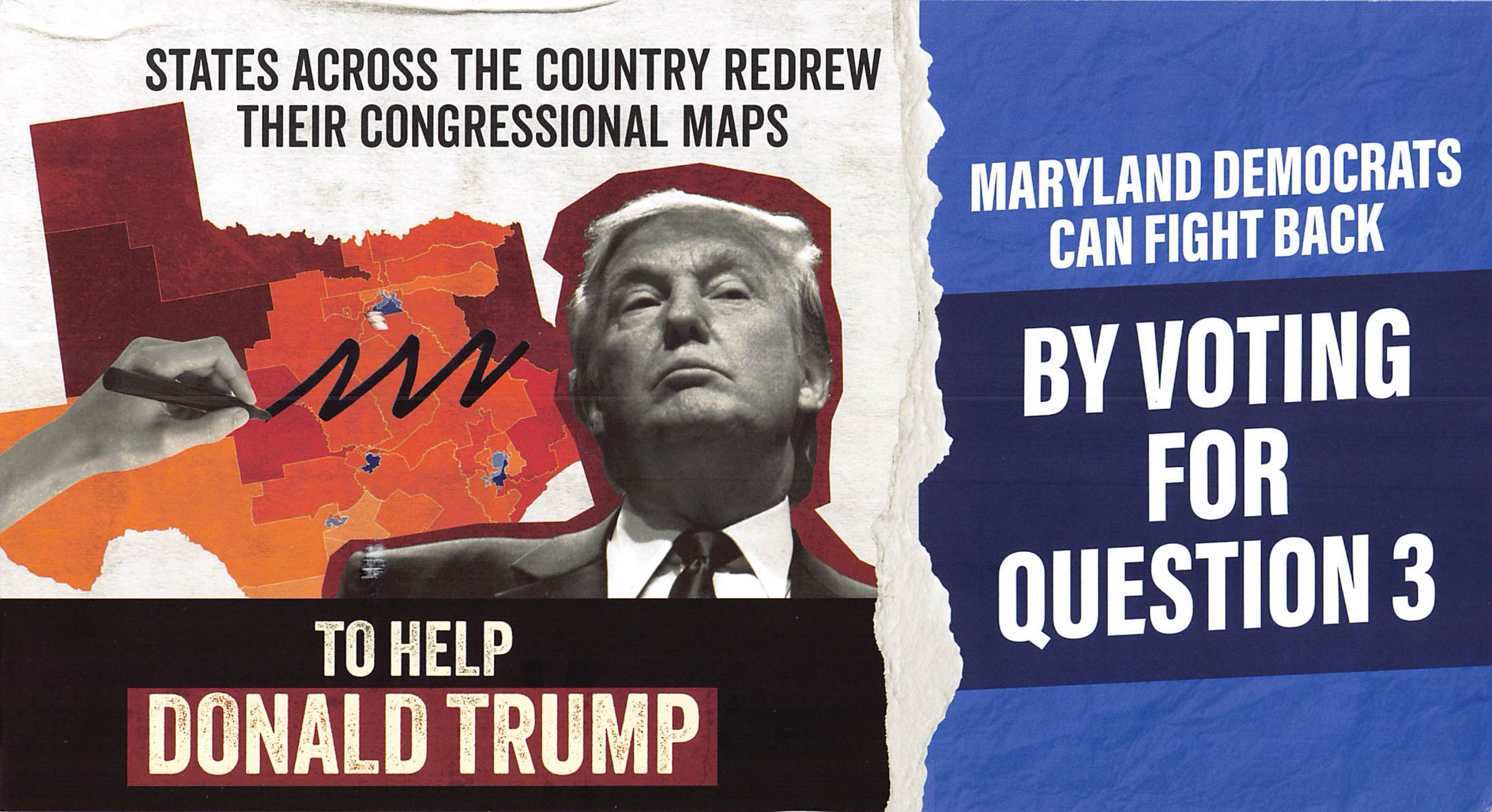
“They did it, so we should too”
The mailer makes another argument that troubles me. Its basic reasoning is that Republicans have redrawn congressional districts elsewhere to help Republicans win more seats, so Maryland Democrats should have the ability to do the same thing here.
That may be an effective political strategy. But it raises a different question: If something is wrong when the other party does it, does it become acceptable when our party does it?
There is a genuine argument on the other side. Supporters of Question 3 can reasonably say that one party should not be expected to follow stricter rules while its opponents take advantage of looser rules elsewhere. In politics, voluntarily giving up a tool your opponents continue to use can amount to unilateral disarmament. But that is an argument about political strategy. It does not answer the larger question of what rules Maryland should place in its Constitution.
Constitutions are supposed to last much longer than one election or one presidency. Donald Trump will not always be president. Democrats may not always control Annapolis. The congressional balance of power will change.
A useful test is therefore to reverse the situation: Would you want exactly the same redistricting rules if the other political party controlled the General Assembly?
If the answer changes depending on who holds power, perhaps the real issue is not constitutional principle but political advantage.
The Mailer Substitutes Trump for the Amendment
The biggest problem with this mailer may be its framing. On one side is a large photograph of Donald Trump. On the other is the instruction to vote for Question 3. The message is straightforward: if you oppose Trump, vote for the amendment.
But that allows voters to answer a much easier question than the one actually on the ballot. “Do I support Donald Trump?” is not the same question as: “What constitutional rules should govern the Maryland General Assembly when it draws congressional districts?”
The official ballot language itself is difficult. It says Question 3 would clarify which districting requirements apply only to the General Assembly, allow the legislature to give the Maryland Supreme Court original jurisdiction over congressional redistricting disputes, and establish that the Maryland Constitution provides no criteria for congressional district boundaries (Maryland State Board of Elections). That is not easy material for any voter to digest.
Which makes it even more important for campaigns to explain what the amendment actually does.
What a FOR or AGAINST vote means
The simplest way I can explain the choice is this:
A FOR vote changes the Maryland Constitution. The General Assembly would continue drawing congressional districts, but Maryland constitutional districting standards could not be used as criteria for congressional district boundaries.
An AGAINST vote leaves the Maryland Constitution as it is now. It does not create a new redistricting commission, prohibit gerrymandering, or adopt a particular congressional map. It simply rejects this proposed constitutional change.
Question 3 also contains a provision allowing the General Assembly to give the Maryland Supreme Court original jurisdiction to review congressional redistricting plans (Maryland State Board of Elections).
Ask the long-term question
Campaign mailers are advertisements. They are designed to persuade, not to provide a seminar in constitutional law.
Still, this mailer tells voters a great deal about the political goal of Question 3 while telling them very little about the constitutional change they are being asked to approve. That distinction matters.
Voters should certainly consider what Republican-led states are doing. They should consider what Maryland Democrats are trying to accomplish in response. They should consider the history of partisan gerrymandering in Maryland as well.
But I think there is an even more useful question: What redistricting rules would we want Maryland to have regardless of which political party happens to be in power?
That is ultimately what a constitutional amendment should be about.


