Mayor and Council to Discuss City Branding, Revising Ethics Code, and Allowing ADUs

At its Monday, July 29, 2024 meeting, the Rockville Mayor and Council will discuss city branding, a code of ethics, accessory dwelling units, development of 900 Rockville Pike, and regulating tobacco and vape shops. On the Consent Agenda (items approved without discussion) are public artworks for Twinbrook and College Gardens, tree conservation for the swim center, changes to the Youth Commission, and bus stop maintenance services, among others. They will also receive the 2023 annual report of the Cultural Arts Commission.
Following a comprehensive review of community feedback gathered through focus groups, the Mayor and Council will select a logo and tagline as the city’s official brand (page 90+). This recommendation comes after six focus groups of three people each, facilitated by Medium Giant, provided their preferences and perceptions of the community regarding the three final brand logos and taglines. The the newly elected Mayor and Council requested the focus groups to engage the community in the rebranding process. The selection of a definitive brand logo and tagline will mark the culmination of an extensive branding initiative that began in June 2022. The total cost of research, design, and implementation was not reported in the staff report.
The City’s Code of Ethics is being revised to reflect recent changes in Maryland’s ethics law (138). Changes under consideration include prohibiting former City officials or employees from disclosing confidential information; restricting City officials and employees from accepting gifts from entities representing counties and municipalities; modifying financial disclosure requirements; and adding an anti-retaliation provision for those reporting or participating in investigations of potential ethics violations. The Rockville Ethics Commission has reviewed the proposed amendments and upon adoption, chapter 16 of the City Code will be updated and the Financial Disclosure Forms will be revised.
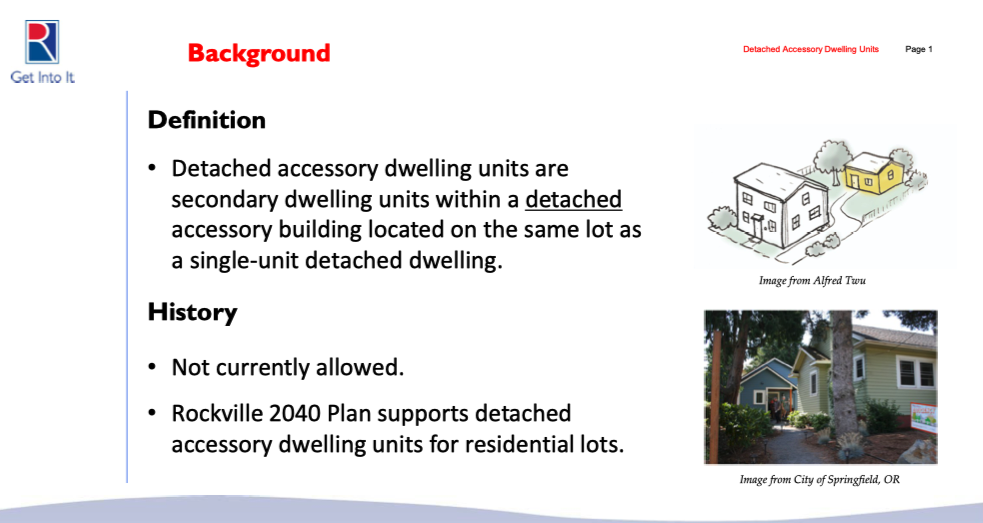
Since at least 2019, Accessory Dwelling Units (ADUs) have been discussed as a means to diversify and increase affordable housing options in Rockville (p 161-222). The proposed ordinance, which has been reviewed by the Planning Commission and received lots of public comments, would allow detached ADUs as a conditional use in all residential zones, with regulations on the size, appearance, and parking requirements. It also addresses property ownership, occupancy, and compliance for existing non-compliant units. The Mayor and Council’s approval is needed to move forward with an ordinance, which is slated for presentation on August 5.
The Mayor and Council are conducting hybrid meetings. If you wish to submit comments in writing for Community Forum or Public Hearings, please email the comments to MayorAndCouncil@RockvilleMD.gov by no later than 10:00 a.m. on the date of the meeting.
More details in the 511-page agenda packet are available at https://www.rockvillemd.gov/AgendaCenter/ViewFile/Agenda/_07292024-7242.
Mayor and Council to Discuss Unsafe Streets in Rockville
At its Monday, January 22, 2024 meeting, the Rockville Mayor and Council will discuss police pension. On the Consent Calendar (items approved without discussion) are contracts for equipment or services related to building construction and repair ($140K); security enhancements to the water treatment plant ($136K), equipment and support for the Data Center ($1.9M); and playground maintenance and repair ($850K), among others. The Mayor and Council will also receive reports on Bus Rapid Transit on MD 355; Environment Commission; Vision Zero; Bikeway and Pedestrian Master Plan; Procurement; and the outreach program for minority, female, disabled, and veteran-owned businesses.
The Montgomery County Department of Transportation has been considering Bus Rapid Transit (BRT) throughout the county, including Viers Mill Road (MD 586) and the Rockville Pike (MD 355) in Rockville, to provide fast and reliable public transportation using dedicated lanes on the busiest streets (Agenda page 5+). In July 2019, the County Council stated they preferred two dedicated lanes in the median (one lane in each direction in the center of the street) for MD 355, however, design has become more complicated for the area near College Parkway. Furthermore, the project will affect Rockville’s Vision Zero, Bikeway, and Rockville Pike plans. To help pay for the project, the County has requested a $1 million contribution from Rockville’s portion of the Montgomery County Transportation Impact Tax.
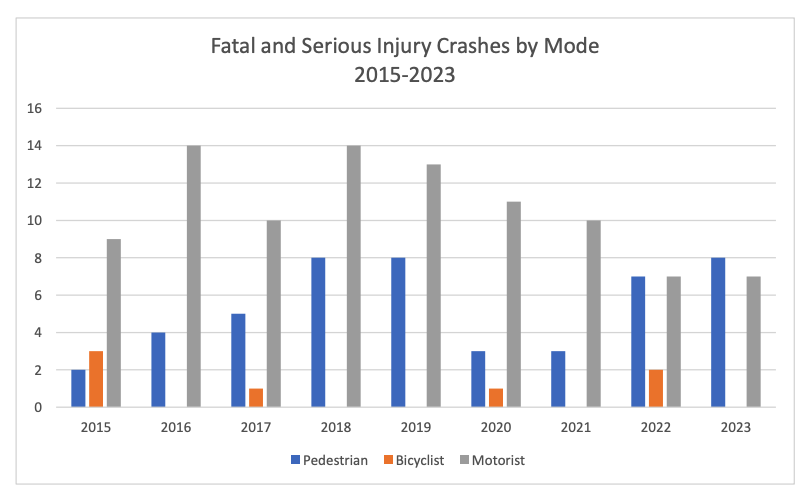
In July 2020, the Mayor and Council adopted the Vision Zero Action Plan (page 28+). Vision Zero is a multidisciplinary traffic safety program with the overarching goal to wholly eliminate deaths and serious injuries that result from traffic crashes. This program is designed for all roadway users: motorists, pedestrians, bicyclists, and transit users. This program departs from past roadway safety programs by explicitly rejecting any traffic death or serious injury as acceptable and recognizing that people will often make mistakes while traveling, but mistakes should not result in death or serious injury. A recent study revealed six roads in Rockville as “High Injury Network” segments, which means there have been at least four fatal or serious injuries crashes: Rockville Pike (from Veirs Mill Road to Bouic Avenue); West Montgomery Avenue (from Research Blved to Mannakee Street); Norbeck Road (from First Street to Avery Road); Frederick Road (from Ridgemont Ave to Watkins Pond Blvd); Veirs Mill Road (from Rockville Pike to Twinbrook Parkway); and North Washington Street (from Hungerford to W. Jefferson St.). Unfortunately, most of these highways are controlled by the State of Maryland (N. Washington Street is the only City-maintained roadway among those listed). Time to contact your State Senator and Delegates to light a fire under the State Highway Administration!
The Mayor and Council are conducting hybrid meetings. If you wish to submit comments in writing for Community Forum or Public Hearings, please email the comments to MayorAndCouncil@RockvilleMD.gov by no later than 10:00 a.m. on the date of the meeting.
More details in the 455-page agenda packet are available at https://www.rockvillemd.gov/AgendaCenter/ViewFile/Agenda/_01222024-7097.
Meanwhile, in the State of Maryland
The 90-day legislative session has begun! Taxes and cost shifts are on the table for the General Assembly session as Gov. Wes Moore (D) and lawmakers look to solve both a structural budget shortfall and massive cuts to transportation projects. In November, legislative budget analysts told the joint Spending Affordability Committee that the state faces a structural gap of $322 million in the coming legislative session. Projections show the gap continuing to grow in fiscal 2026 and 2027 to $376 million and $436 million respectively. More at MarylandMatters.org.
State Delegate Joe Vogel (District 17) is among the seven state lawmakers who are currently running for Congress in either the 3rd or 6th districts, with the primaries fast approaching on May 14.
The FBI arrested Carlos Ayala of Salisbury, a State Board of Elections member, for participating in the January 6 insurrection. He resigned from the Board of Elections on January 11. Ayala was appointed to the state Board of Elections last year by Gov. Wes Moore (D) following a recommendation by the Maryland Republican Party. Looks like they need to do a deeper background check before appointing people to public office.
Pandemic Resulted in High Subsidies for Recreation and Parks in 2021
At its Monday, November 21, 2022 meeting, the Rockville Mayor and Council will discuss financial management policies, annexing 1201 Seven Locks Road, and the new Comprehensive Plan. On the Consent Calendar (items approved without discussion) are employment agreements for the Deputy City Manager and Assistant City Manager for Project Management, among others. The Mayor and Council will also receive reports on staff vacancies and hiring.
How much should the city subsidize Recreation and Parks programs, such as summer camps, skate park, or childcare, that are used by a small segment of residents? How should it manage donations it receives annually for the Holiday Drive and Senior Assistance Fund? At the upcoming meeting, the Council will discuss these and other financial management policies.
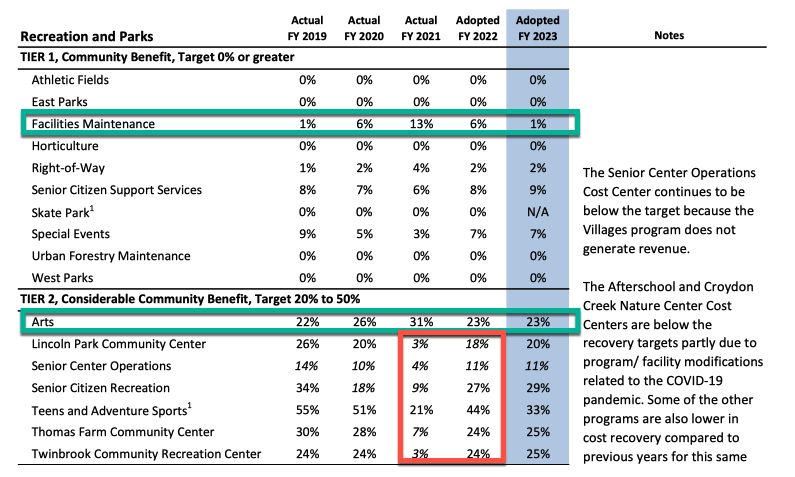
The City of Rockville has an extensive set of financial management policies that affect eight major areas: achieving and maintaining a structurally balanced budget, fund balance and reserve policies, capital planning policies, investment policies for both retirement plans and City funds, revenue control and management policies, economic development policies, and debt compliance and data analysis policies. For Recreation and Parks programs, the City uses a “five-tier cost-recovery pyramid” ranging from Tier 1 for parks, trails, landscapes, playgrounds, and general-use facilities with a 0% cost recovery to a Tier 5 for private rentals and private lessons with a 100% or more cost recovery. Fees and charges are reviewed and adjusted annually, but the pandemic lowered cost recovery significantly. In Tier 2, for example, the Lincoln Park Community Center is expected to recover 20% of its costs in 2022 (a subsidy of 80%) but in 2021 it actually recovered 3% (a subsidy of 97%). There are a couple of bright spots: Facilities Maintenance and Arts recovered more than expected (in other words, required less of a subsidy), most likely as well due to the reduced use of facilities and arts programs during the pandemic. A summary is available on Packet Page 34.
The Financial Advisory Board recently recommended that the City create a formal donations policy. The City receives less than one percent of its revenues from donations each year, which are accepted by check, made through the City’s website, the recreation registration system, and through the round-up feature with online utility bill payments. During FY 2022, the City received approximately $130,000 in donations from over 1,800 donors, averaging $12 for the Recreation Fund and $300 for the Holiday Drive. It also received two donations over $5,000: one $25,000 donation for the Holiday Drive and one $20,000 donation for the Eat Fresh program. Strangely, when the City explored this topic further, it discovered that a donations policy is not a common practice in municipal governments in Maryland. Geez, this suggests an obvious opportunity for embezzlement in government and I’m glad to see the City is thinking ahead. It’s a common practice in nonprofit organizations.
The big kahuna for the meeting (if not the year), however, is the progress on the Rockville 2040 Comprehensive Plan—the city’s “to do” list for the next twenty years. At this meeting, the City Council will review the progress on tasks that are to be completed in the next 1-3 years. This is an enormous undertaking not only to complete, but also to manage. These tasks include a zoning ordinance rewrite, updating the Town Center Master Plan, adopting a Pedestrian Master Plan, assessing speed limits on Wootton Parkway, redeveloping King Farm Farmstead, installing back-up power generation for critical facilities, promoting backyard composting, preparing a Flood Resiliency Plan, and constructing senior housing. Since the Plan’s adoption in August 2021, 228 actions are currently in the near-term completion timeframe, but are not yet completed or in progress; 43 actions are currently in the “in progress” status; and 19 actions have been completed. If you want details on what’s happening in the City or your neighborhood, start on Packet Page 89. Getting everyone on board and focused is a continual challenge, and residents and businesses (and Council members) always have new ideas—but time and staff are limited so establishing priorities is essential.
It’s also enlightening to see which neighborhoods are most engaged in the community. In October, the City distributed surveys about community needs and interests. Among the highest response rates were College Gardens (156 responses) and Twinbrook (52 responses). Among the lowest were Tower Oaks (1 response) and Lincoln Park (0 responses). I wonder if this correlates with voter turnout?
More details in the 152-page agenda packet are available at https://rockvillemd.gov/AgendaCenter/ViewFile/Agenda/_11212022-6754.
Opposition to Carver Bus Depot Grows
The effort to stop the creation of a school bus depot at the Carver Center in Rockville continues to grow with community meetings, presentations at City Council meetings, collecting more than 1,700 signatures on petitions, and hiring an attorney. Montgomery County Public Schools wants to consolidate several bus depots around the county that provide parking, equipment storage, and maintenance for school busses to one central location in Rockville. It doesn’t make sense considering the size of the county—should 100+ busses come and go from Rockville to transport students in Poolesville and Silver Spring?
If you’d like to learn more:
- Visit the Carver Coalition web site at CarverCoalition.org
- Attend the Community Meeting on the plans for the depot hosted by Montgomery County Public Schools on Wednesday, May 11 at 7:30 pm at College Gardens Elementary School
- Attend the Carver Coalition meeting on Tuesday, May 17 at 7:00 pm at the Rockville Unitarian Universalist Church at 100 Welsh Park Drive.
- Read the latest flyer from the Carver Coalition.
There’s a bigger issue that continues to gnaw at me, however. MCPS is one of the largest school districts in the country with a billion-dollar budget. It’s considered one of the best in the nation by U.S. News and World Report, but does that mean it’s also well governed? The school board seems to be continually tone-deaf when it comes to local issues, such as the bus depot, and the County Council seems to be unable to have any influence, despite being the major funder. Is it time to split the school district into manageable parts and have more local control?
College Gardens vs West End in Mayor’s Race
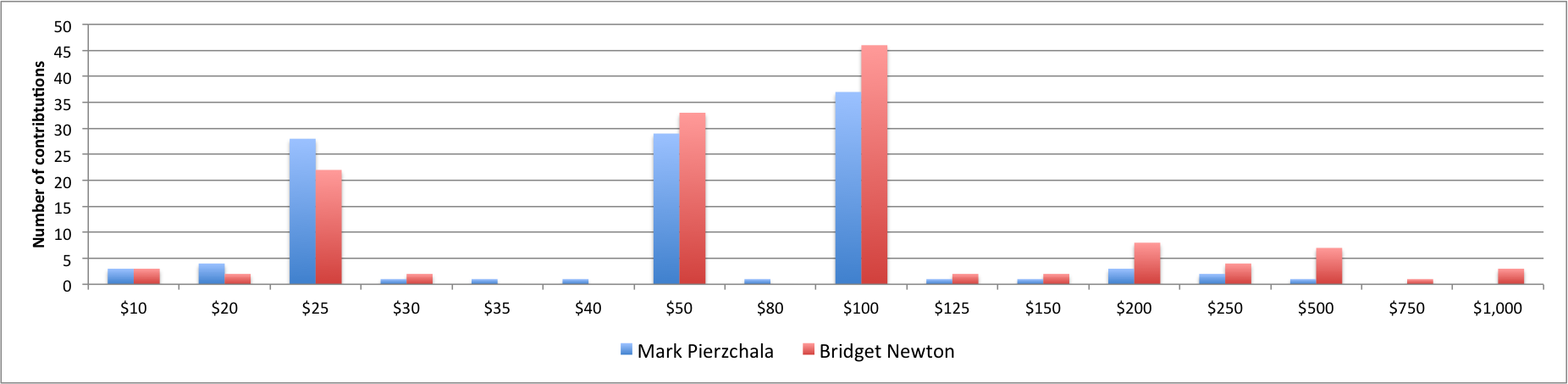
Distribution of contributions to Rockville’s mayoral race in 2013
I continue to delve into the financial support for the mayoral race to determine how it reveals the sentiment of the community (and perhaps the outcome of the election tomorrow). Voters who contribute to campaigns are typically “true believers,” especially as the amount increases, and often actively campaign for their candidates and are rarely dissuaded by any contrary information or facts. Newton has many of them as can be seen in the chart above, but will it be enough?
By plotting the residence of contributors on a map (thanks Google Fusion Tables!), it appears the choice for mayor is Continue reading →
Is Rockville Walkable? Depends Where You Are.
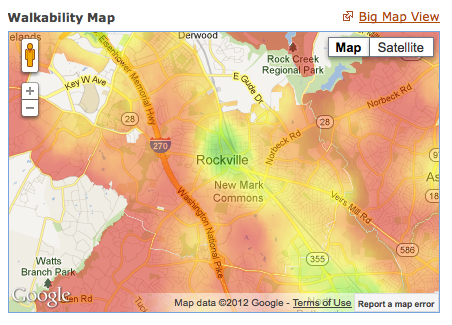
Walk Score map of Rockville
“Walkability” is an increasingly popular measure of a community’s quality of life. By enhancing the convenience and ease of walking, it reduces traffic, improves health, increases community involvement, and puts more eyes on the street for safety. So how does Rockville rate? Walk Score calculates walkability on a block-by-block basis, generating color-coded maps. In the map of Rockville, green indicates the areas that are most walkable (such as downtown) and red the least walkable (such as Horizon Hill west of 270). Around town, they’ve calculated how the following locations fared on a scale of 1-100:
- 85 Very walkable: Maryland Avenue and South Adams (West End)
- 75 Very walkable: Baltimore Road and Grandin (East Rockville)
- 66 Somewhat walkable: Twinbrook Parkway and Viers Mill (Twinbrook)
- 65 Somewhat walkable: Fallsgrove Boulevard and Fallsgrove Road (Fallsgrove)
- 65 Somewhat walkable: Redland Boulevard and Pleasant (King Farm)
- 63 Somewhat walkable: West Montgomery and Laird (West End)
- 48 Car dependent: College Parkway and Princeton (College Gardens)
- 35 Car dependent: Falls Road and Kersey (Horizon Hill)
I’m sure this will generate controversy and prompt comparisons between neighborhoods (what!? Twinbrook rated the same as Fallsgrove and King Farm? Not possible!) but I’d really like to encourage a discussion about making our community more bike and pedestrian (and sometimes car) friendlier.
What makes a neighborhood walkable? According to Walk Score, the more of the following characteristics it has, the better:
- A center: Walkable neighborhoods have a center, whether it’s a main street or a public space.
- People: Enough people for businesses to flourish and for public transit to run frequently.
- Mixed income, mixed use: Affordable housing located near businesses.
- Parks and public space: Plenty of public places to gather and play.
- Pedestrian design: Buildings are close to the street, parking lots are relegated to the back.
- Schools and workplaces: Close enough that most residents can walk from their homes.
- Complete streets: Streets designed for bicyclists, pedestrians, and transit.
The City of Rockville recently received federal funds to develop “complete streets” near the Twinbrook and Rockville Metro stations, so scores for those locations (and pedestrians using those locations) should improve as a result. Any suggestions to make your neighborhood more walkable? Should walkability be a goal for Rockville?
Candidate Forums?
If you want to hear the candidates discuss various issues and meet them in person, various neighborhood and community groups are sponsoring forums throughout the city. These forums are public and everyone is welcome to attend. Some people have called these “debates” but with a baker’s dozen running for office, I regret they are going to be more like brief statements with no discussion (I’m not even sure how they’re going to fit everyone on stage).
At this moment (October 4 at 8 p.m.), here’s what I am aware of (it does keep changing and I’ll try to update this post through the comments, but there are no guarantees or warranties):
- Tuesday, October 7 at 7 pm: Legacy at Lincoln Park Homeowners Association at the Lincoln Park Community Center.
- Thursday, October 8 at 7 pm: West End at the Rockville Senior Center (televised, not confirmed)
- Tuesday, October 13 at 7 pm: Rockville Chamber of Commerce at the Legacy Hotel and Conference Center (televised, not confirmed). I will be unable to attend due to work-related scheduling conflicts.
- Tuesday, October 20 at 7 pm: Twinbrook Citizens Association at the Twinbrook Recreation Center (televised, not confirmed).
- Wednesday, October 21 from 7:30-10 pm: College Gardens Civic Association, Plymouth Woods Homeowners Association, and Woodley Gardens Civic Association at the College Gardens Elementary School (1700 Yale Place)
- Thursday, October 22 at 7 pm: King Farm Candidates Forum at the Saddle Ridge Community Center (300 Saddle Ridge Circle).
- Saturday, October 24 from 9:30-11:30 am: Rockville Central at the Thomas Farm Community Center.
- Thursday, October 29 from 1-3 pm: Rockville Seniors at the Senior Center.

 Max for Rockville