Random Rockville Reports: January 28, 2024
Playing Musical Chairs and Three-Card Monte in Rockville City Hall
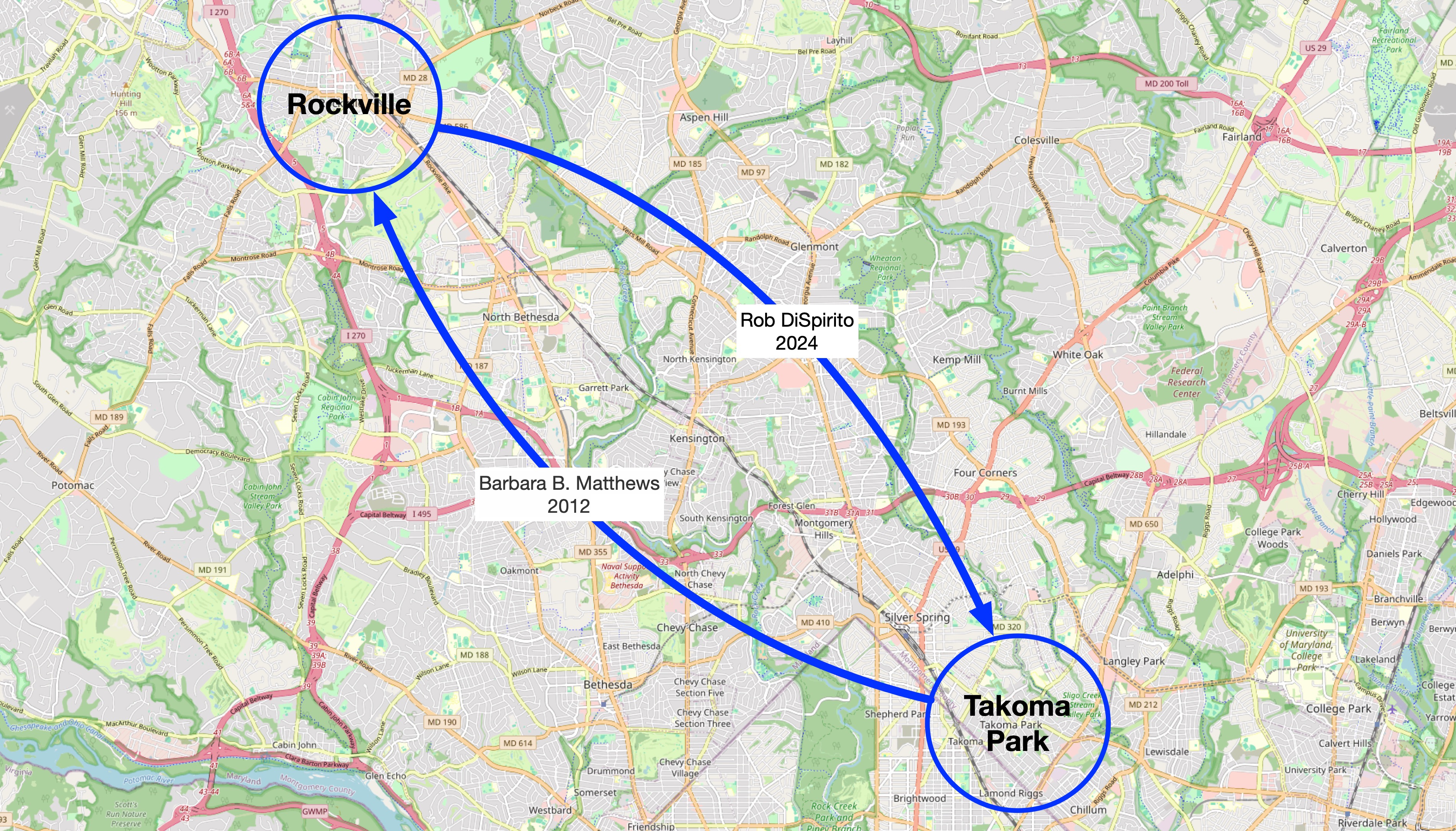
The Takoma Park City Council hired Robert DiSpirito as their new City Manager effective January 22, 2024. DiSpirito was City Manager of Rockville for seven years and by coincidence, his predecessor was Barbara Mathews, who was previously the City Manager of Takoma Park. They were also both hired and fired by the Rockville Mayor and Council, which both times included Mayor Bridget Newton and Councilmember Beryl Feinberg.
DiSpirito’s departure continues to be an embarrassment of poor management by the Mayor and Council. When he resigned at the conclusion of a Closed Session (aka “secret meeting”) of the Mayor and Council on August 17, he also received a $307,093 severance package (typically resignations don’t include severance). But figuring out what was going on was kept secret illegally for several months. According to Maryland’s Open Meetings Act, the Mayor and Council must provide minutes of a closed session at its next open session (3-306), which would have been September 11 but they failed to share the minutes. It wasn’t until October 23, 2023 (three regular meetings later) that the Mayor and Council approved the August 17 minutes (Agenda, page 218), keeping the public uninformed for more than two months. Furthermore, they played a trick in the meeting minutes. The Mayor and Council approved the official minutes of the September 11 meeting as if they included the Closed Session minutes of August 17 (watch the video of September 11 meeting and you’ll see the August 17 meeting was not discussed)–but it actually didn’t happen until October 23. Hmm, looks like the Mayor and Council is playing three-card monte with the public. Clearly, the Mayor and Council violated the Open Meetings Act but also acted unethically in the preparation of their official records.
More Pedestrians Struck in Rockville Than Reported
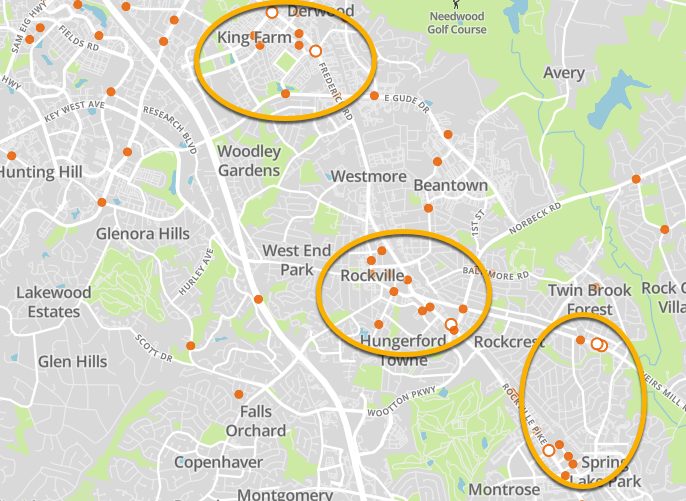
The recent death of a 70-year old pedestrian struck by two vehicles at Atlantic Avenue and Viers Mill Road prompted me to see if this a growing problem in Rockville. Data collected by Montgomery County suggests that many more pedestrians were injured or killed in Rockville in 2023 than the eight reported at the most recent Mayor and Council meeting. Not sure the cause of the discrepancy, but county data shows the greatest numbers of incidents occur in and near King Farm, downtown Rockville, and Twinbrook. Although these high incident areas all share major highways (MD Route 355 and 586), pedestrian injuries and deaths also occurred on smaller streets in these neighborhoods, which conflicts with the City’s conclusions. Both the City of Rockville and Montgomery County have adopted Vision Zero, but they don’t seem to be working from the same data. Should pedestrian safety be a higher priority for Rockville’s Transportation and Mobility Commission?
Rockville Mayor and Council Set to Approve Tower Oaks Development in Final Meeting for Newton and Feinberg
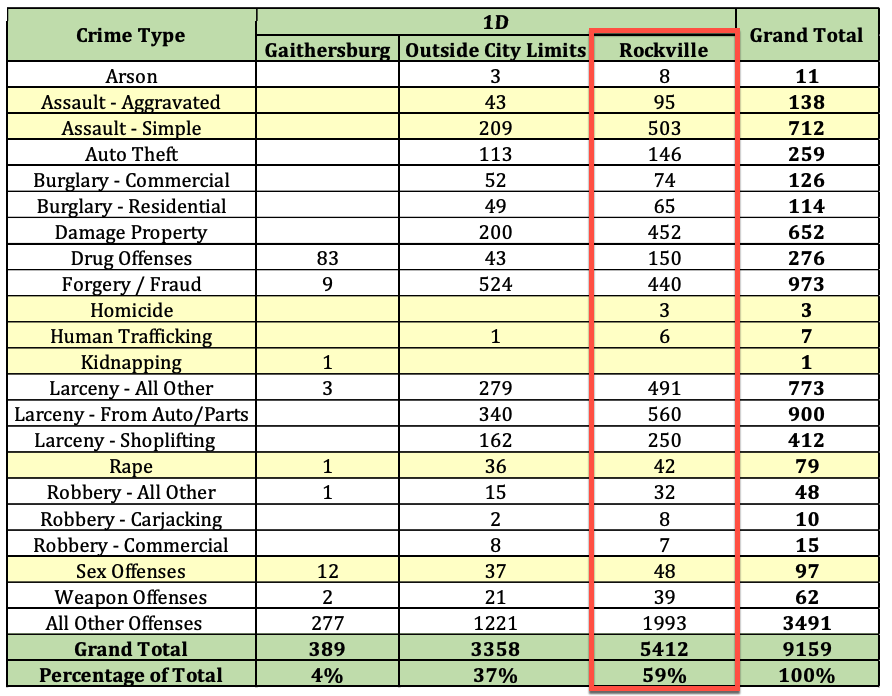
At its Monday, October 30, 2023 meeting, the Rockville Mayor and Council will approve the Tower Oaks townhouse development, possibly adopt the pedestrian master plan, and discuss the City’s personnel manual and County’s development impact tax. On the Consent Calendar (items approved without discussion) are right-of-way agreements for Joseph Street, reclassifying a private road to a public street with waivers for the Tower Oaks townhouse development, contracts to perform stormwater cleanouts, asphalt-concrete improvements to city parks, for the Linkages-to-Learning program and Senior Nutrition Program, among others. The Mayor and Council will also receive reports on the police department deployment plan (which includes the most recent crime report for Rockville, see figure 1). Strangely, the recent issues with the election are not on the agenda (but I suspect they will be mentioned in Community Forum).
This will be the last Mayor and Council meeting attended by Mayor Bridget Newton and Councilmember Beryl Feinberg because they are not seeking re-election; a reception in their honor will be held at 5:00 pm.
The Mayor and Council are conducting hybrid meetings. If you wish to submit comments in writing for Community Forum or Public Hearings, please email the comments to MayorAndCouncil@RockvilleMD.gov by no later than 10:00 a.m. on the date of the meeting.
More details in the 320-page agenda packet are available at https://www.rockvillemd.gov/AgendaCenter/ViewFile/Agenda/_10302023-7043.
Unexpected Resignation: Rockville City Manager Rob DiSpirito Departs Post

Rockville City Manager Rob DiSpirito resigned yesterday on Thursday, August 17, effective at 5:00 pm. The Mayor and Council accepted his resignation and appointed Deputy City Manager Barack Matite as acting city manager, effective immediately. DiSpirito had served as Rockville’s city manager since January 2017. DiSpirito was interim senior manager of the Sarasota County (Florida) Planning and Development Department when appointed in December 2016 and previously served as the city manager of Dunedin, Florida for nine years and city manager of Oberlin, Ohio for 11 years. Barack Matite was previously City Manager of Eudora, Kansas (population 6,449) and holds a master’s in public administration from the University of Kansas.
It’s unclear what prompted the resignation, but we can assume it’s related to the Mayor and Council Closed Session meeting yesterday, which was to conclude the Performance Improvement Plan that the Mayor and Council instituted 90 days ago. Unfortunately, once again the Mayor and Council is unable to follow Maryland Open Meetings Act and failed to post the adjournment of the meeting, which was held exclusively on WebEx. In Maryland, “After a public body has met in a session closed under § 3-305, it must include a summary of the session in the minutes of its next public meeting. Public bodies may instead include the summary in the minutes of the public meeting held that day—that way, the public will see the summary sooner—but should follow a consistent practice or include a cross-reference in the later set of minutes so that the public knows where to look” (Chapter 6, OMA). I strongly recommend the latter approach to provide greater transparency to government, but so far, the Mayor and Council has been reluctant to go down this path. What are they trying to hide? Perhaps this an issue for the upcoming election.
The City Manager is the “executive officer and head of the administrative branch of the City” and one of three employees that report directly to the Mayor and Council (Chapter 2, Rockville City Code). City Manager Rob DiSpirito served six years. The previous City Manager, Barbara B. Matthews, served almost four years, when she was fired by the Mayor and Council in a contentious 3-2 vote (Mayor Bridget Newton and Councilmembers Beryl Feinberg and Virginia Onley voted to terminate her employment; Councilmembers Mark Pierzchala and Julie Palakovich Carr voted against). City Manager Scott Ullery retired in December 2011 after seven years following conflicts with Mayor Phyllis Marcuccio over the management of the City. Notice a pattern? Ironically, most of the current city council members have NO experience supervising employees at a management or executive level, yet make crucial decisions about hiring, supervising, and terminating these types of employees. Are management skills an increasingly important qualification for Mayor and Council?
Follow-up: On August 19, 2023, Barry Jackson, candidate for Rockville City Council, insisted that current Mayor and Council should not begin the search for the new City Manager but instead that the “newly elected Mayor and City Council hire a City Manager through a transparent and thorough process.”
Can You Buy Your Way onto City Council?
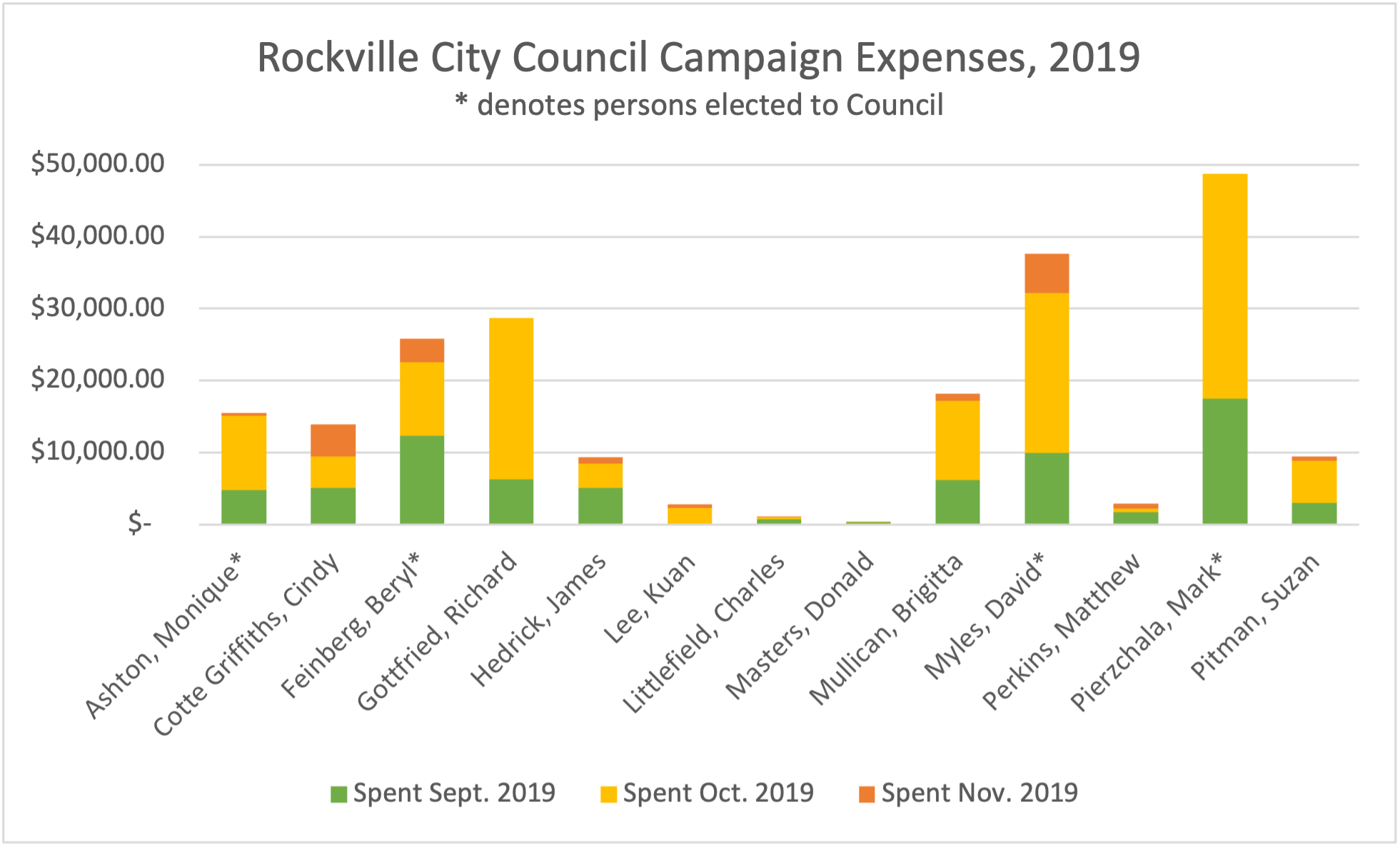
Election campaigns, even small local ones like Rockville City Council, require time and money. With the absence of a local newspaper to reach voters, candidates have to either spend most of their time walking door to door or most of their funds to print and mail campaign literature. In 2019—the last election for Mayor and Council—candidates for Council spent from $424 to $48,776 on their campaigns. Does money matter in local elections? Absolutely, under the right conditions.
As can be seen in the chart above, the candidates who spent the most money (Ashton, Feinberg, Myles, and Pierzchala) were elected to City Council—with one notable exception (Gottfried). The difference? Gottfried had less than a handful of individual contributors to his campaign; his campaign was mostly self-funded. The successful candidates had lots of money and contributors, and those who tended to spend less per vote had more Rockville residents as supporters. I suspect local supporters are more influential on the election than contributors who live out of town.
Looking more closely, successful candidates in 2019 needed at least 5,000 votes and spent between $3 to $10 per vote. In other words, to win a City Council election in Rockville required $15,000 to $50,000—mostly raised from local residents. If a candidate can’t raise those funds locally, they will need to put in a lot of their own money. At the other end of the spectrum, small campaigns who spent $500 to $5,000 didn’t have the capacity to gain sufficient support to cross the 5,000-vote threshold. If there are candidates you’d love to see on City Council, give them your financial support. A contribution of $25, $50, or $100 can make a big difference, especially in September.
The middle-sized campaign of $2 to $5 per voter ($10,000 to $20,000) seem to rely not only on the number of local contributors but also a thoughtfully-crafted campaign. To get out the vote, candidates have lots of ways to spend money (mail, literature, photography, videos, buttons, yard signs, t-shirts, social media, advertising) and time (parades, events, walking door to door, planning meetings, Community Forums, phone calls) but some are more effective than others. Campaigns of this size can’t shoot from the hip; they have to plan and manage carefully. Cotte Griffiths, Hedrick, Lee, Mullican, and Pitman fell into this nebulous and fraught category, so this year’s candidates may want to talk with a couple of them for advice. Perhaps the enlargement of the Council by two seats will allow more middle-sized campaigns to succeed. BTW, Kuan Lee’s expenses are low in the chart but he had over $10,000 in outstanding unpaid bills at the end of 2019, so his expenses are actually closer to $13,000.
The chart also shows that campaigns ramp up in September and at full-speed in October. November is very quiet by comparison because the election is held early in the month. I suspect that Labor Day will begin the campaign season in Rockville and it will include the usual craziness of mud-slinging and dirty tricks (yes, it unfortunately happens in Rockville).
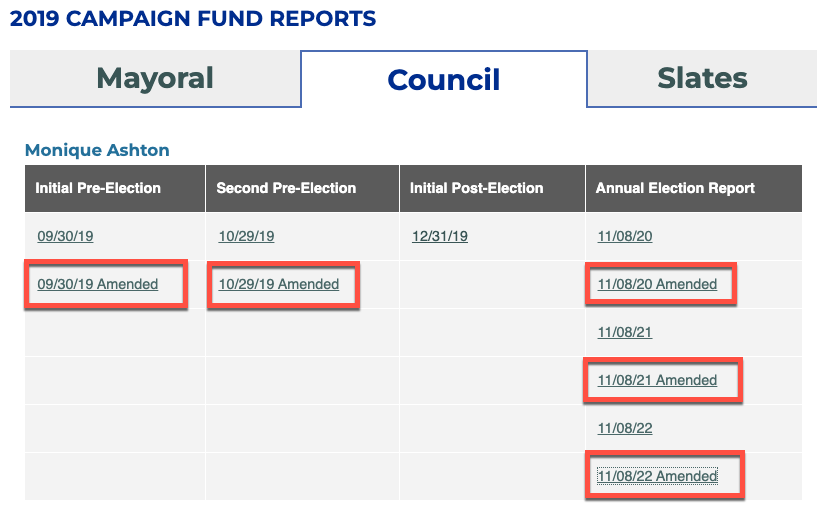
The data for the chart is derived from each candidate’s campaign finance report, which are submitted monthly during the height of the campaign season. Rockville developed its own campaign report forms and they desperately need to be revised because most candidates are unable to complete them properly and have to submit amendments regularly—some of them months later. Plus, key information can obscured because the forms allow candidates to reimburse themselves for expenses—the public can’t see where the cash is flowing, which is the primary purpose of campaign finance reports. The Board of Supervisors of Elections needs to revise the form and establish a standard of performance that no more than 25% of reports in any periods are amended.
Rockville City Manager Faces Performance Improvement Plan in Surprise Session

In an extraordinary last-minute Closed Session held on Thursday morning, May 11, 2023, the Rockville City Council put the City Manager Rob DiSpirito into a three-month Performance Improvement Plan (PIP) for reasons unknown. Improvement Plan (PIP) is a formal, structured process designed to help underperforming employees identify and overcome performance issues. It outlines specific goals, expectations, and timelines for improvement, along with support, resources, and regular progress evaluations to facilitate success and growth.
When the Council came out of Closed Session, Councilmember Monique Ashton quickly moved for the PIP and was supported by Councilmember Beryl Feinberg. Mayor Bridget Newtown rushed for a vote without a discussion, but was interrupted by Councilmember Mark Pierzchala to note that, “I don’t know how the sequence of events unrolled but I’m not going to vote for it. I think things have moved past the point where a performance improvement plan is going to be effective. So I’m gonna vote against it. I had asked to make the first motion but that was not allowed, apparently. I’m not sure where that came from. Thank you.” The motion passed 4-1 with Councilmember Pierzchala voting against. A brief three-minute video is available at https://youtu.be/fIu7e9cHhoo, but of course, the closed session portion is held in secret and it’s unclear how long they debated the issue.
I typically discourage Closed Sessions because they are secret and prevent voters from knowing what’s happening—and Closed Sessions usually deal with major issues. Fortunately, Maryland has an Open Meetings Act to keep council and board meetings available to the public so they can be “in the room where it happens.” A quick introduction is available as FAQs, but here are a fundamentals:
- The Maryland Open Meeting Act lists 15 topics that the City Counci) may choose to discuss behind closed doors under specific conditions. These topics or “exceptions,” include personnel discussions about particular individuals, the receipt of legal advice from the public body’s attorney, and subjects that must be kept confidential under other laws. A discussion on “the appointment, employment, assignment, promotion, discipline, demotion, compensation, removal, resignation, or performance evaluation of an employee over whom the Mayor and Council has jurisdiction” is an appropriate reason for the Closed Session on May 11.
- Public bodies must make an agenda available before each meeting, either when notice is posted, if the items of business are known then, or as soon as practicable, but no later than 24 hours before the meeting. There is an exception for meetings held in response to emergencies. This Closed Session was not publicized as an emergency and the the agenda was posted on the city website on May 10 at 5:20 pm, that’s less than 18 hours in advance, so is in violation of the Act. Furthermore, it was not sent out as an email to those who subscribe to the City Council’s agendas (thanks to a blog reader who alerted me to this meeting).
- This meeting was not publicized an emergency, so why the rush? Two councilmembers had difficulties attending in person. Councilmember Myles was absent at the start of the meeting and showed up virtually later. Councilmember Ashton started the meeting virtually and joined in-person by the end. How much of the Closed Session discussion did they miss? Councilmember Ashton didn’t even notice that the vote to go into Closed Session occurred.
Most management leaders will emphasize that employees are the organization’s most important assets so how well are these assets being managed in the City of Rockville? Most of the current councilmembers lack significant experience in supervising employees and the City Council has a poor record of managing its most senior staff. The City Manager, City Attorney, and City Clerk have each been dismissed during Mayor Newton’s tenure. After a while, the only common denominator to these problems is the City Council.
The City Council needs to provide a better explanation for this decision and how they handle Closed Sessions. Or it’s time to rethink their privilege to serve.
May 21, 2023: This post was corrected to show a vote of 4-1 in the caption of the photo.
Mayor and Council to Receive Final Public Comments on FY24 Budget
At its Monday, April 17, 2023 meeting, the Rockville Mayor and Council will discuss FY 2024 budget (public hearing). On the Consent Calendar (items approved without discussion) are no items. The Mayor and Council will also receive reports on no items.
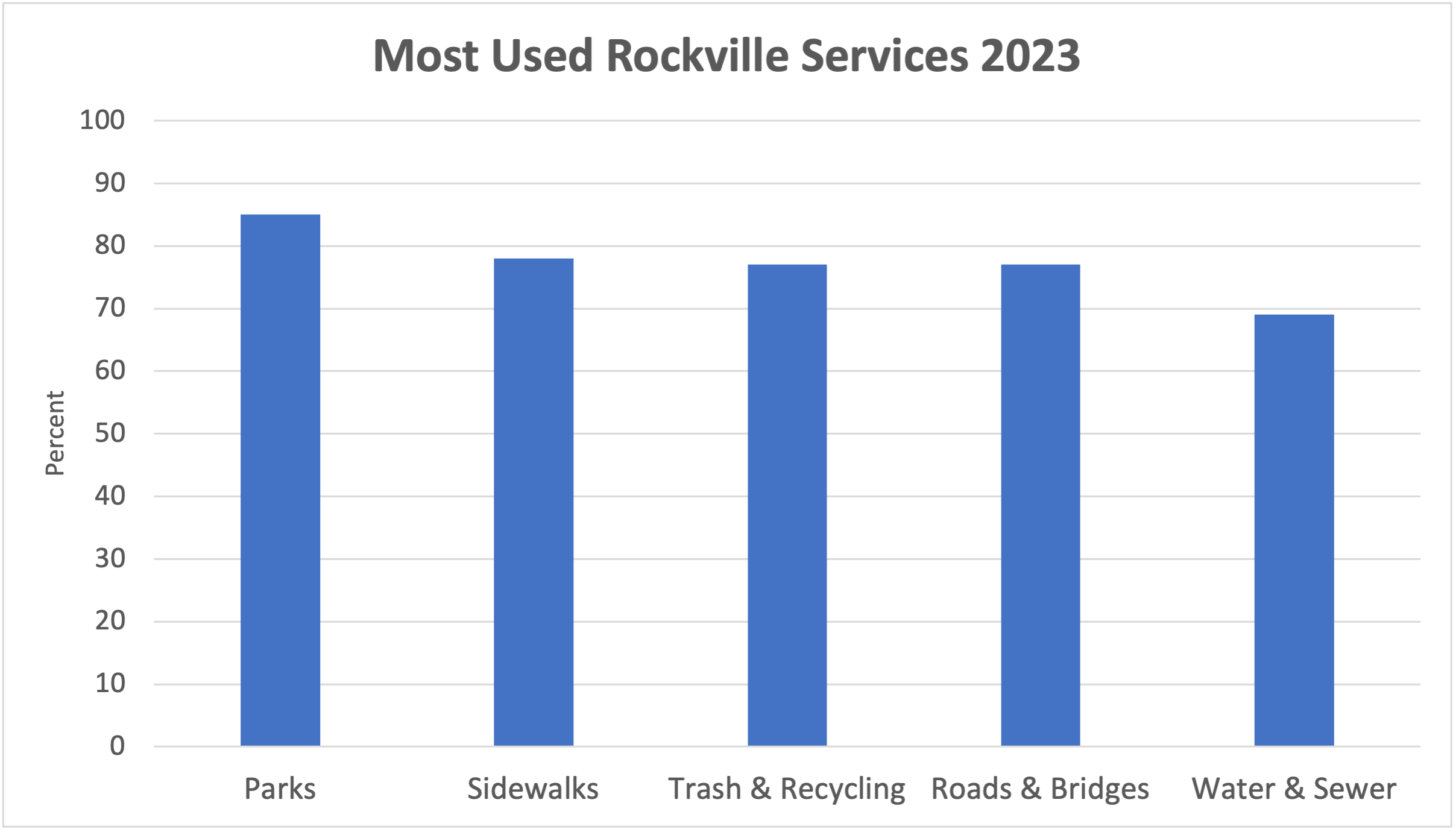
This is the third and final public hearing related to the FY 2024 budget, with more than 100 suggestions received at the March 29 public hearing (lots of requests for community gardens and a new entrance to the senior center from Gude Drive, but many were boiler-plate requests which I tend to ignore). The FY 2024 operating budget totals $156.4 million for the City’s ten operating funds. This represents an overall increase of 5.1 percent from the FY 2023 adopted budget. The total number of full time equivalent (FTE) positions in the FY 2024 operating budget equals 642.7, a net increase of 4.1 FTEs from the FY 2023 adopted level. The FY 2024 proposed budget includes an additional 4.0 regular FTEs over the FY 2023 adopted budget.
The proposed Capital Improvements Program will receive $35.2 million in new funding in FY 2024. The CIP is organized by program area and provides:
- $10 million to the Recreation and Parks program area, which includes funding for the outdoor recreation pool renovations and the design of the dance/fitness studio and multi-purpose space proposed for the King Farm farmstead;
- $7.5 million to the Transportation program area, which includes funding for roadways, sidewalks, and ongoing LED streetlight conversions;
- $10 million to the Utilities program area, which includes funding for water main and sewer rehabilitation;
- $2.4 million to the Stormwater Management program area, which includes funding for stream restoration projects, storm drain analysis and spot repairs, and improvements to City stormwater facilities;
- $5.2 million to the General Government program area, which includes funding for data center and disaster recovery infrastructure and improvements at the city’s Maintenance and Emergency Operations Facility.
A few council members had questions about the budget, which were answered by staff. For Councilmember David Myles, see page 251+, 268+, and 272+. For Councilmember Mark Pierzchala, see page 257+ and 272+. For Councilmember Beryl Feinberg, see page 266 (just one question!), page 269 (two more!), and 277+ (lots, looks like she finally studied the budget by March 20). For Councilmember Monique Ashton, see page 266+ and 274+. For Mayor Bridget Newton, see page 273+ and page 285. If you’re running for council (or really want to know which council members are thoughtful and informed), you’ll want to review this section.
More details in the 294-page agenda packet are available at https://www.rockvillemd.gov/AgendaCenter/ViewFile/Agenda/_04172023-6873.
Will Mayor and Council allow Self-Storage Warehouses near Schools and Adult Day Care Centers?
At its Monday, November 14, 2022 meeting, the Rockville Mayor and Council will discuss financial management policies, state legislative priorities, and a zoning change to allow self-storage warehouses in the MXE Zone.
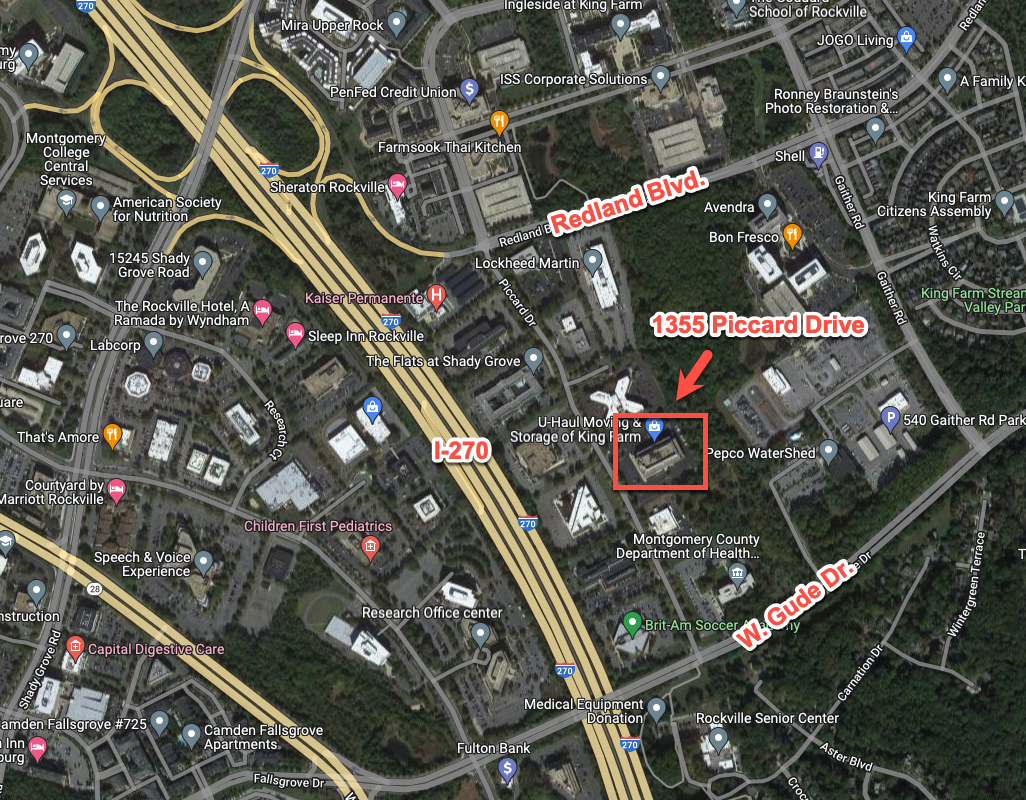
The zoning change is prompted by U-Haul Inc., which owns a four-story office building at 1355 Piccard Drive, an industrial/office area between I-270 and King Farm, north of West Gude Drive. This is in a MXE Zone, which was created to generate more jobs by allowing retail, institutional, and residential uses that were not permitted in the former I-3 (Industrial) Zone. City staff calculated that, “with about 153,000 square feet of floor area, the applicant’s building could accommodate about 600 employees at 250 square feet per person. With only the retail and rental shop and self-storage, there would likely be only five or six employees on-site”—which fails to meet the intent of the MXE Zone. Secondly, Ann Mitchell, CEO of Montgomery Hospice, a tenant in the building, stated that the self-storage warehouse was not compatible with existing adjacent uses, including a private school (The Children in the Shoe) and a senior adult day care center.
At its September 6 meeting, the Planning Commission voted 6-1 to deny a zoning change to allow self-storage warehouses in the MXE Zone. Commissioner Sam Pearson, however, supported the change because self-storage warehouses “brought value to the community” and would not “generate traffic issues nor was it unsightly to the surrounding area.” This issue reminds me of the lawsuit by ezStorage that put Mayor Bridget Newton and Councilmember Beryl Feinberg right in the middle of a legal storm. I wonder how they’ll respond to U-Haul when it comes before the City Council.
More details in the 224-page agenda packet are available at https://www.rockvillemd.gov/AgendaCenter/ViewFile/Agenda/_11142022-6746.
Mayor and Council to Design Rockville Metro, Spend $6 Million in Federal Funds, and Battle over the Budget on December 13
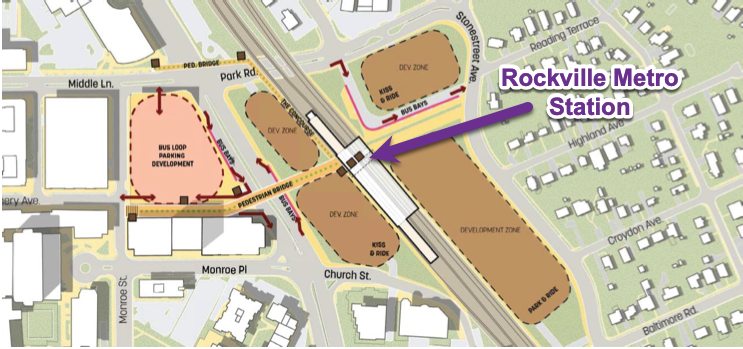
At its Monday, December 13, 2021 meeting, the Rockville Mayor and Council will discuss three design concepts for Rockville Metro station, use of nearly $6 million in ARPA funds, and determine 2023 budget priorities. This is a worksession and will not offer public hearings or a community forum, but it will be streamed live if you are interested in these topics.
Continue reading →A Most Unusual Election
This year’s Mayor and Council election in Rockville is extraordinary not only because Election Day has turned into Election Month due to vote-by-mail, but also because so many new, unusual, and strange campaigning is happening. You’ve probably noticed a few of them but when you bring them all together, you realize this election is very different from its predecessors.
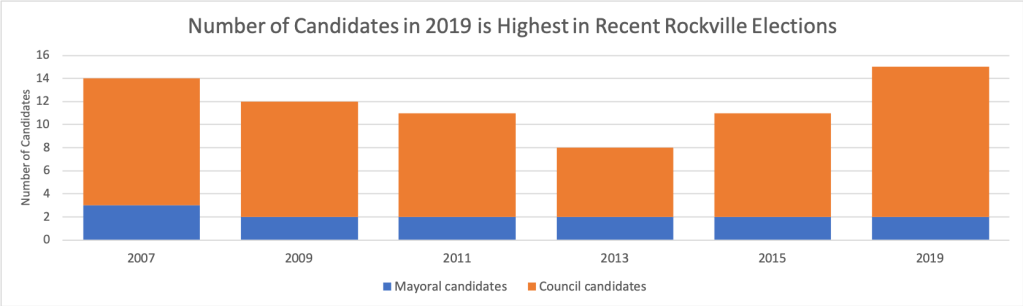
The number of candidates is the largest in recent memory and I’m not sure what’s prompting it. Running for office is grueling and costly. Maybe there’s a gut feeling that the city is being pulled in several directions and people are jumping in to influence the outcome or that there are two slates (which was common twenty years ago) plus the usual unaffiliated candidates.
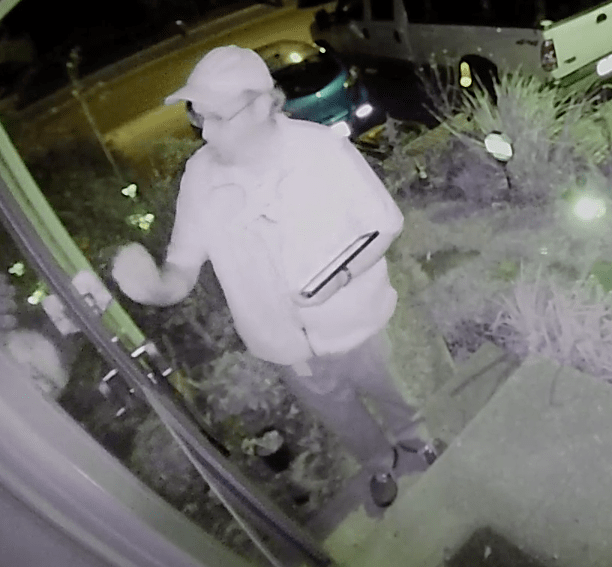
We’re now at the time of the campaign when yard signs become a point of contention. During the day, fanatics will confront homeowners who have signs of their opponents or in the dead of night, steal signs and blame it on teenagers. This election is different because many homes have motion-activated security cameras, making it easier to catch misbehavior on video. Recently posted on Twinbrook Neighbors, a camera caught a person tucking candidate literature into the door who also seemed to go through the resident’s mailbox. And he wasn’t a teenager.
Continue reading →Rockville Voters Grow Younger; Will It Matter?
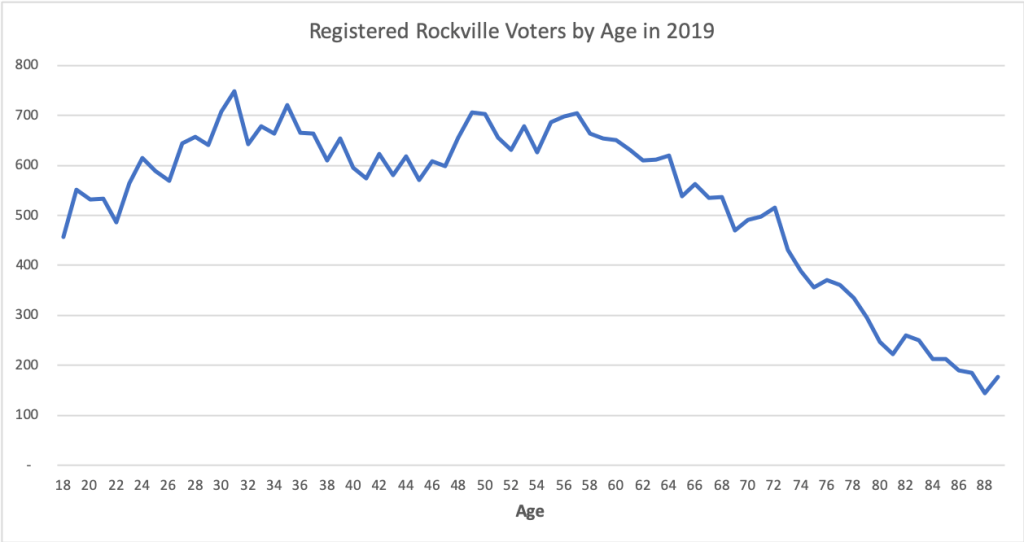
An analysis of Rockville’s registered voters shows that they are dominated by Millennials, those born in the 1980s and 1990s and are now in their 20s and 30s. I suspect much of this is due to voter registration at the DMV, but the bigger question is if they will actually vote. In past city elections, reliable voters were over 50 years old but with the introduction with Vote-by-Mail, this will probably change. Without waiting for Election Day or spending time at the polls, there’s an expectation that younger voters will put their ballots in the mail in greater numbers.
The challenge for candidates is finding issues that will resonate with voters under 40. Their interests are different from older voters. Millennials value diversity and equal rights, are less affiliated with political parties (although they tend to lean liberal), support more government services (such as health care), support the legalization of marijuana, and believe immigrants strengthen the country (see Pew’s “The Generation Gap in American Politics“).
The debates on Rockville’s Mayor and Council reveal these generational differences as well, although they’re not always on generational lines. In June 2017, on a split vote, they adopted the Fostering Community Trust Act, which prohibits city staff (including police officers) from arresting or discriminating against any person on the basis of citizenship or requesting a person’s immigration status when providing city services. It was supported by Councilmembers Onley, Palakovich Carr, and Pierzchala, opposed by Mayor Newton and Councilmember Feinberg and . The differences are stark: one side aligns with the older generation, the other side thinks younger, and led by a mayor that’s unsure where to go. In the meeting, not only did Feinberg vote against the ordinance, she attempted to weaken the City’s position by making it a policy posted on the city website, rather than an ordinance published in the city code. Newton waffled and revealed her indecisiveness by abstaining from the vote on the amendments that clarified federal and city roles in law enforcement (how is it possible for someone to abstain on this topic?).
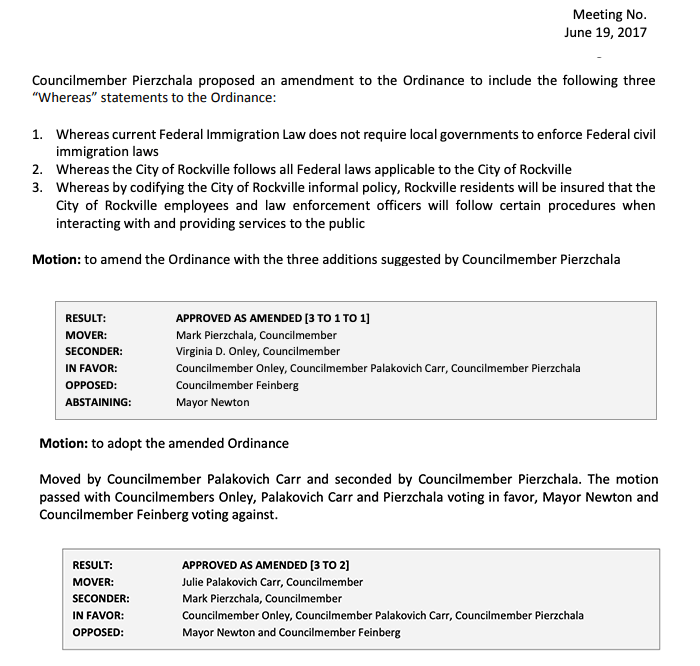
Had Newton and Feinberg prevailed, city officials, staff, and officers would be allowed to ask residents for proof of citizenship. If you called the police to report a crime, the officer could ask if you are a citizen. Before you register for a recreation class, the staff could ask for proof of citizenship. If you talked with a foreign accent at a Mayor and Council meeting, a councilmember could ask if you were a citizen.
How the generational gap will affect the election is unknown—most voters aren’t aware of what’s happening in City Hall and rely on their day-to-day experiences to decide whether to keep or change elected officials. We’ll find out in a month.
This blog post was updated on October 12, 2019 to correct information about the votes on June 19, 2017 and its consequences.

 Max for Rockville