Rockville Council to Weigh Rules of Decorum, Zoning Rewrite, and King Farm Future
The Rockville Mayor and Council will meet on Monday, September 29, 2025. Several significant issues are up for discussion, ranging from meeting rules to long-term planning for land use, transportation, and historic preservation. Below is a preview of the topics most relevant to residents and businesses.
Rules of Decorum for Council Meetings
The Council will consider adopting formal Rules of Decorum and Protocols for public meetings. These rules cover conduct for councilmembers, staff, and members of the public, aiming to ensure meetings run efficiently and respectfully. This proposal formalizes expectations for behavior in Council chambers, reinforcing civility and safety. Some of the proposed rules may be toughest for the councilmembers themselves to follow, especially the bans on interrupting or talking over colleagues and on making lengthy or repetitive comments that delay business.
Opportunities and Threats
Continue reading →Big Changes Coming? Rockville Zoning Rewrite Targets Downtown and Twinbrook
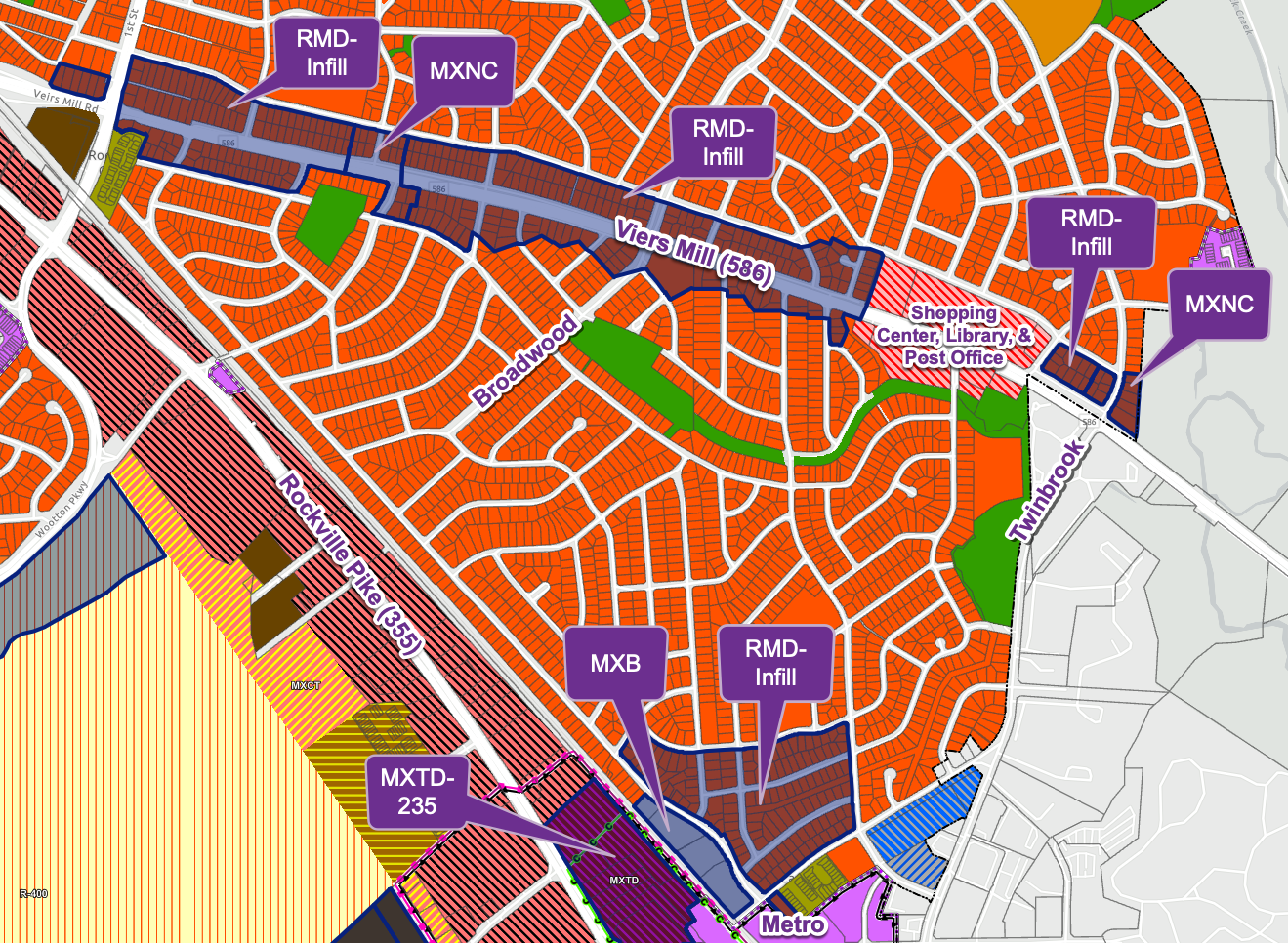
Rockville is rethinking the rules that shape how our neighborhoods and business districts grow—and major zoning changes are on the table for both downtown Rockville and the Twinbrook neighborhood.
The city is updating its zoning ordinance for the first time since 2009 to reflect how people live and work today. This rewrite will bring Rockville’s zoning in line with the Rockville 2040 Comprehensive Plan and could pave the way for new housing options, business models, and construction types—especially in areas identified for growth and change.
If you live, work, or own property in Twinbrook or downtown Rockville, this is the time to get involved.
Key dates to watch:
- Tuesday, June 17 at 7:00 p.m. – Twinbrook Community Association meeting at the Twinbrook Recreation Center (residents especially encouraged to attend)
- Monday, June 24 and Wednesday, June 26 – Two virtual citywide zoning update meetings. Register for the virtual meetings at www.engagerockville.com/zoningrewrite
These meetings will explore how zoning changes could shape the future of your neighborhood—from building heights to business uses and green space requirements.
Understanding Rockville’s Zoning: A Guide for Residents and Businesses
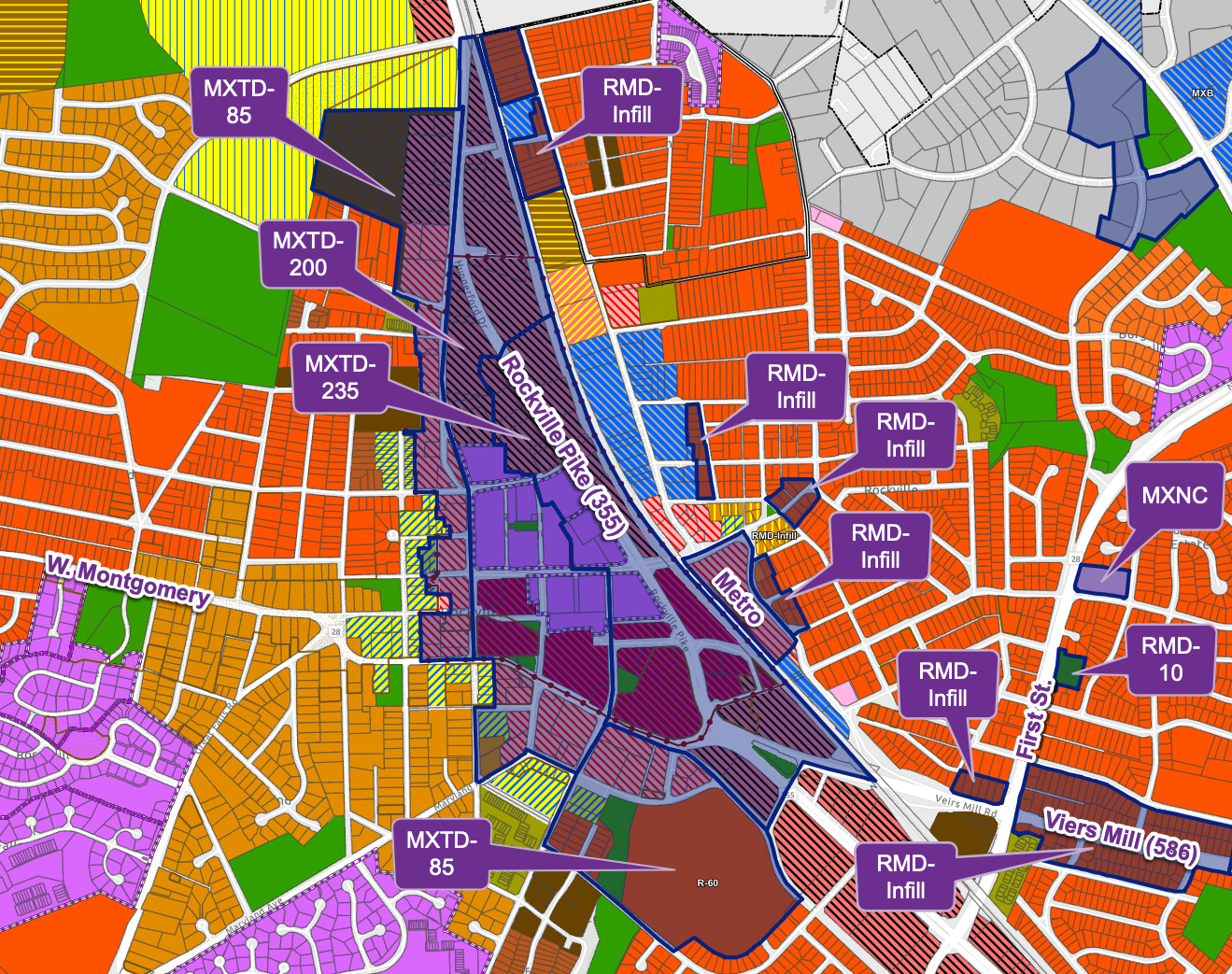
As Rockville updates its zoning ordinance, it’s helpful to understand what the current zones mean—especially if you live, work, or plan to develop in the city. Here’s a breakdown of five key zones under consideration, explained for non-specialists:
Continue reading →Contradictory Suggestions Challenge Decision-Making Process for City’s FY2025 Budget
At its Monday, March 18, 2024 meeting, the Rockville Mayor and Council will discuss the budget for FY2025, tax rates, and modifying Council rules and procedures. On the Consent Agenda (items approved without discussion) are contracts for engineering and design services, a collective bargaining agreement with AFSCME #1453, and nearly $500,000 in data center and disaster recovery, among others. The Mayor and Council will also hold a worksession on the FY25 revenues, fees, and cost recovery. They are also approving the minutes from the Closed Sessions held on November 9, 2023 and November 15, 2023–long after the requirements of the Maryland Open Meetings Act (“as soon as practicable after a public body meets, it shall have minutes of its session prepared.” § 3-306(b)(1)).
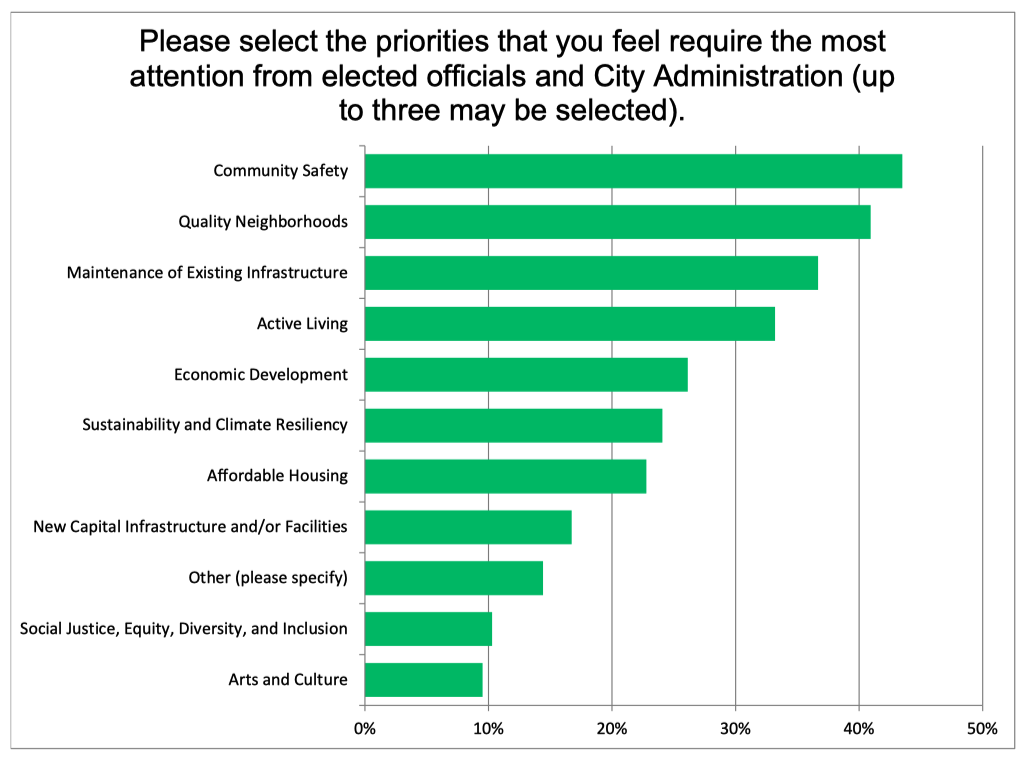
The bulk of the agenda is devoted to the budget for FY2025 and will include a public hearing to collect more comments (p. 770+. The City has received nearly 800 comments from residents and businesses, which identified the top three priorities as community safety, quality neighborhoods, and maintenance of existing infrastructure (receiving about 35-45% of votes). The highest response rate was from the north end of the city (north of West Montgomery between 270 and 355) and lowest were from the east side of the city (east of 355).
Upon reviewing the open comments, it becomes evident that decision-making is a complex process. There are suggestions that fall outside the City’s jurisdiction, such as implementing a Bitcoin standard (a federal issue), improving academics at Twinbrook Elementary School (a school board issue), and prioritizing common sense (whose responsibility is this?). Once these are set aside, a multitude of individual suggestions remain, some of which are in conflict. For instance, while one person suggests increasing pay for police, another proposes eliminating the police department altogether. Similarly, opinions diverge on the addition or removal of bike lanes. With the assistance of ChatGPT, these suggestions seem to cluster around five major issues. However, the ways to address these can also be contradictory, and understandably, no one is keen on increased taxes to fund these initiatives:
- Infrastructure and Environment, such as improving traffic light timings, addressing potholes and street noise, maintaining and improving existing parks, preserving RedGate as green space, increasing preventative maintenance for storm water infrastructure, and promoting environmental sustainability through controlling invasive species and planting more native trees.
- Community Development and Safety, such as reviving the Town Center [didn’t we already do this?], improving safety in neighborhoods and near the Metro station, addressing crime, improving Rockville Pike, adding or removing bike lanes, and ensuring law enforcement is effective and well-funded.
- Housing and Zoning , such as upzoning detached SFH-only zoning areas, discussing housing for asylum seekers, preserving single-family zoning, and increasing residential density in Rockville Town Center.
- Services and Amenities, such as improving water customer service, providing free shuttle buses to key locations, expanding the Latino Youth Development Program, adding a compost service, increasing public art, establishing more dog parks and exercise classes, and providing easily accessible senior services.
- Economic and Business Development, such as supporting local businesses, reducing business turnover, and encouraging businesses to open in the Town Center (TC continues to be a perennial issue—I guess redevelopment in the 1960s didn’t cure it).
I wonder if if the City Council would have better information if they conducted random, in-depth phone interviews with a couple dozen residents, rather than survey of a thousand who decided to participate?
The Council is considering a change in its current Rules and Procedures because of the increase from five to seven members (p. 957). The City Attorney has drafted an amendment for the Council’s consideration, including that an item may only be removed from an agenda with the approval of at least six Council members, otherwise it follows Robert’s Rules of Order (developed by US Army officer Henry Robert in 1876; it is now in its twelfth edition). To add an item to the agenda still requires the request of two or more members.
The Mayor and Council are conducting hybrid meetings. If you wish to submit comments in writing for Community Forum or Public Hearings, please email the comments to MayorAndCouncil@RockvilleMD.gov by no later than 10:00 a.m. on the date of the meeting.
More details in the 1028-page agenda packet are available at https://www.rockvillemd.gov/AgendaCenter/ViewFile/Agenda/_03182024-7139.
Mayor and Council to Consider Major Funding Boost for Climate and Pedestrian Plans

At its Monday, March 4, 2024 meeting, the Rockville Mayor and Council will discuss fees, taxes, and federal earmarks for FY2025. On the Consent Agenda (items approved without discussion) are a water meter easement for 1151 Fortune Terrace. The Mayor and Council will also receive reports on the proposed budget for FY2025.
For FY2025, the City Council will be considering increasing staffing levels by 12 fulltime positions, half of which will be police officers in response to the decrease in support from Montgomery County. Other positions range from transportation engineer and building plan examiner to preschool teacher and board and commissions coordinator. They are also funding efforts to advance the Climate Action Plan ($3.7 M), Vision Zero Action Plan & Pedestrian Master Plan ($10.7 M), Town Center Master Plan, and economic development (primarily $1.4 million for REDI and its efforts to make Rockville a business destination for the life sciences) (page 7+). Capital improvements are expected for parks, including replacement of playground structures, renovating an outdoor pool, implementing the master plan for Red Gate Park, and improvements for the Lincoln Park Community Center, F. Scott Fitzgerald Theatre, and David Scull Park (some of which will require taking out a loan for $30 M). There seems to be nothing related to housing or other commercial districts (i.e., Rockville Pike). The City Council will be accepting comments at their meetings on March 18 and April 8, or you can make suggestions online at https://www.rockvillemd.gov/951/Budget.
While property tax rates should remain unchanged, utility rates for FY2025 may go up:
- Water and Sewer: 4% or $52.56 annual increase
- Refuse/trash: 6% or $32 annual increase
- Stormwater Management: 4% or $6 increase
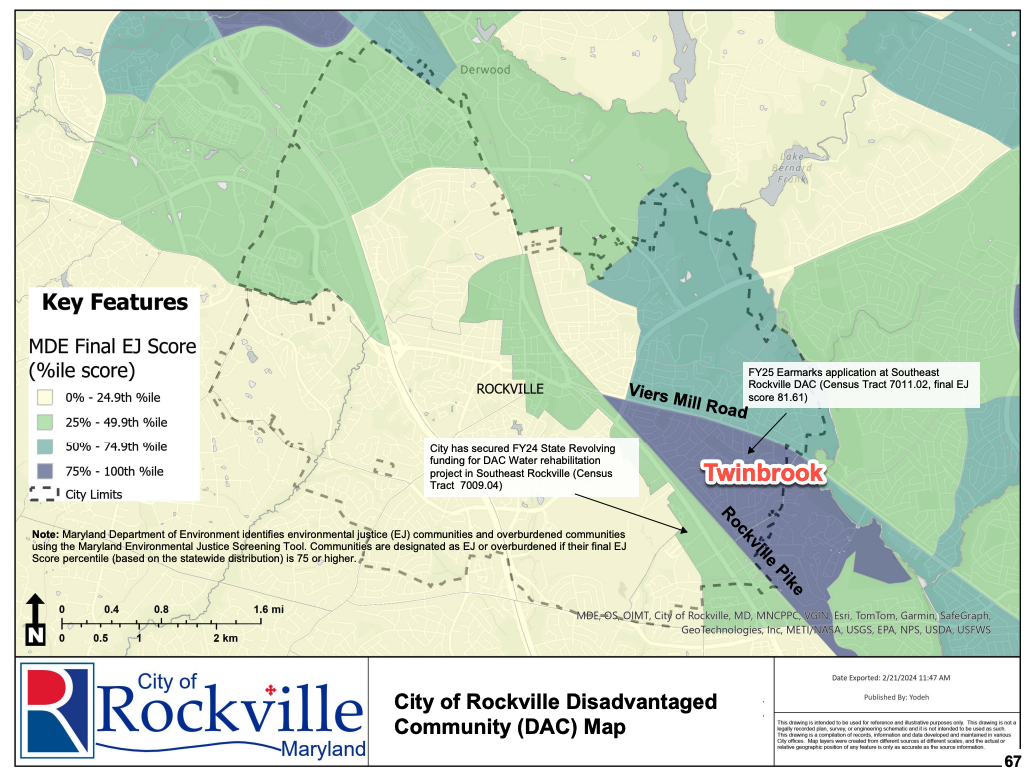
Senator Cardin, Senator Van Hollen, and Congressman Raskin have invited Rockville to submit requests for projects for which the City wishes to partner with the Federal government and seek funding support. Congress revived earmarks in FY22 after a decade-long prohibition (pork barrel politics has returned!) (page 57+). Some suggested projects from staff include:
- Inspecting more than 8,000 water lines for lead to ensure safe drinking water.
- Replacing “orangeburg” sewer lines to prevent backups, overflows, and ground contamination.
- Rehabilitate aging water mains and asbestos cement pipes in southeast Rockville (Twinbrook).
The Mayor and Council are conducting hybrid meetings. If you wish to submit comments in writing for Community Forum or Public Hearings, please email the comments to MayorAndCouncil@RockvilleMD.gov by no later than 10:00 a.m. on the date of the meeting.
More details in the 133-page agenda packet are available at https://www.rockvillemd.gov/AgendaCenter/ViewFile/Agenda/_03042024-7129.
Candidates Share Their Vision for Rockville at October 5, 2023 Forum
Community Reach of Montgomery County, in partnership with Rainbow Place Shelter, hosted a Rockville Election 2023 Candidate Forum at the F. Scott Fitzgerald Theatre on October 5, 2023. The Forum, which was a significant event in the lead-up to the November election, saw candidates take to the stage to present their qualifications, experiences, and key policy positions. It’s important to note that the candidates’ statements were not independently verified, or as Ronald Reagan loved to say, “trust but verify.”
Candidate forums are a valuable opportunity for voters to hear directly from the candidates on a range of important issues but if you didn’t attend or don’t have time to watch the 90-minute replay on YouTube, I’m offering ChatGPT-generated summaries (with some light editing) to the candidates’ responses to the major questions in the attached six-page handout (thanks TM!). This will enable you to swiftly share your preferred candidate’s stance on issues with friends and family, strategize on the optimal choices for Mayor and Council seats, or potentially identify which candidates may be unclear, evasive, or inconsistent in their responses.
If you’re a candidate, these summaries could serve as a tool for reviewing your positions and assessing how effectively you stand out from others. Do the summaries accurately capture your ideas? Did any crucial points get overlooked? How do your views align or differ from other candidates? Are your statements well-rounded, or do they lean towards being too abstract or too specific? Do any of your opponents exhibit a significant lack in knowledge or critical thinking?
Rockville’s Neighborhoods: A Key Factor in Local Elections?
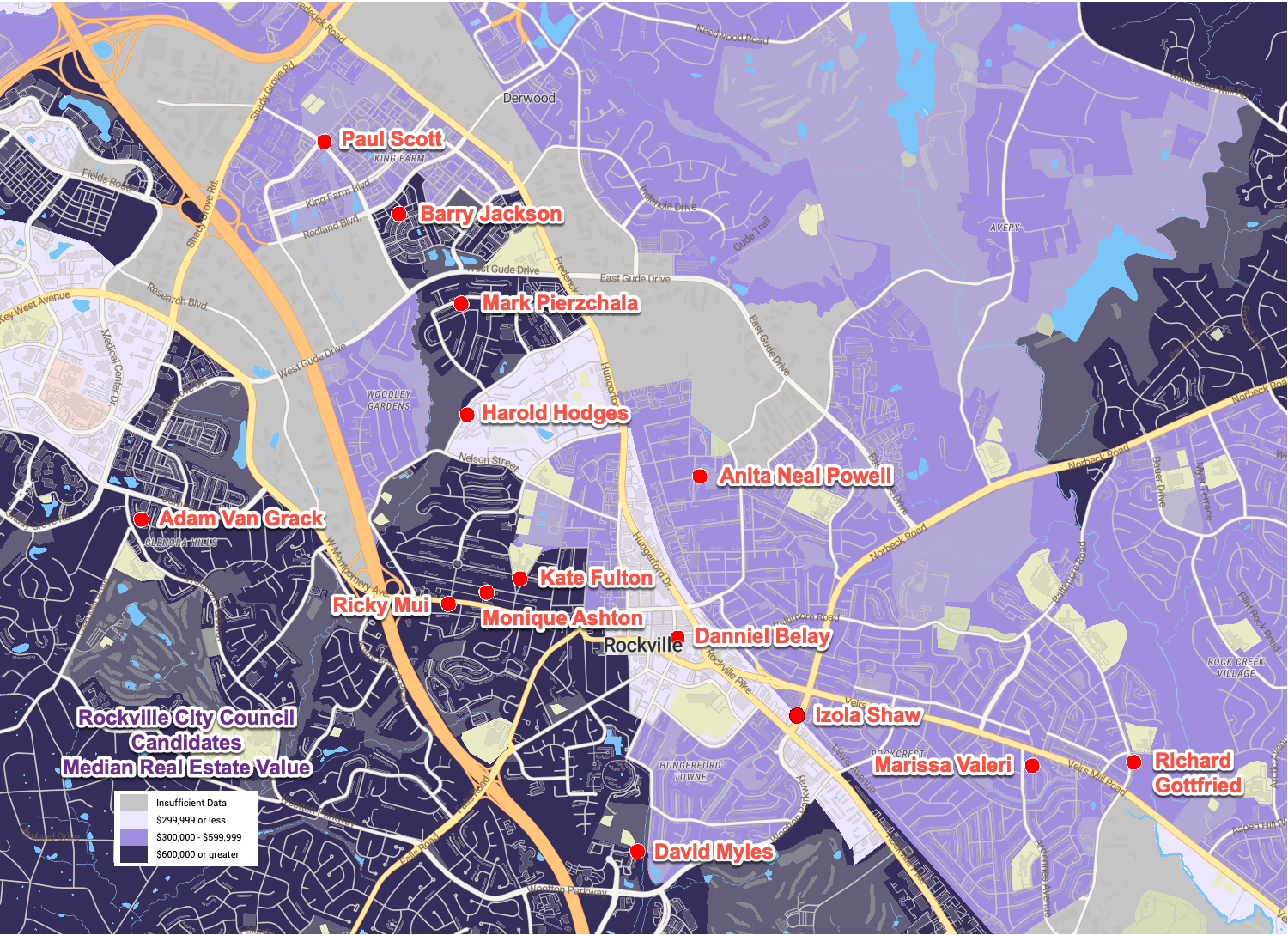
If you want to run for a spot on the Mayor and Council, you need to be at least 18, registered to vote, and have lived in Rockville for at least a year before the election (for this race, that means living here since November 7, 2022). But when people vote, they often pick candidates who they feel are like them and will represent what they care about. So, where a candidate lives can be really important, especially if they live in a neighborhood that’s similar to the voter’s.
Looking at the map, you can see Rockville is split into three parts by major highways. To the west of I-270 is the “wealthy west,” where the average house costs more than $600,000. Adam Van Grack is the only candidate from this part of Rockville. To the east of #355 (Rockville Pike/Hungerford Drive/Frederick Road—actually, the dividing line is Metro) are the “middleburbs,” where houses typically cost between $300,000 and $600,000 and is home to Anita Neal Powell, Izola Shaw, Marissa Valeri, and Richard Gottfried.
Right in the center of the city is the “mixing bowl,” where house prices vary the most and has the greatest number of candidates: Paul Scott, Barry Jackson, Mark Pierzchala, Harold Hodges, Kate Fulton, Monique Ashton, Ricky Mui, Danniel Belay, and David Myles.
In past elections, the richest neighborhoods usually had the most people voting. If we think they’ll vote for people who are like them or share their interests, we will likely see Barry Jackson, Adam Van Grack, Kate Fulton, Ricky Mui, and David Myles take five seats on the next city council. If we continue this logic, there is one more seat available on council so it will be a tight race between Paul Scott, Anita Neal Powell, Izola Shaw, Marissa Valeri, and Richard Gottfried. The contest for Mayor between Mark Pierzchala and Monique Ashton, who both live in wealthy neighborhoods, will be more complicated. Voters will likely consider additional factors like experience, background, personality, and age.
As for age, once again this council election attracted candidates that span at least three generations. The Millennial generation (born 1981-1996) is solely represented by Danniel Belay; Gen Xers (1965-1980) by David Myles, Monique Ashton, Ricky Mui, Izola Shaw, Kate Fulton, Barry Jackson, Marissa Valeri, Adam Van Grack, and Harold Hodges; and Boomers (1946-1964) by Paul Scott, Richard Gottfried, Mark Pierzchala, and Anita Neal Powell. Most people who vote in Rockville are from Generation X. If they vote for people who are like them, we might see a lot of candidates like David Myles, Monique Ashton, Ricky Mui, Izola Shaw, Kate Fulton, Barry Jackson, Marissa Valeri, Adam Van Grack, and Harold Hodges on the city council. But the people who vote the most are Baby Boomers, so Paul Scott, Richard Gottfried, Mark Pierzchala, and Anita Neal Powell could also have a good shot at winning.
The Rockville United campaign committee, which includes Monique Ashton, Kate Fulton, Paul Scott, Izola Shaw, and Marissa Valeri, could really shake things up in the city council if voters decide they want a big change. However, it’s hard to find information about this team online, and usually, people prefer to pick their candidates one by one. But remember, teams like Rockville United can be a great way to make the most out of limited resources.
Twinbrook Holding its First In-Person Community Meeting
On Tuesday, January 24 at 7:30 pm at the Twinbrook Community Recreation Center, the Twinbrook Community Association will be holding its regular community meeting—but it will be in person for the first time since 2020! The meeting will include information about Rockville’s Flood Mitigation Assistance Program (how homeowners and renters can reduce the cost of protecting their home from flooding), a discussion on the expansion of the Mayor and Council from five to seven members, and recognizing Melissa and Tony Downs as Twinbrookers of the Year for their extraordinary support of Twinbrook Elementary School PTA and the community.
Pandemic Resulted in High Subsidies for Recreation and Parks in 2021
At its Monday, November 21, 2022 meeting, the Rockville Mayor and Council will discuss financial management policies, annexing 1201 Seven Locks Road, and the new Comprehensive Plan. On the Consent Calendar (items approved without discussion) are employment agreements for the Deputy City Manager and Assistant City Manager for Project Management, among others. The Mayor and Council will also receive reports on staff vacancies and hiring.
How much should the city subsidize Recreation and Parks programs, such as summer camps, skate park, or childcare, that are used by a small segment of residents? How should it manage donations it receives annually for the Holiday Drive and Senior Assistance Fund? At the upcoming meeting, the Council will discuss these and other financial management policies.
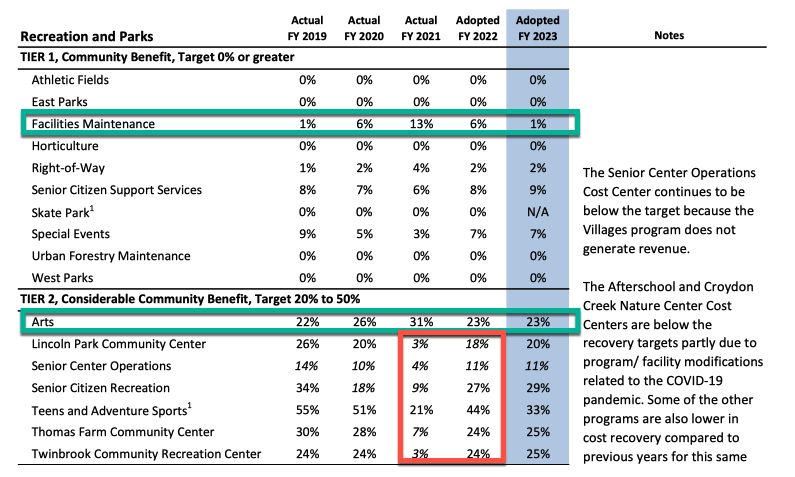
The City of Rockville has an extensive set of financial management policies that affect eight major areas: achieving and maintaining a structurally balanced budget, fund balance and reserve policies, capital planning policies, investment policies for both retirement plans and City funds, revenue control and management policies, economic development policies, and debt compliance and data analysis policies. For Recreation and Parks programs, the City uses a “five-tier cost-recovery pyramid” ranging from Tier 1 for parks, trails, landscapes, playgrounds, and general-use facilities with a 0% cost recovery to a Tier 5 for private rentals and private lessons with a 100% or more cost recovery. Fees and charges are reviewed and adjusted annually, but the pandemic lowered cost recovery significantly. In Tier 2, for example, the Lincoln Park Community Center is expected to recover 20% of its costs in 2022 (a subsidy of 80%) but in 2021 it actually recovered 3% (a subsidy of 97%). There are a couple of bright spots: Facilities Maintenance and Arts recovered more than expected (in other words, required less of a subsidy), most likely as well due to the reduced use of facilities and arts programs during the pandemic. A summary is available on Packet Page 34.
The Financial Advisory Board recently recommended that the City create a formal donations policy. The City receives less than one percent of its revenues from donations each year, which are accepted by check, made through the City’s website, the recreation registration system, and through the round-up feature with online utility bill payments. During FY 2022, the City received approximately $130,000 in donations from over 1,800 donors, averaging $12 for the Recreation Fund and $300 for the Holiday Drive. It also received two donations over $5,000: one $25,000 donation for the Holiday Drive and one $20,000 donation for the Eat Fresh program. Strangely, when the City explored this topic further, it discovered that a donations policy is not a common practice in municipal governments in Maryland. Geez, this suggests an obvious opportunity for embezzlement in government and I’m glad to see the City is thinking ahead. It’s a common practice in nonprofit organizations.
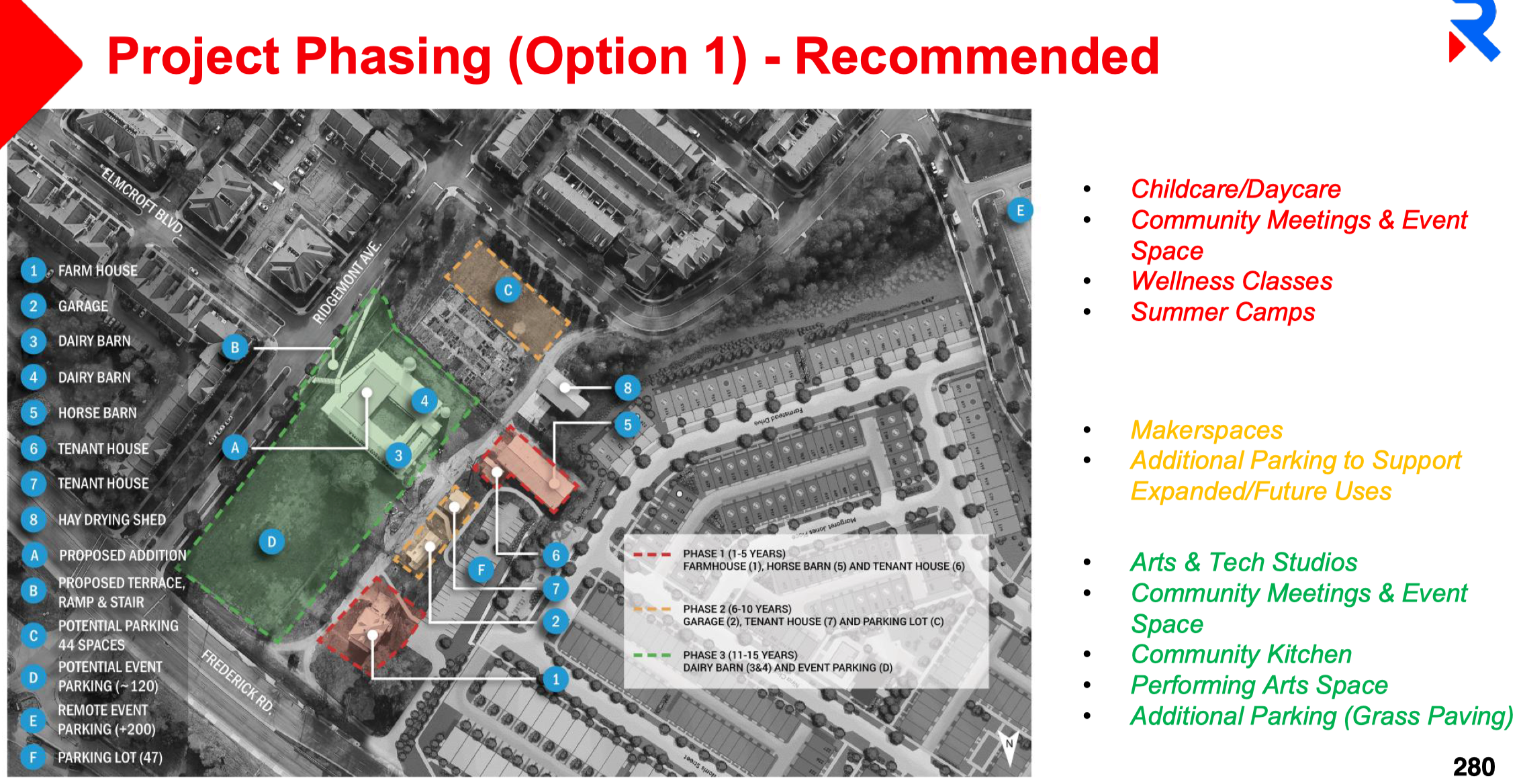
The big kahuna for the meeting (if not the year), however, is the progress on the Rockville 2040 Comprehensive Plan—the city’s “to do” list for the next twenty years. At this meeting, the City Council will review the progress on tasks that are to be completed in the next 1-3 years. This is an enormous undertaking not only to complete, but also to manage. These tasks include a zoning ordinance rewrite, updating the Town Center Master Plan, adopting a Pedestrian Master Plan, assessing speed limits on Wootton Parkway, redeveloping King Farm Farmstead, installing back-up power generation for critical facilities, promoting backyard composting, preparing a Flood Resiliency Plan, and constructing senior housing. Since the Plan’s adoption in August 2021, 228 actions are currently in the near-term completion timeframe, but are not yet completed or in progress; 43 actions are currently in the “in progress” status; and 19 actions have been completed. If you want details on what’s happening in the City or your neighborhood, start on Packet Page 89. Getting everyone on board and focused is a continual challenge, and residents and businesses (and Council members) always have new ideas—but time and staff are limited so establishing priorities is essential.
It’s also enlightening to see which neighborhoods are most engaged in the community. In October, the City distributed surveys about community needs and interests. Among the highest response rates were College Gardens (156 responses) and Twinbrook (52 responses). Among the lowest were Tower Oaks (1 response) and Lincoln Park (0 responses). I wonder if this correlates with voter turnout?
More details in the 152-page agenda packet are available at https://rockvillemd.gov/AgendaCenter/ViewFile/Agenda/_11212022-6754.
Mayor and Council to Adopt Plan for Red Gate Park
At its Monday, October 17, 2022 meeting, the Rockville Mayor and Council will discuss the FY2024 budget and adoption of a master plan for Red Gate Park. On the Consent Calendar (items approved without discussion) are agreements with the Rockville Football League and the Road Runners Club, among others. The Mayor and Council will also receive a report from the Financial Advisory Board.
The Financial Advisory Board‘s report found no issues with City finances under its scope of work, however, it also revealed several significant differences between them and the City Council and staff. The Board believes that all recreation and parks programs should recover their full costs in fees, however, the Council wants some programs to be subsidized for specific residents to be affordable. Secondly, the Board disagrees with the staff on the handling of donations. It’s unclear what the staff position is, but the Board seems to be recommending that a written policy be adopted. Finally, there seems to be a disconnect between Council priorities and city department goals. No examples are provided, but the city has hired Raftelis to review performance management practices.
Continue reading →Mayor and Council Issues Its Top Ten Priorities to the State

At its Monday, December 20, 2021 meeting, the Rockville Mayor and Council will discuss state legislative priorities with District 17 elected officials; approval of 350 apartments in Fallsgrove; an agreement with Rockville Housing Enterprises on 29 homes; tree planting requirements for new residences; revising the ordinance relating to MPDUs, and parkland requirements in lieu of fees. On the Consent Calendar (items approved without discussion) is a letter to WMATA about safety. The Mayor and Council will also receive reports on the FY 2021 finances.
Correction: The Mayor and Council did NOT go into Closed Session on Wednesday, December 15 to conduct a performance evaluation of the City Clerk/Director of Council Operations. This meeting was postponed.
Continue reading →
 Max for Rockville