Can You Buy Your Way onto City Council?
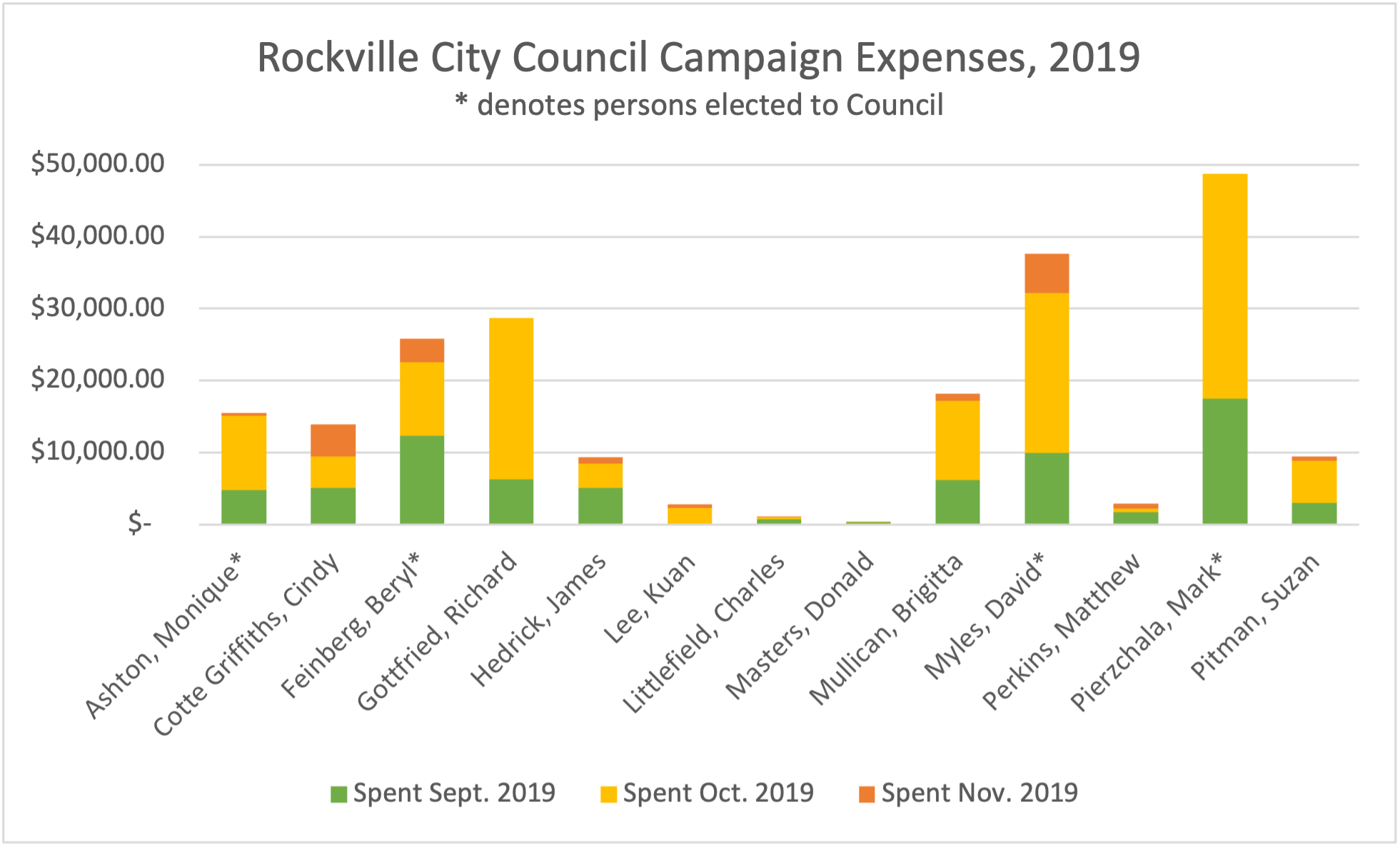
Election campaigns, even small local ones like Rockville City Council, require time and money. With the absence of a local newspaper to reach voters, candidates have to either spend most of their time walking door to door or most of their funds to print and mail campaign literature. In 2019—the last election for Mayor and Council—candidates for Council spent from $424 to $48,776 on their campaigns. Does money matter in local elections? Absolutely, under the right conditions.
As can be seen in the chart above, the candidates who spent the most money (Ashton, Feinberg, Myles, and Pierzchala) were elected to City Council—with one notable exception (Gottfried). The difference? Gottfried had less than a handful of individual contributors to his campaign; his campaign was mostly self-funded. The successful candidates had lots of money and contributors, and those who tended to spend less per vote had more Rockville residents as supporters. I suspect local supporters are more influential on the election than contributors who live out of town.
Looking more closely, successful candidates in 2019 needed at least 5,000 votes and spent between $3 to $10 per vote. In other words, to win a City Council election in Rockville required $15,000 to $50,000—mostly raised from local residents. If a candidate can’t raise those funds locally, they will need to put in a lot of their own money. At the other end of the spectrum, small campaigns who spent $500 to $5,000 didn’t have the capacity to gain sufficient support to cross the 5,000-vote threshold. If there are candidates you’d love to see on City Council, give them your financial support. A contribution of $25, $50, or $100 can make a big difference, especially in September.
The middle-sized campaign of $2 to $5 per voter ($10,000 to $20,000) seem to rely not only on the number of local contributors but also a thoughtfully-crafted campaign. To get out the vote, candidates have lots of ways to spend money (mail, literature, photography, videos, buttons, yard signs, t-shirts, social media, advertising) and time (parades, events, walking door to door, planning meetings, Community Forums, phone calls) but some are more effective than others. Campaigns of this size can’t shoot from the hip; they have to plan and manage carefully. Cotte Griffiths, Hedrick, Lee, Mullican, and Pitman fell into this nebulous and fraught category, so this year’s candidates may want to talk with a couple of them for advice. Perhaps the enlargement of the Council by two seats will allow more middle-sized campaigns to succeed. BTW, Kuan Lee’s expenses are low in the chart but he had over $10,000 in outstanding unpaid bills at the end of 2019, so his expenses are actually closer to $13,000.
The chart also shows that campaigns ramp up in September and at full-speed in October. November is very quiet by comparison because the election is held early in the month. I suspect that Labor Day will begin the campaign season in Rockville and it will include the usual craziness of mud-slinging and dirty tricks (yes, it unfortunately happens in Rockville).
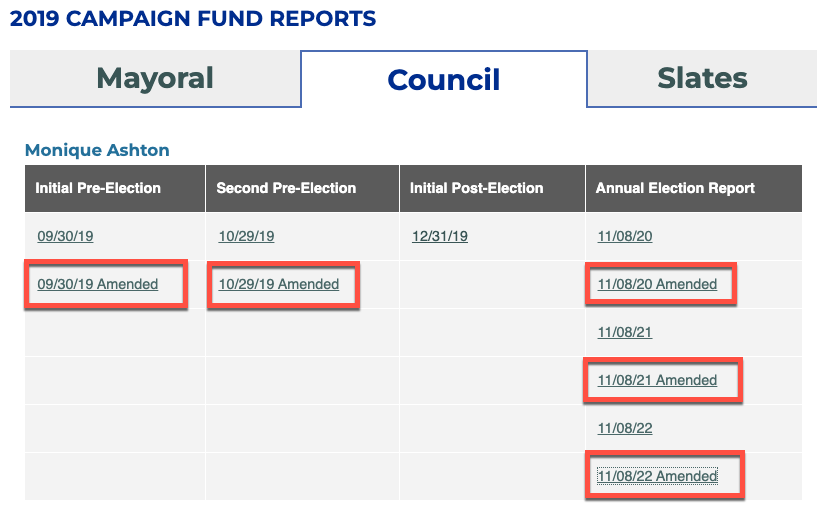
The data for the chart is derived from each candidate’s campaign finance report, which are submitted monthly during the height of the campaign season. Rockville developed its own campaign report forms and they desperately need to be revised because most candidates are unable to complete them properly and have to submit amendments regularly—some of them months later. Plus, key information can obscured because the forms allow candidates to reimburse themselves for expenses—the public can’t see where the cash is flowing, which is the primary purpose of campaign finance reports. The Board of Supervisors of Elections needs to revise the form and establish a standard of performance that no more than 25% of reports in any periods are amended.
Clouded Judgment? Mayor and Council to Discuss Vape Shop Regulations

At its Monday, July 31, 2023 meeting, the Rockville Mayor and Council will discuss a park impact fee for new residential developments, taxes for FY2024, amending the responsibilities of the Cultural Arts Commission, and extending the moratorium on vape shops. On the Consent Calendar (items approved without discussion) are contracts for improvements to the King Farm Farmstead. This regular meeting will be preceded by a Closed Session to discuss the retention of a business (in an unusual move, the public may join the audio conference by phone).
In March 2023, the Mayor and Council adopted a nine-month moratorium on vape shops (businesses that dedicate more than 25% of its floor area to the sale, display, or use of electronic cigarettes; business with less than 25% of floor space dedicated to e-cigarettes are not affected). This moratorium expires on December 27, 2023, so the City is considering whether to adopt new regulations for vape shops or extend the moratorium. There seem to be ten vape and/or tobacco shops located in the city limits, primarily along Hungerford Drive and Rockville Pike (MD 355) along with numerous convenience stores (such as 7-Eleven), grocery stores and other retailers that sell cigarettes and electronic smoking products. Interestingly, the federal government adopted legislation in December 20, 2019 that increased the minimum age of the sale of tobacco products from 18 to 21 years old (somehow at 18 you have enough intelligence to vote, get married, or join the army but not enough smarts to buy a cigarette).
It’s unclear why the moratorium was implemented or what the Council is attempting to control, but if it’s to keep children from smoking, this may be the wrong solution. The staff report reveals that, “most underage vape/e-cigarette users do not purchase vapes from vape shops…Numerous studies show that the majority of underage users purchase or borrow vape pens from friends, purchase them online, or purchase them from convenience stores or grocery stores where age verification may be more lax.” Are e-cigarettes worse for your health than cigarettes, thus require additional regulation? Are national laws so insufficient that Rockville needs its own unique response? Somehow, this reminds me of Footloose. More details starting on page 141.
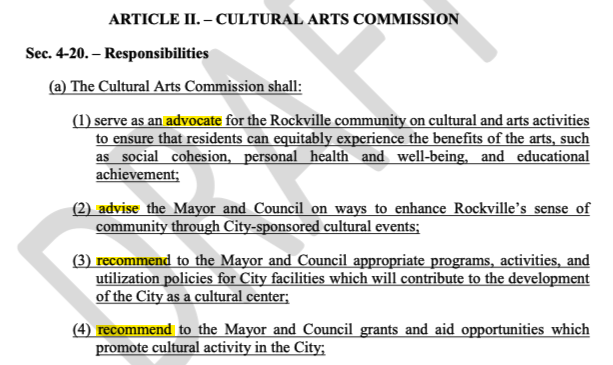
The Mayor and Council is considering revised responsibilities for the Cultural Arts Commission with troubling consequences for citizen involvement. This change is happening at the behest of the Cultural Arts Commission to promote “inclusivity and cultural richness” but they may not have noticed that the revised responsibilities also disempowers them. As proposed, the Commission will no longer review the budget for the Civic Center (where performing and visual arts are primarily presented in Rockville) nor review the design of all new City-owned cultural facilities. Instead, their primary responsibilities are to advise and make recommendations to the Mayor and Council, not encourage, assist, foster, or work. How often will the Mayor and Council ask for their advice or recommendations? The Commission is becoming more passive, less active. More details starting on page 135.
The Mayor and Council are conducting hybrid meetings. If you wish to submit comments in writing for Community Forum or Public Hearings, please email the comments to MayorAndCouncil@RockvilleMD.gov by no later than 10:00 a.m. on the date of the meeting. More details in the 214-page agenda packet are available at https://www.rockvillemd.gov/AgendaCenter/ViewFile/Agenda/_07312023-6977.
Next meeting on August 7 with a presentation by Delegate Joe Vogel and an update on the Rockville Villages Program.
Should the Mayor and Council Give Themselves a Raise?

At its Monday, July 17, 2023 meeting, the Rockville Mayor and Council will discuss whether to ask voters to lower the voting age, allow non-citizens to vote, adopt term limits for council members, adopt ranked choice voting, and create representative districts for council members. They are also considering an annexation of 1202 Seven Locks Road (an office building south of Wootton Parkway near Seven Locks Plaza); a revision of the maximum rental rate for Moderately Priced Housing; adoption of Floating Zones; affordable housing on North Stonestreet Avenue in Lincoln Park; and a letter to the County Council regarding rent control. On the Consent Calendar (items approved without discussion) are agreements for employee retirement management, workers’ compensation, and water quality management, among others. The Mayor and Council will also receive reports on the final Rockville branding initiative and compensation for council members.
Many residents assume that the Mayor and Council are volunteers, but they are considered “part time” positions and given an “annual stipend” of $37,560 for the Mayor and $30,483 for council members. Ten years ago, it was $25,750 for the Mayor and $20,600 for council members. They are also issued a laptop computer and printer; can request office supplies, furniture, and equipment; have access to all City facilities at the same rate as City staff; and have access the City’s health, dental, vision, and life insurance at their own expense. To consider whether this should change or remain the same, the Compensation Commission conducted a city-wide survey that received 95 responses (of which 56% felt that the current compensation was reasonable; the rest were mixed) and a public forum (only two residents provided comments). They also compared stipends with other jurisdictions (Gaitherburg’s Mayor is paid $37,560 and Frederick’s is $105,937–but that’s a fulltime position), but did not consider the income of Rockville residents ($57,336 per capita; $116,031 per household; 7% live in poverty according to the US Census Bureau). The Commission is recommending that the annual stipend increase at the same COLA rate given to City staff; increase the travel allowance for council members according to the Consumer Price Index and for the Mayor by 10% to $6,600 (travel for Sister City events is provided elsewhere in the budget). Otherwise, no additional benefits (e.g., no additional funds for cell phones). The Commission also discussed the role of the annual stipend on attracting candidates for council. More details starting on page 50 of the agenda.
Interested in running for Mayor or Council? Right now there are two candidates for Mayor and nine for Council. There were 13 candidates for Council in 2019. The deadline for petitions is Friday, September 8. More details at https://www.rockvillemd.gov/2262/Running-for-Office.
Coming up on the next agenda is a report from Rockville Housing Enterprises, allowing accessory apartments as a conditional use in single family residential zones, revising the responsibilities of the Cultural Arts Commission, and extending the moratorium on vape shops.
The Mayor and Council are conducting hybrid meetings. If you wish to submit comments in writing for Community Forum or Public Hearings, please email the comments to MayorAndCouncil@RockvilleMD.gov by no later than 10:00 a.m. on the date of the meeting.
More details in the 463-page agenda packet are available at https://www.rockvillemd.gov/AgendaCenter/ViewFile/Agenda/_07172023-6963.
Mayor and Council to Choose New City Logo and Change Election Campaigning
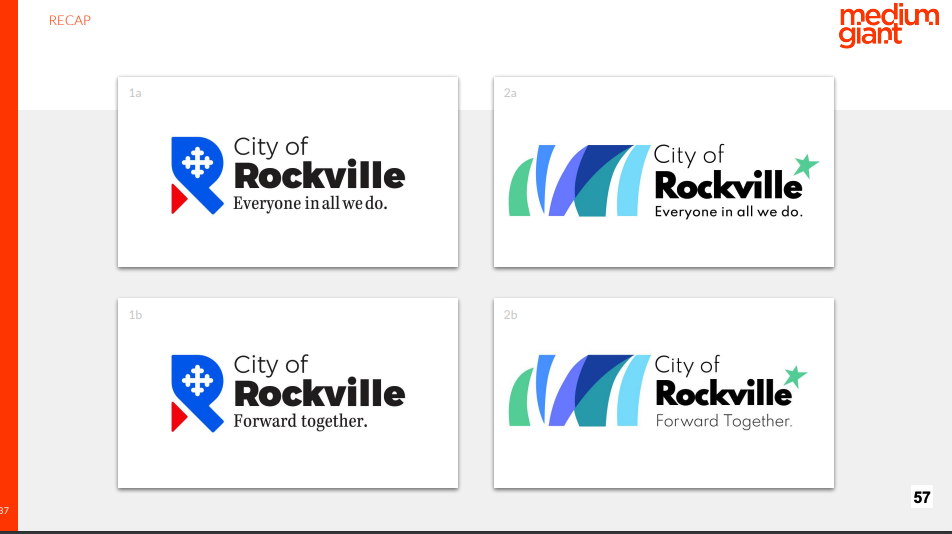
At its Monday, June 11, 2023 meeting, the Rockville Mayor and Council will discuss election campaign materials, referendums on voting eligibility, and repealing Covid vaccination requirements. On the Consent Calendar (items approved without discussion) are construction contracts, grant authorizations, a zoning ordinance rewrite ($294,530), and planting trees and shrubs ($393,570), among others. The Mayor and Council will also receive reports on the state legislation session wrap-up for District 17 and the City’s Branding Initiative.
Fourteen nonprofit organizations will be receiving grants to support programs and services that enhance the quality of life for Rockville residents, including:
- Peerless Rockville Historic Preservation, $120,000
- Rockville Science Center, $60,000
- Rockville Housing Enterprises, $52,820
- Metropolitan Center for the Visual Arts, $48,830
- Rockville Little Theatre, $18,000
- Rockville Musical Theatre, $18,000
- Victorian Lyric Opera Company, $17,200
- Rockville Volunteer Fire Department, $10,000
- F. Scott Fitzgerald LIterary Conference, $6,700
- Main Street Connect, $6,000
- Bender JCC of Greater Washington, $6,000
- Women Who Care Ministries, $5,000
The City Council is considering an Eleventh Amendment to the Interim Management Agreement for Rockville Town Square, the a 12.5-acre mixed-use development located in the heart of Rockville City Center, and is encompassed within the area bounded by Beall Avenue, Hungerford Drive, Middle Lane , and North Washington Street. On September 26, 2022, Morguard acquired from Street Retail, the fee simple interest in all of the commercial retail properties in the Rockville Townsquare (RTS) Mixed-Use Development. Although a long-term Management Agreement is desired by both the City and Morguard, both parties need additional time to engage further. As such, staff recommends that the Mayor and Council authorize and direct the City Manager to execute the Eleventh Amendment to the Interim Management Agreement, thus extending the term of the Interim Management Agreement to June 30, 2024. This would continue the agreement that the City will not assess a property tax in exchange for management and maintenance of the Plaza and sidewalks by Morguard. More details starting on page 636.
The City Council is considering a long list of changes to city elections, including:
- Amending definition of campaign materials to include campaign websites, emails, text messages, and other electronic communications.
- Establishing a second vote center at Thomas Farm Community Center and ballot drop boxes at City Hall, Montrose Community Center, Rockville Senior Center, and Twinbrook Community Center.
- Prohibiting electioneering within 50 feet of an outdoor ballot drop box.
- Independent communications and advertisements must include a notice stating that they have not been authorized by a candidate or candidate’s committee.
- Aggregate campaign contributions are no longer limited to $2,000.
- Requiring electronic filing of all Campaign Finance Reports, but permitting the Board of Supervisors of Elections to waive that requirement, on request, for good cause.
- Requiring clear and conspicuous disclaimers on campaign materials stating whether the material has been paid for or authorized by a candidate or political committee, and if not, identifying the person who did pay for the campaign materials, but also including an exception for materials on which disclaimers cannot be conveniently displayed.
- Requiring all campaign materials to state that they are paid political advertisements and to identify the person who paid for the advertisement.
The Council is also considering a series of advisory questions to submit to voters in November about lowering the voting age to 16 years, allowing residents who are not U.S. citizens to vote, introducing a limit of three consecutive terms (12 years) for Mayor and Councilmembers, ranked choice voting, and establishing council districts.
The Mayor and Council are conducting hybrid meetings. If you wish to submit comments in writing for Community Forum or Public Hearings, please email the comments to MayorAndCouncil@RockvilleMD.gov by no later than 10:00 a.m. on the date of the meeting.
More details in the 704-page/127 Mb agenda packet are available at https://www.rockvillemd.gov/AgendaCenter/ViewFile/Agenda/_06122023-6935.
Mayor and Council to Consider Loosening Requirements for Accessory Apartments
At its Monday, June 5, 2023 meeting, the Rockville Mayor and Council will discuss a FY2024 Budget Debrief and an ordinance to allow accessory apartments (aka Attached Accessory Dwelling Units) in residential zones. On the Consent Calendar (items approved without discussion) are construction contracts and grant authorization. The Mayor and Council will also receive reports on Environmental Excellence Awards, Human Services Advisory Commission, and Monthly Rent Schedule for Moderately Priced Dwelling Units.
Twenty years ago, the Rockville City Council established Environmental Excellence Awards to recognize residents, organizations, and businesses for their extraordinary efforts to improve the community’s environmental and sustainability efforts. Congratulations to Rishi Iyer (a student at Wootton High School who developed an online carbon footprint tool at co2schools.com) and to Mark Wright (for leading efforts to install two pollinator gardens at Christ Church and Christ Episcopal School).
Moderately Priced Dwelling Units are the City’s methods for keeping housing affordable to families with household incomes of less than $64,000-$99,000 (depending on household size). The City regulates the maximum rent allowed and adjusts it annually according to schedules prepared by the US Department of Housing and Urban Development (HUD). For FY2024, the maximum rent is $1,330-$1,900 (depending on the number of bedrooms) for an increase of 12-13 percent compared to the current year.
Attached Accessory Dwelling Units (aka Accessory Apartments) are a second dwelling that is either attached or within the main single family detached house (not to be confused with accessory dwelling units (ADU), which are unattached or separate from the main house–I think). They are currently allowed as a Special Exception by the Board of Appeals and the City is now considering an ordinance that would allow attached accessory dwelling units as a conditional use to streamline the process and provide more housing opportunities. These types of accessory dwelling units are often used by a retired person who wants to downsize, a professional who’s moved to the area, or a college student (that’s how I lived during grad school). The City held public hearings in 2019 and 2021, the City Council discussed it in 2020, and the Planning Commission reviewed it in 2023. The Twinbrook Community Association, Lincoln Park Civic Association, East Rockville Civic Association, and West End Citizens Association support accessory apartments as a conditional use. Lots of interesting comments for and against accessory apartments, but you’ll want to read these carefully because they can refer to AirBnB, VRBO, and attached and unattached dwelling units interchangeably. For more details, including the draft ordinance, see page 232+.
Coming up: new brand for the City of Rockville, amending Chapter 8 “Elections” in the City Code, annexation of 1201 Seven Locks Road, community organization grant agreements, and repealing the requirement for COVID-19 vaccinations for city employees and contractors (page 273+).
More details in the 276-page agenda packet are available at https://www.rockvillemd.gov/AgendaCenter/ViewFile/Agenda/_06052023-6928.
Mayor and Council to Review Policies for Managing Grants, Staff, and Sponsorships
At its Monday, May 22, 2023 meeting, the Rockville Mayor and Council will receive reports on the city’s management of its grants, staff vacancies and hiring (p. 186), recreation and parks sponsorship policy (193), and proposed personnel policies and procedures (197). On the Consent Calendar (items approved without discussion) are grant agreements for Rockville Senior Center, Twinbrook Community Recreation Center, F. Scott Fitzgerald Theatre, and the Rockcrest Ballet Center. The Mayor and Council will also issue five proclamations, including the recognition of Eritrean Independence Day on May 24 (do you know where Eritrea is located?).
Eleventh House Solutions is recommending that the City adopt a policy to bring consistency and control over grant activities. Currently, grant management is “decentralized throughout the City and are nonexistent in several departments that could benefit from grant funding. This has made grant information difficult to retrieve or track in some departments.” Furthermore, “except for Public Works, no grants or funding program had a system to track the grant’s requirements or conditions. Without these documents, departments risk not complying with grant conditions which could result in the rejection of reimbursement requests or loss of grant funding.” Kudos to the Public Works Department, who were also called out as a “perfect example of how a grants process, although informal, implemented from the top down can expand programming and, therefore, further the City’s mission and priorities.” For more details, see the consultant’s report of findings and recommendations starting on page 33 and departmental comments starting on page 43. One interesting finding is that the City Council’s approval process and August recess can delay agreements by two months (49)—is it time for them to meet year ’round?
According to the Staff Vacancy and Hiring Report (187), two positions are frozen (Human Resources Associate and Principal Network and Cyber Security Automation Engineer) and four on hold pending release (Senior Planner, Information Systems and Cyber Security Engineer, Secretary, Recreation Facilities Clerk, and Maintenance Worker III).
More details in the 395-page agenda packet are available at https://www.rockvillemd.gov/AgendaCenter/ViewFile/Agenda/_05222023-6921.
Rockville City Manager Faces Performance Improvement Plan in Surprise Session

In an extraordinary last-minute Closed Session held on Thursday morning, May 11, 2023, the Rockville City Council put the City Manager Rob DiSpirito into a three-month Performance Improvement Plan (PIP) for reasons unknown. Improvement Plan (PIP) is a formal, structured process designed to help underperforming employees identify and overcome performance issues. It outlines specific goals, expectations, and timelines for improvement, along with support, resources, and regular progress evaluations to facilitate success and growth.
When the Council came out of Closed Session, Councilmember Monique Ashton quickly moved for the PIP and was supported by Councilmember Beryl Feinberg. Mayor Bridget Newtown rushed for a vote without a discussion, but was interrupted by Councilmember Mark Pierzchala to note that, “I don’t know how the sequence of events unrolled but I’m not going to vote for it. I think things have moved past the point where a performance improvement plan is going to be effective. So I’m gonna vote against it. I had asked to make the first motion but that was not allowed, apparently. I’m not sure where that came from. Thank you.” The motion passed 4-1 with Councilmember Pierzchala voting against. A brief three-minute video is available at https://youtu.be/fIu7e9cHhoo, but of course, the closed session portion is held in secret and it’s unclear how long they debated the issue.
I typically discourage Closed Sessions because they are secret and prevent voters from knowing what’s happening—and Closed Sessions usually deal with major issues. Fortunately, Maryland has an Open Meetings Act to keep council and board meetings available to the public so they can be “in the room where it happens.” A quick introduction is available as FAQs, but here are a fundamentals:
- The Maryland Open Meeting Act lists 15 topics that the City Counci) may choose to discuss behind closed doors under specific conditions. These topics or “exceptions,” include personnel discussions about particular individuals, the receipt of legal advice from the public body’s attorney, and subjects that must be kept confidential under other laws. A discussion on “the appointment, employment, assignment, promotion, discipline, demotion, compensation, removal, resignation, or performance evaluation of an employee over whom the Mayor and Council has jurisdiction” is an appropriate reason for the Closed Session on May 11.
- Public bodies must make an agenda available before each meeting, either when notice is posted, if the items of business are known then, or as soon as practicable, but no later than 24 hours before the meeting. There is an exception for meetings held in response to emergencies. This Closed Session was not publicized as an emergency and the the agenda was posted on the city website on May 10 at 5:20 pm, that’s less than 18 hours in advance, so is in violation of the Act. Furthermore, it was not sent out as an email to those who subscribe to the City Council’s agendas (thanks to a blog reader who alerted me to this meeting).
- This meeting was not publicized an emergency, so why the rush? Two councilmembers had difficulties attending in person. Councilmember Myles was absent at the start of the meeting and showed up virtually later. Councilmember Ashton started the meeting virtually and joined in-person by the end. How much of the Closed Session discussion did they miss? Councilmember Ashton didn’t even notice that the vote to go into Closed Session occurred.
Most management leaders will emphasize that employees are the organization’s most important assets so how well are these assets being managed in the City of Rockville? Most of the current councilmembers lack significant experience in supervising employees and the City Council has a poor record of managing its most senior staff. The City Manager, City Attorney, and City Clerk have each been dismissed during Mayor Newton’s tenure. After a while, the only common denominator to these problems is the City Council.
The City Council needs to provide a better explanation for this decision and how they handle Closed Sessions. Or it’s time to rethink their privilege to serve.
May 21, 2023: This post was corrected to show a vote of 4-1 in the caption of the photo.
Mayor and Council to Consider Increasing Lots of Fees; Can it Untangle 900 Rockville Pike?
At its Monday, May 8, 2023 meeting, the Rockville Mayor and Council will discuss amending master fees for community planning and development services. On the Consent Calendar (items approved without discussion) are the pension plan for 2023. The Mayor and Council will also receive reports on the Vision Zero Action Plan, Bikeway and Pedestrian Master Plans, development of 900 Rockville Pike, and the historic preservation work plan.
Fees for building permits, inspections, and licenses are proposed to increase 2.5% to keep up with inflation; include a 10% fee to offset the cost of technology; adopt a fee structure based on square footage or estimated construction cost; and assess a separate application fee. For example, a building permit for new residential construction or to repair fire damage will be $0.25 per square foot, including the basement, garage, and roof; a license for short-term rentals is $450; and a building permit for a swimming pool or to demolish a building of any size is $553.
Interestingly, the staff report admits that the actual cost of providing services is unknown and it is uncertain whether the revenues from fees are sufficient to cover their expenses (170). Secondly, new construction accounts for 35-40% of global greenhouse gas emissions and “virtually every green rating program (LEED, USGBC, IgCC) recognizes the value of adaptive reuse” (173). Nevertheless, the City is comfortable granting inexpensive demolition permits (where does all that building material go? into the county dump!). Instead, it should encourage adaptive reuse by significantly increasing the demolition permit fees on a square-foot basis.

J. Danshes LLC has filed an application to build a 4,400 square foot one-story retail building at 900 Rockville Pike (southeast corner of Rockville Pike and Edmonston Drive, one of the narrowest lots on the east side of the Pike due to the railroad tracks). In 2006, the City adopted a Mixed-Use Corridor District zone for this small lot, which allowed up to 12,754 square feet of retail space. Despite this new proposal being a much smaller building, it is now subject to several new city regulations that have been adopted over the years plus it needs to accommodate the proposed Bus Rapid Transit (BRT) route. As a result, this project has been in the pipeline since 2017 and is becoming an enigma wrapped in a puzzle—what would you do with this property when you’re faced with the following situation:
“To create the right-of-way land area dictated by the public agencies, the Applicant must dedicate 6,523 square feet of area (0.15 acres, 25.2% of existing lot area) to public use. Said dedication reduces the size of the site from 25,862 (0.59) acre to 19, 339 square feet (0.44 acre).” (257)
More details in the 329-page agenda packet are available at https://www.rockvillemd.gov/AgendaCenter/ViewFile/Agenda/_05082023-6899.
When is the Next Council Meeting? Agenda Center Creates Confusion
In an effort to better align with the requirements of Maryland’s Open Meetings Act, the City of Rockville has revised the Agenda Center for Mayor and Council to included anything and everything that might be attended by one or more councilmembers. The City has violated the Open Meetings Act in previous years and new City Attorney is reviewing everything to assure compliance. The problem is that the Agenda Center is now a mishmash that makes it difficult to separate the wheat from the chaff. Can you easily locate the regular meeting of the Mayor and Council in this screenshot of the Agenda Center?
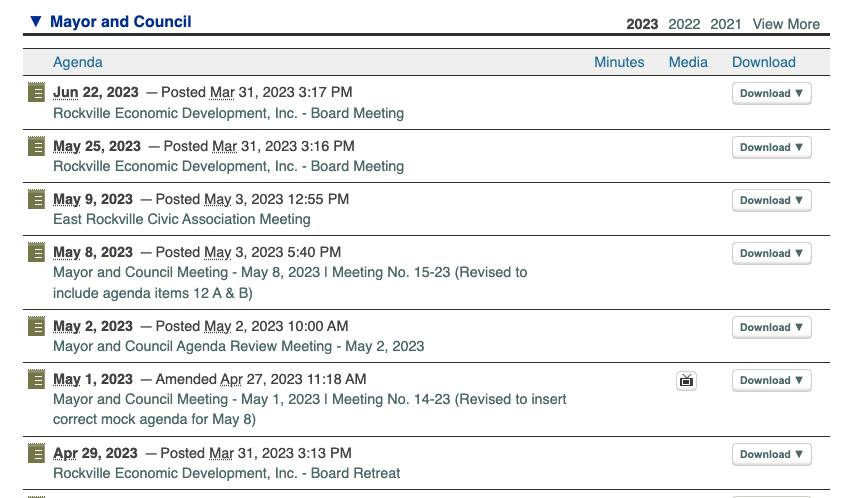
The confusion is caused by treating all meetings the same, when they’re not. Residents and businesses want to attend the meetings that have the most impact on them, which are the Mayor and Council meetings. While a councilmember may attend the East Rockville Civic Association or the Rockville Economic Development board meeting, the City Council is not making decisions about taxes or ordinances at those events. The next step is keep the audience in mind–who uses the Agenda Center? Who is it for primarily? Secondly, distinguish the meetings to highlight the meetings that are most important for the audience. Hire a good graphic designer to figure this out. Otherwise, it’s going to cause residents and business to be even more frustrated in their efforts to learn what their elected officials are doing (have you noticed that minutes aren’t available for about six weeks, which means you have to rewatch the entire council meeting for the latest news).
The latest annual report of the Maryland Open Meetings Compliance Board (which has no budget and no staff!) notes that it received 57 complaints concerning 95 separate entities, so ensuring that government operates transparently and openly is an ongoing concern. It also summarized the most common violations by city councils, boards, and commissions (emphasis mine):
“The overall number of complaints, and of those in which we found a violation, remains small in proportion to the total number of public bodies statewide. This fiscal year saw a significant increase in the number of opinions we issued (forty-eight), which is eighteen more than the previous year and the most we have issued in a single year since at least Fiscal Year 2013. But much of this increase may be attributable to COVID-19: Many complaints alleged violations of the Act based on practices that public bodies have adopted in light of the pandemic (for example, requiring the public to observe meetings virtually or limiting how many people may attend a meeting in person19), or alleged violations related to meetings (or alleged meetings) that involved topics of discussion directly related to the pandemic (for example, masking policies and other COVID-19 protocols).
“In any event, although we issued forty-eight opinions this year, we found violations in twenty-five opinions, a little over half the total number of opinions for FY 2022. Of those opinions involving one or more violations, fewer than half of the opinions (eleven)
involved a failure to provide reasonable notice of a meeting. The most common type of violation (found in eighteen opinions) involved some deficiency related to meeting minutes, either the failure to prepare or post them timely, or the failure to provide enough details. Thirteen opinions involved the failure to fully satisfy the Act’s procedural requirements for closing a meeting to the public. Eleven involved a violation of the Act’s general openness requirements, most often because a public body failed to make clear in its meeting notice that the body would be meeting in open session before entering closed session, or because a public body misapplied an exception in GP § 3-305(b) and discussed a matter in closed session that should have been open to the public.”
Mayor and Council Tweaking FY2024 Budget
At its Monday, May 1, 2023 meeting, the Rockville Mayor and Council will discuss the FY2024 Budget (that’s it!). On the Consent Calendar (items approved without discussion) are four proclamations for Asian American and Pacific Islander Heritage Month, Historic Preservation Month, Older Americans Month, and National Public Service Recognition Week.
The City Council is continuing to adjust the budget. Reductions include the Movies in the Park series, residential street sweeping, composting, Latino Youth Development Program, Lincoln Park Community Center, Thomas Farm Community Center After School programs, Twinbrook rentals, and Peerless Rockville [just in time for Historic Preservation Month!] (page 18). Increases include fall protection at the Senior Center, mowing for cross country events at RedGate, Teens on the Go program, energy audits, badge system annual fees, and overtime pay for Rockville Police (page 18). Concerned? Community Forum happens at 7:10 pm (but you have to request to speak by noon of the day of the meeting at mayorandcouncil@rockvillemd.gov; no more opportunities to just drop in!).
More details in the 92-page agenda packet are available at https://www.rockvillemd.gov/AgendaCenter/ViewFile/Agenda/_05012023-6892.


