Rockville’s New Police Station Unveiled
After five years of discussion, planning, and construction, the City of Rockville unveiled its new police station with a dedication and public open house on Saturday, October 20, providing a rare behind-the-scenes glimpse inside both buildings and all floors. It was a bit difficult to tell how many people showed up given the informal nature of the open house, but I’m guessing it was about 100-150 people. Most of it consists of (yawn) offices, but some of the more interesting spots were the armory and communications center. The best part, though, was meeting the staff and officers who gave tours or explained the work of their department–so much nicer than when you typically encounter them on the street when they’re handing a crime or a conflict.
The federal government abandoned the 1938 post office a few years ago and transferred it free to the City of Rockville so it could be used for a police station. The decision to undertake the $8.5 million rehabilitation and construction project was controversial at times but the new building provides much needed space for public safety and consolidates city offices that were rented and scattered throughout the city. The architects did an outstanding job of preserving the historic post office’s distinctive features, including the lobby and its mural, as well as adding a second building that’s modern but doesn’t compete. One feature that’s not obvious is the emphasis on saving energy, which can be seen in the extensive use of skylights, white roofs, and motion-detecting light switches. One element that does rattle my design sensibilities are the signs, which seem a bit cartoonish and dated, plus I don’t like the colors of green and silver. Chief Treschuk explained that green is a color that’s being increasingly adopted for places of safety (much like yellow for school busses) so I can live with that choice, but the otherwise, the signs really need to be rethought (okay, I’m partially to blame–I sat on the Historic District Commission when it reviewed the plans back in 2010).
Dawson’s Market Opens in Downtown Rockville
After five years of work by the City of Rockville and Federal Realty Investment Trust, Dawson’s Market held its grand opening tonight in Rockville’s Town Square. A grocery store had been slated as an anchor for the Town Square since its inception, but an initial tenant’s bankruptcy and threatened lawsuits by a competing liquor store caused delays, as well as finding a grocery willing to move into space smaller than is typical today. Fortunately, Rick Hood, president of Ellwood Thompson’s Local Market in Richmond, was looking to expand and found an ideal location in Rockville. The Richmond store is named for the two streets that intersect at that store’s location; the Rockville store is named for longtime residents of Rockville (e.g., Beall-Dawson House, Dawson Farm Park).
Dawson’s Market is now open and customers will find it emphasizes local and organic food, and discover such nice amenities as beer and wine departments, juice bar, and a cafe. Many people have compared it to Roots or a small version of Whole Foods. Parking in Town Square is available free for two hours with validation and you’ll find the store at the corner of Washington and Beall, near the modernist Suburban Trust Bank building.
Montgomery County Tax Rates Up Last 5 Years
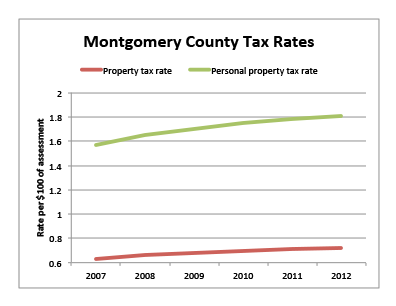
Montgomery County Tax Rates from 2007 to 2012
I often hear Rockville residents grumble about property taxes and they often blame the city for taking an unfair share of their hard-earned income. Although property taxes in the City of Rockville have held steady for the last few years, they’ve risen in Montgomery County. From 2007 to 2012, the County Council has increased the tax rate each year–but hardly anyone in Rockville has noticed and put the blame in the right place. In 2007, the property tax rate was 62 cents for every $100 in assessed value, today it’s 72 cents–a 15 percent increase over five years. Businesses were similarly affected through personal property taxes (which is assessed on inventory, manufacturing equipment, etc.), rising from $1.57 to $1.81, a 16 percent increase over five years. No changes at the State of Maryland–it does not assess property taxes.
Why blame the City and not the County? I suspect it’s because residents assume that 100 percent of their property taxes goes to the city in which they live. Actually, each jurisdiction sets its own rates and you’ll see it split out in writing on your annual property tax bill. If you live in Rockville, for every $100 in the assessed value of your property, you pay 72 cents to the county and 29 cents to the city. Today, the median sales price for a house is Rockville is $416,000, so the total annual property tax bill would be $4,227–$3,012 for the county and $1,215 for the city. Montgomery County receives more than twice as much money from you as the City of Rockville–do you feel you get the same proportion of value in return?
It is has been proposed that a person’s recognition that they pay property taxes is directly related to their level of civic engagement (e.g., voting, writing city council, speaking up at public hearings). In other words, a homeowner knows they pay property taxes because they receive an annual bill, so they’re aware that they’re taxpayers and have a say about government. That’s not true about renters, condo owners, or resthome residents, whose property taxes are rolled into their monthly fees or dues, so they’re not as apt to think they’re tax payers and have a stake in government. What do you think?
Tax rates for the last ten years are available from the Maryland State Department of Assessments and Taxation.
Is Rockville Walkable? Depends Where You Are.
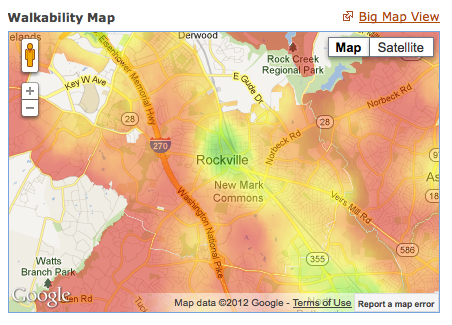
Walk Score map of Rockville
“Walkability” is an increasingly popular measure of a community’s quality of life. By enhancing the convenience and ease of walking, it reduces traffic, improves health, increases community involvement, and puts more eyes on the street for safety. So how does Rockville rate? Walk Score calculates walkability on a block-by-block basis, generating color-coded maps. In the map of Rockville, green indicates the areas that are most walkable (such as downtown) and red the least walkable (such as Horizon Hill west of 270). Around town, they’ve calculated how the following locations fared on a scale of 1-100:
- 85 Very walkable: Maryland Avenue and South Adams (West End)
- 75 Very walkable: Baltimore Road and Grandin (East Rockville)
- 66 Somewhat walkable: Twinbrook Parkway and Viers Mill (Twinbrook)
- 65 Somewhat walkable: Fallsgrove Boulevard and Fallsgrove Road (Fallsgrove)
- 65 Somewhat walkable: Redland Boulevard and Pleasant (King Farm)
- 63 Somewhat walkable: West Montgomery and Laird (West End)
- 48 Car dependent: College Parkway and Princeton (College Gardens)
- 35 Car dependent: Falls Road and Kersey (Horizon Hill)
I’m sure this will generate controversy and prompt comparisons between neighborhoods (what!? Twinbrook rated the same as Fallsgrove and King Farm? Not possible!) but I’d really like to encourage a discussion about making our community more bike and pedestrian (and sometimes car) friendlier.
What makes a neighborhood walkable? According to Walk Score, the more of the following characteristics it has, the better:
- A center: Walkable neighborhoods have a center, whether it’s a main street or a public space.
- People: Enough people for businesses to flourish and for public transit to run frequently.
- Mixed income, mixed use: Affordable housing located near businesses.
- Parks and public space: Plenty of public places to gather and play.
- Pedestrian design: Buildings are close to the street, parking lots are relegated to the back.
- Schools and workplaces: Close enough that most residents can walk from their homes.
- Complete streets: Streets designed for bicyclists, pedestrians, and transit.
The City of Rockville recently received federal funds to develop “complete streets” near the Twinbrook and Rockville Metro stations, so scores for those locations (and pedestrians using those locations) should improve as a result. Any suggestions to make your neighborhood more walkable? Should walkability be a goal for Rockville?
Does Rockville Have the Best Chinese Restaurant in the DMV?
In the July issue of Washingtonian magazine, East Pearl is called the “gleaming new addition to Rockville’s thriving Chinese-restaurant scene” and although it’s been open for only a few months, they’re tempted to call it the “best Chinese restaurant around”. That’s high praise so I checked it out myself a few weeks ago, and I have to say, it’s a significant step up from the others. I was struck first by the interior decor because it didn’t have the usual cliches of red vinyl booths, lanterns, and pictures of China on the wall. If you were dropped at the front door and didn’t notice the display of barbequed ducks in the back corner, you would have assumed it was nice modern restaurant serving Caesar salads with grilled chicken for lunch and crab soup and ribeye steaks for dinner.
The menu is extensive and you’ll see many of the usual dishes but also many that will be new. Some are definitely suited to Chinese tastes that might make Westerners squeamish, such as squid or intestine with sour cabbage. I hate to stereotype, but it seems that the Chinese love chewy textures. Most dishes will be intriguing because of their unusual combinations or preparation, such as steak mignon Cantonese style, Szechuan eggplant with ground pork in a casserole, or pan-fried stuffed triple delight. I tried the latter, which is minced meat (probably pork) sandwiched between slices of eggplant, bell pepper, or tofu, battered and fried, and then covered with a light black bean sauce and sprinkled with chopped green onions. Wow! I also had a side dish of barbeque pork (cha sui) and spicy shrimp dumplings Hong Kong style, while my wife had hot and sour soup. We found them all to be outstanding–well prepared, freshly made, delicious, and nicely presented. I haven’t had a chance to visit again, but I’ve recommended it to neighbors and they’ve come back happy as well.
East Pearl Restaurant is located at 838-B Rockville Pike in Rockville, north of Edmonston in the midst of the string of shops on the east side of the Pike adjacent to the railroad (between YoCake and the MoCo liquor store). Parking is tight and limited. I’ve heard there’s usually a line at dinner, so arrive early or plan to hunt for a parking space and wait for a table. By the way, the Vietnamese restaurant nearby is also a great place to try!
Residential Segregation Trends Affect Rockville
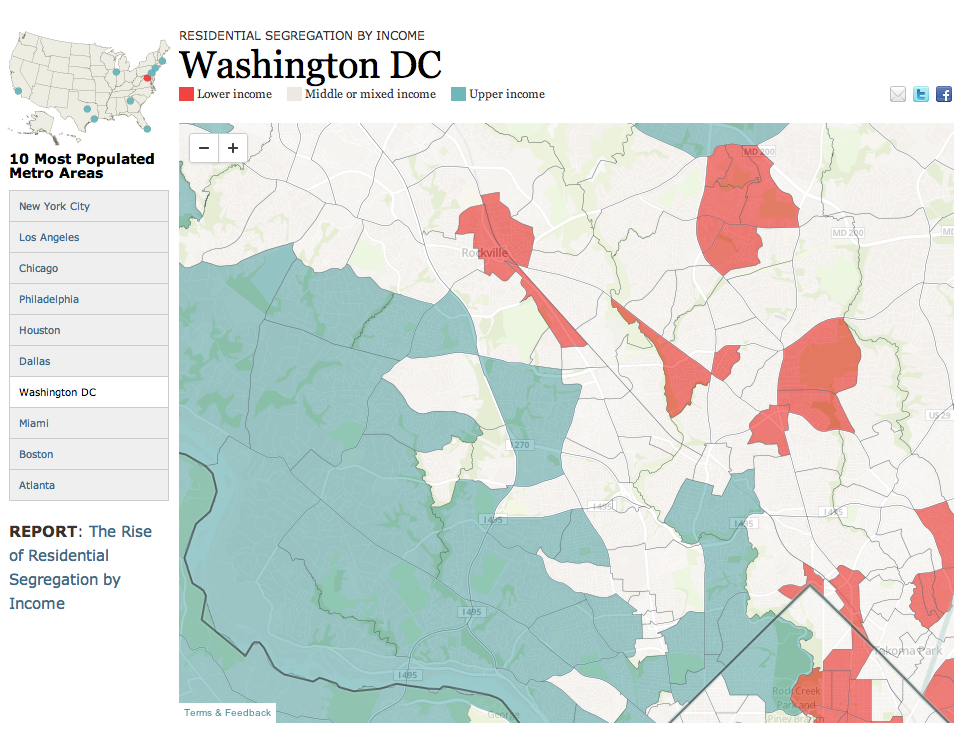
Income segregation by income in the Washington, DC region, based on a 2012 study by the Pew Research Center.
Residential segregation by income has increased during the past three decades across the United States and in 27 of the nation’s 30 largest major metropolitan areas, according to a new analysis of census tract and household income data by the Pew Research Center. Montgomery County, as one of the counties surrounding Washington, DC, is included in that study and shows that Rockville was at the bottom end of the spectrum. It’s primarily a result of a shrinking middle class: “These increases are related to the long-term rise in income inequality, which has led to a shrinkage in the share of neighborhoods across the United States that are predominantly middle class or mixed income—to 76% in 2010, down from 85% in 1980—and a rise in the shares that are majority lower income (18% in 2010, up from 12% in 1980) and majority upper income (6% in 2010, up from 3% in 1980).”
Pew didn’t provide details on the causes of this residential segregation, which could historical settlement patterns; local housing policies, zoning laws, real estate practices and migration trends; and the characteristics of the local economy and workforce. What it could mean for Rockville is that in the longterm, the types of city services and public amenities we’ve enjoyed may erode and disappear as the community’s ability to pay for them declines. Is the City Council looking far enough ahead to respond to this trend, or are they just looking at today?
For more details, see the interactive map or read, “The Rise of Residential Segregation by Income” and “The Middle Class Shrinks and Income Segregation Rises“, all available at the Pew Research Center.
What We Learned in the Blackout of Summer 2012
It’s been a month since the powerful thunderstorm–a derecho to be specific–knocked out power to most of Rockville and the Mid-Atlantic. But let’s call a spade a spade–it was a massive power outage, a blackout, during the hottest days of summer. Most lost power for days, some for a week. As we discovered, if you lose the internet, you’re back in 1979; if you lose electricity, you’re back in 1879. Anger boiled over in the days that followed, but now it seems nearly forgotten. Before our memories fade, what did we learn? Here’s my list, culled from talking with neighbors, reading the newspapers, and scanning the listservs:
1. Pepco doesn’t know your power is out unless you tell them. Don’t assume they have some fancy computer system that notifies them automatically that you’ve lost power, assume that your neighbor has called, assume it’ll fix itself, or assume that they’re busy and you don’t want to trouble them (poor dears!). Call them at 877-737-2662. Write this number down and put it on your fridge–another power outage will occur and you’ll want this handy. Many people said they called but Pepco thought their power had been restored, so call daily to ensure they have the correct information. David Greene noted that he used his mobile phone to, “monitor the Pepco outage map, and they marked our power as restored several times during the week when it was not actually restored. I called them many times to get us back on their map.”
2. Pepco prioritizes work based on the number of outages. That makes sense–first tackle the jobs that will benefit the most people–if they have the correct information. But if you and your neighbors don’t call Pepco, they will assume everything is okay (see #1 above). You might want to visit your neighbors and check to see if they’ve called.
3. If you have FIOS, your “landline” phone won’t work. How disappointing to have the latest technology and discover it’s useless in a power outage. My FIOS system came with a battery backup, but Continue reading →
Rockville’s Connections to Watergate on its 40th Anniversary

Rockvillian James McCord’s connections to Watergate uncovered by the Washington Post, June 1972
Sunday, June 17 marked the 40th anniversary of the arrest of five burglars caught in the offices of the Democratic National Committee at the Watergate in Washington, DC in 1972. Little did people know at the time that this burglary was actually part of a much larger effort by President Nixon to undermine his opponents and support his allies through threats, harassment, lies, fraud, sabotage, bribes, and crimes for many years. For those who aren’t familiar with the story, James McCord, Bernard Barker, Frank Sturgis, Eugenio Martinez, and Virgilio Gonzales broke into the offices of the Democratic National Committee to plant listening devices on the phones and in the rooms, as well as photograph financial records and donor files. When they were initially arrested, they gave false names and it was unclear who they were and who they worked for (there was some thought it might be Cuba) but two days later, Edward Martin revealed his true identity as James McCord of Rockville and that he formerly worked for the CIA. It quickly became apparent these weren’t burglars but spies–and they were working for the White House. The Watergate break-in was one of several clandestine operations coming out of the Nixon White House and as Bob Woodward and Carl Bernstein stated in a recent Washington Post article, “It was only a glimpse into something far worse. By the time he was forced to resign, Nixon had turned his White House, to a remarkable extent, into a criminal enterprise.” In addition to the five “burglars,” another 35 of Nixon’s closest aides and associates went to prison. Nixon was pardoned by President Ford.
Few people know that Rockville, our fair city, had many connections to the incident that eventually led to the downfall of President Nixon. My research continues but at this point, there are at least a half dozen places Continue reading →
Courthouse Fountain Getting a Facelift
The walkway around the “Spirit of Rockville” fountain at the Red Brick Courthouse is undergoing a facelift, thanks to a recent commission from the Cultural Arts Commission. Artist Diedre Saunder and craftsman Peter Tabri are installing a huge mosaic carpet around the fountain. The colored tendrils are made of smalti (pieces of brightly colored glass) while the field is commercial floor tile broken into random pieces and set in a bed of latex adhesive. They’re about 75% finished and it’s slow back-breaking work, but portions are already grouted so you can get a sense of the final appearance. I expect it’ll be finished in July, but in the meantime, stop by and get a preview.
If this work looks familiar, Diedre and Peter also worked on the snake that envelopes the Elwood Smith Recreation Center as well as the entry wall at the Croydon Creek Nature Center.
Hometown Holidays in Rockville
Hometown Holidays is one of Rockville’s biggest events and spreads out among several streets in downtown with artists, restaurants, music, kiddie rides, businesses, and local organizations. For a few hours today I joined the volunteers in the food ticket booth in a wonderful location between Oro Pomodoro and Bombay Bistro, two great Rockville restaurants. Oro Pomodoro brought their wood burning stove and prepared the pizzas next to me, which was fun to watch (and I ordered a pizza al funghi when I finished my rotation in the booth). Strolling the artists’ booth, I encountered Charlie Barton of Baltimore, who creates stunning silkscreened images that merges high contrast panoramic photography with the boldness of 1960s psychedelic art. If you collect contemporary art by local artists, he’s one to watch.


