Housing, Mental Health, and Election Reform on June 16 Council Agenda
The next Rockville Mayor and Council meeting on Monday, June 16, 2025, will tackle several important topics that could shape life in the city—from how affordable housing is preserved, to how the police handle mental health calls, to how future city elections are run. Residents and businesses alike may want to tune in or weigh in on these wide-ranging proposals.
Affordable Housing Preservation
What’s on the Agenda
The Council will hear a presentation on strategies to preserve affordable housing in Rockville, especially older apartment buildings that may otherwise be lost to redevelopment or rising rents. The report recommends creating a database to track at-risk properties, reviving a rehabilitation loan program, and building a coalition of local partners to protect long-term affordability. However, the report does not fully address the challenges faced by property owners and developers, such as rising construction costs, regulatory burdens, and limited access to financing—all of which make it increasingly difficult to preserve or create affordable units.
Why It Matters
Housing affordability is a growing concern in Rockville. These strategies could help longtime residents stay in their homes, keep neighborhoods stable, and ensure a mix of incomes across the city.
Mental Health Specialist for Rockville Police
What’s on the Agenda
The Council will vote to renew an agreement with Montgomery County to embed a licensed mental health professional in the Rockville Police Department for $160,000 per year. This specialist assists officers on mental health calls and helps connect residents to support services. The role also includes training officers on crisis response.
Why It Matters
While mental health calls only represent 3% of police activity (742 out of 26,047 calls in 2024), they require a set of skills that few police officers are trained to handle. This program is a way to improve public safety responses, reduce emergency room visits, and support residents in crisis more effectively.
City Election Reform
What’s on the Agenda
As part of an ongoing review, the Council will hold a worksession on proposed changes to Rockville’s election system. The discussion will focus on four main areas: rewriting the election code, updating campaign finance rules, rethinking the structure and independence of the Board of Supervisors of Elections, and improving public education and enforcement. Potentially off-the-table issues are ranked-choice voting and public funding of campaigns. A Charter Review Commission presented recommendations in late 2022, voters responded to advisory referendum questions in the 2023 election, and the Mayor and Council is revisiting everything again (except increasing the size of Council) in 2025. Seems there’s little traction on this issue and I wonder if they’ll consider what voters and Charter Review Commission said previously (they’re not mentioned in the staff report).
Why It Matters
Rockville’s election rules haven’t kept up with modern expectations. These updates could make local elections fairer, more transparent, and easier to understand for voters, candidates, and campaign volunteers alike.
The meeting will be broadcast live on Rockville 11 and streamed on the city’s website.
Residents can send comments to the Mayor and Council by email or speak during Community Forum, which begins at 6:50 p.m. You can sign up to speak online at rockvillemd.gov before 10 a.m. the day of the meeting.
Affordable Housing and Election Integrity: Residents Share Concerns with Council
The public comments during the Rockville City Council’s Community Forum on October 21, 2024, covered the following major topics:
- Enforcement of Campaign Laws: Several speakers, including Brigitta Mullican, Steven Weiner, and Bridget Newton, emphasized concerns over the enforcement of Rockville’s campaign regulations. They argued that a lack of consistent action on campaign violations could undermine trust in local election laws. These comments called for clearer standards and increased accountability for campaign rule violations. Next steps? The Council could direct the City Attorney to establish clear guidelines for when and how campaign violations will be addressed, possibly creating a review process for the Board of Supervisors of Election to report findings and suggest enforcement actions.
- Rent Stabilization and Housing Affordability: Numerous residents, such as Misha Clive, Grant Sams, and Wendy Murphy, urged the council to prioritize rent stabilization. They discussed the challenges of rising rent costs, particularly for renters on fixed incomes or with lower-wage jobs, and expressed concerns that the current lack of rent caps could displace long-term residents. The call for rent stabilization was framed as a measure to maintain Rockville’s diversity and accessibility. Next steps? At the same meeting, the Council held a work session on housing strategies.
- Election Integrity and Voter Access: Senator Cheryl Kagan provided comments focused on election integrity and reminded the community of available options for casting ballots securely in the upcoming elections. Her remarks aimed to dispel misinformation and highlighted her efforts in sponsoring election-related bills for improved municipal election oversight. Next steps? The Council could enhance outreach efforts to ensure residents understand their voting options and election security measures. Partnering with state or county election boards may provide additional support.
- Traffic and Speed Control on Major Roads: John Becker addressed issues regarding traffic safety, especially along Rockville Pike and East Jefferson Street. He advocated for the installation of speed cameras to enhance safety in residential areas, especially given the planned increases in residential development along these roads. Next steps? The Council could explore the installation of speed cameras or other traffic-calming measures on Rockville Pike, East Jefferson, and Viers Mill Road. A collaboration with the State Highway Administration to address these concerns would ensure safety for both current and future residents.
- Requests for Transparent Campaign Finance Records: There was also a response from council members, including Mayor Monique Ashton and Council Member Adam Van Grack, who clarified that they had not accepted any PAC donations, addressing comments about alleged developer influence on council decisions. Next steps? The Council might consider publishing more detailed campaign finance records or hosting an information session to clarify the council’s stance on developer influence. This could foster greater trust and show commitment to transparency.
These topics reflect a community deeply engaged in matters of governance, housing equity, and transparency.
Continue reading →Rockville Election Laws at Risk: Board Pushes for City Attorney Action
During the September 30, 2024 Rockville City Council meeting, two members of the Board of Supervisors of Elections, Robert Kurnick (Chair) and David Sklar, addressed the council to express serious concerns about the enforcement of the city’s election laws following the 2023 election.
Election Law Crisis
Kurnick emphasized that Rockville faces a crisis regarding its election laws. The city attorney has declined to enforce citations issued against candidates who violated campaign finance laws in the 2023 election. According to Kurnick, the rationale provided—that violations are not “ongoing” and therefore not enforceable—renders Rockville’s campaign finance laws essentially “unenforceable.” Kurnick urged the council to direct the city attorney to enforce these violations to maintain the integrity of the city’s election laws. Without enforcement, Kurnick warned, there would be no incentive for future candidates to comply with campaign finance regulations, leading to a breakdown in transparency.
Impact on Election Integrity
David Sklar, another member of the Board, echoed Kurnick’s concerns, stating that the decision not to enforce these laws undermines the entire election process. Sklar pointed out that the failure to hold violators accountable erodes the purpose of having campaign finance laws in the first place. He noted that the current approach could lead to candidates repeatedly violating election laws with no consequences, rendering the role of the Board of Supervisors of Elections meaningless. Sklar added that if the city continues down this path, he would resign from the Board, as there would be no reason to analyze campaign finance forms if the law itself is ignored.
Continue reading →First Public Hearing on FY2025 Budget Scheduled for Newly Elected Rockville Council
At its Monday, November 20, 2023 meeting, the Rockville Mayor and Council will receive the certification of the 2023 election and hold its first public hearing on the FY2025 budget. This is the first meeting of the new Mayor and expanded six-member Council.
After resolving all challenges, the Board of Supervisors of Elections certifies the results of the election to the City Clerk/Director of Council Operations, who records the results in the minutes of the Mayor and Council. In January, the Board of Supervisors of Elections will hold two Post-Election Forums and prepare a report on the 2023 Vote by Mail Election to the Mayor and Council.
This election was marred by two major instances of Rockville residents not receiving ballots. Most recently, voters in the Bainbridge community did not receive ballots, which was not discovered until Election Day when voters requested provisional ballots on Election Day at City Hall.
The Mayor and Council are conducting hybrid meetings. If you wish to submit comments in writing for Community Forum or Public Hearings, please email the comments to MayorAndCouncil@RockvilleMD.gov by no later than 10:00 a.m. on the date of the meeting.
More details in the 153-page agenda packet are available at https://www.rockvillemd.gov/AgendaCenter/ViewFile/Agenda/_11202023-7061.
Database Error Leaves nearly 1,000 Rockville Voters Without Ballots
Due to reporting errors, the City of Rockville has suspended the ballot tracking system for the imminent election. Several voters lodged complaints with the Board of Supervisors of Elections in Rockville, stating they were notified via email that their votes had been cast, despite physically holding their ballots. David Sklar, a board member of BOSE, relayed an incident where a voter received an email alert that his ballot was en route for delivery, and within five minutes, another email confirmed the receipt of his voted ballot at the election office, even though the ballot was still in the voter’s possession. This incident raised concerns about potential election fraud.
At the Board of Supervisors of Elections’ (BOSE) meeting on Thursday, October 26, 2023, Chair Robert Kurnick acknowledged the severity of the issue, “Rather than trying to ascertain what should have happened, I think what we have to tell people is that the system was flawed in several respects. We’re sorry but it’s Taylor’s system….The whole point of this is to confirm voter confidence and it’s doing the opposite….It’s really bad.” Officially on the City’s website it’s described as an “unexpected issue technology affecting the ballot tracking system,” but there’s more happening behind the scenes. Turns out nearly 1,000 voters in Rockville did not receive ballots for the upcoming Mayor and Council election due to an error in the voter database.

The Taylor Corporation (no relation to City Clerk Sara Taylor-Ferrell) is a private company that manages the packaging and mailing of Rockville’s ballots but is largely invisible to voters. Although the ballot voters received in the mail has the return address of the City Clerk’s Office, it was mailed from another address and Taylor’s name does not appear on the materials. The State of Maryland uses Taylor for processing other government documents and the City of Rockville hired Taylor to package and mail the ballots this year.
The process is confusing but according to BOSE Chair Robert Kurnick, the “State of Maryland Board of Elections provides names and addresses to the Taylor Corporation, and they send out the ballot. In the last election, Maryland permitted voters to get delivery of their ballots online, so when the State of Maryland provided the name and addresses to Taylor, it would have a name and an address but for some people, it had a name and a ‘web delivery.’ So Taylor did not have addresses for those people, who in the last election, asked to have their ballots delivered online…of which there are hundreds.” The City Clerk stated it was about 800-900 ballots that were not mailed due to missing addresses in the State’s voter database. The City Clerk discovered the error when she received a copy of the database earlier this week.
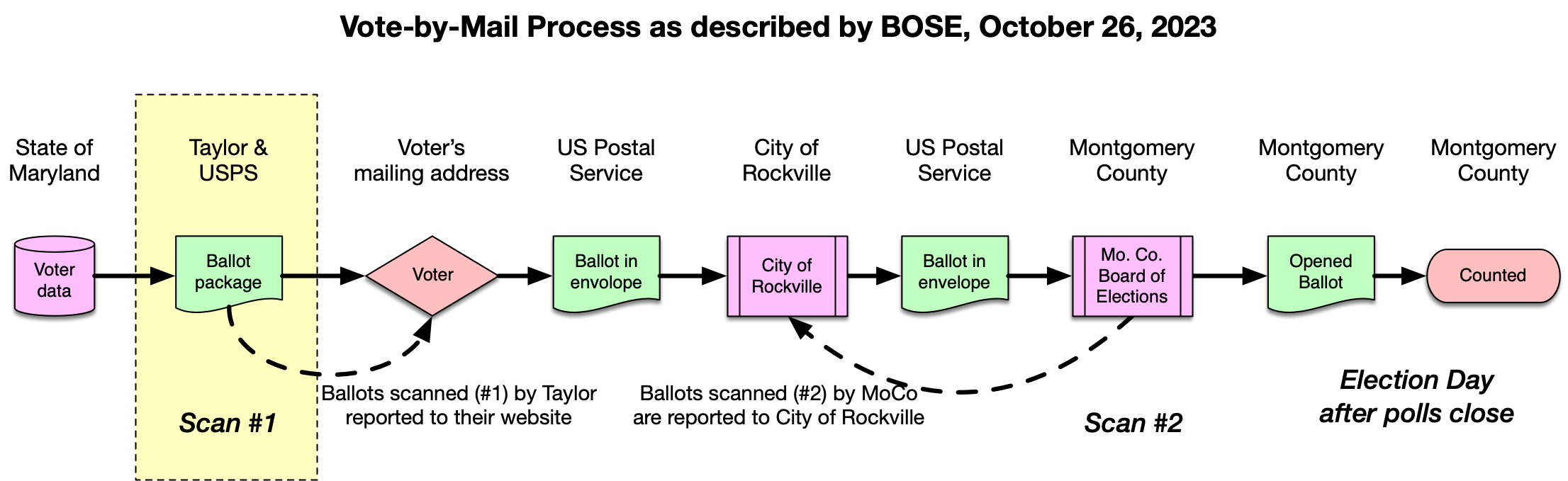
The City Clerk is in the process of mailing the missing ballots and BOSE has prepared a statement for the Mayor and Council and the candidates for the upcoming election (see below), along with a message on the City’s website that noted, “This technical issue has not affected the integrity of the city’s election process. This issue affected only the ability of voters to track their ballots through the United States Postal Service. The issue had no effect on the actual delivery of ballots.” No mention of the missing ballots, alas.
The City Clerk also mentioned that a couple of thousand ballots have already been received and will be sent to the Montgomery County Board of Elections for processing. Ballots received will be posted on the City website starting on November 1; ballots are not counted until the polls close on Election Day.
Please remember to vote early by mail. Ballots must be received by (NOT mailed to) the City of Rockville by 8 pm on November 7. If you’re running late, two outdoor drop boxes are located at City Hall and Montrose Community Center. Four indoor drop boxes are located at the Senior Center, Lincoln Park Community Center, Twinbrook Community Center, and Thomas Farm Community Center only during hours of operation.
Financial Reports Reveal Top Contenders in Rockville Mayor and Council Race
UPDATE: This post was corrected and expanded to reflect the following: revision of funds raised in the mayoral race, charts clarifying loans and mayoral vs council candidates, and a minor error in Danniel Belay’s financial report.
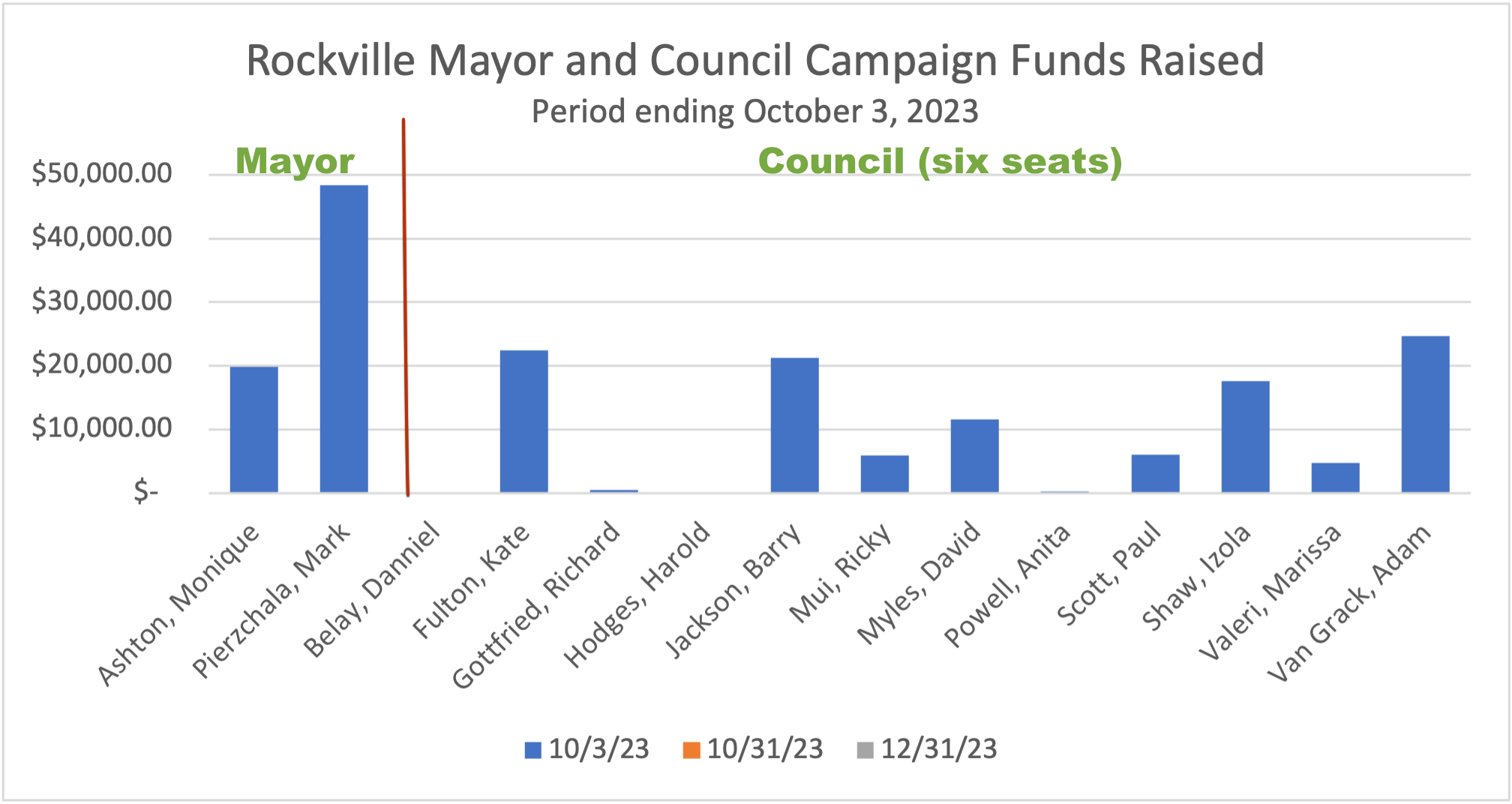
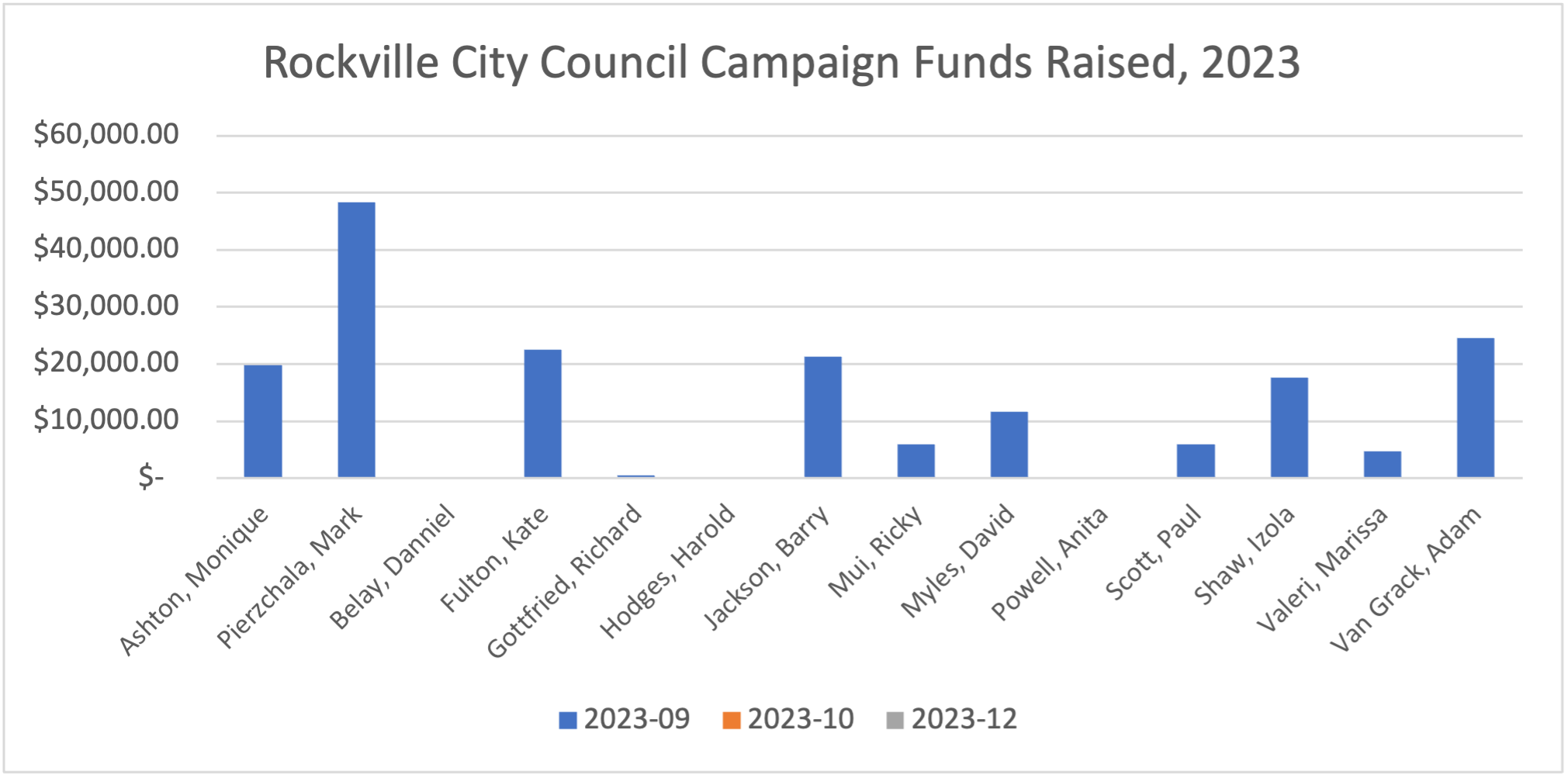
In the Rockville Mayor and Council race, the first round of financial reports, due on October 9, 2023, have begun to paint a picture of the candidates with the most substantial resources and support. As the race for the six council seats intensifies, the field appears to have narrowed from twelve to eight contenders: Kate Fulton, Barry Jackson, Ricky Mui, David Myles, Paul Scott, Izola Shaw, Marissa Valeri, and Adam Van Grack.
However, not all candidates are faring as well. Financial reports indicate that Danniel Belay, Anita Powell, and Richard Gottfried are trailing, each having raised less than $500, a sum considered insufficient to garner substantial voter support in Rockville. Harold Hodges, another candidate, appears to be even less active in the race, having not submitted a financial report.
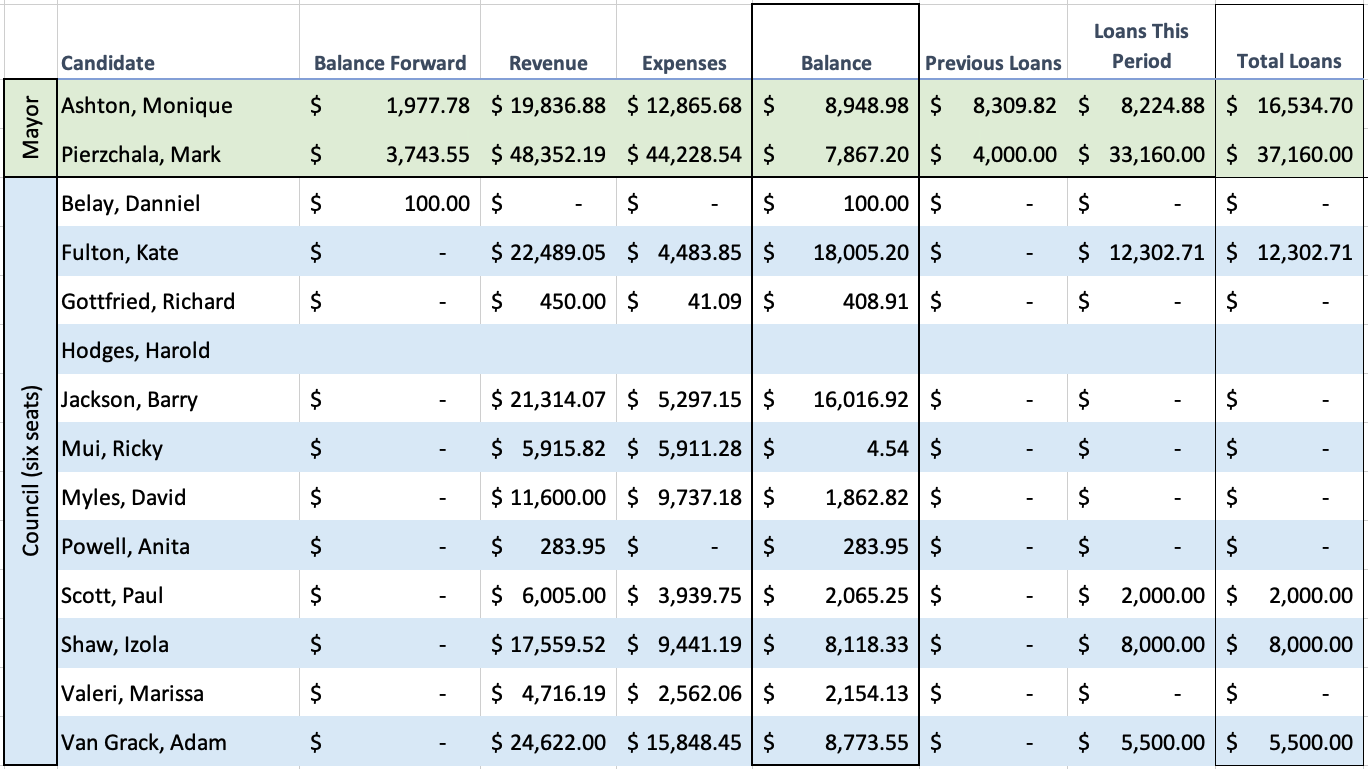
The mayoral race in Rockville is shaping up to be a complex contest. Candidate Mark Pierzchala has raised an impressive $48,352, but with a self-loan of $33,160 this period, his effective fundraising total comes to $15,192 (ignoring funds and loans carried over from his 2019 campaign).
In contrast, Monique Ashton‘s fundraising efforts have yielded $19,836, a figure that not only falls short of her opponent’s total but also those of council candidates Kate Fulton, Barry Jackson, and Adam Van Grack. Ashton has loaned her campaign $8,224, leaving her with a net fundraising total of $11,612, (ignoring funds and loans carried over from her 2019 campaign). This places Ashton among the middle of all candidates in this election but an improvement compared to 2019, when she had raised nearly $8,000 by the end of September.
Contributors to campaigns offer revealing insights into financial influences and influencers, but it is different in smaller local races as in Rockville. Donor analysis typically shows many candidates receive support from family, such as Adam Van Grack. However, this election reveals an unusual trend: incumbents Monique Ashton, Mark Pierzchala, and David Myles have not garnered substantial support from local residents, which would be expected if they had significantly impacted residents’ lives. This raises questions about the perceived influence of the Mayor and Council. Are their actions going unnoticed, or are they not making a significant impact? Notably, current Mayor Bridget Newton and her husband are supporting Monique Ashton, Barry Jackson, and Paul Scott.
For your own analysis, here are the individuals who made contributions of $500 or more, all of whom are based in Rockville unless stated otherwise:
Ashton, Monique: Aaron Stallworth (DC, $500), Antonio Quirindongo (NY, $1,000), Joseph Song (CA, $500), Simon Francis (DC, $1,000), Bridget Newton ($750), Fred Newton ($750), Cyrus Allafi ($500)
Pierzchala, Mark: Norma Pierzchala ($1,000), Joel Martinez ($1,000), Paul O’Brien ($500), Janet Gallant ($1,000), Carl Pierzchala ($1,000), George and Barbara Felber ($500), Benjamin Ross (MD, $500), Ingrid Chua ($1,000), Eduardo Alueta ($1,000; returned)
Belay, Danniel: None over $500
Fulton, Kate: Joel Martinez ($1,000), Beverly McFarland (Delaware, $1,000), Bill Fulton (California, $500)
Gottfried, Richard: None over $500
Hodges, Harold: No report
Jackson, Barry: Elizabeth Bartz (Ohio, $500), James “Jack” Jackson (Washington, $1,000), Peter Fosselman ($750), John Killpack (California, $1,000), Bridget Newton ($750), Fred Newton ($750)
Mui, Ricky (DBA Communities Electing Ricky Mui & Supporters of Mui Ricky Fai): Jacob Miller (Washington, $500), Mark Pierzchala ($500), Michael O’Brien (Pennsylvania, $500)
Myles, David: Duncan Maru (NY, $1,000), Tommy Roberts (GA, $500)
Powell, Anita: None over $500
Scott, Paul: Christopher Cash ($1,000), Bridget Newton ($750), Fred Newton ($750)
Shaw, Izola: Steven Van Grack ($520.87), Michael Rubin (MD, $520.87), Kimberley Propeack (MD, $500), Quinton Zondervan (MA, $1,000)
Valeri, Marissa: None over $500
Van Grack, Adam: Steven Van Grack ($1,000), Brandon Van Grack ($1,000), Claire Bohenegel (DC, $1,000), Gail Van Grack-Aks ($1,000), Ryan Van Grack (MD, $1,000), Citizens for Brian Feldman (MD, $500), Terry Lierman (MD, $1,000).
The Board of Supervisors of Elections requires candidates to file their campaign financial statements on simple yet confusing forms (or are they simply confusing forms?) that always trip up candidates and require correction (to see how widespread this problem occurs, count the number of amended returns in 2019). For this round, there seem to be a couple errors that deserve closer scrutiny but do not seem to affect my overall conclusions:
- Rockville United lists an in-kind contribution of $200 to Paul Scott, which does not appear in Paul Scott’s report.
- Danniel Belay lists $100 as a balance forward, however, there is no previous campaign finance report. I suspect this was a self-contribution to open a bank account for the campaign and is recorded incorrectly.
- Anita Powell lists $283.95 in contributions as loans but they are actually campaign expenses.
Mayor and Council to Approve 82-Townhouse Development Despite Environmental and School Capacity Concerns
At its Monday, October 2, 2023 meeting, the Rockville Mayor and Council will discuss permission to build 82 townhouses at 2200 Tower Oaks Boulevard and reduce parking by 18% at 2000 Tower Oaks Boulevard. On the Consent Calendar (items approved without discussion) are increasing funding for stormwater management from $95,000 to $422,000 and appointing David Sklar to the Board of Supervisors of Elections. The Mayor and Council will also receive reports on the Seven Locks Road Diversion Center (aka “county jail”), Financial Advisory Board, and Pedestrian Master Plan.
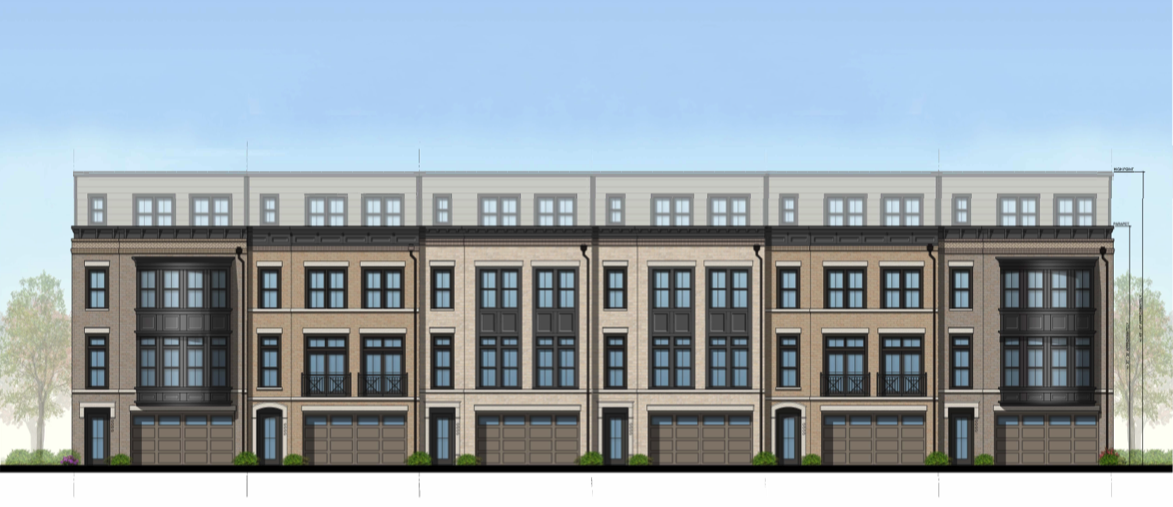
The Planning Commission, Bicycle Advisory Committee, and Pedestrian Advocacy Committee reviewed and approved the proposed 82-townhouse development, but strangely, the Mayor and Council excluded the Environment Commission and Education Commission. This project will replace about 10,000 sf of forest and with 7,600 sf of “new” forest; is adjacent to a stream; and subject to an existing Forest Conservation Plan (pages 47-8)—aren’t these environmental issues? For those who are concerned about school capacity in the Richard Montgomery Cluster Area, the proposed townhouse development will generate 18 students at the elementary school grade level; 10 students at the middle school level; and 14 students at the high school level (page 44). That means capacity is expected to rise to 99% for Bayard Rustin Elementary School, to 95% for Julius West Middle School, and to 123% for Richard Mongomery High School. By fall 2027, however, “capacity at Richard Montgomery is slated to be adequate due to an approved CIP project that will reassign students among Gaithersburg HS, Richard Montgomery HS, Quince Orchard HS, Thomas S. Wootton HS, and Crown HS.” What’s the purpose of the Education Committee if they aren’t aware of one of the most contentious school issues?
On pages 135-166, the Financial Advisory Board, chaired by Bob Wright, presented its FY2023 Annual report and found no discrepancies in Rockville’s financial reports; had no recommendations on the financial policies (although noted that no policies on donations was needed); found that the investment portfolio declined in value due to rising interest rates; stated that the city staff had done an outstanding job in preparing the annual budget; made three recommendations regarding the Capital Improvements Program; made complex findings and recommendations regarding the 2015 Purchasing Study; reported that the City has spent nearly $6 million on the King Farm Farmstead (and noted that the Mayor and Council do not agree on future uses); and that City is making good progress on including performance measures in the budget.
On pages 167-189, the Pedestrian Master Plan seems to be running ahead of itself and should take a step back. It offers five goals and ten recommendations, but nothing sufficiently specific nor any priorities to help the Mayor and Council know what to do next and why. Strangely, the Traffic and Transportation Department is hoping to propose an ordinance to City Council on October 23 even though the nearly 300 public comments collected since May haven’t been summarized (it doesn’t even close until October 13!). Perhaps they’re trying to get in done in “Walktober” month but it looks like they need to do a lot more research and analysis. For examples, here are pedestrian master plans from Portland and Seattle. Let’s hope the Mayor and Council provides clarity on expectations for a master plan.
October is National Arts and Humanities Month and the Rockville’s Cultural Arts Commission recommends that you celebrate by reading book, putting your child’s art on the fridge, and singing in the car, among others. Alas the expectations are pretty low, so here are five better suggestions from the non-human ChatGPT:
- Visit a Local Museum or Art Gallery: Explore the rich cultural heritage and artistic talent in your community by visiting local museums and art galleries.
- Attend a Workshop or Lecture: Many institutions offer workshops, lectures, or webinars during National Arts and Humanities Month. These can provide a deeper understanding of various art forms and humanities topics.
- Participate in a Community Art Project: Engage with your local community by participating in a collaborative art project or humanities event. This could be a mural painting, a community theater production, or a local history project.
- Read a Book: Celebrate the humanities by reading a book on a topic you’re interested in, such as history, philosophy, or literature. Consider joining a book club to discuss and share insights.
- Support Local Artists and Scholars: Purchase artwork from local artists or attend performances and presentations by local scholars. Your support can help sustain the arts and humanities in your community.
The Mayor and Council are conducting hybrid meetings. If you wish to submit comments in writing for Community Forum or Public Hearings, please email the comments to MayorAndCouncil@RockvilleMD.gov by no later than 10:00 a.m. on the date of the meeting.
More details in the 197-page agenda packet are available at https://www.rockvillemd.gov/AgendaCenter/ViewFile/Agenda/_10022023-7016.
Mayor and Council to Choose Earmarks and Decide Upcoming Election Changes
At its Monday, February 27, 2023 meeting, the Rockville Mayor and Council will discuss proposed earmarks for the FY24 federal budget, requests from the Board of Supervisors of Elections, and recommendations from the Charter Review Commission. On the Consent Calendar (items approved without discussion) are the preservation of public art, funding for the Rockcrest Ballet Center, Taste of Rockville agreement, and funding for the flood resilience master plan, among others. The Mayor and Council will also receive reports on operating budget and capital improvements budget for FY2024.
Yes, Congress is openly using earmarks again, “funds provided for projects or programs where the congressional direction (in bill or report language) circumvents the merit-based or competitive allocation process, or specifies the location or recipient.” For some, it’s simply another form of pork barrel politics but for others it’s a vital project. Perhaps the most famous earmark was by US Senator Ted Stevens to construct the Gravina Island Bridge or the “Bridge to Nowhere” for $250 million in 2002. But if you want federal funds for a specific project, the best way to ensure it is through earmarks. This year, the City of Rockville is considering several potential requests to Senator Cardin, Senator Van Hollen, and Congressman Raskin, including the emergency operations center at 6 Taft Court, police radio equipment ($1.4 million!), storm drain improvements in Potomac Woods, security for the water treatment plant, and water main or sewer main rehabilitation in an “equity focused area” (not identified but somewhere in southeast Rockville).
Preparations for the 2023 Mayor and Council election are underway and candidate information packets should be ready by May 1—however, there is still lots to be done. The Board of Supervisors of Elections is waiting for approval from the Mayor and Council on several changes to the City Charter and City Code in limbo; proposed translation of outreach materials in Spanish, Chinese, and French; adding a second vote center at Thomas Farm and placing ballot drop boxes in Montrose, Lincoln Park, and the Rockville Senior Center. Indeed, if the minimum voting age is lowered from 18 years to 16 years and the deadline for submitting nomination petitions is increased from 60 to 90 days prior to the election, the City may have already missed its ability to implement these changes for the November 2023 election.
Discussion of the 30 recommendations by the Charter Review Commission continues, this time on a more “precise, open, transparent, and definitive administrative process” for filling a vacancy on the city council after two years; adding a “none of the above” option on election ballots; increasing the size of the Board of Supervisors of Elections; increasing the number of ballot drop-off boxes; lowering the voting age to 16; and limiting the number of consecutive terms of council members to three four-year terms (but allowing a person to serve 12 years as a councilmember and 12 years as mayor—really? 12 years is plenty, give other people a chance!).
More details in the 450-page agenda packet are available at https://www.rockvillemd.gov/AgendaCenter/ViewFile/Agenda/_02272023-6820.
Mayor and Council to Consider Changes to Mayor and Council
At its Monday, December 12, 2022 meeting, the Rockville Mayor and Council will discuss the FY22 financial report and the FY24 budget priorities. On the Consent Calendar (items approved without discussion) are a dozen items, including easements, services, grant agreement, and the tenth amendment to the interim management agreement with Morguard for Rockville Town Square, among others. The Mayor and Council will also receive reports on priorities with the District 17 Delegation and recommendations from the 2020-22 Charter Review Commission.
The Charter Review Commission has developed recommendations for a wide variety of issues related to the City Charter (its constitution), including expanding the size of the City Council, term limits for councilmembers, alternative voting systems, translation of election materials, the scope and size of the Board of Supervisors of Elections, and increasing voter turnout. After forty meetings and interruptions due to the pandemic, the Commission is recommending that,
“the City maintain the status-quo on several topics (e.g., staggered Council terms and alternative methods of advertising elections), the Commission is also recommending bolder changes to City policy and operations in order to enhance accountability and transparency, increase voter turnout, and advance racial equity and social justice. Notably, the Commission is recommending such reforms as an increase in the size of the Council, implementation of term limits on the Mayor and Council, creation of representative districts, exploring changing the time of the election, and allowing residents who are not United States citizens and those at least 16 years of age to vote in municipal elections.”
More details in the 465-page agenda packet are available at https://www.rockvillemd.gov/AgendaCenter/ViewFile/Agenda/_12122022-6765.
Heard on the street: things are heating up in the West End neighborhood regarding design guidelines proposed by the West End Citizens Association. I suspect this is related to the 2040 Comprehensive Plan. A website opposed to WECA’s action can be found at PreserveTheWestEnd.com.
Board of Supervisors of Elections Recommends Lowering Voting Age to 16
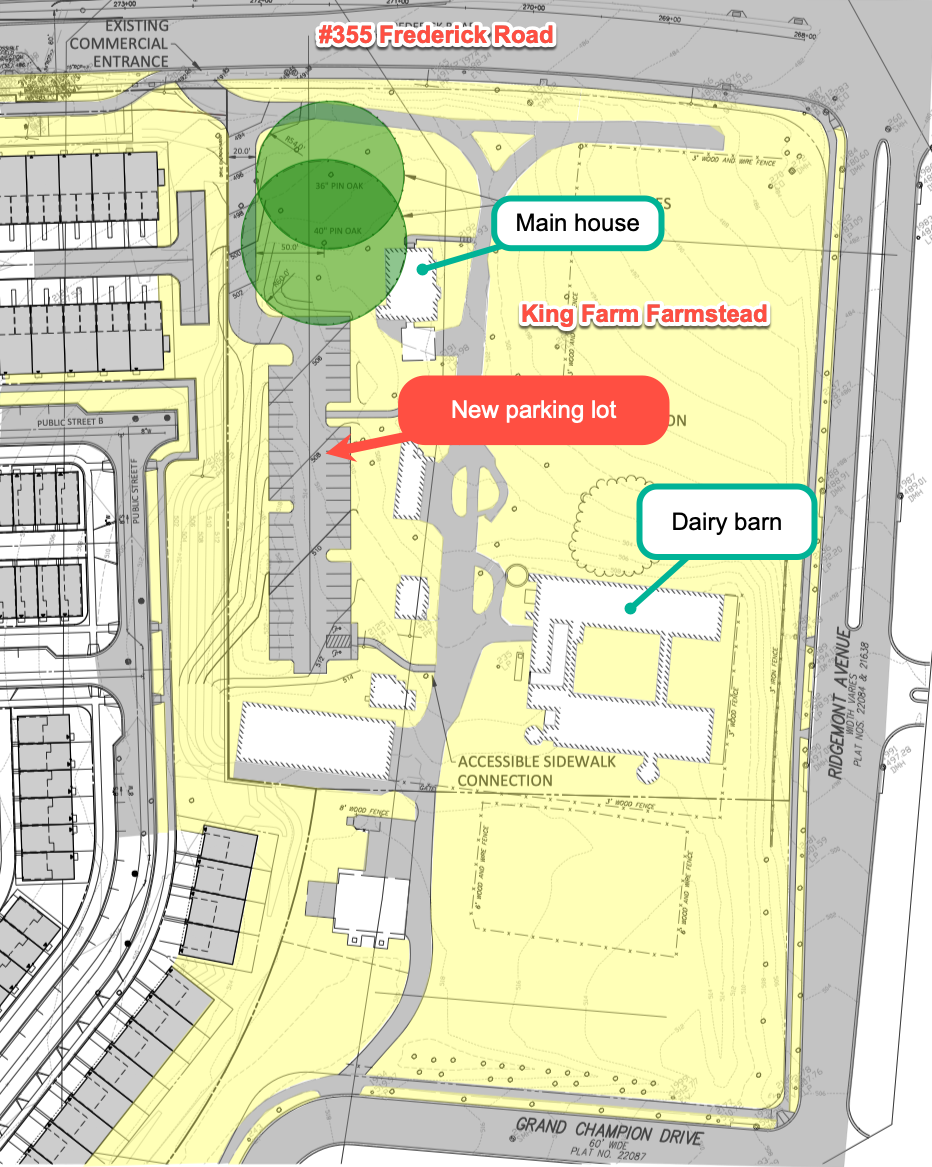
At its Monday, October 24, 2022 meeting, the Rockville Mayor and Council will discuss creating RHE Scarborough Square (no staff report was available when the agenda was posted). On the Consent Calendar (items approved without discussion) is a license to KBSG to construct a 47-space parking lot at King Farm Farmstead Park, among others. The Mayor and Council will also receive reports from the Board of Supervisors of Elections and the Traffic and Transportation Commission.
The Board of Supervisors of Elections is recommending a “series of amendments to the City Charter and to Chapter 8 of the City Code,” including lowering the voting age to 16 years; increasing the deadline for submitting nominations for candidates to city council from 60 to 90 days prior to the election; prohibit campaigning within 50 feet of a ballot drop box; requiring electronic filing of all campaign finance reports; and limiting campaign committees (“slates”) to one election cycle. Some of these changes will be controversial.
The Traffic and Transportation Commission is requesting its scope of responsibilities be updated from its creation in the 1970s, including two ex-officio, non-voting seats from the Bicycle Advisory Committee and Pedestrian Advocacy Committee; meetings be held quarterly; advise on “opportunities to advance a transportation and mobility network that is safe, equitable, convenient, fiscally resilient, and environmentally sustainable;” “approve the official names of newly constructed or reconstructed bridges” (but why not streets, turnpikes, highways, intersections, bus shelters, and parking lots?); and changing its name to the Transportation and Mobility Commission. So let me get this straight: there are three city commissions responsible for “transportation and mobility” in the city (Traffic and Transportation, Bicycle, and Pedestrian)? Seems like a lot more bureaucracy than needed for such a small city. Can’t they be combined with a balanced representation of all three interests? That might result in better solutions and more efficiency.
More details in the 109-page agenda packet (21 pages of which are devoted to proclamations) are available at https://www.rockvillemd.gov/AgendaCenter/ViewFile/Agenda/_10242022-6728.

 Max for Rockville