Maryland voters will face an unusually complicated constitutional question this November concerning congressional redistricting. Question 3 does not itself redraw Maryland’s congressional districts. Instead, it would change the Maryland Constitution to clarify which state constitutional rules apply when congressional districts are drawn—and, just as importantly, which rules do not.
The history behind the amendment helps explain why it is controversial.
Maryland’s Constitution requires legislative districts to be contiguous, compact, and drawn with “due regard” for natural boundaries and the boundaries of political subdivisions. For many years, those provisions were generally treated as rules governing districts for the Maryland General Assembly. That understanding changed during litigation over the congressional map enacted after the 2020 census.
In 2022, retired Judge Lynne Battaglia ruled that those state constitutional requirements also applied to Maryland’s congressional districts. She struck down the General Assembly’s 2021 congressional map, finding, among other things, that it failed state constitutional standards concerning compactness and political boundaries. The General Assembly subsequently adopted a replacement congressional map.
Question 3 is, in significant part, a response to that 2022 decision. During a special session in August 2026, the General Assembly passed HB 2100, sponsored by House Speaker Joseline Peña-Melnyk. The measure passed the Senate 32–13 and was approved by the governor on August 5. Because it changes the Constitution, however, voters must approve it before it can take effect.
If adopted, Question 3 would make three principal changes.
- First, it would specify that Maryland’s constitutional requirements concerning compactness, contiguity, and political and natural boundaries apply to districts for the Maryland Senate and House of Delegates—not congressional districts.
- Second, it would state explicitly that nothing elsewhere in the Maryland Constitution, including the Declaration of Rights, supplies criteria for drawing congressional district boundaries.
- Third, it would allow the General Assembly to give the Supreme Court of Maryland original jurisdiction to hear challenges to congressional redistricting plans.
The argument for Question 3
Supporters describe the amendment principally as a clarification of constitutional law. Their argument is that Article III of the Maryland Constitution was designed to regulate districts for the General Assembly and that the 2022 court decision extended those provisions to congressional districts in a way that had not previously been understood. Under that view, Question 3 restores the historical distinction between state legislative redistricting and congressional redistricting and establishes clearer rules before the next round of mapmaking.
Supporters can also argue that uncertainty is itself a problem. If lawmakers, courts, and voters do not know which constitutional standards govern congressional redistricting, maps may face prolonged litigation. Making the rules explicit could reduce that uncertainty.
There is also a broader political context. Redistricting battles have intensified nationally, including disputes over mid-decade congressional redistricting. Maryland lawmakers called a special session in August specifically to address congressional districting standards.
The argument against Question 3
Opponents contend that describing the amendment as merely a “clarification” understates its effect. Their central argument is that the 2022 ruling established meaningful state constitutional restraints on partisan mapmaking. Compactness, contiguity, and respect for county and municipal boundaries can make it more difficult to construct highly irregular districts designed primarily for political advantage.
Question 3 would expressly prevent courts from using those provisions to review congressional maps. Opponents therefore argue that the amendment gives future General Assemblies greater freedom to draw congressional districts for partisan purposes. Several opponents testifying before the legislature described the amendment as removing constitutional “guardrails” against gerrymandering.
Some opponents have also criticized the process. The amendment was considered during a two-day special session rather than during the regular 90-day legislative session, prompting arguments that a permanent constitutional change deserved more deliberation.
Opponents include the Maryland Republican Party, Maryland Right to Life, Association of American Physicians and Surgeons, the Maryland Forward Party (YouTube; public testimony), and ABATE of Maryland opposing the bill. Supporters include the NAACP Howard County, NAACP Montgomery County, Indivisible Bowie and Beyond, and other civic and advocacy group (although their testimony wasn’t not fully documented by the State of Maryland). Common Cause Maryland and the League of Women Voters of Maryland submitted informational testimony rather than simply registering support or opposition.
Even the ballot wording became controversial
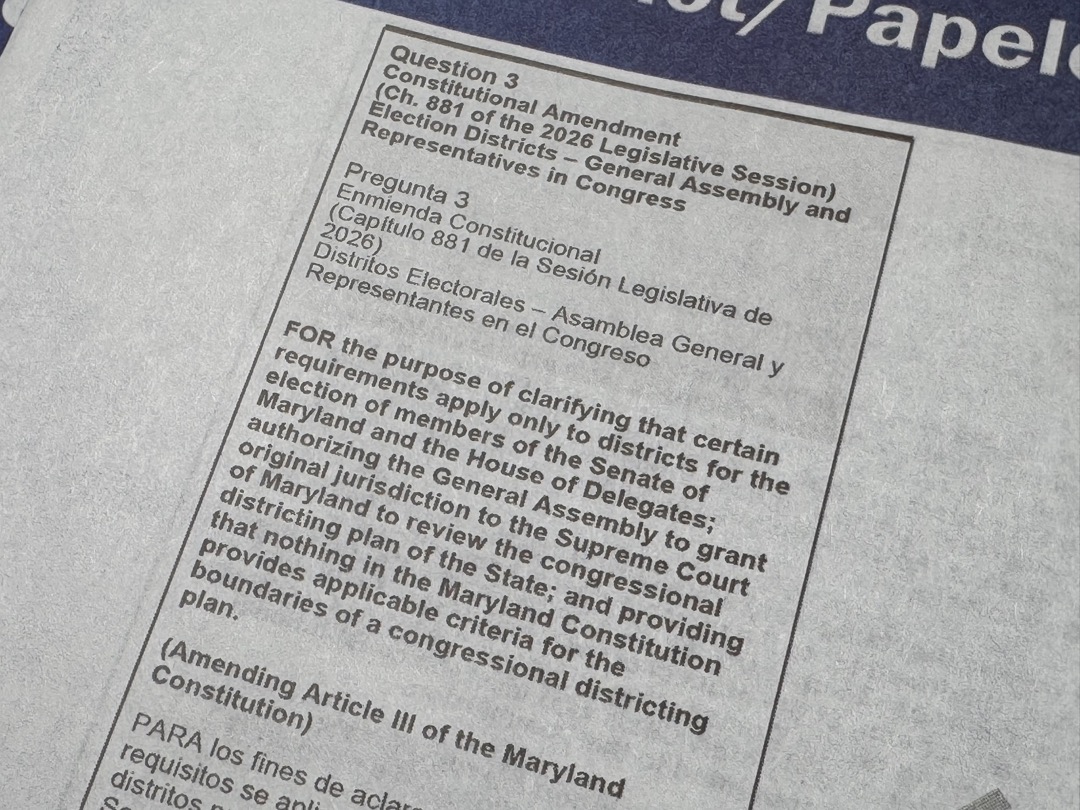
The wording voters will see is not the wording originally passed by the General Assembly. The original version said the amendment would require congressional district criteria to be determined by “applicable federal laws.” Opponents challenged that wording in court, arguing that it was misleading. Two lower courts agreed and initially prevented the question from appearing on the ballot.
On September 3, the Supreme Court of Maryland allowed Question 3 to remain on the ballot but agreed that the original description was misleading. The Court replaced it with language drawn more directly from the legislation. The ballot now tells voters that the amendment would provide that “nothing in the Maryland Constitution provides applicable criteria for the boundaries of a congressional districting plan.”
That revised wording is important because it makes the choice somewhat clearer.
What would a FOR or AGAINST vote mean?
A vote FOR Question 3 would amend the Maryland Constitution so that its existing districting standards could not be used to judge congressional district boundaries. Federal constitutional and statutory requirements would still apply.
A vote AGAINST would leave the Maryland Constitution unchanged. It would not automatically establish any particular congressional map or prohibit future redistricting. It would leave open the possibility that Maryland courts could continue to apply state constitutional provisions to congressional districts, as occurred in 2022.
That is the basic choice behind Question 3.
The dispute is partly about legal interpretation—whether the 2022 ruling properly applied state legislative districting standards to congressional districts—but it is also about a larger question of governance: How much discretion should the General Assembly have when drawing Maryland’s congressional districts, and how much authority should Maryland courts have to constrain that discretion under the state Constitution?
Personally, I’m voting against Question 3. I’m tired of political parties slicing and dicing voting districts to strengthen their control over state and national government. In Texas, Republicans have pursued that strategy; in Maryland, Democrats have done the same. Elected officials need to win their seats through their ideas and values, not by shopping for voters through redistricting.
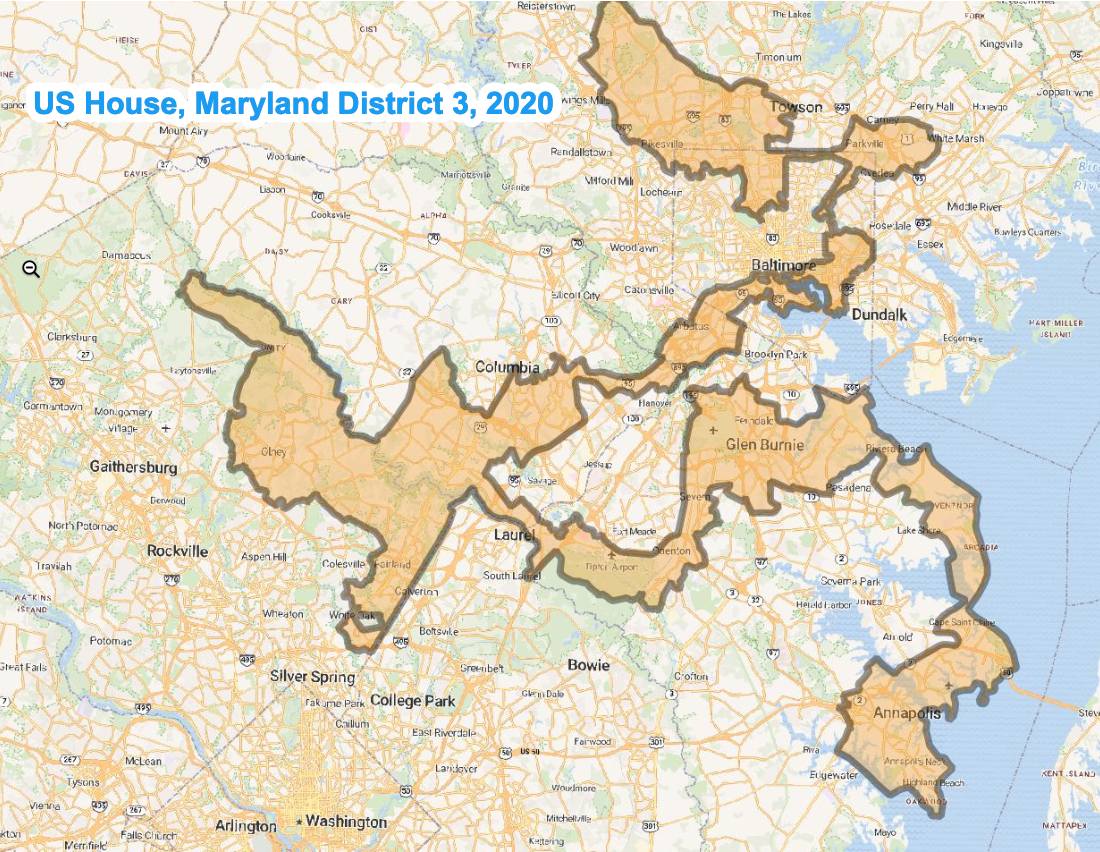
If you’re not convinced that Maryland has had a gerrymandering problem, take a look at the infamous 3rd Congressional District as it existed in 2020. Its sprawling, contorted boundaries raise an obvious question: How could a district shaped like that meaningfully represent a coherent community of voters? It doesn’t—it’s designed to deliver enough votes so that Democrats will win an election.
Ultimately, however, Maryland voters will decide what limits should apply to congressional redistricting when they vote on the confusing Question 3 on November 3.