JBG Reveals Updated Plans for Downtown Rockville
The JBG Companies, who are currently building a large complex of offices, residences, and stores around the Twinbrook Metro station, are also working on a portion of downtown Rockville that’s slated as phase two of the Town Center. The 2008 economic downturn slowed development considerably but is now picking up, as evidenced by the construction of the corporate headquarters of Choice Hotels. JBG owns the former Giant Grocery store at 275 North Washington Street (across from the Beall’s Grant Apartments) and has been exploring various uses for this vacant building and adjoining parking lot. Today, they shared the following plans:
New shopping, apartments and offices are slated for an overlooked city block in Rockville’s downtown, offering the opportunity to energize a long-vacant Giant grocery store site and adjoining tracts. The JBG Companies is proposing to demolish the grocery store and build new offices and shopping as a complement to busy Rockville Town Square next door. JBG has shared its plans with multiple audiences including neighbors, city officials, community groups and civic users.
“We are fortunate to have strong support from neighbors and businesses alike who have long been asking for renewed vigor in this part of downtown Rockville,” said Anthony Greenberg, a JBG official. “Redeveloping this property is an excellent opportunity to Continue reading →
Is Rockville Middle Class?
During the past few years, I’ve heard people often refer to Rockville as a “middle class” community and in the upcoming economic summit, you’ll hear it mentioned as the defining characteristic for the residents of our fair city. But what does that mean, really? Is it a measure of wealth, values, or behavior? I suspect it’s a bit of all three–and it’s a term that’s slippery enough that everyone can define it differently and still agree with each other. Much like the fictional Lake Wobegon, it seems that everyone is above average…and in the middle class. The alternatives–working class or wealthy–just don’t seem to be appropriate for us, do they?
Recent surveys by the Pew Research Center suggest that for most Americans, being in the middle class is defined as having a secure job, but not necessarily that you own a home or have a college education. It also turned out that about half the people surveyed identified themselves as middle class–but this varies tremendously depending on Continue reading →
Is Rockville Walkable? Depends Where You Are.
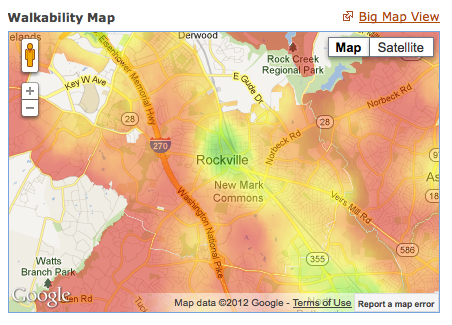
Walk Score map of Rockville
“Walkability” is an increasingly popular measure of a community’s quality of life. By enhancing the convenience and ease of walking, it reduces traffic, improves health, increases community involvement, and puts more eyes on the street for safety. So how does Rockville rate? Walk Score calculates walkability on a block-by-block basis, generating color-coded maps. In the map of Rockville, green indicates the areas that are most walkable (such as downtown) and red the least walkable (such as Horizon Hill west of 270). Around town, they’ve calculated how the following locations fared on a scale of 1-100:
- 85 Very walkable: Maryland Avenue and South Adams (West End)
- 75 Very walkable: Baltimore Road and Grandin (East Rockville)
- 66 Somewhat walkable: Twinbrook Parkway and Viers Mill (Twinbrook)
- 65 Somewhat walkable: Fallsgrove Boulevard and Fallsgrove Road (Fallsgrove)
- 65 Somewhat walkable: Redland Boulevard and Pleasant (King Farm)
- 63 Somewhat walkable: West Montgomery and Laird (West End)
- 48 Car dependent: College Parkway and Princeton (College Gardens)
- 35 Car dependent: Falls Road and Kersey (Horizon Hill)
I’m sure this will generate controversy and prompt comparisons between neighborhoods (what!? Twinbrook rated the same as Fallsgrove and King Farm? Not possible!) but I’d really like to encourage a discussion about making our community more bike and pedestrian (and sometimes car) friendlier.
What makes a neighborhood walkable? According to Walk Score, the more of the following characteristics it has, the better:
- A center: Walkable neighborhoods have a center, whether it’s a main street or a public space.
- People: Enough people for businesses to flourish and for public transit to run frequently.
- Mixed income, mixed use: Affordable housing located near businesses.
- Parks and public space: Plenty of public places to gather and play.
- Pedestrian design: Buildings are close to the street, parking lots are relegated to the back.
- Schools and workplaces: Close enough that most residents can walk from their homes.
- Complete streets: Streets designed for bicyclists, pedestrians, and transit.
The City of Rockville recently received federal funds to develop “complete streets” near the Twinbrook and Rockville Metro stations, so scores for those locations (and pedestrians using those locations) should improve as a result. Any suggestions to make your neighborhood more walkable? Should walkability be a goal for Rockville?
Residential Segregation Trends Affect Rockville
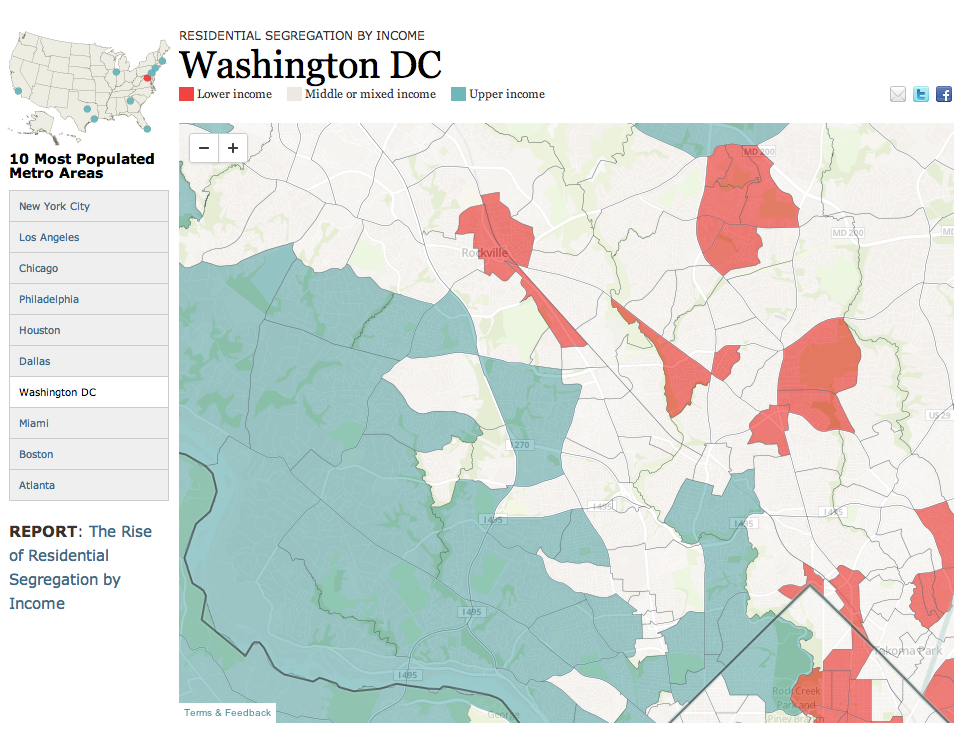
Income segregation by income in the Washington, DC region, based on a 2012 study by the Pew Research Center.
Residential segregation by income has increased during the past three decades across the United States and in 27 of the nation’s 30 largest major metropolitan areas, according to a new analysis of census tract and household income data by the Pew Research Center. Montgomery County, as one of the counties surrounding Washington, DC, is included in that study and shows that Rockville was at the bottom end of the spectrum. It’s primarily a result of a shrinking middle class: “These increases are related to the long-term rise in income inequality, which has led to a shrinkage in the share of neighborhoods across the United States that are predominantly middle class or mixed income—to 76% in 2010, down from 85% in 1980—and a rise in the shares that are majority lower income (18% in 2010, up from 12% in 1980) and majority upper income (6% in 2010, up from 3% in 1980).”
Pew didn’t provide details on the causes of this residential segregation, which could historical settlement patterns; local housing policies, zoning laws, real estate practices and migration trends; and the characteristics of the local economy and workforce. What it could mean for Rockville is that in the longterm, the types of city services and public amenities we’ve enjoyed may erode and disappear as the community’s ability to pay for them declines. Is the City Council looking far enough ahead to respond to this trend, or are they just looking at today?
For more details, see the interactive map or read, “The Rise of Residential Segregation by Income” and “The Middle Class Shrinks and Income Segregation Rises“, all available at the Pew Research Center.
What We Learned in the Blackout of Summer 2012
It’s been a month since the powerful thunderstorm–a derecho to be specific–knocked out power to most of Rockville and the Mid-Atlantic. But let’s call a spade a spade–it was a massive power outage, a blackout, during the hottest days of summer. Most lost power for days, some for a week. As we discovered, if you lose the internet, you’re back in 1979; if you lose electricity, you’re back in 1879. Anger boiled over in the days that followed, but now it seems nearly forgotten. Before our memories fade, what did we learn? Here’s my list, culled from talking with neighbors, reading the newspapers, and scanning the listservs:
1. Pepco doesn’t know your power is out unless you tell them. Don’t assume they have some fancy computer system that notifies them automatically that you’ve lost power, assume that your neighbor has called, assume it’ll fix itself, or assume that they’re busy and you don’t want to trouble them (poor dears!). Call them at 877-737-2662. Write this number down and put it on your fridge–another power outage will occur and you’ll want this handy. Many people said they called but Pepco thought their power had been restored, so call daily to ensure they have the correct information. David Greene noted that he used his mobile phone to, “monitor the Pepco outage map, and they marked our power as restored several times during the week when it was not actually restored. I called them many times to get us back on their map.”
2. Pepco prioritizes work based on the number of outages. That makes sense–first tackle the jobs that will benefit the most people–if they have the correct information. But if you and your neighbors don’t call Pepco, they will assume everything is okay (see #1 above). You might want to visit your neighbors and check to see if they’ve called.
3. If you have FIOS, your “landline” phone won’t work. How disappointing to have the latest technology and discover it’s useless in a power outage. My FIOS system came with a battery backup, but Continue reading →
Courthouse Fountain Getting a Facelift
The walkway around the “Spirit of Rockville” fountain at the Red Brick Courthouse is undergoing a facelift, thanks to a recent commission from the Cultural Arts Commission. Artist Diedre Saunder and craftsman Peter Tabri are installing a huge mosaic carpet around the fountain. The colored tendrils are made of smalti (pieces of brightly colored glass) while the field is commercial floor tile broken into random pieces and set in a bed of latex adhesive. They’re about 75% finished and it’s slow back-breaking work, but portions are already grouted so you can get a sense of the final appearance. I expect it’ll be finished in July, but in the meantime, stop by and get a preview.
If this work looks familiar, Diedre and Peter also worked on the snake that envelopes the Elwood Smith Recreation Center as well as the entry wall at the Croydon Creek Nature Center.
Suburban Dreams or Nightmares?
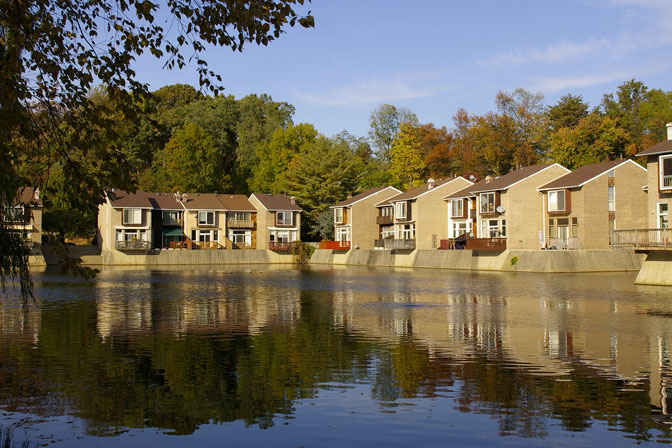
The “lakeside villas” at New Mark Commons in Rockville, Maryland.
This Wednesday, May 16, I’ll be leading a tour of 20th-century planned communities for the American Institute of Architects’ annual convention. We’ll start with 1930s Greenbelt (one of a handful developed by the federal government to demonstrate how communities could be intentionally planned, not just haphazardly developed) and then visit two other nationally significant planned communities, both in Rockville: 1960s-70s New Mark Commons and 2000s King Farm. I’ll be joined by Dr. Elizabeth Milnarik, Dr. Isabel Gournay, and Jim Wasilak (Rockville’s Chief of Planning). By the end of the day, participants will have a nice overview of “community making” in the 20th century, all very different responses by some of the best minds of their times.
I love sharing Rockville with anyone who’s interested but unfortunately, this tour is limited to members of the AIA. But you can easily explore these neighborhoods yourself and if you want more details, Greenbelt has a museum in one of the original residences and Dr. Isabel Gournay at the University of Maryland has written a scholarly essay on King Farm (and Woodley Gardens) in Housing Washington: Two Centuries of Residential Development and Planning in the National Capital Area , edited by Richard Longstreth (2010). If you’d like a guided tour, suggest it to Peerless Rockville and perhaps they’ll put one together in the near future.
New Mark Commons and King Farm are hailed as idealistic suburban communities, but it wasn’t true of all neighborhoods in Rockville. In 1956, John Keats criticized the monotony and isolation of the suburbs around Washington, DC in his popular novel, The Crack in the Picture Window. He follows the lives of Mary and John Drone, a young family trying to get established. They move up from a small old apartment in northern Virginia and move to a new house in suburban Maryland, supposedly based on Rockville’s Twinbrook neighborhood:
[John Drone counted his blessings and said,] “Great. I have a wife and two swell kids, a new split level with everything in it, a new car with all the extras, and I got myself not one but three jobs. I’m meeting all my payments, every month.”
As for Mary’s life, the first few weeks were spent in the charming exhilaration which new surroundings always bring. Gaily, she explored the cellar bedroom which had been added to her domain. She liked the little thrill of going up two steps to the living room, and then up another two into the bedrooms. She was as happy as a squirrel in a new, three-ring cage. This light mood persisted through nearly two months, until at last there came that day when her new world suddenly became only too familiar.
It was the day she stood looking out her picture window and for the first time became completely aware of the picture window across the treeless street. For a horrid moment she stood there, staring. The she ran to her door and tore it open, looking up and down the block. And everywhere she looked, she saw houses exactly like her own, row on row of them, the same, the same, the same…
Can Rockville’s 2013 Budget Avoid a Crossroads in 2014?
The Mayor and Council just closed public hearing on the upcoming $65 million budget and about twenty people had comments (mostly community service groups, such as Community Ministries, Sister City, Jefferson House, Scholarship Foundation, and Bike Advisory Committee). Out of nearly 70,000 residents, that doesn’t seem like very many people and I’m not sure if that means that residents don’t care, don’t understand it, or didn’t know about it, but considering it’s all about how their money is used, it’s surprising. The public record stays open until 5 pm on May 17 so there’s still time to submit comments before the budget is adopted on May 21 (although some members of the Council admitted they are drowning in budget information).
As many of you know, I’ve had ongoing concerns that there’s been a trend that revenues aren’t keeping up with expenses and although the Council has so far kept those lines from crossing, it may be impossible to avoid in the next couple years without some serious consequences. Of course, the City can’t run a deficit, so that means either increasing revenues (typically taxes) or reducing expenses (fewer city services). No politician likes that situation because voters don’t like those options. We prefer an imaginary world of more services and fewer taxes believing it’s possible by following platitudes like cutting fat, working smarter, and thinking outside the box (and incidents like the recent GSA conference only confirm those feelings). What really happens is that politicians will avoid tax increases on those who yell the most and the loudest (usually seniors because they understand the system and have time) and cut services to those don’t complain (people who don’t understand the system or don’t have time, such as children, families with kids, renters, recent immigrants, and the poor).
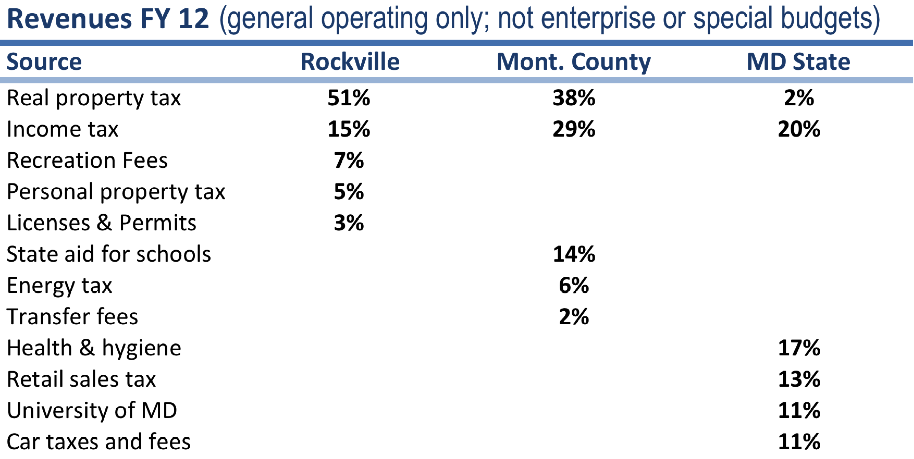
City, county, and state revenue sources in 2012. Click to enlarge.
For the Council’s deliberations on the budget for fiscal year 2013, rather than look at ways to cut expenses, I urged them to consider new or expanded sources of revenue to maintain and enhance existing city services (particularly the parks and recreation, historic preservation, and public art programs) that make Rockville a distinctive place to live and work. Of course we need good roads, a responsive police department, regular trash pickup, and clean water–those are basics but they don’t make Rockville distinctive and prevent the monotony that’s so much the norm of suburban living. A comparison of the top five revenue sources among the city, county, and state suggests Continue reading →
Bridget Newton at RCC
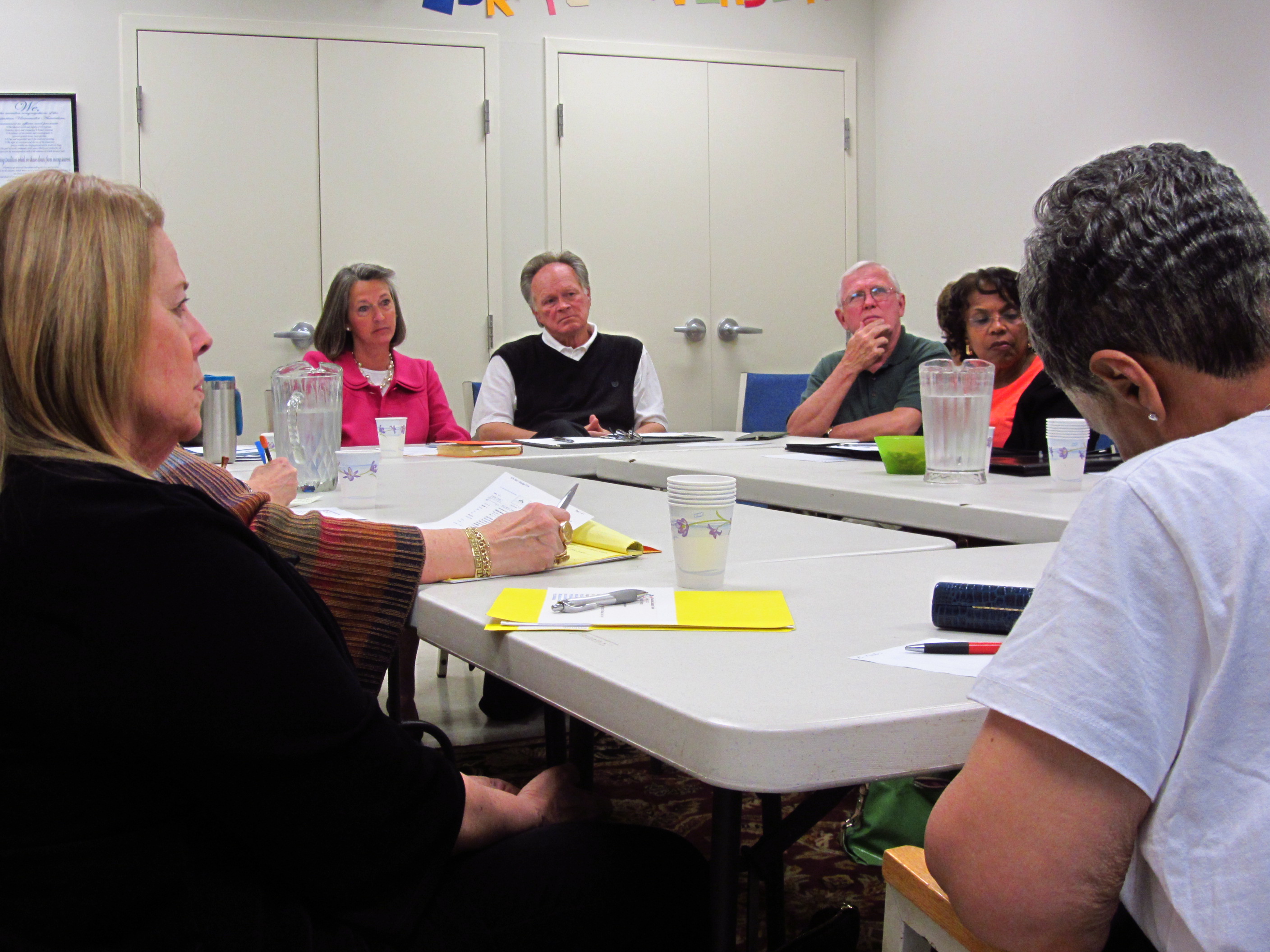
Councilmember Bridget Newton at Rockville Community Coalition meeting.
On May 3, 2012, Councilmember Bridget Newton joined the the quarterly Rockville Community Coalition meeting at the Unitarian Universalist Church to discuss various issues facing the City of Rockville, including:
Charter Review Commission: she supports opening the commission membership to applications from citizens and at the last Council meeting it was decided that each Councilmember could appoint one person and that together they would appoint another five, plus the Mayor would appoint the Chair. She doesn’t have any problems with the current charter, although she noted that a few years ago there were some discussions about whether to continue the Manager-Council form of government, but she had no issues with that. She also had no preconceived outcomes, such as a 7-member council, and wants the commission to be an independent group who would do their own research. She’s committed to holding a referendum on any changes to the Charter before Council makes a decision.
Council conflicts: she stated that her goal is to work together and there would no major/minority divisions. It’s not productive to have a divided Council and she looks forward to more 5-0 votes. Newton mentioned that when she first moved to Rockville, it seemed that despite the diverse perspectives and opinions, people got along but now discussions seem to be mean-spirited. She would like things to Continue reading →
Homes and Hospitality Tour this Saturday
Get to know your city a bit better through the upcoming Homes and Hospitality Tour on Saturday afternoon, May 12. Peerless Rockville organizes this special one-day exploration of a neighborhood every two years, and this year’s focus is East Rockville. Most people don’t realize that this neighborhood east of the tracks not only has one of the densest collections of historic houses, but also some award-winning contemporary homes. Once directly connected to downtown Rockville via Baltimore Road, after the streets were rerouted in the mid-20th century, East Rockville became hidden and forgotten, with many of the houses being cut up into apartments or falling into disrepair. During the last couple decades, however, young couples and entrepreneurial investors saw the potential of this derelict neighborhood and began restoring the historic houses or building new ones on rare empty lots. Interest in this neighborhood continues to grow given its long history, its architectural diversity, and its proximity to Metro, MARC, and downtown.
The Tour includes six different places to visit at your own pace and in any order: three historic houses, two modern houses, and one public building. All have remarkable stories (one of the first electrified houses in the city, another linked to a typhoid epidemic, and another that stands on a former “laboratory to prepare for Armageddon”–wow!) and by exploring them together, you’ll leave with a new appreciation for your community and be inspired by the care of your fellow residents (several have won awards). Unlike most home tours, however, the event is staffed by many community leaders (so you may greeted by your Mayor, Police Chief, or State Delegate), many local restaurants provide refreshments (such as Carmen’s Ice Cream and Tower Oaks Lodge), and music is provided by local artists and students. For $25, it’s a bargain for a special afternoon in your own town (and a great gift for Mother’s Day!) but if you buy in advance or if you’re a Peerless Rockville member, you can get a discount of up to 25% off. Get your tickets in advance at PeerlessRockville.org or on the day of the event at the Pump House at 401 South Horner’s Lane.

 Max for Rockville