Housing Aid, Election Reforms, and Vision Zero on Rockville’s September 8 Agenda
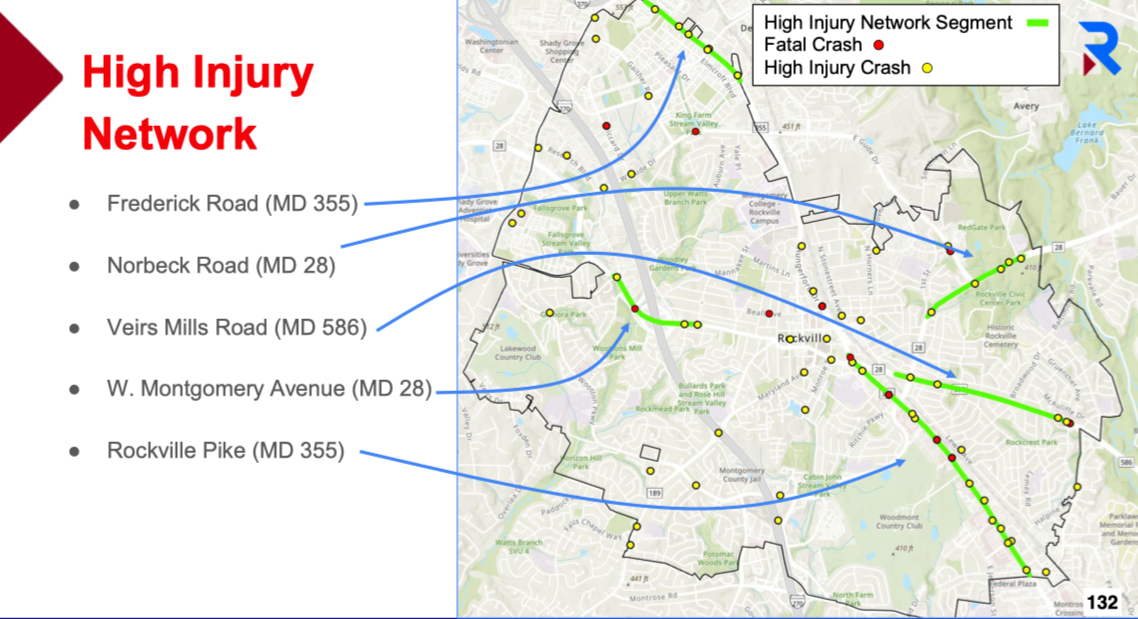
Rockville’s Mayor and Council is returning from its August break facing a packed agenda with decisions that could shape the city’s future for years to come. At the September 8 meeting, three major issues will take center stage: housing affordability and federal funding priorities, a complete overhaul of the city’s election code, and progress on Rockville’s ambitious Vision Zero traffic safety plan. Each of these topics speaks directly to the daily lives of residents and businesses, raising questions about how Rockville grows, governs, and protects its people.
Rockville Council to Hear Public Testimony on Housing Needs and Federal Grant Priorities
The Rockville City Council will hold a public hearing to shape how the city will spend its $263,000 allocation of federal Community Development Block Grant (CDBG) funds for FY 2027. The grants, distributed through Montgomery County, must be used for projects that benefit low- and moderate-income residents.
In the past, Rockville has used CDBG funding to rehabilitate supportive housing at Jefferson House, upgrade shared recovery housing, replace failing HVAC systems at David Scull Courts, and fund its single-family rehab program. With housing affordability worsening, this year’s hearing carries added weight.
A recent city needs assessment underscores the challenge: nearly half of Rockville residents are renters, and more than half of them are cost-burdened, paying over 30 percent of their income on housing. Median rent has climbed to $2,244 per month, requiring an income of nearly $90,000, while the median home price now tops $681,500. Homeownership rates continue to fall, particularly for younger and first-time buyers.
Continue reading →Rockville Residents Rally Along Rockville Pike in “No Kings” Protest
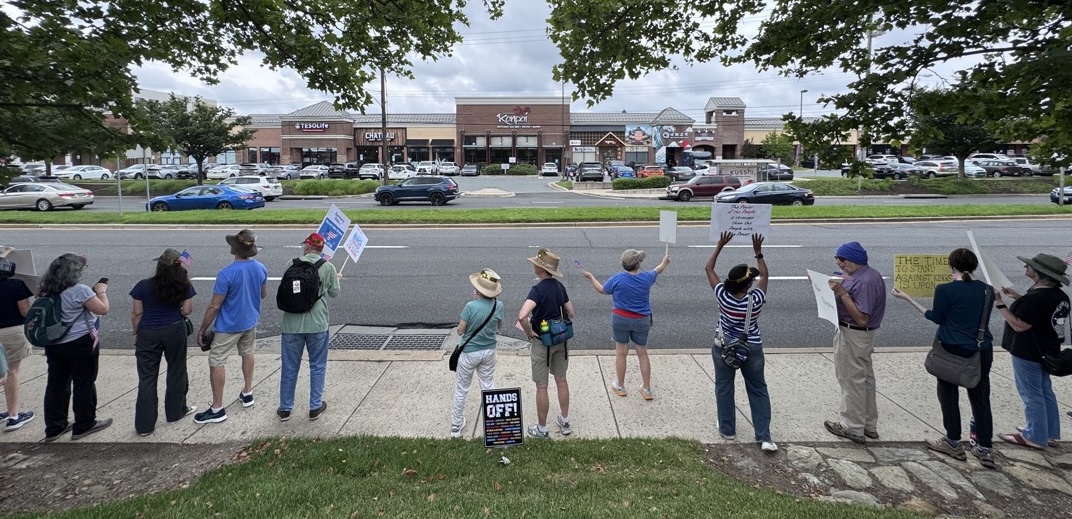
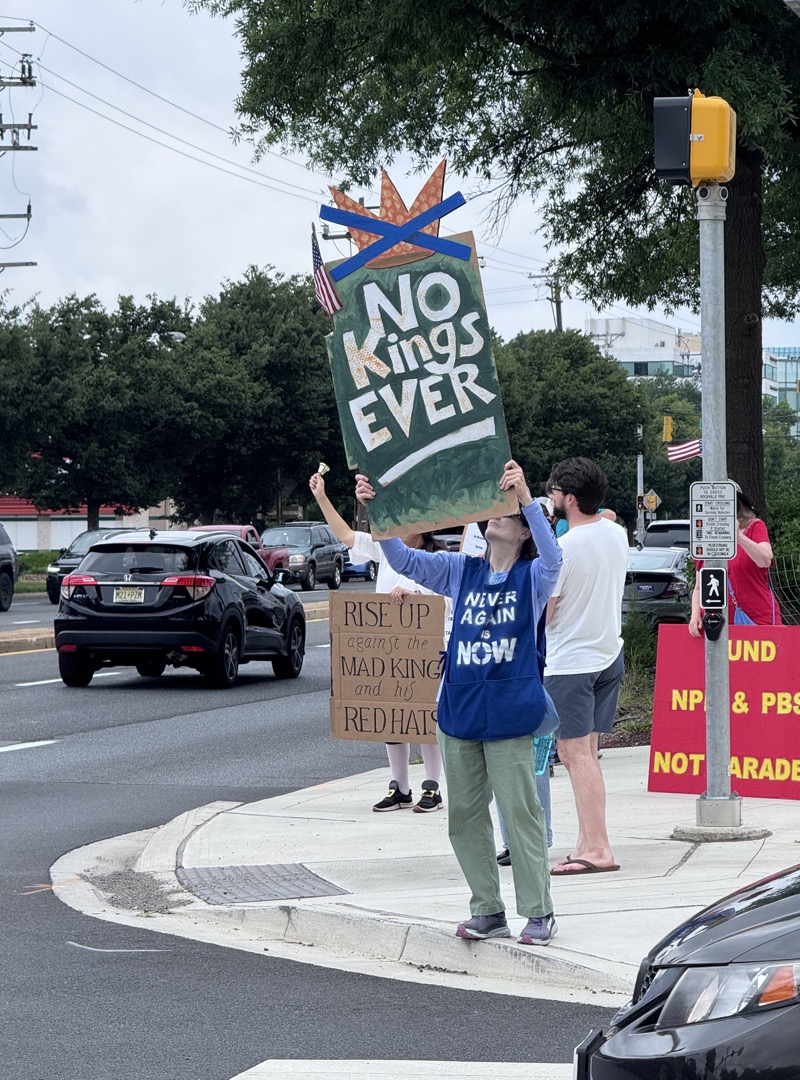
Today thousands of residents lined Rockville Pike from north to south in a spirited “No Kings” protest, drawing attention to growing concerns about government overreach. The demonstration, marked by homemade signs, upside down crowns, American flags, and spontaneous cheers, brought together neighbors, friends, and families united by a shared sense that President Trump is exceeding his authority.
Support came not only from the sidewalks but also the street—drivers honked in solidarity, though Tesla drivers, notably, were less enthusiastic. The strong turnout and shared energy reflected a deep undercurrent of concern and frustration with the direction of the nation.
The protest evoked memories of a similar moment in Rockville’s history, when then-Mayor Phyllis Marcuccio controversially claimed the title of chief executive—despite the city code reserving that role for the city manager. In that instance, the city council remained silent just as Congress is today, leaving it to residents to voice their objections.
This latest demonstration is a reminder that citizen vigilance remains essential. Elected officials, both national and local, are far too tempted by power. The message from Rockville is clear: no one person should be above the law or the people.
Affordable Housing and Election Integrity: Residents Share Concerns with Council
The public comments during the Rockville City Council’s Community Forum on October 21, 2024, covered the following major topics:
- Enforcement of Campaign Laws: Several speakers, including Brigitta Mullican, Steven Weiner, and Bridget Newton, emphasized concerns over the enforcement of Rockville’s campaign regulations. They argued that a lack of consistent action on campaign violations could undermine trust in local election laws. These comments called for clearer standards and increased accountability for campaign rule violations. Next steps? The Council could direct the City Attorney to establish clear guidelines for when and how campaign violations will be addressed, possibly creating a review process for the Board of Supervisors of Election to report findings and suggest enforcement actions.
- Rent Stabilization and Housing Affordability: Numerous residents, such as Misha Clive, Grant Sams, and Wendy Murphy, urged the council to prioritize rent stabilization. They discussed the challenges of rising rent costs, particularly for renters on fixed incomes or with lower-wage jobs, and expressed concerns that the current lack of rent caps could displace long-term residents. The call for rent stabilization was framed as a measure to maintain Rockville’s diversity and accessibility. Next steps? At the same meeting, the Council held a work session on housing strategies.
- Election Integrity and Voter Access: Senator Cheryl Kagan provided comments focused on election integrity and reminded the community of available options for casting ballots securely in the upcoming elections. Her remarks aimed to dispel misinformation and highlighted her efforts in sponsoring election-related bills for improved municipal election oversight. Next steps? The Council could enhance outreach efforts to ensure residents understand their voting options and election security measures. Partnering with state or county election boards may provide additional support.
- Traffic and Speed Control on Major Roads: John Becker addressed issues regarding traffic safety, especially along Rockville Pike and East Jefferson Street. He advocated for the installation of speed cameras to enhance safety in residential areas, especially given the planned increases in residential development along these roads. Next steps? The Council could explore the installation of speed cameras or other traffic-calming measures on Rockville Pike, East Jefferson, and Viers Mill Road. A collaboration with the State Highway Administration to address these concerns would ensure safety for both current and future residents.
- Requests for Transparent Campaign Finance Records: There was also a response from council members, including Mayor Monique Ashton and Council Member Adam Van Grack, who clarified that they had not accepted any PAC donations, addressing comments about alleged developer influence on council decisions. Next steps? The Council might consider publishing more detailed campaign finance records or hosting an information session to clarify the council’s stance on developer influence. This could foster greater trust and show commitment to transparency.
These topics reflect a community deeply engaged in matters of governance, housing equity, and transparency.
Continue reading →Rockville Election Laws at Risk: Board Pushes for City Attorney Action
During the September 30, 2024 Rockville City Council meeting, two members of the Board of Supervisors of Elections, Robert Kurnick (Chair) and David Sklar, addressed the council to express serious concerns about the enforcement of the city’s election laws following the 2023 election.
Election Law Crisis
Kurnick emphasized that Rockville faces a crisis regarding its election laws. The city attorney has declined to enforce citations issued against candidates who violated campaign finance laws in the 2023 election. According to Kurnick, the rationale provided—that violations are not “ongoing” and therefore not enforceable—renders Rockville’s campaign finance laws essentially “unenforceable.” Kurnick urged the council to direct the city attorney to enforce these violations to maintain the integrity of the city’s election laws. Without enforcement, Kurnick warned, there would be no incentive for future candidates to comply with campaign finance regulations, leading to a breakdown in transparency.
Impact on Election Integrity
David Sklar, another member of the Board, echoed Kurnick’s concerns, stating that the decision not to enforce these laws undermines the entire election process. Sklar pointed out that the failure to hold violators accountable erodes the purpose of having campaign finance laws in the first place. He noted that the current approach could lead to candidates repeatedly violating election laws with no consequences, rendering the role of the Board of Supervisors of Elections meaningless. Sklar added that if the city continues down this path, he would resign from the Board, as there would be no reason to analyze campaign finance forms if the law itself is ignored.
Continue reading →Is Candidate Richard Gottfried a DINO or RINO?
Once again, the 2023 campaign for Rockville’s Mayor and Council took another strange turn, this time from council candidate Richard Gottfried. Late last week, a letter arrived from him in our mailbox addressed to “Dear Twinbrook Voters,” urging residents to “vote strategically for your neighborhood candidates [Richard Gottfried and Marissa Valeri]” and that he is the “clear choice for Twinbrook.”
What he doesn’t tell us is that he sent a similar letter addressed to “Dear Republican Voter” which instead emphasized the ballot referenda questions on allowing non-citizens and 16-17 year old residents to vote. He states that he is a “conservative candidate who firmly believes that the answers to these two referenda questions should be NO” and that the “other candidates in this election are democrats with very progressive viewpoints.” He especially requests the votes of “republican voters that are registered, but may not take the time to vote in the City of Rockville’s non-partisan election.”
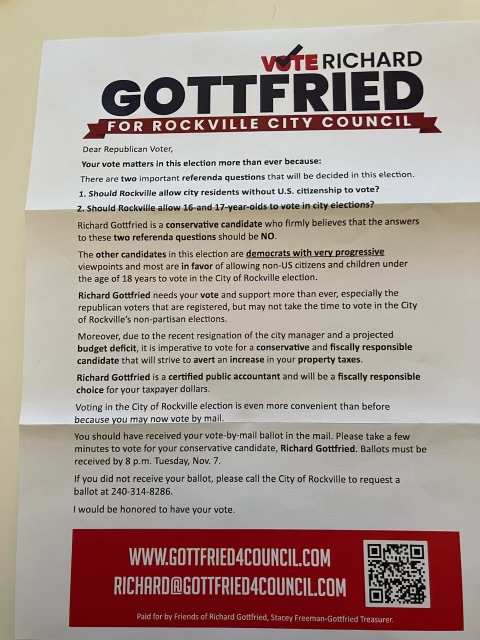
It’s fine that candidates tailor their messages for their audiences, even along party lines in a non-partisan election (although it is really stretching the bounds of traditional campaigning in Rockville). But if you care about a candidate’s values and how they will conduct themselves in office, these letters will be eye-openers. Democrats will be incensed that he’s campaigning in this manner. But Republicans will be as well, because in the 2019 election, Richard Gottfried was registered as a Democrat. I’m not sure if this makes him a DINO (Democrat in Name Only) or a RINO (Republican INcognitO).

Money Talks: Pierzchala, Jackson, Van Grack, and Fulton Lead in Rockville Election Funding
Who’s on top in the Rockville Mayor and Council race? If you based it on money, it would be Mark Pierzchala for Mayor and Barry Jackson, Adam Van Grack, and Kate Fulton for City Council (I suspect Izola Shaw is among them, however, she did not submit a financial report by the deadline). The status of the remaining candidates remain ambiguous, and even the initial insights from the financial reports for these four top-seated candidates warrant further examination.
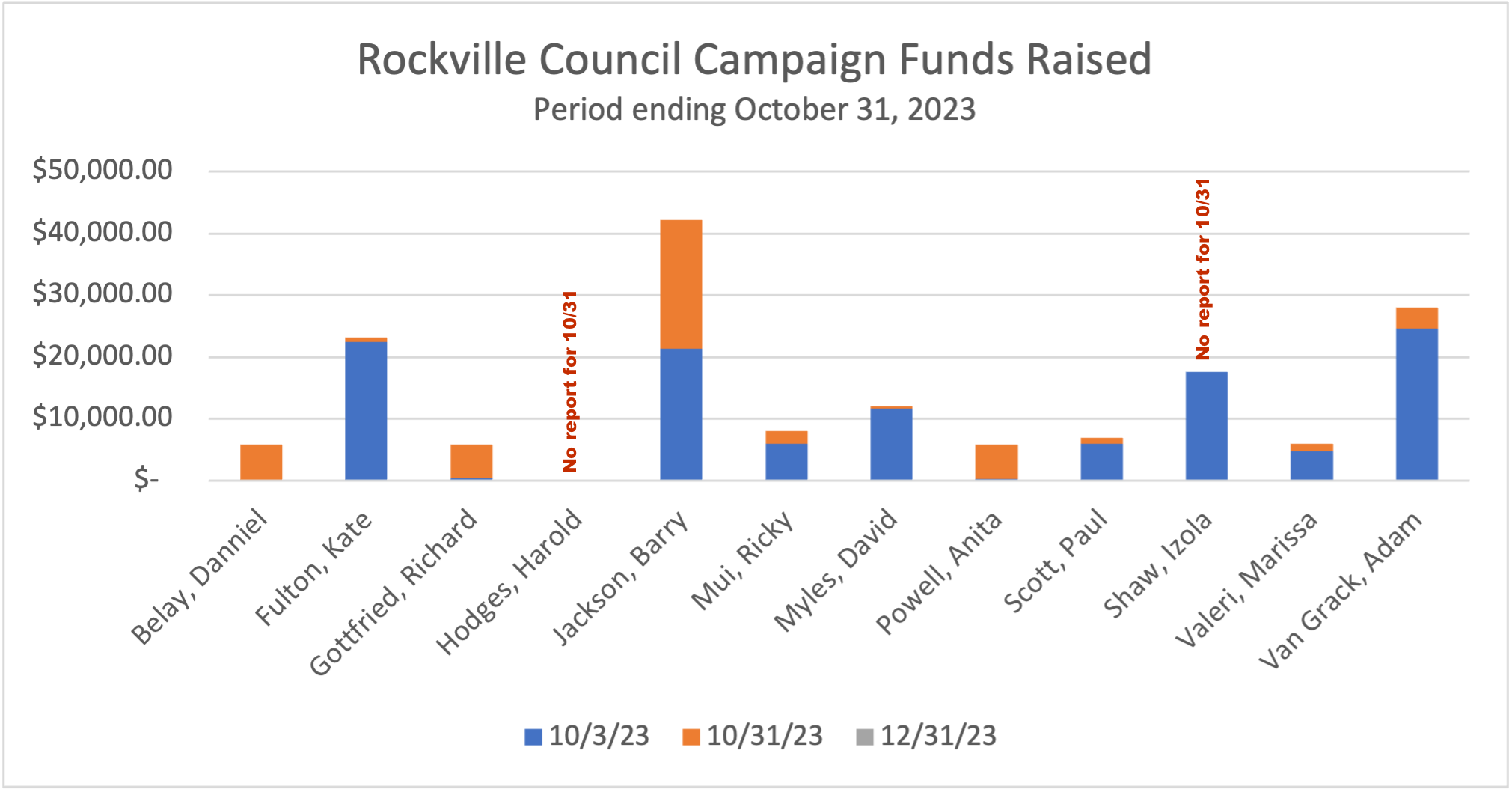
Among the Council candidates, Barry Jackson, Adam Van Grack, and Kate Fulton have each raised more than $20,000 to date, allowing them to run a well-rounded effective campaign. In the 2019 campaign, successful candidates raised about $15,000. To take the lead among Fulton and Van Grack, Jackson loaned himself $20,000. The remaining candidates have raised less than $10,000 to date, putting them on roughly equal footing (again, Harold Hodges did not submit reports so we can assume he is not an active candidate). Among the latest campaign finance reports were several surprises:
- Richard Gottfried attracted only two donors, including Art Stigile, the treasurer of Mark Pierzchala’s campaign.
- Danniel Belay posted an extraordinary growth in contributions from $0 by October 3 to $5,850 by the end of the month, but only one $50 donation came from a Rockville resident. The rest came from outside of the city, state, or United States.
- Ricky Mui raised just over $2,000 but spent more than $2,500 for catering and Chinese lion dancers at a fundraiser, so he actually fell behind. There’s also an unusual comment that his campaign owes Brigitta Mullican, a Rockville resident, $1,286 for 1200 printed mailers.
The Mayoral race contains the biggest surprises as both candidates have raised more than $65,000, overshadowing the council candidates: $67,303 for Monique Ashton and an extraordinary $146,677 for Mark Pierzchala. To achieve those record-setting numbers required loaning themselves record-setting amounts in this month: $35,143 for Monique Ashton and $90,000 for Mark Pierzchala. Combined with their loans for the previous periods (both are incumbents carrying loans from the 2019 campaign), Ashton has debts of $51,678 and Pierzchala has a whopping debt of $126,500. Many residents assume that the Mayor and Council are volunteers, but they are considered “part time” positions and given an “annual stipend” of $37,560 for the Mayor and $30,483 for council members. If Pierzchala wins, it will take more than three years of his four-year term to pay back this loan. Is it worth it? Evidently, it is for him.
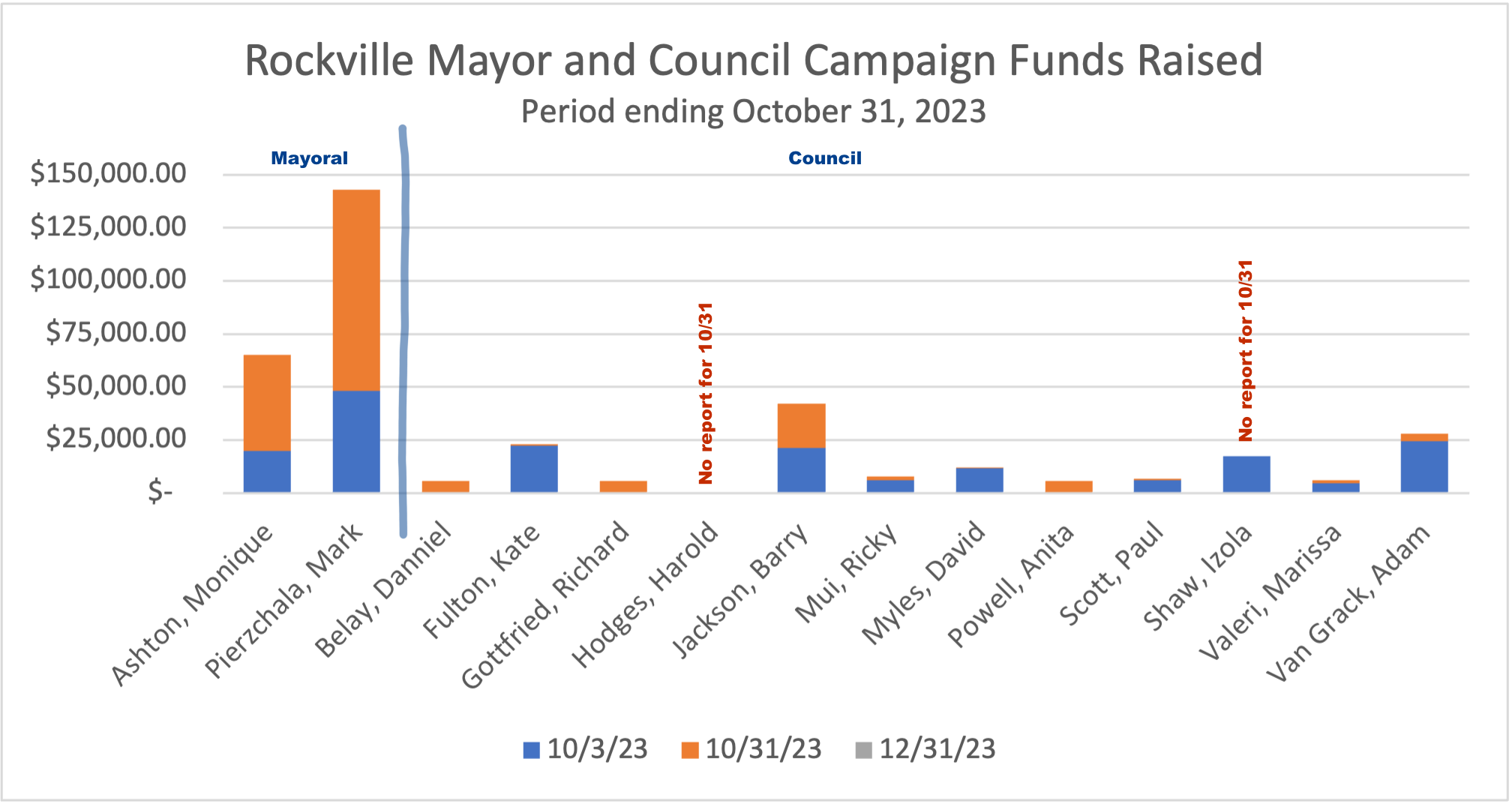
Compared to the 2019 campaign, the amounts raised for 2023 have reached new heights. Most of it is spent on printing and mailing campaign literatures to homes of Rockville residents, which seems to be the most effective way to connecting with voters. If the City changes from city-wide to campaign districts, it will make the cost to run for office much less expensive and open it up to more residents.
Who is Monique Ashton, candidate for Mayor?

In another strange twist in the 2023 campaign for Rockville Mayor and Council, current councilmember and mayoral candidate lacks an official biography on the City’s website. The page is genuinely blank—this is not due to a computer error. The reason for its absence remains unclear.
If you are interested in her qualifications, she provides this biography on her website MoniqueAshton.com:
I have been a Rockville resident for 19 years, living in both East and West Rockville. I was born in New York to a hispanic mother and a west indian father, I grew up in Jamaica queens, attended NYU to study public health and came to DC in 2001 to pursue a masters in public health at GWU. While there I met my husband George Ashton, and in time we moved to Rockville to begin our lives together and start a family. I am an executive champion for our kids and schools , community leader, protector of smart growth, and a strong mother of 3 (2 kids & 1 dog). I am committed to preserving and improving Rockville.
Update November 6, 2023: The City of Rockville website now provides Monique Ashton’s official bio.
Rockville’s $307,093 Question: What Led to City Manager DiSpirito’s Resignation?

The cause of former City Manager Rob DiSpirito’s resignation in August remains a mystery except that we now know that it cost the City of Rockville $307,093.21, including $229,630.98 representing nine months’ salary and benefits and $77,462.23 for unused vacation time. It’s an extraordinary expense for the City of Rockville which so far remains unmentioned by the Mayor and Council and would be equal to:
- Ten years of the Senior Nutrition Program ($30,070 per year according to the upcoming agreement to be approved by Mayor and Council at Monday’s meeting).
- Salaries for three to four police officers ($70,036.00 – $105,429.00 annually according to the latest job posting).
- All computer and communication equipment expenses for the City ($259,880 in the FY 2024 budget)
- Janitorial services for all City facilities for a year (almost! annual expenses are $364,840 in the FY 2024 budget)
- Annual property tax for 175 houses (if $600,000 is the average cost of a house in Rockville and tax rate is $0.292 per $100 of assessed value on real property = $1,752.00 per house)
Why would someone who has gone through a Performance Improvement Program and then resign be entitled to a severance package? According to his 2016 contract, “the City shall have no obligation to pay the one-time lump sum cash payment and shall have the right to immediately terminated this Agreement without payment of any further compensation to the City Manager” if he commits “any act which involves moral turpitude.” Obviously, no moral turpitude occurred or he wouldn’t have received a severance payment.
So under what circumstances could the City Manager receive a severance package? His 2016 contract states that the “City may terminate the City Manager at any time for any reason including, but not limited to, a conflict in management style or philosophy” and if the “City Manager is still willing and able to perform the duties under this agreement, then, in that event, the City agrees to pay the City Manager a one-time lump sum cash payment equal to nine (9) months’ aggregate salary.” Hmm. So there’s a reason for his resignation, or should we say termination, but no one has provided an adequate explanation.
Rob DiSpirito has refused to explain why he resigned, but that’s because his 2023 Settlement Agreement requires that he “shall keep the terms of this settlement completely confidential, and that confidentiality is an essential element of the settlement itself” nor can he “directly or indirectly, engage in communication or conduct that disparages the City, its elected officials, officers, employees or agents or make any negative statements about the employment practices of the City.”
The Mayor and Council is not required to keep this confidential, but unfortunately, they’ve insisted on secrecy. Indeed, obtaining copies of the City Manager’s 2016 Employment Agreement and 2023 Settlement Agreement required invoking the Maryland Public Information Act. What is the Mayor and Council hiding that’s worth $307,093? If there’s a “conflict in management style,” let’s discuss it and stop guessing. Mayor and Council, where are you leading the City? Right now you’re being sneaky and opaque—exactly the opposite of good governance. Mayoral candidates Ashton and Pierzchala, will you be able to bring better governance and transparency? What will you do better and differently than Mayor Newton? Or is just more of the same?
October 30, 2023: Response from Mark Pierzchala, Rockville City Councilmember and candidate for Rockville Mayor:
In your October 29 post about Mr. DiSpirito’s departure, I remind you that in May, it was I who wanted to end the drama at that time. The Performance Improvement Plan (PIP) was unwarranted for such a senior manager.
The date of the closed August 17 meeting, concerning Mr. DiSpirito’s status, was chosen because that was after the 3-month ending of the PIP. Note that the August 17 meeting was held during the Mayor and Council summer recess.
I was the one who took the August 17 closed-session minutes. These were typed up immediately after that meeting and sent confidentially to my colleagues before 8 pm on August 17. The length of time it took to officially approve them, over 2 months later, is not appropriate. Indeed, Mayor Newton pulled them off the October 9 consent agenda.
The August 17, 2023 closed-session minutes were approved at the October 23, 2023 meeting, as were the September 11 minutes. Since the August 17 minutes were from a closed session, they are to be included in the September 11 minutes when these are put on the City’s website (the September 11 meeting was the next public meeting of the Mayor and Council). In the August 17 minutes, you will see the motions and results that led to Mr. DiSpirito’s departure. These minutes should soon be posted.
There is no reason for Mayor and Council to hide actions and votes from a closed session. Some of the information presented therein should be kept confidential, but the resulting decisions should be made public in a timely manner. That is what I will achieve as Mayor.
Former Council Member Advocates for Lower Voting Age and Noncitizen Voting in Rockville
These opinions on Advisory Referenda Questions are provided by Tom Moore, a whom I first met when we both ran for Council years ago. Even though we don’t always agree, he’s informed, thoughtful, and may help you with your ballot choices. He served two terms on the Rockville City Council from 2011 to 2015, then served as counsel and chief of staff to Commissioner Ellen L. Weintraub of the Federal Election Commmission. In June, he joined the Center for American Progress as a senior fellow on its Democracy team. He has lived in Rockville since 1997.
I care quite a bit about one of the advisory referenda questions on Rockville’s ballot this year, and wanted to let you know that I’m voting YES on whether to permit noncitizens to vote, and I ask that you consider doing so as well.
And I have thoughts about the other three ballot questions, which I’ll dispense quickly:
- Lower the voting age to 16: I’m voting YES; it has been shown to help build better lifetime voting behavior.
- Set term limits: I’m voting NO. Term limits are a bad idea in general, and I’ve fought hard against them before. I’ve learned that they almost always pass when put on the ballot, so I’m a little resigned to this one.
- Create representative districts: I’m voting YES. They’re more fair than at-large districts.
Now, to the one I care quite a bit about: whether to permit noncitizens to vote. I think this is a misnomer – it’s not about allowing “noncitizens” to vote, it’s about allowing Rockville citizens who are not U.S. citizens to vote in Rockville’s elections.
I could have pushed for this when I was on the Council, but I made a political calculation and chose against doing so. It is my single greatest regret from my four years on the Council. I testified before the Mayor and Council on this earlier this year. Here’s what I said about it then:
—–
The Declaration of Independence got it right: governments derive “their just powers from the consent of the governed.” But the government of Rockville does not, at the moment, derive its just powers from the consent of all its governed: roughly ten thousand of Rockville’s 67,000 citizens are governed by the City without their consent.
These Rockville citizens are policed by the City. They are subject to City planning policies and ordinances. The City provides their water and sewer service, their parks, their recreation programs, and their trash pickups. The City paves their streets and plows the snow from them. The City takes their tax money.
These Rockville citizens have exactly the same relationship to their City government as every other Rockville citizen except for one thing: because they are not citizens of the United States, they cannot vote in City elections.
This was not always the case. At least 22 states and territories allowed non-U.S.-citizen voting in the 19th century; it was undone by ugly anti-immigrant bigotry in the wake of World War One.
I am recommending to the Mayor and Council that it amend the Rockville City Charter to allow non-U.S. citizens to vote in Rockville elections, effective for the 2027 elections. That way, the Mayor and Council elected this fall will have plenty of time to consider, pass, and publicize an implementing ordinance that will handle the details.
Database Error Leaves nearly 1,000 Rockville Voters Without Ballots
Due to reporting errors, the City of Rockville has suspended the ballot tracking system for the imminent election. Several voters lodged complaints with the Board of Supervisors of Elections in Rockville, stating they were notified via email that their votes had been cast, despite physically holding their ballots. David Sklar, a board member of BOSE, relayed an incident where a voter received an email alert that his ballot was en route for delivery, and within five minutes, another email confirmed the receipt of his voted ballot at the election office, even though the ballot was still in the voter’s possession. This incident raised concerns about potential election fraud.
At the Board of Supervisors of Elections’ (BOSE) meeting on Thursday, October 26, 2023, Chair Robert Kurnick acknowledged the severity of the issue, “Rather than trying to ascertain what should have happened, I think what we have to tell people is that the system was flawed in several respects. We’re sorry but it’s Taylor’s system….The whole point of this is to confirm voter confidence and it’s doing the opposite….It’s really bad.” Officially on the City’s website it’s described as an “unexpected issue technology affecting the ballot tracking system,” but there’s more happening behind the scenes. Turns out nearly 1,000 voters in Rockville did not receive ballots for the upcoming Mayor and Council election due to an error in the voter database.

The Taylor Corporation (no relation to City Clerk Sara Taylor-Ferrell) is a private company that manages the packaging and mailing of Rockville’s ballots but is largely invisible to voters. Although the ballot voters received in the mail has the return address of the City Clerk’s Office, it was mailed from another address and Taylor’s name does not appear on the materials. The State of Maryland uses Taylor for processing other government documents and the City of Rockville hired Taylor to package and mail the ballots this year.
The process is confusing but according to BOSE Chair Robert Kurnick, the “State of Maryland Board of Elections provides names and addresses to the Taylor Corporation, and they send out the ballot. In the last election, Maryland permitted voters to get delivery of their ballots online, so when the State of Maryland provided the name and addresses to Taylor, it would have a name and an address but for some people, it had a name and a ‘web delivery.’ So Taylor did not have addresses for those people, who in the last election, asked to have their ballots delivered online…of which there are hundreds.” The City Clerk stated it was about 800-900 ballots that were not mailed due to missing addresses in the State’s voter database. The City Clerk discovered the error when she received a copy of the database earlier this week.
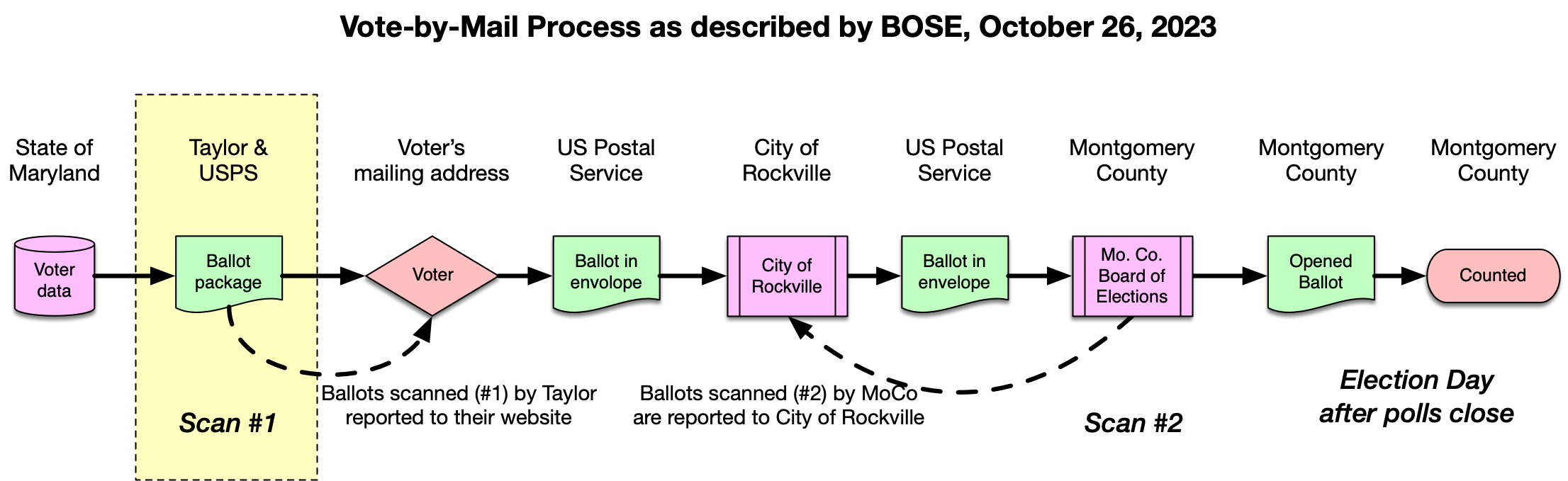
The City Clerk is in the process of mailing the missing ballots and BOSE has prepared a statement for the Mayor and Council and the candidates for the upcoming election (see below), along with a message on the City’s website that noted, “This technical issue has not affected the integrity of the city’s election process. This issue affected only the ability of voters to track their ballots through the United States Postal Service. The issue had no effect on the actual delivery of ballots.” No mention of the missing ballots, alas.
The City Clerk also mentioned that a couple of thousand ballots have already been received and will be sent to the Montgomery County Board of Elections for processing. Ballots received will be posted on the City website starting on November 1; ballots are not counted until the polls close on Election Day.
Please remember to vote early by mail. Ballots must be received by (NOT mailed to) the City of Rockville by 8 pm on November 7. If you’re running late, two outdoor drop boxes are located at City Hall and Montrose Community Center. Four indoor drop boxes are located at the Senior Center, Lincoln Park Community Center, Twinbrook Community Center, and Thomas Farm Community Center only during hours of operation.

 Max for Rockville