Historic Preservation, Election Rules, and State Priorities on Rockville Council’s September 14 Agenda
Rockville’s Mayor and Council meets Monday, September 14, 2026 beginning at 5:30 p.m. The first hour will be devoted largely to community recognitions and proclamations. The heavier policy work begins around 7 p.m., with the first significant Council actions scheduled for roughly 7:20 to 7:25 p.m. Several items deserve particular attention because they could shape Rockville well beyond Monday night.
Will Rockville Preserve 24 Martins Lane?
The most immediate decision concerns 24 Martins Lane, a property associated with the historically Black Haiti/Martins Lane community. The Mayor and Council will first hold a public hearing and then are scheduled to vote on whether to place the property in Rockville’s Historic District Overlay Zone. The Historic District Commission voted 4-1 to recommend designation, finding that the property met five of the city’s historic-designation criteria. The Planning Commission later found the designation consistent with the Comprehensive Plan.
The history here matters. The Haiti/Martins Lane community is one of Rockville’s oldest Black neighborhoods, with roots extending to about 1830, when free Black landowner Samuel Martin settled in the area. The neighborhood’s name reflects a broader African American identification with Haiti, whose successful revolution against slavery and declaration of independence in 1804 made it a powerful symbol of Black freedom and self-determination in the nineteenth century. The city’s analysis also identifies the property as representative of Rockville’s Black heritage and of early vernacular residential construction.
The timing also matters because demolition is contemplated. Historic designation would not freeze the property in time, but it would require Historic District Commission review of future exterior alterations and changes to the site. This is the kind of decision that forces Rockville to weigh several legitimate interests at once: preserving African American history, respecting private property, accommodating future development, and deciding what parts of the city’s physical history should remain visible.
Rockville’s Election Rules Are Heading Toward a Rewrite
Later in the evening, the Mayor and Council will hold a worksession on a substantial rewrite of Chapter 8 of the City Code, which governs municipal elections. This discussion is part of a much longer reconsideration of how Rockville conducts its elections. In 2022, the city’s Charter Review Commission recommended a range of changes, including term limits, representative districts, lowering the voting age, allowing noncitizen residents to vote in municipal elections, and exploring ranked-choice voting. The Mayor and Council initially considered placing ranked-choice voting before voters along with several of those questions in 2023, but it did not appear on the final ballot. Instead, voters considered four nonbinding questions on voting age, noncitizen voting, term limits, and representative districts.
Continue reading →Rockville Council to Weigh Rules of Decorum, Zoning Rewrite, and King Farm Future
The Rockville Mayor and Council will meet on Monday, September 29, 2025. Several significant issues are up for discussion, ranging from meeting rules to long-term planning for land use, transportation, and historic preservation. Below is a preview of the topics most relevant to residents and businesses.
Rules of Decorum for Council Meetings
The Council will consider adopting formal Rules of Decorum and Protocols for public meetings. These rules cover conduct for councilmembers, staff, and members of the public, aiming to ensure meetings run efficiently and respectfully. This proposal formalizes expectations for behavior in Council chambers, reinforcing civility and safety. Some of the proposed rules may be toughest for the councilmembers themselves to follow, especially the bans on interrupting or talking over colleagues and on making lengthy or repetitive comments that delay business.
Opportunities and Threats
Continue reading →In 1776, Independence Wasn’t Obvious
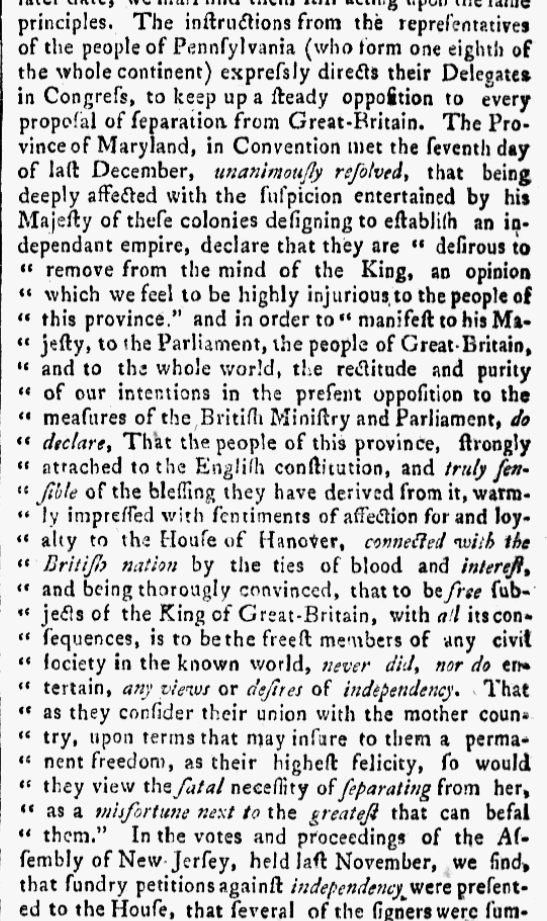
Today, as we celebrate our independence from Great Britain and look forward to the 250th anniversary in 2026, it’s important to reflect on the complex journey to liberty and freedom. While we grill hot dogs and slice watermelon, we might nostalgically view the decision for independence as an obvious one. However, it was a highly contentious process. If you think achieving national consensus is challenging today, consider 1776, when delegates from the colonies gathered in Philadelphia to debate independence. For instance, in December 1775, Maryland unanimously and vigorously voted against separation from Great Britain, declaring they were:
desirous to remove from the mind of the King, an opinion which we feel to be highly injurious to the people of this province and in order to manifest to his Majesty, to the Parliament, the people of Great Britain, and to the whole world, the rectitude and purity of our intentions in the present opposition to the measures of the British Ministry and Parliament, do declare, That the people of this province, strongly attached to the English constitution, and truly sensible of the blessing they have derived from it, warmly impressed with sentiments of affection for and loyalty to the House of Hanover, connected with the British nation by the ties of blood and interest and being thoroughly convinced, that to be free subjects of the King of Great Britain, with all its consequences is to be the freest members of any civil society in the known world, never did, nor do entertain, any views or desires of independency. That as they consider their union with the mother country, upon terms that may insure to them a permanent freedom, as their highest felicity, so would they view the fatal necessity of separating from her, as a misfortune next to the greatest that can befall them.
Maryland considered independence a “misfortune next to the greatest”? Why did they change their minds six months later?