Question 3: What This Mailer Doesn’t Tell You
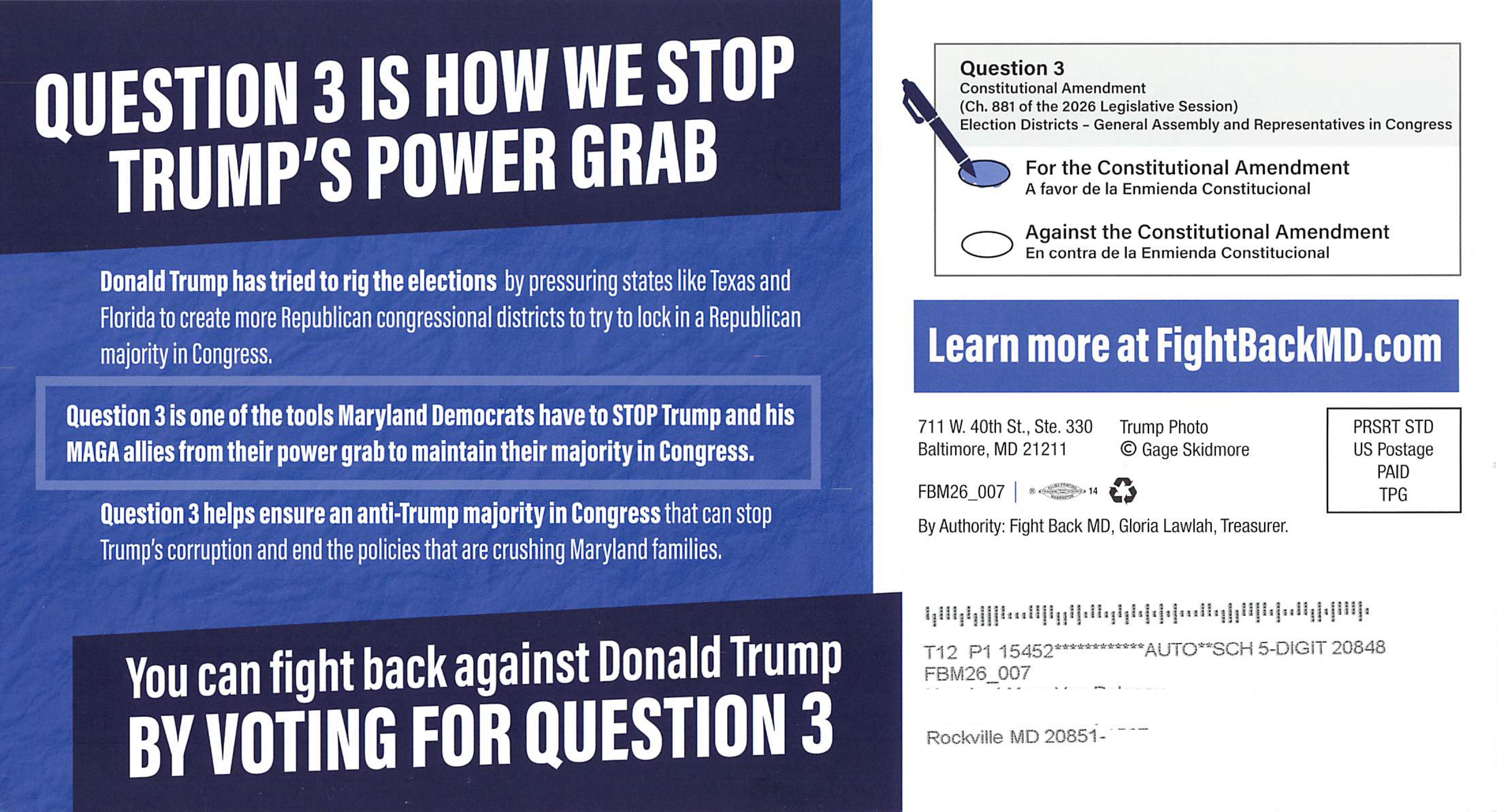
Today I received a campaign mailer urging Maryland voters to vote for Question 3, the constitutional amendment concerning congressional redistricting. The front says, in large letters, “QUESTION 3 IS HOW WE STOP TRUMP’S POWER GRAB.” It argues that Republican-led states such as Texas and Florida have redrawn congressional districts to increase Republican power in Congress. Maryland Democrats, the mailer says, should “fight back” by voting for Question 3.
That certainly tells me why the group that sent the mailer wants Question 3 to pass. What it does not tell me is something more basic: What does Question 3 actually do?
That omission matters because voters are not being asked to approve a temporary political strategy. We are being asked to amend the Maryland Constitution.
What Question 3 actually changes
Today, the Maryland General Assembly draws Maryland’s congressional districts through legislation. Question 3 would not change that. Legislators in Annapolis would continue to decide where congressional district boundaries are drawn.
The important change involves the rules that can be used to judge those maps. Maryland’s Constitution contains standards for drawing legislative districts. Among other things, districts are supposed to be compact and contiguous, and lawmakers are supposed to pay attention to county and other political boundaries. A 2022 court ruling applied Maryland constitutional protections to a congressional redistricting plan and struck down the map adopted by the General Assembly. That ruling is an important part of the history behind Question 3.
If Question 3 passes, the Maryland Constitution would specifically say that certain districting requirements apply only to districts for the Maryland Senate and House of Delegates. It would also state that nothing in the Maryland Constitution provides criteria for the boundaries of congressional districts (Maryland State Board of Elections).
That is a significant change.
Continue reading →Maryland Ballot 2026: Question 3 on Redistricting
Maryland voters will face an unusually complicated constitutional question this November concerning congressional redistricting. Question 3 does not itself redraw Maryland’s congressional districts. Instead, it would change the Maryland Constitution to clarify which state constitutional rules apply when congressional districts are drawn—and, just as importantly, which rules do not.
The history behind the amendment helps explain why it is controversial.
Maryland’s Constitution requires legislative districts to be contiguous, compact, and drawn with “due regard” for natural boundaries and the boundaries of political subdivisions. For many years, those provisions were generally treated as rules governing districts for the Maryland General Assembly. That understanding changed during litigation over the congressional map enacted after the 2020 census.
In 2022, retired Judge Lynne Battaglia ruled that those state constitutional requirements also applied to Maryland’s congressional districts. She struck down the General Assembly’s 2021 congressional map, finding, among other things, that it failed state constitutional standards concerning compactness and political boundaries. The General Assembly subsequently adopted a replacement congressional map.
Question 3 is, in significant part, a response to that 2022 decision. During a special session in August 2026, the General Assembly passed HB 2100, sponsored by House Speaker Joseline Peña-Melnyk. The measure passed the Senate 32–13 and was approved by the governor on August 5. Because it changes the Constitution, however, voters must approve it before it can take effect.
If adopted, Question 3 would make three principal changes.
- First, it would specify that Maryland’s constitutional requirements concerning compactness, contiguity, and political and natural boundaries apply to districts for the Maryland Senate and House of Delegates—not congressional districts.
- Second, it would state explicitly that nothing elsewhere in the Maryland Constitution, including the Declaration of Rights, supplies criteria for drawing congressional district boundaries.
- Third, it would allow the General Assembly to give the Supreme Court of Maryland original jurisdiction to hear challenges to congressional redistricting plans.
The argument for Question 3
Supporters describe the amendment principally as a clarification of constitutional law. Their argument is that Article III of the Maryland Constitution was designed to regulate districts for the General Assembly and that the 2022 court decision extended those provisions to congressional districts in a way that had not previously been understood. Under that view, Question 3 restores the historical distinction between state legislative redistricting and congressional redistricting and establishes clearer rules before the next round of mapmaking.
Continue reading →

