Can You Buy Your Way onto City Council?
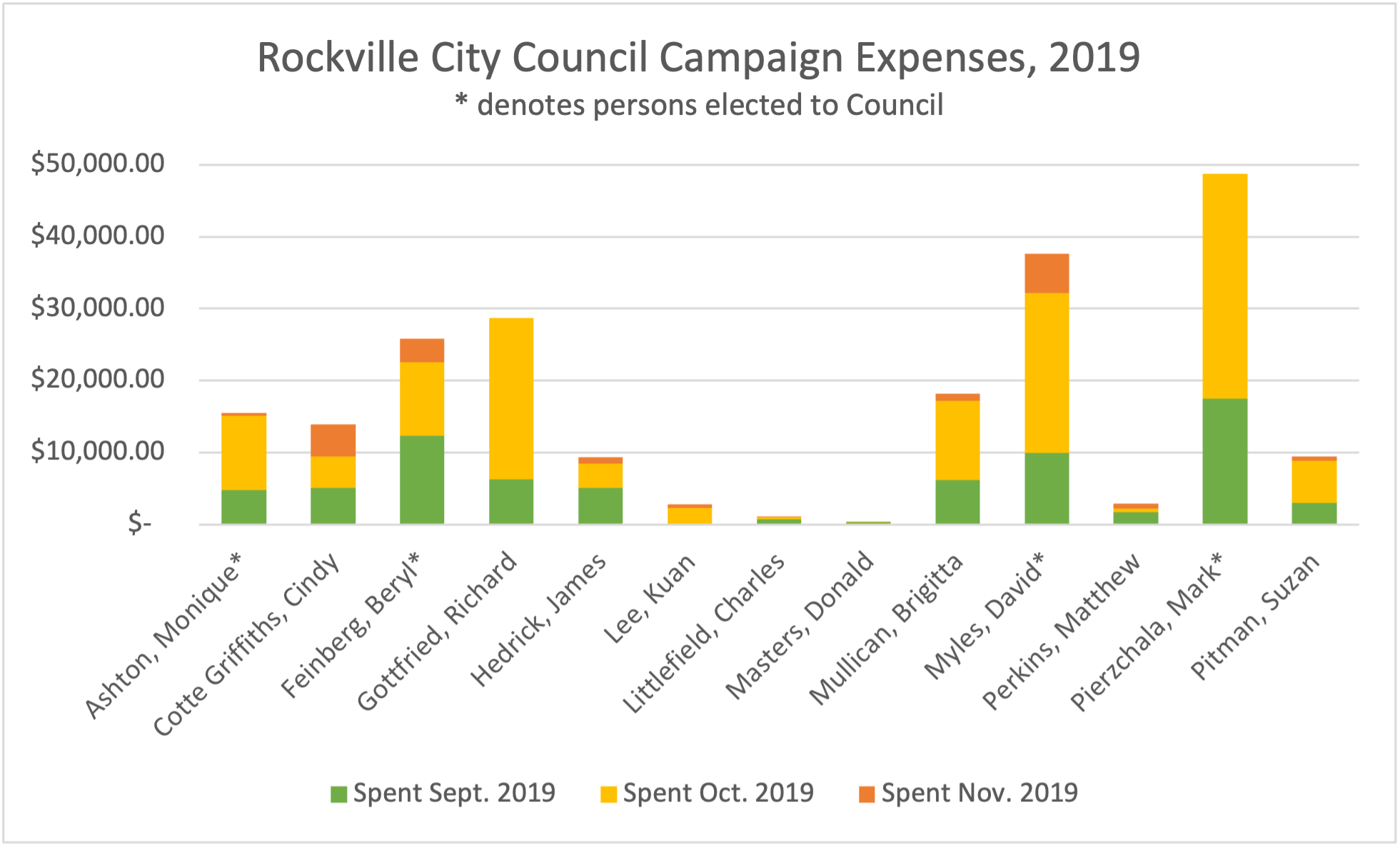
Election campaigns, even small local ones like Rockville City Council, require time and money. With the absence of a local newspaper to reach voters, candidates have to either spend most of their time walking door to door or most of their funds to print and mail campaign literature. In 2019—the last election for Mayor and Council—candidates for Council spent from $424 to $48,776 on their campaigns. Does money matter in local elections? Absolutely, under the right conditions.
As can be seen in the chart above, the candidates who spent the most money (Ashton, Feinberg, Myles, and Pierzchala) were elected to City Council—with one notable exception (Gottfried). The difference? Gottfried had less than a handful of individual contributors to his campaign; his campaign was mostly self-funded. The successful candidates had lots of money and contributors, and those who tended to spend less per vote had more Rockville residents as supporters. I suspect local supporters are more influential on the election than contributors who live out of town.
Looking more closely, successful candidates in 2019 needed at least 5,000 votes and spent between $3 to $10 per vote. In other words, to win a City Council election in Rockville required $15,000 to $50,000—mostly raised from local residents. If a candidate can’t raise those funds locally, they will need to put in a lot of their own money. At the other end of the spectrum, small campaigns who spent $500 to $5,000 didn’t have the capacity to gain sufficient support to cross the 5,000-vote threshold. If there are candidates you’d love to see on City Council, give them your financial support. A contribution of $25, $50, or $100 can make a big difference, especially in September.
The middle-sized campaign of $2 to $5 per voter ($10,000 to $20,000) seem to rely not only on the number of local contributors but also a thoughtfully-crafted campaign. To get out the vote, candidates have lots of ways to spend money (mail, literature, photography, videos, buttons, yard signs, t-shirts, social media, advertising) and time (parades, events, walking door to door, planning meetings, Community Forums, phone calls) but some are more effective than others. Campaigns of this size can’t shoot from the hip; they have to plan and manage carefully. Cotte Griffiths, Hedrick, Lee, Mullican, and Pitman fell into this nebulous and fraught category, so this year’s candidates may want to talk with a couple of them for advice. Perhaps the enlargement of the Council by two seats will allow more middle-sized campaigns to succeed. BTW, Kuan Lee’s expenses are low in the chart but he had over $10,000 in outstanding unpaid bills at the end of 2019, so his expenses are actually closer to $13,000.
The chart also shows that campaigns ramp up in September and at full-speed in October. November is very quiet by comparison because the election is held early in the month. I suspect that Labor Day will begin the campaign season in Rockville and it will include the usual craziness of mud-slinging and dirty tricks (yes, it unfortunately happens in Rockville).
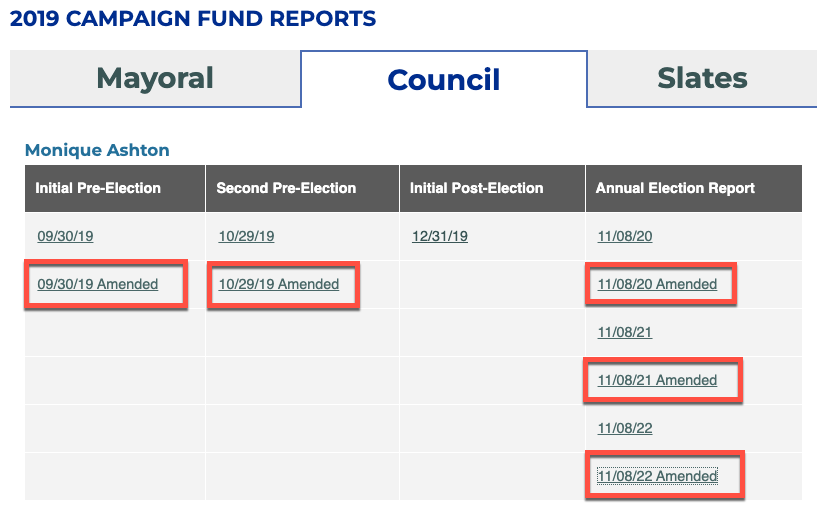
The data for the chart is derived from each candidate’s campaign finance report, which are submitted monthly during the height of the campaign season. Rockville developed its own campaign report forms and they desperately need to be revised because most candidates are unable to complete them properly and have to submit amendments regularly—some of them months later. Plus, key information can obscured because the forms allow candidates to reimburse themselves for expenses—the public can’t see where the cash is flowing, which is the primary purpose of campaign finance reports. The Board of Supervisors of Elections needs to revise the form and establish a standard of performance that no more than 25% of reports in any periods are amended.
City Council Campaign On Its Way with Ten Candidates
The 2023 campaign for Rockville Mayor and Council officially started on May 11 when the Board of Supervisors of Elections (BOSE) certified the petitions of Mark Pierzchala for Mayor and Izola Shaw for Council. As of May 25, there are currently two candidates for Mayor and eight candidates for Council—a total of ten people running for office.
- Candidates for the Office of Mayor
- Monique Ashton (currently on Council)
- Mark Pierzchala (currently on Council)
- Candidates for the Office of Council
- Kate Fulton
- Barry Jackson
- Ricky Mui
- David Myles (currently on Council)
- Paul Scott
- Izola Shaw
- Marissa Valeri
- Adam Van Grack
That’s low compared to 2019 (13 people) and 2015 (11 people), so I suspect more candidates will be added, especially with the number of seats on Council increasing from four to six. Indeed, Harold Hodges’ petition for Council is expected to be certified in June but I’m guessing that incumbents Bridget Newton or Beryl Feinberg won’t run again if they haven’t already submitted petitions. The deadline to submit petitions is Friday, September 8. If you want the latest information, the City Clerk’s office is maintaining a list online (BOSE meeting minutes and videos are not always available).
The big challenge for the candidates is getting the attention of voters. Yard signs and direct mail will be essential, but it is incredibly expensive (especially as postage rates increase on July 9) and can create a campaign budget that easily crosses the $10,000 line—which can discourage good candidates for office. Candidate for Council David Myles demonstrates the tenacity required when running for office nowadays. In the last election, he knocked on the doors of every voter at least twice. Last week, he already dropped off a brochure at my house.
The big challenge for voters is sorting through the candidates’ slogans and platitudes (lower taxes!, fight crime! end government waste! stop overcrowded schools!—if you hear any of these, choose someone else who understands the issues better). With no local newspaper covering Rockville on a regular basis to provide an independent perspective, voters will have to rely on what the candidates say (hmm, sounds mighty biased to me). It will be the candidate’s postcard in the mail, one of the three candidate forums, meeting candidates as they walk the neighborhood, the Rockville 11 special broadcast, or the City’s voter’s guide. I’ll try to do my part in navigating the noise, so check back regularly. Comments and suggestions are welcome.
The election for Mayor and six Councilmembers to four-year terms will be on Tuesday, November 7, 2023. Rockville will conduct its second vote-by-mail election with ballots mailed to all registered voters who live within Rockville city limits by October 13. Ballots must be returned via an official drop box, by mail to City Hall, or in person on Election Day at City Hall and Thomas Farm Community Center. All ballots must be received by 8 p.m. on Tuesday, November 7, 2023. More details at Voting and Elections on the city website.
Rockville City Manager Faces Performance Improvement Plan in Surprise Session

In an extraordinary last-minute Closed Session held on Thursday morning, May 11, 2023, the Rockville City Council put the City Manager Rob DiSpirito into a three-month Performance Improvement Plan (PIP) for reasons unknown. Improvement Plan (PIP) is a formal, structured process designed to help underperforming employees identify and overcome performance issues. It outlines specific goals, expectations, and timelines for improvement, along with support, resources, and regular progress evaluations to facilitate success and growth.
When the Council came out of Closed Session, Councilmember Monique Ashton quickly moved for the PIP and was supported by Councilmember Beryl Feinberg. Mayor Bridget Newtown rushed for a vote without a discussion, but was interrupted by Councilmember Mark Pierzchala to note that, “I don’t know how the sequence of events unrolled but I’m not going to vote for it. I think things have moved past the point where a performance improvement plan is going to be effective. So I’m gonna vote against it. I had asked to make the first motion but that was not allowed, apparently. I’m not sure where that came from. Thank you.” The motion passed 4-1 with Councilmember Pierzchala voting against. A brief three-minute video is available at https://youtu.be/fIu7e9cHhoo, but of course, the closed session portion is held in secret and it’s unclear how long they debated the issue.
I typically discourage Closed Sessions because they are secret and prevent voters from knowing what’s happening—and Closed Sessions usually deal with major issues. Fortunately, Maryland has an Open Meetings Act to keep council and board meetings available to the public so they can be “in the room where it happens.” A quick introduction is available as FAQs, but here are a fundamentals:
- The Maryland Open Meeting Act lists 15 topics that the City Counci) may choose to discuss behind closed doors under specific conditions. These topics or “exceptions,” include personnel discussions about particular individuals, the receipt of legal advice from the public body’s attorney, and subjects that must be kept confidential under other laws. A discussion on “the appointment, employment, assignment, promotion, discipline, demotion, compensation, removal, resignation, or performance evaluation of an employee over whom the Mayor and Council has jurisdiction” is an appropriate reason for the Closed Session on May 11.
- Public bodies must make an agenda available before each meeting, either when notice is posted, if the items of business are known then, or as soon as practicable, but no later than 24 hours before the meeting. There is an exception for meetings held in response to emergencies. This Closed Session was not publicized as an emergency and the the agenda was posted on the city website on May 10 at 5:20 pm, that’s less than 18 hours in advance, so is in violation of the Act. Furthermore, it was not sent out as an email to those who subscribe to the City Council’s agendas (thanks to a blog reader who alerted me to this meeting).
- This meeting was not publicized an emergency, so why the rush? Two councilmembers had difficulties attending in person. Councilmember Myles was absent at the start of the meeting and showed up virtually later. Councilmember Ashton started the meeting virtually and joined in-person by the end. How much of the Closed Session discussion did they miss? Councilmember Ashton didn’t even notice that the vote to go into Closed Session occurred.
Most management leaders will emphasize that employees are the organization’s most important assets so how well are these assets being managed in the City of Rockville? Most of the current councilmembers lack significant experience in supervising employees and the City Council has a poor record of managing its most senior staff. The City Manager, City Attorney, and City Clerk have each been dismissed during Mayor Newton’s tenure. After a while, the only common denominator to these problems is the City Council.
The City Council needs to provide a better explanation for this decision and how they handle Closed Sessions. Or it’s time to rethink their privilege to serve.
May 21, 2023: This post was corrected to show a vote of 4-1 in the caption of the photo.
Mayor and Council to Receive Final Public Comments on FY24 Budget
At its Monday, April 17, 2023 meeting, the Rockville Mayor and Council will discuss FY 2024 budget (public hearing). On the Consent Calendar (items approved without discussion) are no items. The Mayor and Council will also receive reports on no items.
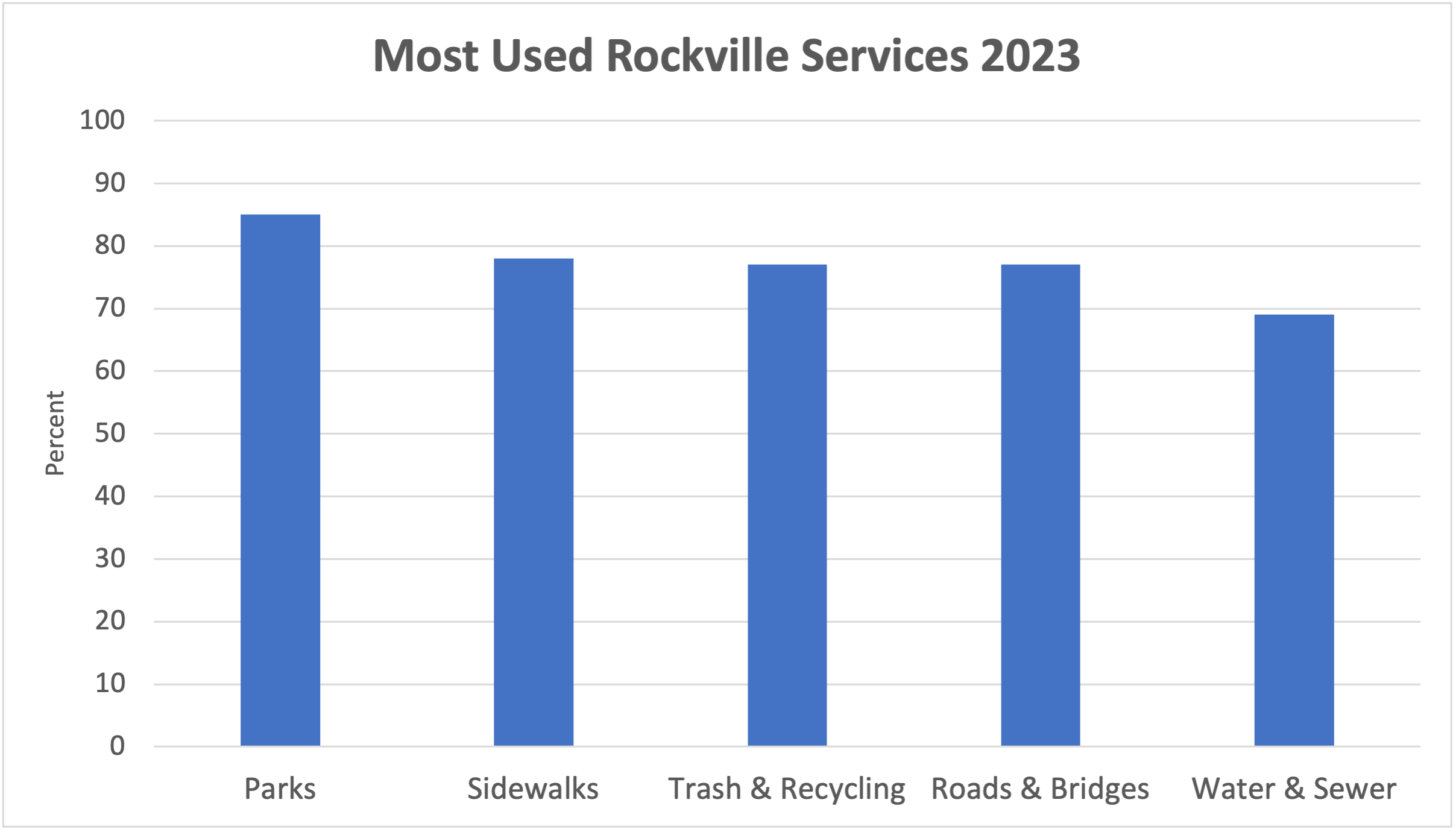
This is the third and final public hearing related to the FY 2024 budget, with more than 100 suggestions received at the March 29 public hearing (lots of requests for community gardens and a new entrance to the senior center from Gude Drive, but many were boiler-plate requests which I tend to ignore). The FY 2024 operating budget totals $156.4 million for the City’s ten operating funds. This represents an overall increase of 5.1 percent from the FY 2023 adopted budget. The total number of full time equivalent (FTE) positions in the FY 2024 operating budget equals 642.7, a net increase of 4.1 FTEs from the FY 2023 adopted level. The FY 2024 proposed budget includes an additional 4.0 regular FTEs over the FY 2023 adopted budget.
The proposed Capital Improvements Program will receive $35.2 million in new funding in FY 2024. The CIP is organized by program area and provides:
- $10 million to the Recreation and Parks program area, which includes funding for the outdoor recreation pool renovations and the design of the dance/fitness studio and multi-purpose space proposed for the King Farm farmstead;
- $7.5 million to the Transportation program area, which includes funding for roadways, sidewalks, and ongoing LED streetlight conversions;
- $10 million to the Utilities program area, which includes funding for water main and sewer rehabilitation;
- $2.4 million to the Stormwater Management program area, which includes funding for stream restoration projects, storm drain analysis and spot repairs, and improvements to City stormwater facilities;
- $5.2 million to the General Government program area, which includes funding for data center and disaster recovery infrastructure and improvements at the city’s Maintenance and Emergency Operations Facility.
A few council members had questions about the budget, which were answered by staff. For Councilmember David Myles, see page 251+, 268+, and 272+. For Councilmember Mark Pierzchala, see page 257+ and 272+. For Councilmember Beryl Feinberg, see page 266 (just one question!), page 269 (two more!), and 277+ (lots, looks like she finally studied the budget by March 20). For Councilmember Monique Ashton, see page 266+ and 274+. For Mayor Bridget Newton, see page 273+ and page 285. If you’re running for council (or really want to know which council members are thoughtful and informed), you’ll want to review this section.
More details in the 294-page agenda packet are available at https://www.rockvillemd.gov/AgendaCenter/ViewFile/Agenda/_04172023-6873.
Mayor and Council to Design Rockville Metro, Spend $6 Million in Federal Funds, and Battle over the Budget on December 13
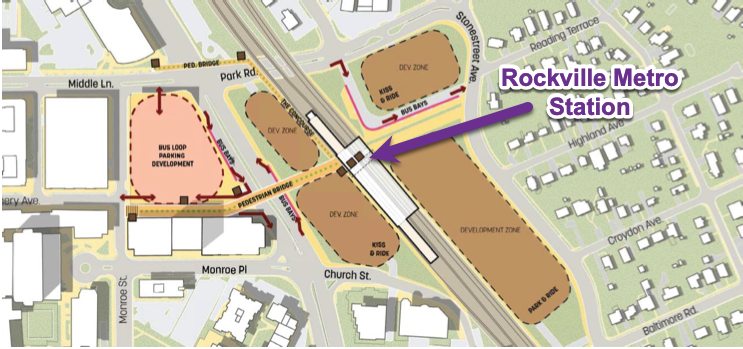
At its Monday, December 13, 2021 meeting, the Rockville Mayor and Council will discuss three design concepts for Rockville Metro station, use of nearly $6 million in ARPA funds, and determine 2023 budget priorities. This is a worksession and will not offer public hearings or a community forum, but it will be streamed live if you are interested in these topics.
Continue reading →Welcome the Mayor and Council for 2019-2023
Congratulations to Bridget Donnell Newton, Monique Ashton, Beryl L. Feinberg, David Myles and Mark Pierzchala, who were elected as Rockville’s Mayor and Council for 2019-2023. Ashton and Myles will bring new perspectives to the Council, both being under 50 years old and people of color.
Just as important is the tremendous turnout for the election. A total of 12,213 ballots were cast in this election, versus 6,468 cast in 2015. The number of votes cast increased by 88.82% between 2015 and 2019. It validates the efforts by the Mayor and Council and the Board of Supervisors of Elections (BOSE) to increase turnout and reverse the downward trend of previous elections by adopting vote-by-mail. Although used in many other states, this is the first time this type of voting has been adopted in Maryland, so I’m sure many other jurisdictions will be asking Rockville for more information. A big thanks to BOSE, the City Clerk’s office, and the city’s Communications department for planning and executing this complex project.
An inauguration ceremony for the new Mayor and Council will be held at 1:00 p.m. on Sunday, November 17 at F. Scott Fitzgerald Theatre, 603 Edmonston Drive. The inauguration is free and open to the public.
The first meeting of the new Mayor and Council is scheduled for 7 p.m. on Monday, November 18 at City Hall, 111 Maryland Ave.

 Max for Rockville