3 Rockville Restaurants Among DC’s 100 Best
The February 2013 issue of Washingtonian magazine is devoted to the 100 very best restaurants in the DC region and three Rockville restaurants are included! Here’s what the critics had to say about them:
- Cava Mezze: “Casual-rustic digs, clever takes on Greek mezze, and gentle prices make these eateries among the buzziest around [the two other Cava Mezzes are in DC and Arlington]. Sometimes the ktichen takes liberties with tradition–gyros, for example, are fashioned into sliders–but it’s usually to the good, and chef Dimitri Moshovitis understands that a bit of innovation goes a long way. And though it might seem there’s little reason to stray from small plates, a whole branzino crisscrossed with char marks convinced us otherwise.” 9713 Traville Gateway Drive (west of #270, just west of Shady Grove near a Giant grocery store). Warning: Traville Gateway Drive is a large loop that intersects twice with Shady Grove Road and nearby there’s a separate but similarly named Travilah Road–don’t the police and fire departments find these loose street-naming conventions a safety hazard? And technically, this restaurant is outside of the City of Rockville (which ends at Shady Grove Road).
- La Limeña: “You can eat Peruvian chicken anywhere these days. You come here to explore the multifaceted cuisine beyond pollo a la brasa–from tiradito (lime-marinated tilapia atop yellow-pepper sauce) to grilled beef hearts (imagine a hanger steak with slightly more chew) to rich aji de gallina (chicken in a sauce of egg, white wine, and garlic). And don’t allow the steam of a sizzling steak trailing through the room divert you from the fish, particularly the ceviches and the whole fried trout blitzed with shaved almonds.” 765-B Rockville Pike (in the far corner of the Continue reading →
A Farmers Market for Winter opens in Sandy Spring
You won’t find tomatoes or peaches, but there are plenty of other items available at the new Winter Market in Sandy Spring. The year, the Olney Farmers and Artists Market has extended the season by moving east a few miles, finding shelter at the Sandy Spring Museum on Sundays from 10 am to 2 pm.
Last weekend I found nearly two dozen vendors selling a variety of produce (mostly squash, greens, carrots, radishes, apples), meat (chicken, beef, lamb), food (tea, sheep cheese, cupcakes, jams, Vietnamese food), plants, handcrafted goods (soap, jewelry, quilted table runners, pet tags), and firewood. It was good weather and many vendors were spread outside but during inclement weather, there’s plenty of room inside the museum (plus there are restrooms!). And at noon, there’s typically a cooking demonstration by a local chef (last Sunday it was the former chef of the White House).
The winter market is every Sunday through April 29, when it shifts to its usual summer location in Olney. If you’re not familiar with quaint historic Sandy Spring, go east from Olney past the Olney Theater Center and continue on Route 108 until you encounter a tighter cluster of housing and a small commercial district that includes an Urban BBQ (a branch of the Rockville restaurant). The museum is on the left just past the gas station–if you pass Sherwood High School, you’ve gone too far. Free parking is available on site.
2012 in review
The WordPress.com stats helper monkeys prepared a 2012 annual report for this blog.

Here’s an excerpt:
600 people reached the top of Mt. Everest in 2012. This blog got about 8,400 views in 2012. If every person who reached the top of Mt. Everest viewed this blog, it would have taken 14 years to get that many views.
JBG Reveals Updated Plans for Downtown Rockville
The JBG Companies, who are currently building a large complex of offices, residences, and stores around the Twinbrook Metro station, are also working on a portion of downtown Rockville that’s slated as phase two of the Town Center. The 2008 economic downturn slowed development considerably but is now picking up, as evidenced by the construction of the corporate headquarters of Choice Hotels. JBG owns the former Giant Grocery store at 275 North Washington Street (across from the Beall’s Grant Apartments) and has been exploring various uses for this vacant building and adjoining parking lot. Today, they shared the following plans:
New shopping, apartments and offices are slated for an overlooked city block in Rockville’s downtown, offering the opportunity to energize a long-vacant Giant grocery store site and adjoining tracts. The JBG Companies is proposing to demolish the grocery store and build new offices and shopping as a complement to busy Rockville Town Square next door. JBG has shared its plans with multiple audiences including neighbors, city officials, community groups and civic users.
“We are fortunate to have strong support from neighbors and businesses alike who have long been asking for renewed vigor in this part of downtown Rockville,” said Anthony Greenberg, a JBG official. “Redeveloping this property is an excellent opportunity to Continue reading →
Is Rockville Middle Class?
During the past few years, I’ve heard people often refer to Rockville as a “middle class” community and in the upcoming economic summit, you’ll hear it mentioned as the defining characteristic for the residents of our fair city. But what does that mean, really? Is it a measure of wealth, values, or behavior? I suspect it’s a bit of all three–and it’s a term that’s slippery enough that everyone can define it differently and still agree with each other. Much like the fictional Lake Wobegon, it seems that everyone is above average…and in the middle class. The alternatives–working class or wealthy–just don’t seem to be appropriate for us, do they?
Recent surveys by the Pew Research Center suggest that for most Americans, being in the middle class is defined as having a secure job, but not necessarily that you own a home or have a college education. It also turned out that about half the people surveyed identified themselves as middle class–but this varies tremendously depending on Continue reading →
Rockville’s New Police Station Unveiled
After five years of discussion, planning, and construction, the City of Rockville unveiled its new police station with a dedication and public open house on Saturday, October 20, providing a rare behind-the-scenes glimpse inside both buildings and all floors. It was a bit difficult to tell how many people showed up given the informal nature of the open house, but I’m guessing it was about 100-150 people. Most of it consists of (yawn) offices, but some of the more interesting spots were the armory and communications center. The best part, though, was meeting the staff and officers who gave tours or explained the work of their department–so much nicer than when you typically encounter them on the street when they’re handing a crime or a conflict.
The federal government abandoned the 1938 post office a few years ago and transferred it free to the City of Rockville so it could be used for a police station. The decision to undertake the $8.5 million rehabilitation and construction project was controversial at times but the new building provides much needed space for public safety and consolidates city offices that were rented and scattered throughout the city. The architects did an outstanding job of preserving the historic post office’s distinctive features, including the lobby and its mural, as well as adding a second building that’s modern but doesn’t compete. One feature that’s not obvious is the emphasis on saving energy, which can be seen in the extensive use of skylights, white roofs, and motion-detecting light switches. One element that does rattle my design sensibilities are the signs, which seem a bit cartoonish and dated, plus I don’t like the colors of green and silver. Chief Treschuk explained that green is a color that’s being increasingly adopted for places of safety (much like yellow for school busses) so I can live with that choice, but the otherwise, the signs really need to be rethought (okay, I’m partially to blame–I sat on the Historic District Commission when it reviewed the plans back in 2010).
Dawson’s Market Opens in Downtown Rockville
After five years of work by the City of Rockville and Federal Realty Investment Trust, Dawson’s Market held its grand opening tonight in Rockville’s Town Square. A grocery store had been slated as an anchor for the Town Square since its inception, but an initial tenant’s bankruptcy and threatened lawsuits by a competing liquor store caused delays, as well as finding a grocery willing to move into space smaller than is typical today. Fortunately, Rick Hood, president of Ellwood Thompson’s Local Market in Richmond, was looking to expand and found an ideal location in Rockville. The Richmond store is named for the two streets that intersect at that store’s location; the Rockville store is named for longtime residents of Rockville (e.g., Beall-Dawson House, Dawson Farm Park).
Dawson’s Market is now open and customers will find it emphasizes local and organic food, and discover such nice amenities as beer and wine departments, juice bar, and a cafe. Many people have compared it to Roots or a small version of Whole Foods. Parking in Town Square is available free for two hours with validation and you’ll find the store at the corner of Washington and Beall, near the modernist Suburban Trust Bank building.
Montgomery County Tax Rates Up Last 5 Years
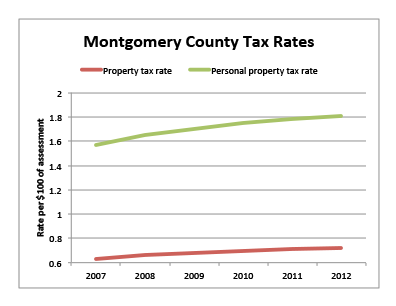
Montgomery County Tax Rates from 2007 to 2012
I often hear Rockville residents grumble about property taxes and they often blame the city for taking an unfair share of their hard-earned income. Although property taxes in the City of Rockville have held steady for the last few years, they’ve risen in Montgomery County. From 2007 to 2012, the County Council has increased the tax rate each year–but hardly anyone in Rockville has noticed and put the blame in the right place. In 2007, the property tax rate was 62 cents for every $100 in assessed value, today it’s 72 cents–a 15 percent increase over five years. Businesses were similarly affected through personal property taxes (which is assessed on inventory, manufacturing equipment, etc.), rising from $1.57 to $1.81, a 16 percent increase over five years. No changes at the State of Maryland–it does not assess property taxes.
Why blame the City and not the County? I suspect it’s because residents assume that 100 percent of their property taxes goes to the city in which they live. Actually, each jurisdiction sets its own rates and you’ll see it split out in writing on your annual property tax bill. If you live in Rockville, for every $100 in the assessed value of your property, you pay 72 cents to the county and 29 cents to the city. Today, the median sales price for a house is Rockville is $416,000, so the total annual property tax bill would be $4,227–$3,012 for the county and $1,215 for the city. Montgomery County receives more than twice as much money from you as the City of Rockville–do you feel you get the same proportion of value in return?
It is has been proposed that a person’s recognition that they pay property taxes is directly related to their level of civic engagement (e.g., voting, writing city council, speaking up at public hearings). In other words, a homeowner knows they pay property taxes because they receive an annual bill, so they’re aware that they’re taxpayers and have a say about government. That’s not true about renters, condo owners, or resthome residents, whose property taxes are rolled into their monthly fees or dues, so they’re not as apt to think they’re tax payers and have a stake in government. What do you think?
Tax rates for the last ten years are available from the Maryland State Department of Assessments and Taxation.
Is Rockville Walkable? Depends Where You Are.
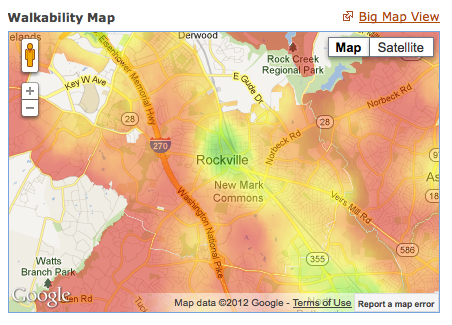
Walk Score map of Rockville
“Walkability” is an increasingly popular measure of a community’s quality of life. By enhancing the convenience and ease of walking, it reduces traffic, improves health, increases community involvement, and puts more eyes on the street for safety. So how does Rockville rate? Walk Score calculates walkability on a block-by-block basis, generating color-coded maps. In the map of Rockville, green indicates the areas that are most walkable (such as downtown) and red the least walkable (such as Horizon Hill west of 270). Around town, they’ve calculated how the following locations fared on a scale of 1-100:
- 85 Very walkable: Maryland Avenue and South Adams (West End)
- 75 Very walkable: Baltimore Road and Grandin (East Rockville)
- 66 Somewhat walkable: Twinbrook Parkway and Viers Mill (Twinbrook)
- 65 Somewhat walkable: Fallsgrove Boulevard and Fallsgrove Road (Fallsgrove)
- 65 Somewhat walkable: Redland Boulevard and Pleasant (King Farm)
- 63 Somewhat walkable: West Montgomery and Laird (West End)
- 48 Car dependent: College Parkway and Princeton (College Gardens)
- 35 Car dependent: Falls Road and Kersey (Horizon Hill)
I’m sure this will generate controversy and prompt comparisons between neighborhoods (what!? Twinbrook rated the same as Fallsgrove and King Farm? Not possible!) but I’d really like to encourage a discussion about making our community more bike and pedestrian (and sometimes car) friendlier.
What makes a neighborhood walkable? According to Walk Score, the more of the following characteristics it has, the better:
- A center: Walkable neighborhoods have a center, whether it’s a main street or a public space.
- People: Enough people for businesses to flourish and for public transit to run frequently.
- Mixed income, mixed use: Affordable housing located near businesses.
- Parks and public space: Plenty of public places to gather and play.
- Pedestrian design: Buildings are close to the street, parking lots are relegated to the back.
- Schools and workplaces: Close enough that most residents can walk from their homes.
- Complete streets: Streets designed for bicyclists, pedestrians, and transit.
The City of Rockville recently received federal funds to develop “complete streets” near the Twinbrook and Rockville Metro stations, so scores for those locations (and pedestrians using those locations) should improve as a result. Any suggestions to make your neighborhood more walkable? Should walkability be a goal for Rockville?
Does Rockville Have the Best Chinese Restaurant in the DMV?
In the July issue of Washingtonian magazine, East Pearl is called the “gleaming new addition to Rockville’s thriving Chinese-restaurant scene” and although it’s been open for only a few months, they’re tempted to call it the “best Chinese restaurant around”. That’s high praise so I checked it out myself a few weeks ago, and I have to say, it’s a significant step up from the others. I was struck first by the interior decor because it didn’t have the usual cliches of red vinyl booths, lanterns, and pictures of China on the wall. If you were dropped at the front door and didn’t notice the display of barbequed ducks in the back corner, you would have assumed it was nice modern restaurant serving Caesar salads with grilled chicken for lunch and crab soup and ribeye steaks for dinner.
The menu is extensive and you’ll see many of the usual dishes but also many that will be new. Some are definitely suited to Chinese tastes that might make Westerners squeamish, such as squid or intestine with sour cabbage. I hate to stereotype, but it seems that the Chinese love chewy textures. Most dishes will be intriguing because of their unusual combinations or preparation, such as steak mignon Cantonese style, Szechuan eggplant with ground pork in a casserole, or pan-fried stuffed triple delight. I tried the latter, which is minced meat (probably pork) sandwiched between slices of eggplant, bell pepper, or tofu, battered and fried, and then covered with a light black bean sauce and sprinkled with chopped green onions. Wow! I also had a side dish of barbeque pork (cha sui) and spicy shrimp dumplings Hong Kong style, while my wife had hot and sour soup. We found them all to be outstanding–well prepared, freshly made, delicious, and nicely presented. I haven’t had a chance to visit again, but I’ve recommended it to neighbors and they’ve come back happy as well.
East Pearl Restaurant is located at 838-B Rockville Pike in Rockville, north of Edmonston in the midst of the string of shops on the east side of the Pike adjacent to the railroad (between YoCake and the MoCo liquor store). Parking is tight and limited. I’ve heard there’s usually a line at dinner, so arrive early or plan to hunt for a parking space and wait for a table. By the way, the Vietnamese restaurant nearby is also a great place to try!

 Max for Rockville