Rapid Transit on the Rockville Pike?

Rockville Pike at Bou Avenue, Rockville, Maryland
Rockville is a key link in the effort to improve transportation from Friendship Heights to Clarksburg. Everyone complains about the traffic, but what can be done about it without building more highways through our neighborhoods? Join residents, local businesses, organizations, and community leaders to learn about the County’s Rapid Transit proposal, get your questions answered by County officials, and engage in a discussion about Rapid Transit and other solutions for turning 355 into a safe, efficient, and attractive boulevard of the future. This is related to the Rockville Pike Plan, so if you’re following that project, you’ll probably be interested in this as well.
Thursday, October 3, 2013 at 6:00 pm in the Cafeteria of the Executive Office Building, 101 Monroe Street in downtown Rockville. Metered parking on the street; free parking in the jury parking lot at Jefferson and Monroe.
Speakers:
- Casey Anderson, Montgomery County Planning Board
- Larry Cole, Montgomery County Planning Department
- Chuck Lattuca, Rapid Transit System Development Manager for MCDOT.
Refreshments will be served.
If you are interested in attending, please register in advance.
This event is co-sponsored and facilitated by Coalition for Smarter Growth and Communities for Transit. Our co-hosts include Montgomery County Sierra Club, TAME Coalition, the White Flint Partnership, and Friends of White Flint.
Capital Bikeshare Coming to Rockville (somewhat)
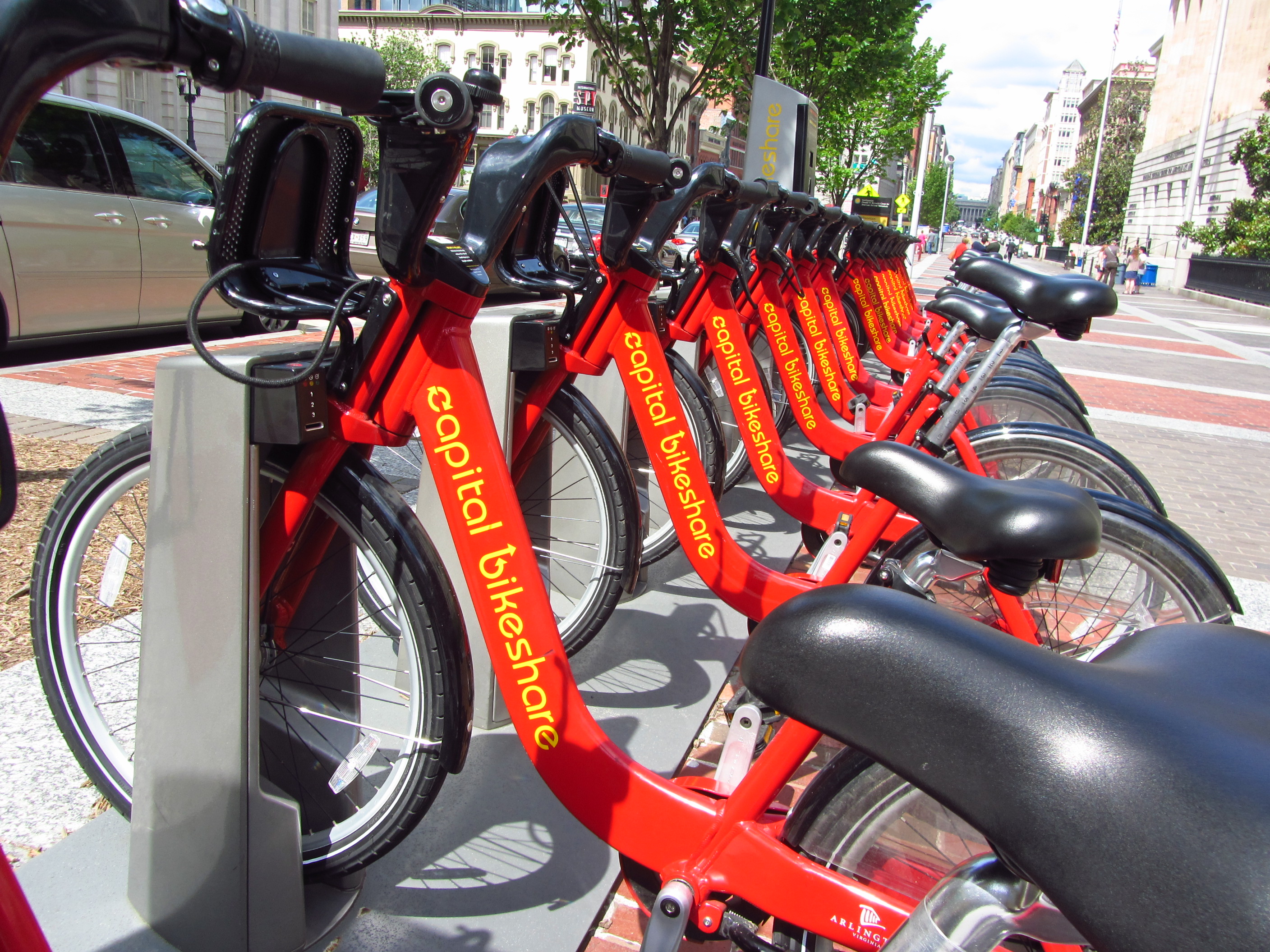
Capital Bikeshare station in Washington, DC.
The City of Rockville has announced that Capital Bikeshare is coming to Rockville in early fall with 13 bike stations through a partnership with Montgomery County. Capital Bikeshare is a network of bicycle-sharing stations that provides access to bikes and offers an alternative to driving. Check out a bike for your trip to work, run errands, go shopping, explore a neighborhood, head to a park, or visit friends and family.
Through bikesharing, cyclists can rent a bike from a designated station and drop it off at any other station within the Capital Bikeshare network. The program currently has more than 1,800 bikes at over 200 stations in circulation across Washington, D.C. and Virginia. It’s been incredibly popular in Washington, DC with both residents and tourists, and I’m happy to see it come into Rockville.
The bike stations in Rockville will be some of the first locations for Capital Bikeshare in Maryland. Proposed locations in Rockville include:
- Campus Drive and Mannakee Street
- Piccard Drive and West Gude Drive
- Rockville Metro – East
- Rockville Metro – West
- Courthouse Square and East Montgomery Avenue
- Fallsgrove Drive and West Montgomery Avenue
- Fleet Street and Ritchie Parkway
- King Farm Boulevard and Piccard Drive
- King Farm Boulevard and Pleasant Drive
- Monroe Street and Monroe Place
- Spring Avenue and Lenmore Avenue
- Taft Street and East Gude Drive
- Fallsgrove Boulevard and Fallsgrove Drive
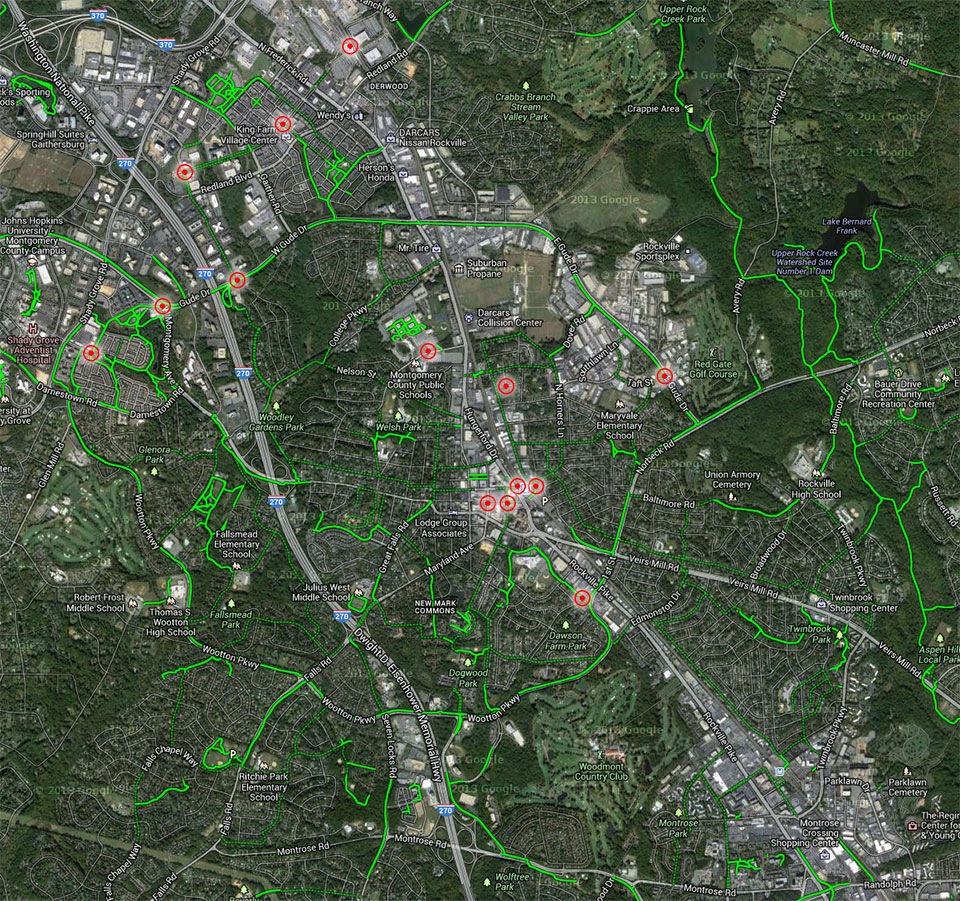
Proposed stations for Capital Bikeshare on a Google Map with bike routes. Click to enlarge.
I’ve plotted these locations (plus Shady Grove Metro, which is outside of Rockville but will be part of the BikeShare network) on a bike-route-version of Google Maps to better understand the impact on and benefit to Rockville. Google Maps can identify bike routes, with a Continue reading →
JBG Reveals Updated Plans for Downtown Rockville
The JBG Companies, who are currently building a large complex of offices, residences, and stores around the Twinbrook Metro station, are also working on a portion of downtown Rockville that’s slated as phase two of the Town Center. The 2008 economic downturn slowed development considerably but is now picking up, as evidenced by the construction of the corporate headquarters of Choice Hotels. JBG owns the former Giant Grocery store at 275 North Washington Street (across from the Beall’s Grant Apartments) and has been exploring various uses for this vacant building and adjoining parking lot. Today, they shared the following plans:
New shopping, apartments and offices are slated for an overlooked city block in Rockville’s downtown, offering the opportunity to energize a long-vacant Giant grocery store site and adjoining tracts. The JBG Companies is proposing to demolish the grocery store and build new offices and shopping as a complement to busy Rockville Town Square next door. JBG has shared its plans with multiple audiences including neighbors, city officials, community groups and civic users.
“We are fortunate to have strong support from neighbors and businesses alike who have long been asking for renewed vigor in this part of downtown Rockville,” said Anthony Greenberg, a JBG official. “Redeveloping this property is an excellent opportunity to Continue reading →
Is Rockville Walkable? Depends Where You Are.
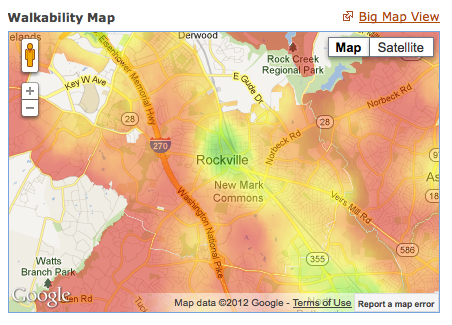
Walk Score map of Rockville
“Walkability” is an increasingly popular measure of a community’s quality of life. By enhancing the convenience and ease of walking, it reduces traffic, improves health, increases community involvement, and puts more eyes on the street for safety. So how does Rockville rate? Walk Score calculates walkability on a block-by-block basis, generating color-coded maps. In the map of Rockville, green indicates the areas that are most walkable (such as downtown) and red the least walkable (such as Horizon Hill west of 270). Around town, they’ve calculated how the following locations fared on a scale of 1-100:
- 85 Very walkable: Maryland Avenue and South Adams (West End)
- 75 Very walkable: Baltimore Road and Grandin (East Rockville)
- 66 Somewhat walkable: Twinbrook Parkway and Viers Mill (Twinbrook)
- 65 Somewhat walkable: Fallsgrove Boulevard and Fallsgrove Road (Fallsgrove)
- 65 Somewhat walkable: Redland Boulevard and Pleasant (King Farm)
- 63 Somewhat walkable: West Montgomery and Laird (West End)
- 48 Car dependent: College Parkway and Princeton (College Gardens)
- 35 Car dependent: Falls Road and Kersey (Horizon Hill)
I’m sure this will generate controversy and prompt comparisons between neighborhoods (what!? Twinbrook rated the same as Fallsgrove and King Farm? Not possible!) but I’d really like to encourage a discussion about making our community more bike and pedestrian (and sometimes car) friendlier.
What makes a neighborhood walkable? According to Walk Score, the more of the following characteristics it has, the better:
- A center: Walkable neighborhoods have a center, whether it’s a main street or a public space.
- People: Enough people for businesses to flourish and for public transit to run frequently.
- Mixed income, mixed use: Affordable housing located near businesses.
- Parks and public space: Plenty of public places to gather and play.
- Pedestrian design: Buildings are close to the street, parking lots are relegated to the back.
- Schools and workplaces: Close enough that most residents can walk from their homes.
- Complete streets: Streets designed for bicyclists, pedestrians, and transit.
The City of Rockville recently received federal funds to develop “complete streets” near the Twinbrook and Rockville Metro stations, so scores for those locations (and pedestrians using those locations) should improve as a result. Any suggestions to make your neighborhood more walkable? Should walkability be a goal for Rockville?
Max For Rockville Now on Twitter
If you use Twitter to keep up with what’s happening, you can follow this blog @MaxforRockville. Every blog post is automatically shared on Twitter, plus I often use Twitter to report on immediate events in Rockville as I encounter them, such as traffic snarls and city meetings. If you’ve been following @MaxvanBalgooy, those tweets will now focus on my professional work in historic preservation, community engagement, and urban design.
Town Square Parking: The Next Generation
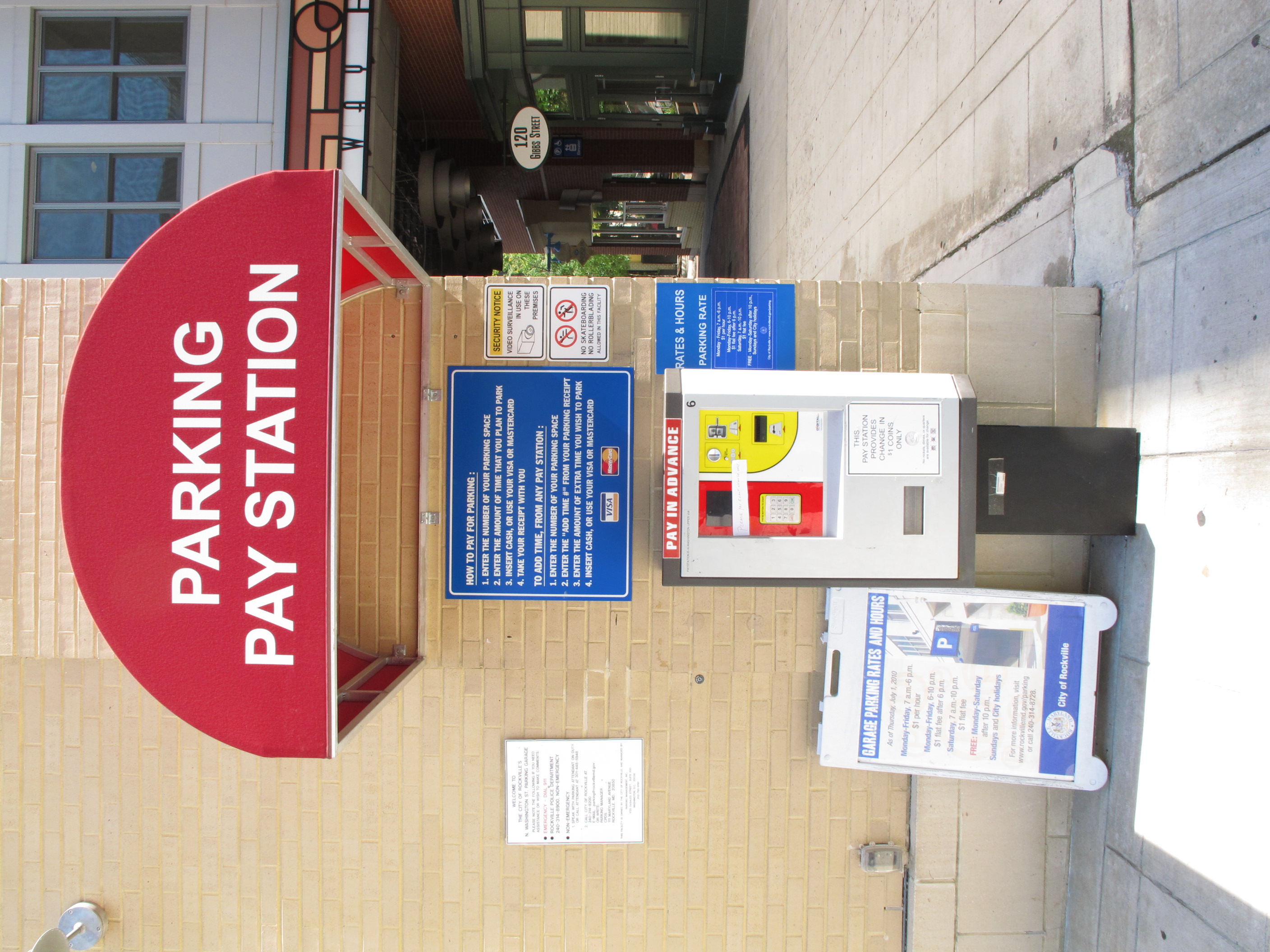
Parking Pay Station in Town Square: System Slated for Retirement
At its August 15, 2011 meeting, in 35 minutes the Mayor and Council of the City of Rockville unanimously approved a fifty-year lease of the three Town Square parking garages to Street Retail, Inc. (a wholly-owned subsidiary of Federal Realty Investment Trust (FRIT)). As Rockville Patch and the Gazette have reported, the lease provides the City with $300,000 in annual rent plus 30 percent of net income and FRIT manages and maintains the garages 24/7 as a “first class public parking garage.” The wayfinding system (red/green lights for each parking space) will stay but FRIT will remove the paying system where you enter your parking space number at a station. FRIT sets all the parking rates (including monthly passes and prepaid cards) and can establish a validated parking system beginning September 1, 2011 for fifty years.
That’s an incredibly long time, especially when I, all the current council members, and perhaps even you won’t be living when this agreement comes to an end. I guess you don’t always get to see things in life to their natural conclusion (my home mortgage?) but in major situations like this, I’d like to consider the impact not only on the next City Council but the next generation of city residents. Although we’re all familiar with time and we measure it precisely down to the second, it’s surprisingly fungible. An hour waiting at the DMV seems so much longer than an hour watching a good movie. So we know that this lease will end in 2061, but what would that look like? To explore this idea, I’ve assembled a timeline looking both forward and back fifty years: Continue reading →
“‘Round Rockville” Bus Returns to Service on Rocky Road
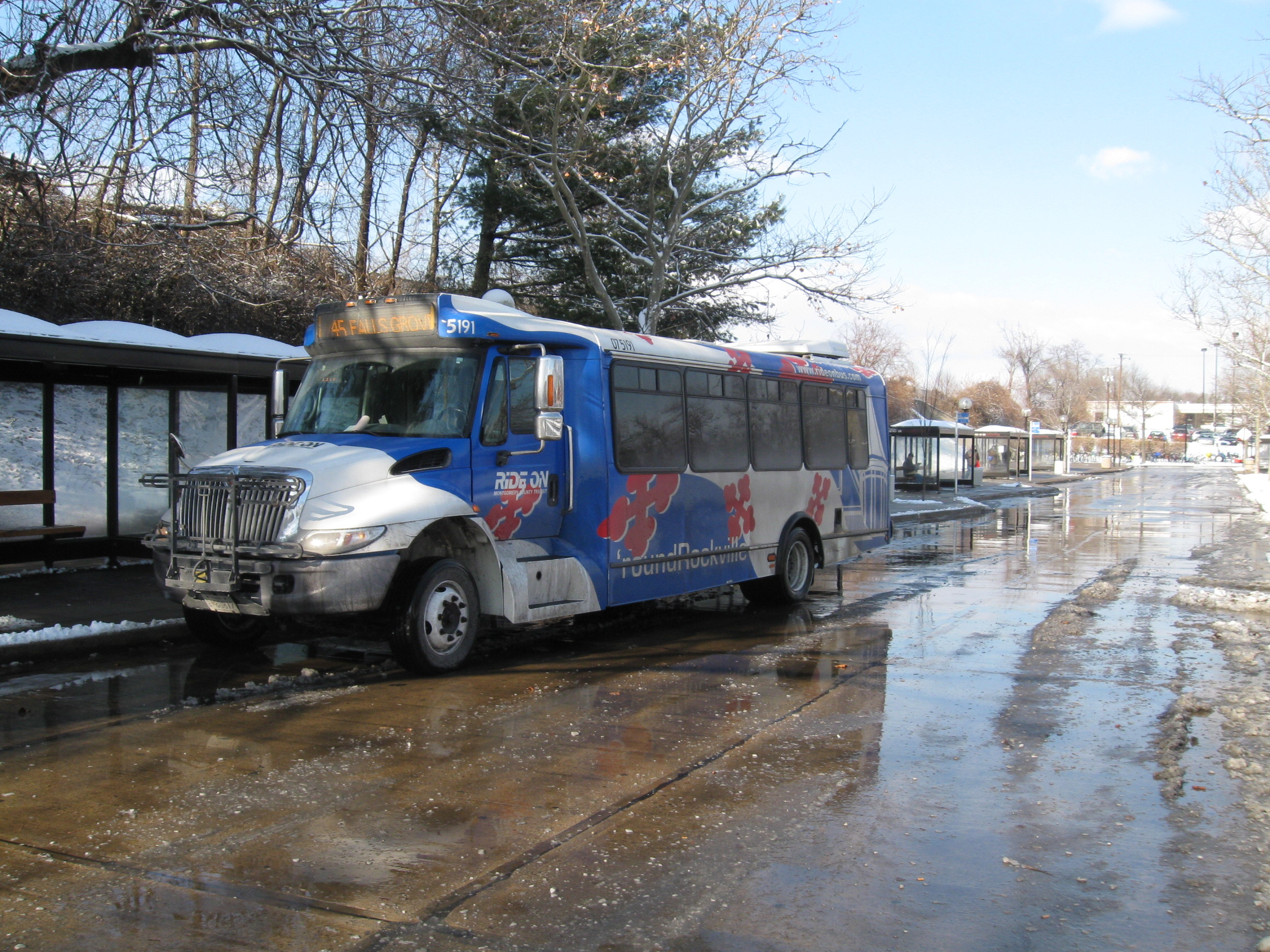
Ride On Bus #45: 'Round Rockville shuttle at Twinbrook Metro
The ‘Round Rockville bus has returned to service, but what does the future hold?
Ride On’s #45 is the major connector for Rockville–it’s the only bus that connects the Twinbrook and Rockville Metro stations with the Civic Center, Town Center, Senior Center, and Fallsgrove. Despite the county’s agreement to operate the six specially branded buses and nearly $1 million of federal and city funds in 2009, it’s been a troubled route.
Shortly after its launch, the buses were pulled from service due to mechanical problems and replaced with an assortment of large and small busses in varying conditions and ages. In 2010, County Executive Ike Leggett proposed eliminating the route and although service was preserved, it was significantly reduced. The “Rockville” busses are now back on the streets, but problems continue. My ride today (and everyone else’s) was free because the fare box was broken. What’s going on in the county’s Department of Transportation? Councilmember Phil Andrews, what are you doing?
Free Parking in Town Square: A New York Perspective
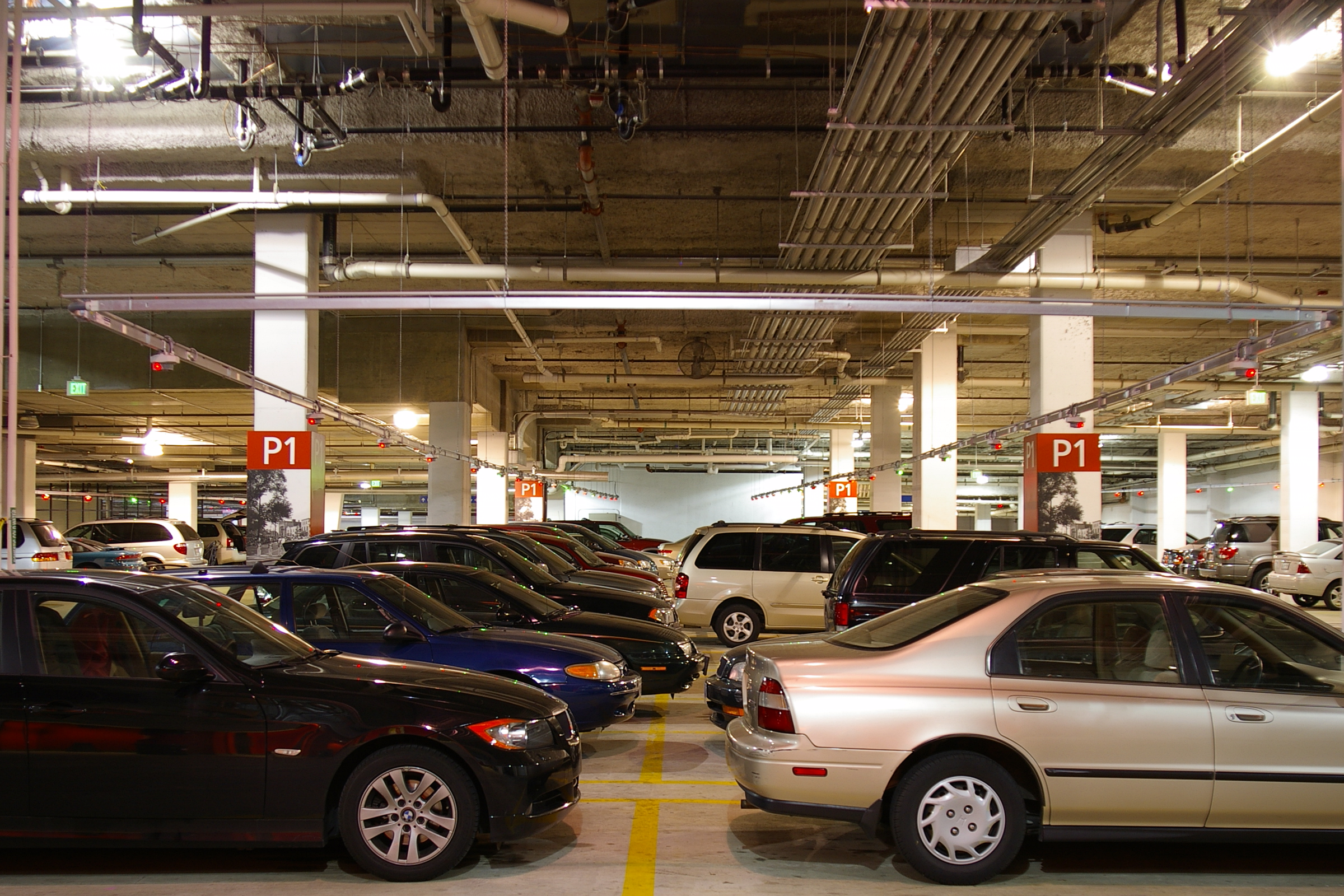
Town Square parking garage
In case you didn’t catch the August 14 edition of the New York Times, it includes an economic evaluation on parking which might bring a different perspective on our perennial debate on Town Center parking. In “Free Parking Comes at a Price,” Tyler Cowen, a professor of economics at George Mason University, suggests that while many people see a free parking space as an entitlement, it’s actually a subsidy that wastes space and money:
Many suburbanites take free parking for granted, whether it’s in the lot of a big-box store or at home in the driveway. Yet the presence of so many parking spaces is an artifact of regulation and serves as a powerful subsidy to cars and car trips. Legally mandated parking lowers the market price of parking spaces, often to zero. Zoning and development restrictions often require a large number of parking spaces attached to a store or a smaller number of spaces attached to a house or apartment block.
If developers were allowed to face directly the high land costs of providing so much parking, the number of spaces would be a result of a careful economic calculation rather than a matter of satisfying a legal requirement. Parking would be scarcer, and more likely to have a price — or a higher one than it does now — and people would be more careful about when and where they drove.
He goes on to note that a parking space may cost more than the vehicle that’s parked in it, especially when you consider a car’s rapid depreciation. So I decided to do some quick calculations based on our situation for the three city parking garages in the Town Center based on the City’s FY2011 budget: Continue reading →
Baltimore Road improvements planned
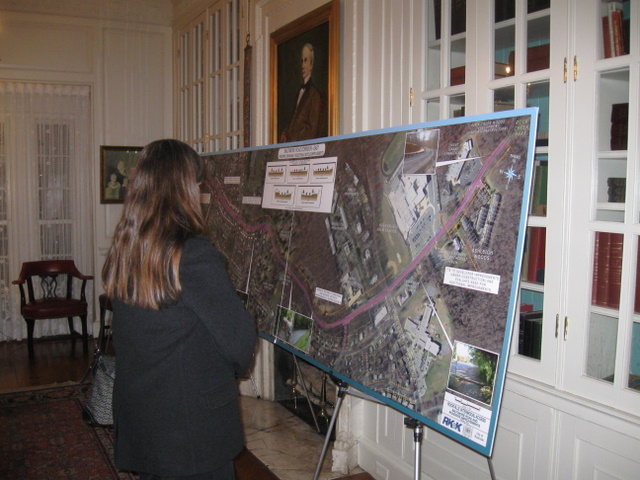
Baltimore Road project map on exhibit.
With about thirty other residents, I attended the public meeting on the “Baltimore Road Intermodal Access Project” at Glenview Mansion on Wednesday night, February 3. The City of Rockville is studying the entire length of Baltimore Road from the Town Center through East Rockville and Twinbrook to the city limits at Rock Creek.
A bit of background
Emad Elshafei, chief of traffic and transportation, opened the meeting by stating that Baltimore Road was studied nearly ten years ago but wasn’t implemented due to lack of funds. In 2006, the City received a federal appropriation of $4 million spread over a series of years for planning and implementation (and the City needs to provide a 20% match). The City also expanded the scope of the project to consider the needs to pedestrians and bicyclists, as well as connect to the new Town Square. Earlier this year, the City hired Rummel, Klepper and Kahl (RKK) to lead the study, documentation, and planning with the assistance of several city staff members. RKK is based in Baltimore and their previous projects include the Wilson Bridge and the Downtown Charlottesville Pedestrian Mall.
First of three public meetings
This public meeting is one of three planned prior to construction in summer 2011–if funding supports the project costs. RKK is conducting a survey of the entire route and this meeting was merely to Continue reading →
Mayor and Council meets in Twinbrook
For the first time in a very long time (John Tyner can perhaps assign a precise date), the Mayor and Council held one of their regular meetings at the Twinbrook Recreation Center since, as Mayor Marcuccio stated, “you can’t come to see us, so we’re coming to see you.” It was a regular meeting, so no agenda items were Twinbrook-focused, but half of the people who spoke at Citizen’s Forum were from Twinbrook and raised the following concerns: Continue reading →

 Max for Rockville