New Mark Commons is not So Common
It was a beautiful day to explore New Mark Commons, the exceptionally well-designed mid-century neighborhood west of downtown Rockville. Hosted by Peerless Rockville, a standing-room only crowd of about 60 people gathered in the Clubhouse to hear an illustrated lecture by Dr. Isabel Gournay of the University of Maryland. Rose Krasnow, a longtime resident and former administrator of New Mark Commons, provided the introductory remarks. Afterwards, about half the group walked the neighborhood to visit a single-family house on Radburn and a townhouse on the lake–plus a surprise invitation to visit a second townhouse. Two more neighborhoods will be visited in the next month–the Americana Centre and King Farm–so if you’d like architecture and local history, these are a perfect way to enjoy both.
Twinbrook’s Beginnings Explored in Chairs and On Foot
Nearly sixty people gathered this morning for an illustrated lecture on the history of Twinbrook by Dr. Richard Longstreth of George Washington University. In the 1940s and 1950s, Joseph Geeraert developed Twinbrook on a 200-acre farm that spanned Viers Mill Road. Geeraert’s Twinbrook was roughly south of Broadwood between Rockville Pike and Baltimore Road, although today Twinbrook is considered to be much larger and runs up to First Avenue (much to the consternation of those who live in the neighborhoods of Viers Mill Village and Silver Rock).
Geeraert was born in Belgium but came to America as a young man, getting started in construction in Takoma Park. Although he had many projects around the Washington, DC region, Twinbrook was his largest, longest running, and most complex development. He built as funding came available and eventually these small developments interconnected to become the neighborhood of houses, schools, churches, library, post office, and shopping centers that we know today. Most people who drive through Twinbrook assume the houses are all the same, but Geeraert modified and enlarged the designs over time to appeal to the changing tastes of buyers.
After the lecture, the audience discussed the names of streets, racial discrimination, and evolving construction practices. Then about half of the group went on a short walk around the neighborhood to see various types of houses and take a stroll on a hidden walkway. It was great to see so many current and former Twinbrookers (including some who lived here for 50 years!) and to hear their stories of living in the neighborhood.
This lecture is the first in a series on Rockville’s recent neighborhoods, so check Peerless Rockville’s website for the times and dates of upcoming events, as well as a two new interpretive maps of Twinbrook.
Rockville to Explore its 20th-Century Communities
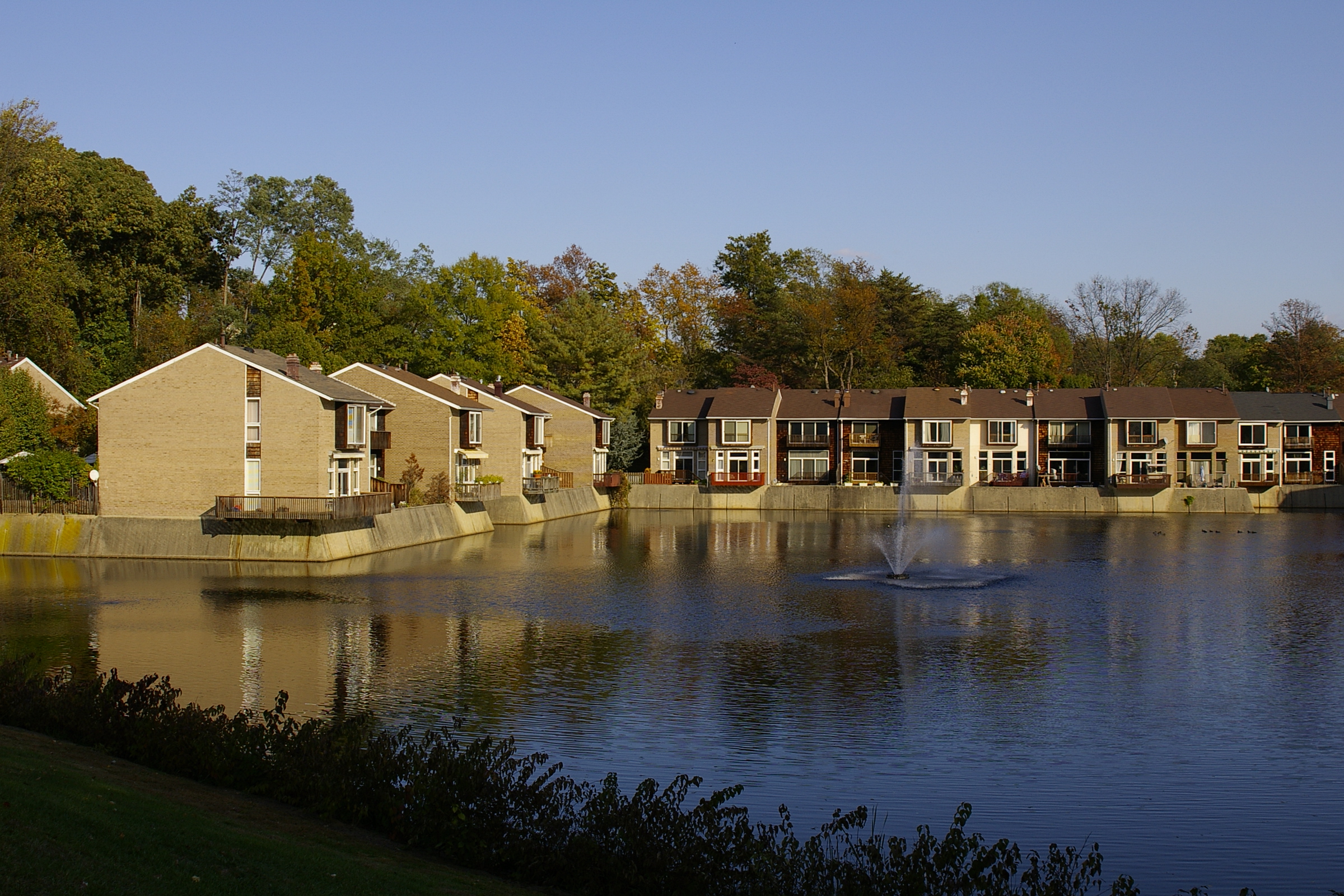
New Mark Commons: Maryland or Scandinavia?
In a series of illustrated presentations and walking tours this spring, Peerless Rockville will explore several of Rockville’s modern neighborhoods, including Twinbrook, New Mark Commons, and King Farm.
Free and open to the public, the series will highlight five neighborhood communities from the early postwar housing boom to mid-century planned development to the “new town” movement popular at the end of the century. The series will culminate in an evening lecture and panel discussion at Rockville City Hall on the factors that influenced modern development, the significant elements of each time period, and the special features of each community that have contributed to its success and left lasting imprints.
The schedule for the upcoming series:
Building Houses, Creating Community: Joseph Geeraert and Twinbrook, featuring professor Dr. Richard Longstreth of George Washington University, Saturday, March 23, 10 am at the Twinbrook Community Center Annex.
Woodley Gardens: A Traditional Red Brick Neighborhood with a Modern Feel, featuring Continue reading →
Is Rockville Walkable? Depends Where You Are.
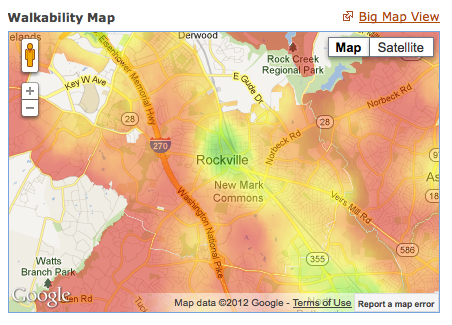
Walk Score map of Rockville
“Walkability” is an increasingly popular measure of a community’s quality of life. By enhancing the convenience and ease of walking, it reduces traffic, improves health, increases community involvement, and puts more eyes on the street for safety. So how does Rockville rate? Walk Score calculates walkability on a block-by-block basis, generating color-coded maps. In the map of Rockville, green indicates the areas that are most walkable (such as downtown) and red the least walkable (such as Horizon Hill west of 270). Around town, they’ve calculated how the following locations fared on a scale of 1-100:
- 85 Very walkable: Maryland Avenue and South Adams (West End)
- 75 Very walkable: Baltimore Road and Grandin (East Rockville)
- 66 Somewhat walkable: Twinbrook Parkway and Viers Mill (Twinbrook)
- 65 Somewhat walkable: Fallsgrove Boulevard and Fallsgrove Road (Fallsgrove)
- 65 Somewhat walkable: Redland Boulevard and Pleasant (King Farm)
- 63 Somewhat walkable: West Montgomery and Laird (West End)
- 48 Car dependent: College Parkway and Princeton (College Gardens)
- 35 Car dependent: Falls Road and Kersey (Horizon Hill)
I’m sure this will generate controversy and prompt comparisons between neighborhoods (what!? Twinbrook rated the same as Fallsgrove and King Farm? Not possible!) but I’d really like to encourage a discussion about making our community more bike and pedestrian (and sometimes car) friendlier.
What makes a neighborhood walkable? According to Walk Score, the more of the following characteristics it has, the better:
- A center: Walkable neighborhoods have a center, whether it’s a main street or a public space.
- People: Enough people for businesses to flourish and for public transit to run frequently.
- Mixed income, mixed use: Affordable housing located near businesses.
- Parks and public space: Plenty of public places to gather and play.
- Pedestrian design: Buildings are close to the street, parking lots are relegated to the back.
- Schools and workplaces: Close enough that most residents can walk from their homes.
- Complete streets: Streets designed for bicyclists, pedestrians, and transit.
The City of Rockville recently received federal funds to develop “complete streets” near the Twinbrook and Rockville Metro stations, so scores for those locations (and pedestrians using those locations) should improve as a result. Any suggestions to make your neighborhood more walkable? Should walkability be a goal for Rockville?
Suburban Dreams or Nightmares?
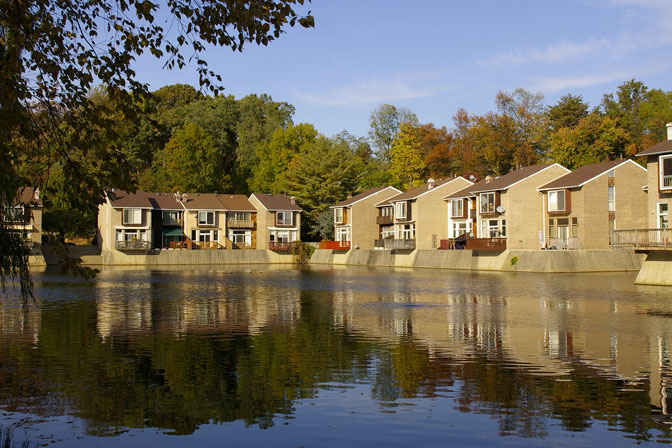
The “lakeside villas” at New Mark Commons in Rockville, Maryland.
This Wednesday, May 16, I’ll be leading a tour of 20th-century planned communities for the American Institute of Architects’ annual convention. We’ll start with 1930s Greenbelt (one of a handful developed by the federal government to demonstrate how communities could be intentionally planned, not just haphazardly developed) and then visit two other nationally significant planned communities, both in Rockville: 1960s-70s New Mark Commons and 2000s King Farm. I’ll be joined by Dr. Elizabeth Milnarik, Dr. Isabel Gournay, and Jim Wasilak (Rockville’s Chief of Planning). By the end of the day, participants will have a nice overview of “community making” in the 20th century, all very different responses by some of the best minds of their times.
I love sharing Rockville with anyone who’s interested but unfortunately, this tour is limited to members of the AIA. But you can easily explore these neighborhoods yourself and if you want more details, Greenbelt has a museum in one of the original residences and Dr. Isabel Gournay at the University of Maryland has written a scholarly essay on King Farm (and Woodley Gardens) in Housing Washington: Two Centuries of Residential Development and Planning in the National Capital Area , edited by Richard Longstreth (2010). If you’d like a guided tour, suggest it to Peerless Rockville and perhaps they’ll put one together in the near future.
New Mark Commons and King Farm are hailed as idealistic suburban communities, but it wasn’t true of all neighborhoods in Rockville. In 1956, John Keats criticized the monotony and isolation of the suburbs around Washington, DC in his popular novel, The Crack in the Picture Window. He follows the lives of Mary and John Drone, a young family trying to get established. They move up from a small old apartment in northern Virginia and move to a new house in suburban Maryland, supposedly based on Rockville’s Twinbrook neighborhood:
[John Drone counted his blessings and said,] “Great. I have a wife and two swell kids, a new split level with everything in it, a new car with all the extras, and I got myself not one but three jobs. I’m meeting all my payments, every month.”
As for Mary’s life, the first few weeks were spent in the charming exhilaration which new surroundings always bring. Gaily, she explored the cellar bedroom which had been added to her domain. She liked the little thrill of going up two steps to the living room, and then up another two into the bedrooms. She was as happy as a squirrel in a new, three-ring cage. This light mood persisted through nearly two months, until at last there came that day when her new world suddenly became only too familiar.
It was the day she stood looking out her picture window and for the first time became completely aware of the picture window across the treeless street. For a horrid moment she stood there, staring. The she ran to her door and tore it open, looking up and down the block. And everywhere she looked, she saw houses exactly like her own, row on row of them, the same, the same, the same…
Homes and Hospitality Tour this Saturday
Get to know your city a bit better through the upcoming Homes and Hospitality Tour on Saturday afternoon, May 12. Peerless Rockville organizes this special one-day exploration of a neighborhood every two years, and this year’s focus is East Rockville. Most people don’t realize that this neighborhood east of the tracks not only has one of the densest collections of historic houses, but also some award-winning contemporary homes. Once directly connected to downtown Rockville via Baltimore Road, after the streets were rerouted in the mid-20th century, East Rockville became hidden and forgotten, with many of the houses being cut up into apartments or falling into disrepair. During the last couple decades, however, young couples and entrepreneurial investors saw the potential of this derelict neighborhood and began restoring the historic houses or building new ones on rare empty lots. Interest in this neighborhood continues to grow given its long history, its architectural diversity, and its proximity to Metro, MARC, and downtown.
The Tour includes six different places to visit at your own pace and in any order: three historic houses, two modern houses, and one public building. All have remarkable stories (one of the first electrified houses in the city, another linked to a typhoid epidemic, and another that stands on a former “laboratory to prepare for Armageddon”–wow!) and by exploring them together, you’ll leave with a new appreciation for your community and be inspired by the care of your fellow residents (several have won awards). Unlike most home tours, however, the event is staffed by many community leaders (so you may greeted by your Mayor, Police Chief, or State Delegate), many local restaurants provide refreshments (such as Carmen’s Ice Cream and Tower Oaks Lodge), and music is provided by local artists and students. For $25, it’s a bargain for a special afternoon in your own town (and a great gift for Mother’s Day!) but if you buy in advance or if you’re a Peerless Rockville member, you can get a discount of up to 25% off. Get your tickets in advance at PeerlessRockville.org or on the day of the event at the Pump House at 401 South Horner’s Lane.
Developments around Rockville Metro to be Explored
This Saturday, April 21, from 10 am to 12 noon, join Peerless Rockville for a tour of The Alaire at Twinbrook Station, the beginning of a significant, New Urbanist community called Twinbrook Station being developed by the JBG Companies and WMATA. It’s the first Gold Leadership in Energy and Environmental Design Neighborhood Development (LEED-ND) plan in the Washington metropolitan area, has been designated a Smart Growth project by the Washington Smart Growth Alliance, and received the International Charter Award for Excellence from the Congress for the New Urbanism. So if you want to know what all the fuss is about, staff from JBG will discuss their approach to development around a transit station, view an apartment, and find out more about their future plans and on-going projects, both at Twinbrook Station and on adjacent properties. Tour starts at 10 am at 1101 Higgins Place (the entrance to the Alaire apartments) and costs $7. Space is limited and reservations are recommended. Two-hour free parking in the Alaire garage (and the adjacent Metro lot is free on weekends). For more information, please visit PeerlessRockville.org or call 301-762-0096.
And just in case you didn’t catch my previous tweets, it appears that the nearby Walmart project at the Rockville Pike and Bou Avenue has been temporarily postponed: Bagel City recently signed a two-and-a-half year lease. A few doors down, the Office Depot is closing but it’s unrelated to future developments of the site (btw, everything is on sale at 10-30% off but is non-returnable).
In other related news, a couple of Rockville’s communities will enjoy national attention in May when I co-lead a tour of New Mark Commons and King Farm for the annual convention of the American Institute of Architects. We’ll be looking at cutting-edge planned communities in Montgomery County, starting with 1930s Greenbelt and ending with the 21st century King Farm. Lunch will be in Town Square, which has turned up as the poster child for the Congress for the New Urbanism. If you thought Rockville was just a little sleepy suburb, it’s time to change your mind.
Mayoral Promises Missed or Fulfilled?

Mayor Marcuccio giving her inauguration speech, Nov. 22, 2009
At the November 22, 2009 inauguration of the current City Council, Phyllis Marcucchio opened her speech as the newly seated Mayor with the following words:
In keeping with my campaign issues, where I called for bringing citizens into the decision-making process, there are a number of actions I will propose during my administration which I hope the Council will support and which I believe will move our hometown safely and thoughtfully into a more citizen-driven future. Here are a few of those initiatives.
Over the next five minutes, she laid out a half dozen promises around financial management, charter reform, communications, citizen engagement, the environment, and others. Now that she’s nearing the end of her first term as mayor and hoping to be elected to another, I’ll examine each of these over the next few months to see how’s she fared (and if possible, where the other council members and candidates stand as well and include some of my own analysis). Of course, you’ll be invited to share your opinions but because the election season can provoke stronger and sharper words, I’ll be placing a stronger hand on the rudder to keep us on topic (you’ll want to review the rules for commenting on this blog if you’re unsure what I mean). I am also closing comments after a period of 30-60 days so that we can move the conversation along.
“Choice Hotels Lane” a Bad Choice for Rockville
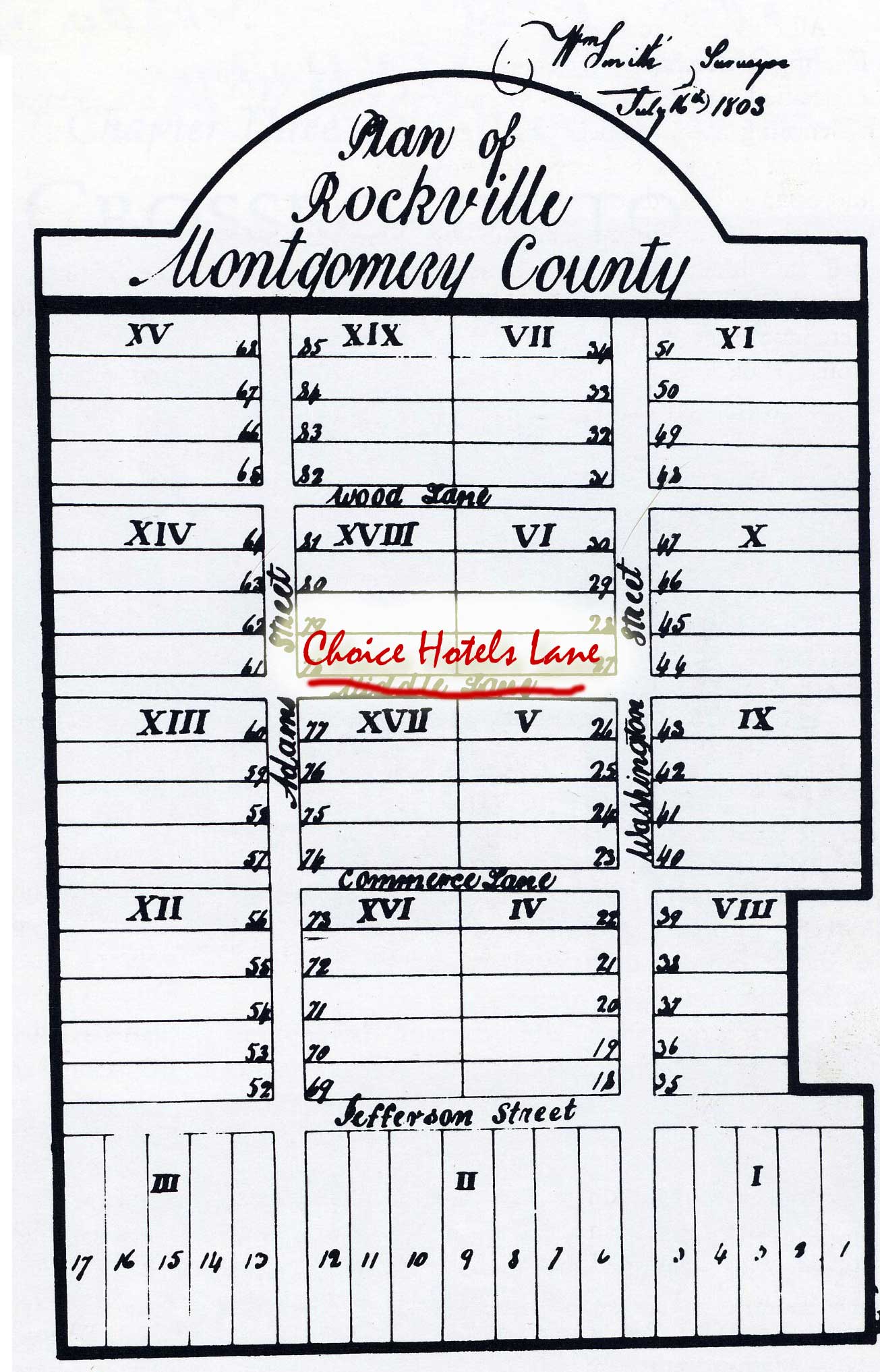
Choice Hotels Lane?
Choice Hotels International is proposing to move their world headquarters to downtown Rockville but it includes a request to rename “Middle Lane” to “Choice Hotels Lane.” Really, this is no April Fool’s Joke–in a letter to the City of Rockville on March 11, Dan Slear of Choice Hotels International stated, “To clarify, Choice requests to change East Middle Lane in its entirety to Choice Hotels Lane.” It’ll be considered at the April 13, 2011 Planning Commission Meeting–but if it happens, the joke will be on us.
Although the name change was proffered as an incentive by the City of Rockville (really? really??), the staff report to the Planning Commission mentioned several concerns:
- it raised eyebrows at the Emergency Communications Center and the Montgomery-National Capitol Park and Planning Commission, who not only were concerned about confusion by emergency responders (are we going to the hotel or the street?) but thought it odd that we’d rename a street after a company.
- it changes the name of this street three times within a three block stretch–West Middle Lane, Choice Hotels Lane, and Park Road–in downtown. Boy, that’ll help people find their way around downtown.
- downtown businesses, such as Gordon Biersch and HSBC Bank, who would be effected by the name change haven’t had sufficient time to respond, but I’m guessing they don’t want to change their neutral address to one that advertises another business.
- it changes the name of an historic street, indeed, the name of a street that’s been part of downtown Rockville since 1803, when the first map of Rockville was drawn. Let’s see, which has the better track record? Middle Lane has been around for more than 200 years while Choice Hotels has been around since 1981.
I’ll add a couple of my concerns: Continue reading →
Exploring Rockville’s Downtowns on May 7
I’ll be leading a 1.5-hour walking tour of Rockville’s downtowns for Peerless Rockville on Saturday, May 7 at 10 am. Wear comfortable shoes, be prepared for the weather, and consider enjoying lunch afterwards (unfortunately, some of the tour is not accessible to persons with limited mobility). Space is limited so please register in advance with Peerless Rockville.

 Max for Rockville