2011 City Boards and Commissions Scorecard
Along with the City Council, the City of Rockville has 23 official boards and commissions to study, advise, and decide on a wide range of issues, from city planning to cultural arts, from human services to animal matters. In addition, there are at least ten other unofficial task forces or committees. All of these boards and commissions are composed of volunteers, usually residents (some include property or business owners who live elsewhere) and most members are nominated by the Mayor and appointed by City Council (a few have members elected in other ways, such as RSI).
Rockville has always encouraged and supported citizen involvement in its government, and used these board and commissions to keep the residents informed and part of the decision-making process. But how well informed are its citizens? All commission meetings are open to the public (I’m going to call them all “commissions” to keep things simple), but only three commissions–Planning Commission, Historic District Commission, and the Board of Appeals–have meetings that are regularly broadcast on Channel 11 and the City website (most likely because the City Council has granted them exclusive decision-making powers). For the other commissions, to find out what’s happening you have to attend the meeting, talk to one of the commissioners, or review the minutes. Obviously, the most convenient way is reviewing the minutes or notes of the meeting, so let’s see how we’ve done.
On January 20, 2012, I tallied the number of meetings and minutes posted on the City website for 2011 (cancelled meetings don’t count). By dividing the number of minutes by the number of meetings, I calculated a “public information score.” So if a commission had posted 9 minutes for 12 meetings, that would earn them a Minutes Score of 9/12 or 75%. The higher the score the better, and here’s how they fared: Continue reading →
Strategies for Engaging Voters
The City Council and community activists have often called for increased voter participation in Rockville’s elections with little success. Typical are the results from the November 2011 election, when 6,240 ballots were cast out of 36,840 registered voters in a city with 62,476 residents. If I pull out my calculator, that’s a voter turnout rate of 17 percent or put another way, ten percent of the residents are making the decisions for Mayor and Council. We may find that level of involvement low, but it’s much better than neighboring Gaithersburg, where the voter turnout rate is in the single digits. Nevertheless, every two years there’s a call to increase voter participation but not much happens.
Last night, I joined a committee of the Rockville Community Coalition to explore ways to actually work on this issue. We didn’t develop any strategies or start any campaigns, but we did identify that voters are motivated by issues, good candidates, and yes, money (the current Republican primaries are a great example). We’ll explore all three to see how this fledgling group can tackle these topics and we hope to be ready in plenty of time for the next City Council election!
Max For Rockville Now on Twitter
If you use Twitter to keep up with what’s happening, you can follow this blog @MaxforRockville. Every blog post is automatically shared on Twitter, plus I often use Twitter to report on immediate events in Rockville as I encounter them, such as traffic snarls and city meetings. If you’ve been following @MaxvanBalgooy, those tweets will now focus on my professional work in historic preservation, community engagement, and urban design.
2011 Rockville Election Analysis Available
Dr. Roald Schrack recently released his analysis of the city council election based upon a statistical breakdown of each voting precinct in the city. His observations include:
- About 17 percent of registered voters actually voted, continuing the trend of a low participation rate. [or to put it another way, less than 10 percent of the population (6,240 voters) decided the fate of the entire city (66,000 residents)] Kudos to District 9 (College Gardens and Woodley Gardens) for a highest participation rate of 23 percent (and what’s happening in District 6 (Montrose, North Farm) with only 8 percent?).
- Hot topics were the Red Gate Golf Course and resistance to urbanization.
- State officials associated with political parties actively joined campaigns for the first time, breaking the non-partisan nature of city elections.
- Endorsements by the Gazette, forums, and mailings were probably the tactics that most influenced voters.
- Absentee ballots were much higher than usual, perhaps due to the televised forums and the introduction of the City’s effort to assist residents in nursing homes with voting.
- Formal slates or informal allies among candidates are a clear advantage.
- Negative campaigning is effective in Rockville.
- Well-informed campaigns are much more effective in Rockville than in the county.
Roald provided a charts to compare the Mayoral races in 2009 and 2011, but didn’t provide any analysis. Comparing Marcuccio’s performance in both years seems to show that she maintained her appeal in the same precincts except for significant gains in districts 2 (West End) and 5 (Twinbrook) and significant losses in districts 4 (Twinbrook Forest, Silver Rock, Burgundy) and 7 (Potomac Woods, Fallsmead, Rockshire).
You’ll find more details (and lots of charts) in his 2011 Rockville Election Analysis (pdf). Thanks, Roald!
The Election is Over but Challenges Lie Ahead
The Rockville City Council elections are over and while the results aren’t official until certified, congratulations to Phyllis Marcuccio who will continue as Mayor, Bridget Newton and Mark Pierzchala who will continue on Council, Tom Moore who will be new on Council, and John Hall who will return to Council after a brief hiatus (and thanks to John Britton and Piotr Gajewski for their recent service on Council). No doubt everyone has already seen the election returns and noted that the Mayor’s race was not only heated but close–they were separated by 415 votes out of a total of 6113 votes. If 209 people (that’s 3 percent of those voting for Mayor) had voted differently, we’d have someone else as Mayor. It’s even closer in the Council race–Moore made it onto Council by just 51 votes. So if anyone thinks their vote doesn’t count, think again if you’re living in Rockville.
Although we know the election results for the entire city, Roald Schrack has broken it down by precinct which provides a clearer picture of what happened–and what it might mean for the governance of the city during the next two years:
- Voting followed two different clusters of candidates: Hall-Gottfried-Newton-Trahan vs Moore-Onley-Pierzchala. That suggests that the community has formed two different visions for its governance, and since the election resulted in an even split among these two “slates” on Council, we might have Continue reading →
All Signs Point to Election Day

It’s 7 am and the campaign signs are surrounding the polling places. They’ll guide you and make a last minute persuasion but don’t believe everything you read (although I’m from Twinbrook and I don’t recall the neighborhood supporting Marcuccio). This sign was authorized by Michael Sweet–does he even live in Twinbrook?). I’ll be at the Twinbrook Community Center to assist any undecided voters and will tweet the numbers in the morning. Be sure to vote today!
Endorsements for Rockville City Council
I’ve read the literature, participated in two debates, visited the websites, listened to neighborhood discussions, and talked to some of the candidates and am now ready to announce my endorsements for City Council:
City Council
- Tom Moore: I met Tom during the last election and even though I was among his opponents, he was incredibly fair, thoughtful, considerate, and funny. I liked him so much that I passed out his literature as well as mine on election day. Although he wasn’t elected to Council in 2009, he’s continued to stay involved in the community and shows that he analyzes issues and gives other perspectives a fair hearing.
- Mark Pierzchala: Mark’s knowledge of city and neighborhood issues has grown tremendously during his first term on Council and he understands the complex nature of making decisions in a diverse community. I don’t always agree with his decisions (he seems to favor businesses more than residents and the city’s heritage at times) but he always explains how he came to his decisions. He’s the only incumbent I’m endorsing for City Council, and losing him would lose continuity on the Council.
- Virginia Onley: Virginia has a long history of service to Rockville through various committees and boards, so she’s experienced the community from various perspectives. Yet, serving on Council will be Continue reading →
Candidates Face Last Day of Debates
Today is a double-header for the Rockville City Council candidates, putting a punctuation point to a long series of debates this season. I attended this afternoon’s session hosted at the Senior Center and tonight is the last with the Chamber of Commerce. By now, the candidates have honed their thoughts and can quickly state their positions, which is much more helpful to the voters. You can also see where alliances have formed, how their personalities affect their thinking, and where there is uncertainty. From today’s forum, it seemed the alliances are Marcuccio, Newton, Hall, and maybe Gottfried vs. Gajewski and Pierzchala (if we arranged this by nationality, we’d have. . .hmm).
This forum was primarily focused on the needs and interests of seniors, so there were questions about the candidates’ ideas to support “aging in place,” homeowner’s tax credit, affordable housing, and the impact of decreased county and state support on Rockville’s senior programming, but some ranged further, for example a surprising question on the King Farm transitway. The $100 homeowners tax credit was discussed throughout the afternoon, with Gajewski and Hall clearly supporting its reappearance; Marcuccio and Newton only if the eligibility criteria could be tightened (e.g., only for seniors); and Francis clearly against, calling it a smokescreen for the more important issue of unfair property taxes and adoption of a piggyback income tax. Time was wasted on the question, “Where senior services ranked as a priority” because no politician will Continue reading →
Rockville Candidates Forum #3
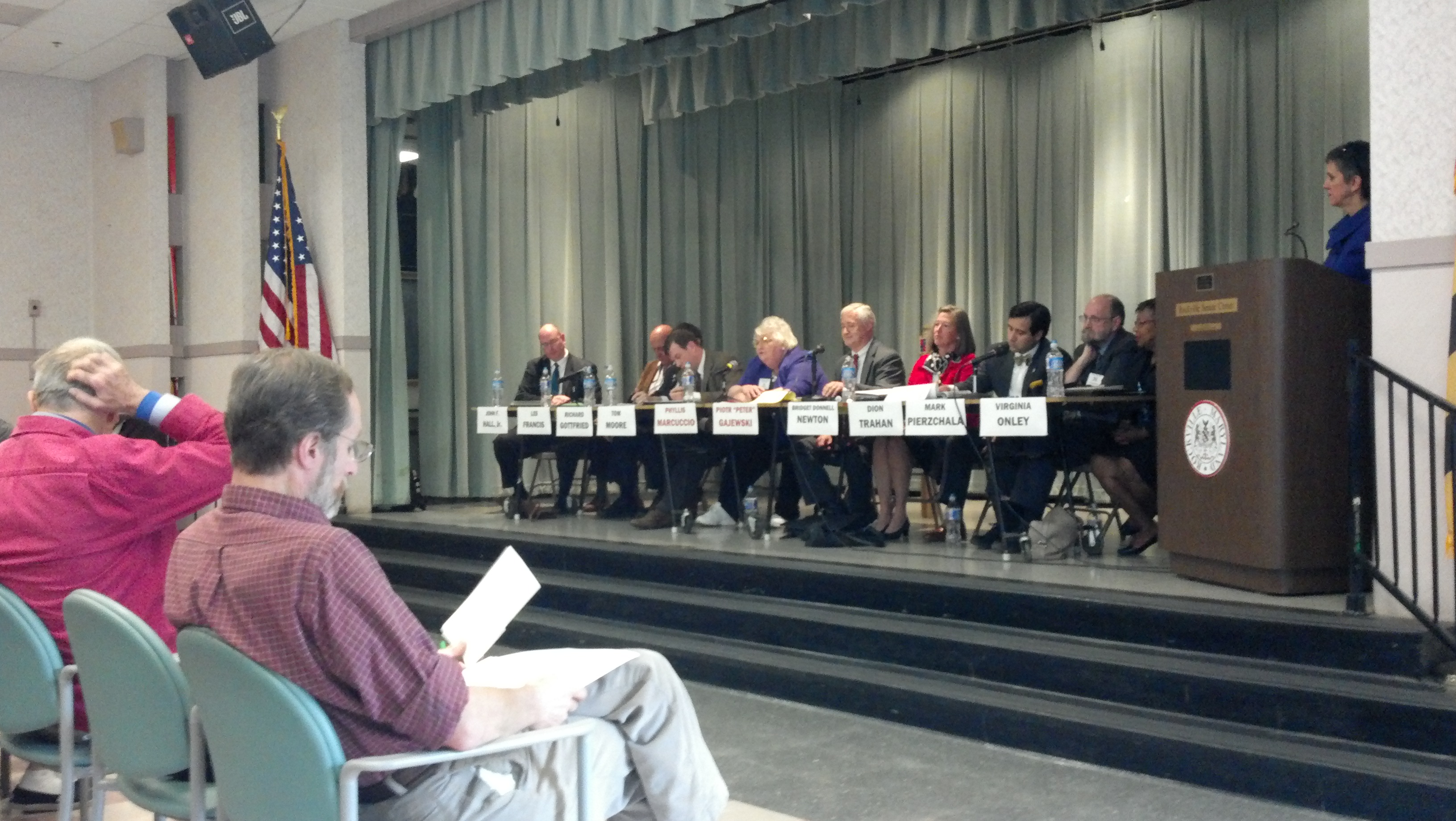
Rockville City Council Candidate Forum at the Senior Center.
I had a chance to attend my first city council candidates forum today, which I think is actually the third of more than a half dozen. If you missed it, don’t worry, you have plenty of opportunities coming up (including two this upcoming week that will be broadcast).
Today’s forum was held in the senior center and hosted by the neighborhood associations for College Gardens, Woodley Gardens, and Plymouth Woods and moderated by Cheryl Kagan. All the candidates were seated in a single row, barely fitting on stage, and about 60 people attended, mostly senior citizens. Unlike some neighborhood forums that focus exclusively on their parochial issues, this one ranged widely around Rockville, including such topics as Rockville in ten years, budget and finances, the APFO, Rockville Pike Plan, the fence separating Montgomery College, the city logo and branding, qualifications of the next city manager, relationships with other government agencies, relations with city staff, the proposed Walmart, and an assessment of the city’s website. Perhaps the most provocative question was, “which candidate do you oppose in this election and why?” I won’t provide a detailed report on everyone’s statements–I’ll leave that to the Gazette or you can watch the 2+ hours of it on YouTube–but will just give general impressions and highlights.
It seems that the candidates are beginning to solidify their statements and finding ways to Continue reading →
Council Election Status
I’ve just confirmed with the City Clerk’s office that the following persons will be on the ballot in November 2011:
Mayor
- Peter Gajewski
- Phyllis Marcuccio
Council
- John Hall
- Tom Moore
- Bridget Newton
- Virginia Onley
The deadline for getting on the ballot is Friday, September 9, so I suspect more names will be added this next week.
If you’re not familiar with the process, it’s not required of any other elected officials serving Rockville–not the County Council, our State Delegates, or State Senator. Each candidate has to submit a petition signed by one hundred registered Rockville voters along with their request to be placed on the ballot. Superficially, it sounds like a nice way to separate the wheat from the chaff, but it’s very hard to do. Most of us don’t know 100 registered Rockville voters, so you have to find them at shopping centers, the Metro stations, or walking your neighborhood. Because most strangers don’t want to be bothered, it provides a major advantage to incumbents who have name recognition and a existing pool of supporters. Complicating matters is that you have to sign the petition exactly as you registered to vote with the Board of Elections or it won’t count. And after Congresswoman Giffords’ shooting in Tucson, shopping centers are shooing away political activities to avoid a repeat of that tragedy. So now it’s more than just an exercise in identifying serious candidates, it’s become one of Donald Trump’s projects out of “The Apprentice”. It may be legal (but I’m guessing it’s as legal as poll taxes), but this process of collecting 100 signatures isn’t required at county or state levels of government (our neighboring City of Gaithersburg requires 100 signatures, but are they our model?). Has it ensured a better quality candidate? Or has it dissuaded good residents from running? Why one hundred?


