Housing, Mental Health, and Election Reform on June 16 Council Agenda
The next Rockville Mayor and Council meeting on Monday, June 16, 2025, will tackle several important topics that could shape life in the city—from how affordable housing is preserved, to how the police handle mental health calls, to how future city elections are run. Residents and businesses alike may want to tune in or weigh in on these wide-ranging proposals.
Affordable Housing Preservation
What’s on the Agenda
The Council will hear a presentation on strategies to preserve affordable housing in Rockville, especially older apartment buildings that may otherwise be lost to redevelopment or rising rents. The report recommends creating a database to track at-risk properties, reviving a rehabilitation loan program, and building a coalition of local partners to protect long-term affordability. However, the report does not fully address the challenges faced by property owners and developers, such as rising construction costs, regulatory burdens, and limited access to financing—all of which make it increasingly difficult to preserve or create affordable units.
Why It Matters
Housing affordability is a growing concern in Rockville. These strategies could help longtime residents stay in their homes, keep neighborhoods stable, and ensure a mix of incomes across the city.
Mental Health Specialist for Rockville Police
What’s on the Agenda
The Council will vote to renew an agreement with Montgomery County to embed a licensed mental health professional in the Rockville Police Department for $160,000 per year. This specialist assists officers on mental health calls and helps connect residents to support services. The role also includes training officers on crisis response.
Why It Matters
While mental health calls only represent 3% of police activity (742 out of 26,047 calls in 2024), they require a set of skills that few police officers are trained to handle. This program is a way to improve public safety responses, reduce emergency room visits, and support residents in crisis more effectively.
City Election Reform
What’s on the Agenda
As part of an ongoing review, the Council will hold a worksession on proposed changes to Rockville’s election system. The discussion will focus on four main areas: rewriting the election code, updating campaign finance rules, rethinking the structure and independence of the Board of Supervisors of Elections, and improving public education and enforcement. Potentially off-the-table issues are ranked-choice voting and public funding of campaigns. A Charter Review Commission presented recommendations in late 2022, voters responded to advisory referendum questions in the 2023 election, and the Mayor and Council is revisiting everything again (except increasing the size of Council) in 2025. Seems there’s little traction on this issue and I wonder if they’ll consider what voters and Charter Review Commission said previously (they’re not mentioned in the staff report).
Why It Matters
Rockville’s election rules haven’t kept up with modern expectations. These updates could make local elections fairer, more transparent, and easier to understand for voters, candidates, and campaign volunteers alike.
The meeting will be broadcast live on Rockville 11 and streamed on the city’s website.
Residents can send comments to the Mayor and Council by email or speak during Community Forum, which begins at 6:50 p.m. You can sign up to speak online at rockvillemd.gov before 10 a.m. the day of the meeting.
Is Candidate Richard Gottfried a DINO or RINO?
Once again, the 2023 campaign for Rockville’s Mayor and Council took another strange turn, this time from council candidate Richard Gottfried. Late last week, a letter arrived from him in our mailbox addressed to “Dear Twinbrook Voters,” urging residents to “vote strategically for your neighborhood candidates [Richard Gottfried and Marissa Valeri]” and that he is the “clear choice for Twinbrook.”
What he doesn’t tell us is that he sent a similar letter addressed to “Dear Republican Voter” which instead emphasized the ballot referenda questions on allowing non-citizens and 16-17 year old residents to vote. He states that he is a “conservative candidate who firmly believes that the answers to these two referenda questions should be NO” and that the “other candidates in this election are democrats with very progressive viewpoints.” He especially requests the votes of “republican voters that are registered, but may not take the time to vote in the City of Rockville’s non-partisan election.”
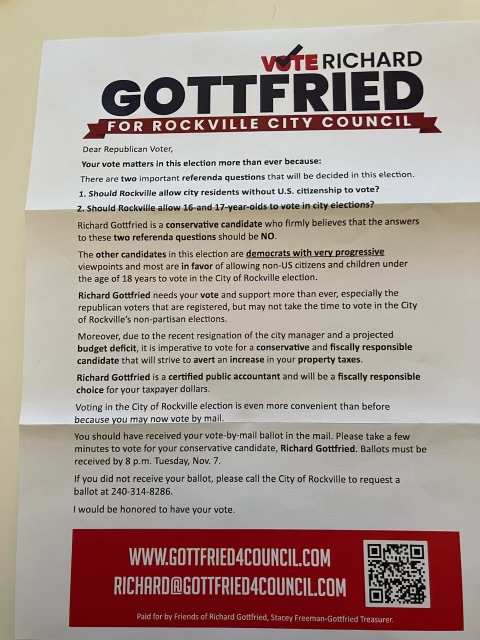
It’s fine that candidates tailor their messages for their audiences, even along party lines in a non-partisan election (although it is really stretching the bounds of traditional campaigning in Rockville). But if you care about a candidate’s values and how they will conduct themselves in office, these letters will be eye-openers. Democrats will be incensed that he’s campaigning in this manner. But Republicans will be as well, because in the 2019 election, Richard Gottfried was registered as a Democrat. I’m not sure if this makes him a DINO (Democrat in Name Only) or a RINO (Republican INcognitO).

Former Council Member Advocates for Lower Voting Age and Noncitizen Voting in Rockville
These opinions on Advisory Referenda Questions are provided by Tom Moore, a whom I first met when we both ran for Council years ago. Even though we don’t always agree, he’s informed, thoughtful, and may help you with your ballot choices. He served two terms on the Rockville City Council from 2011 to 2015, then served as counsel and chief of staff to Commissioner Ellen L. Weintraub of the Federal Election Commmission. In June, he joined the Center for American Progress as a senior fellow on its Democracy team. He has lived in Rockville since 1997.
I care quite a bit about one of the advisory referenda questions on Rockville’s ballot this year, and wanted to let you know that I’m voting YES on whether to permit noncitizens to vote, and I ask that you consider doing so as well.
And I have thoughts about the other three ballot questions, which I’ll dispense quickly:
- Lower the voting age to 16: I’m voting YES; it has been shown to help build better lifetime voting behavior.
- Set term limits: I’m voting NO. Term limits are a bad idea in general, and I’ve fought hard against them before. I’ve learned that they almost always pass when put on the ballot, so I’m a little resigned to this one.
- Create representative districts: I’m voting YES. They’re more fair than at-large districts.
Now, to the one I care quite a bit about: whether to permit noncitizens to vote. I think this is a misnomer – it’s not about allowing “noncitizens” to vote, it’s about allowing Rockville citizens who are not U.S. citizens to vote in Rockville’s elections.
I could have pushed for this when I was on the Council, but I made a political calculation and chose against doing so. It is my single greatest regret from my four years on the Council. I testified before the Mayor and Council on this earlier this year. Here’s what I said about it then:
—–
The Declaration of Independence got it right: governments derive “their just powers from the consent of the governed.” But the government of Rockville does not, at the moment, derive its just powers from the consent of all its governed: roughly ten thousand of Rockville’s 67,000 citizens are governed by the City without their consent.
These Rockville citizens are policed by the City. They are subject to City planning policies and ordinances. The City provides their water and sewer service, their parks, their recreation programs, and their trash pickups. The City paves their streets and plows the snow from them. The City takes their tax money.
These Rockville citizens have exactly the same relationship to their City government as every other Rockville citizen except for one thing: because they are not citizens of the United States, they cannot vote in City elections.
This was not always the case. At least 22 states and territories allowed non-U.S.-citizen voting in the 19th century; it was undone by ugly anti-immigrant bigotry in the wake of World War One.
I am recommending to the Mayor and Council that it amend the Rockville City Charter to allow non-U.S. citizens to vote in Rockville elections, effective for the 2027 elections. That way, the Mayor and Council elected this fall will have plenty of time to consider, pass, and publicize an implementing ordinance that will handle the details.
Mayor and Council to Consider Changes to Mayor and Council
At its Monday, December 12, 2022 meeting, the Rockville Mayor and Council will discuss the FY22 financial report and the FY24 budget priorities. On the Consent Calendar (items approved without discussion) are a dozen items, including easements, services, grant agreement, and the tenth amendment to the interim management agreement with Morguard for Rockville Town Square, among others. The Mayor and Council will also receive reports on priorities with the District 17 Delegation and recommendations from the 2020-22 Charter Review Commission.
The Charter Review Commission has developed recommendations for a wide variety of issues related to the City Charter (its constitution), including expanding the size of the City Council, term limits for councilmembers, alternative voting systems, translation of election materials, the scope and size of the Board of Supervisors of Elections, and increasing voter turnout. After forty meetings and interruptions due to the pandemic, the Commission is recommending that,
“the City maintain the status-quo on several topics (e.g., staggered Council terms and alternative methods of advertising elections), the Commission is also recommending bolder changes to City policy and operations in order to enhance accountability and transparency, increase voter turnout, and advance racial equity and social justice. Notably, the Commission is recommending such reforms as an increase in the size of the Council, implementation of term limits on the Mayor and Council, creation of representative districts, exploring changing the time of the election, and allowing residents who are not United States citizens and those at least 16 years of age to vote in municipal elections.”
More details in the 465-page agenda packet are available at https://www.rockvillemd.gov/AgendaCenter/ViewFile/Agenda/_12122022-6765.
Heard on the street: things are heating up in the West End neighborhood regarding design guidelines proposed by the West End Citizens Association. I suspect this is related to the 2040 Comprehensive Plan. A website opposed to WECA’s action can be found at PreserveTheWestEnd.com.
What is Senator Kagan Doing in Annapolis?
 The Maryland General Assembly is about halfway through its 90-day annual grind through more than 2,500 pieces of legislation along with the State’s budgets. State Senator Cheryl Kagan provides a regular email that lists her current activities, but it’s incomplete because so much is happening. To see the entire picture, you have to visit the General Assembly website to discover that she’s shepherding 78 bills, 10 of which she is sponsoring and 67 she is co-sponsoring. As a sponsor of a bill, she’s the one who introduced the legislation. Sen. Kagan is the primary sponsor of the following bills but note that they are subject to numerous revisions in the legislative process (so what you read here may change):
SB0001: Health Insurance – In Vitro Fertilization – Use of Spouse’s Sperm – Exception. This bill alters the required conditions for health insurance coverage of in vitro fertilization (IVF) by creating an exception to the required use of the spouse’s sperm. For a patient whose spouse is of the opposite sex, the patient’s eggs must be fertilized with the spouse’s sperm, unless (1) the spouse is unable to produce and deliver sperm and (2) the inability does not
result from a vasectomy or other method of voluntary sterilization. According to the Department of Budget and Management, State plan expenditures increase by an estimated $216,310 in fiscal 2017, or approximately 0.025% of annual State plan spending. The State plan currently covers IVF. Expenditures reflect increased utilization of IVF and medical claims associated with the resulting pregnancies.
SB0028: State Government – Web Sites – Language Access. This bill requires specified State departments, agencies, and programs to take reasonable steps, beginning October 1, 2016, to operate and maintain, for Continue reading →
This Week Two More Debates and Early Voting
 The candidates for Rockville Mayor and Council will square off again this week two more times, giving voters more opportunities to size them up before Early Voting over the weekend. These forums will probably focus on different topics, although there should be some overlap.
Tuesday, October 20 at 7:30 pm at the Senior Center, 1150 Carnation Drive. The College Gardens Civic Association and the Woodley Gardens Civic Association are teaming up to host this debate, which will most likely focus on issues important to residential neighborhoods. The debate will be moderated by Maryland State Senator Cheryl Kagan, who’s been known to add questions of her own.
Thursday, October 22 at 7:00 pm at the F. Scott Fitzgerald Theatre, 603 Edmonston Drive (in the Rockville Civic Center adjacent to the Twinbrook/Silver Rock/Burgundy neighborhoods). The League of Women Voters of Montgomery County is hosting this forum, which will most likely focus on issues of city-wide concern. It will also be televised live and rebroadcast on Rockville Channel 11.
This weekend you can cast your votes early on Saturday and Sunday, October 24-25 from 10 am-8 pmat City Hall, 111 Maryland Avenue (downtown near the courthouses). Same-day registration and voting is available to eligible individuals (bring a valid photo ID and proof of residency) at City Hall only on early voting days and Election Day, November 3.
The election is now two weeks away and last week all registered voters should have received a sample ballot in the mail. If you did not receive it, you probably need to register with the City Clerk’s Office at City Hall. For more information, visit www.rockvillemd.gov/election, email election2015@rockvillemd.gov or call 240-314-8286.
Absentee ballot applications, for voters who cannot make it to a location, are available in English or Spanish at City Hall and at www.rockvillemd.gov/election. The last day the city will mail absentee ballots is Monday, October 26. After October 26, absentee ballots must be picked up at the City Clerk’s Office. Ballots must be dropped off or received by mail at the City Clerk’s Office, City Hall, 111 Maryland Ave., Rockville, MD 20850 no later than 8 pm on Tuesday, November 3. Ballots received after 8 pm on November 3 will not be counted in the election.
Who Decides the Future of Rockville?
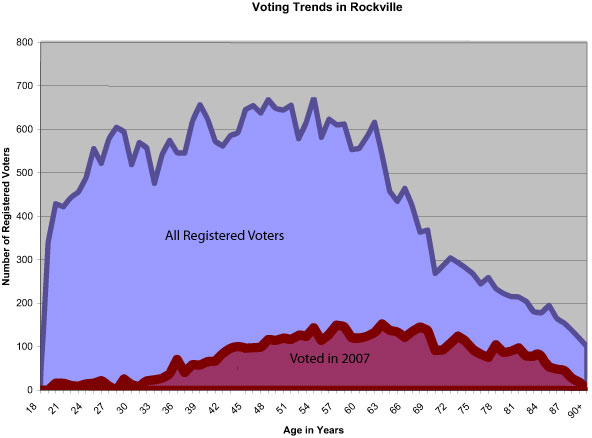
2007 Rockville Election Trends by Age
If you want to influence the government of Rockville, you need to recognize who makes the decisions. Usually it’s the Mayor and Council, and you need to persuade just three of the five. In an election, it’s voters. Although there are 60,000 residents in Rockville, only about half are registered to vote. As much as we talk about “democracy” and “the power of the people,” ultimately, people who can’t vote, can’t decide.
So if you want to make a difference in your community, state, or nation, Rule #1 is register to vote. Two centuries ago, only white men who owned real estate had the right to vote. Since then, the rules have changed thanks to the battles fought by our predecessors. Today, the only citizens who are ineligible to vote in Maryland are imprisoned felons, the mentally disabled, and those under 18.
Now here’s the rub: Continue reading →

 Max for Rockville