Rockville’s New Website Improves Access to Services—But Not to Mayor and Council
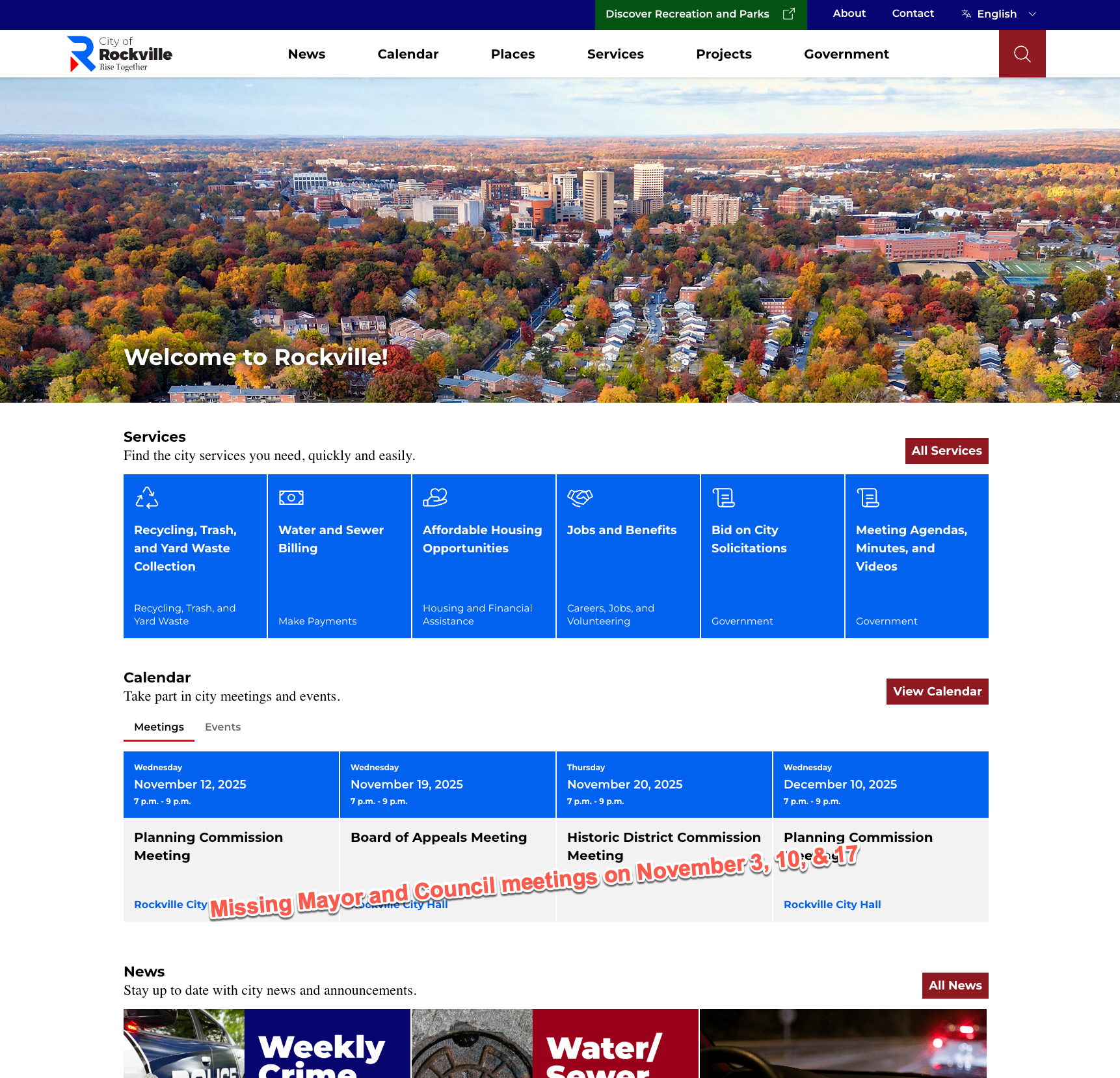
Rockville recently launched a redesigned city website with a fresh look and a more user-friendly layout. The home page now highlights key services—trash pickup, water billing, affordable housing, and city jobs—making it much easier for residents to find the information they use most often.
Unfortunately, the same can’t be said for the Mayor and Council page, which is far less intuitive and raises concerns about public access and transparency.
Continue reading →Rockville Council Agenda Includes Major Forest Preservation Updates and Transportation Achievements
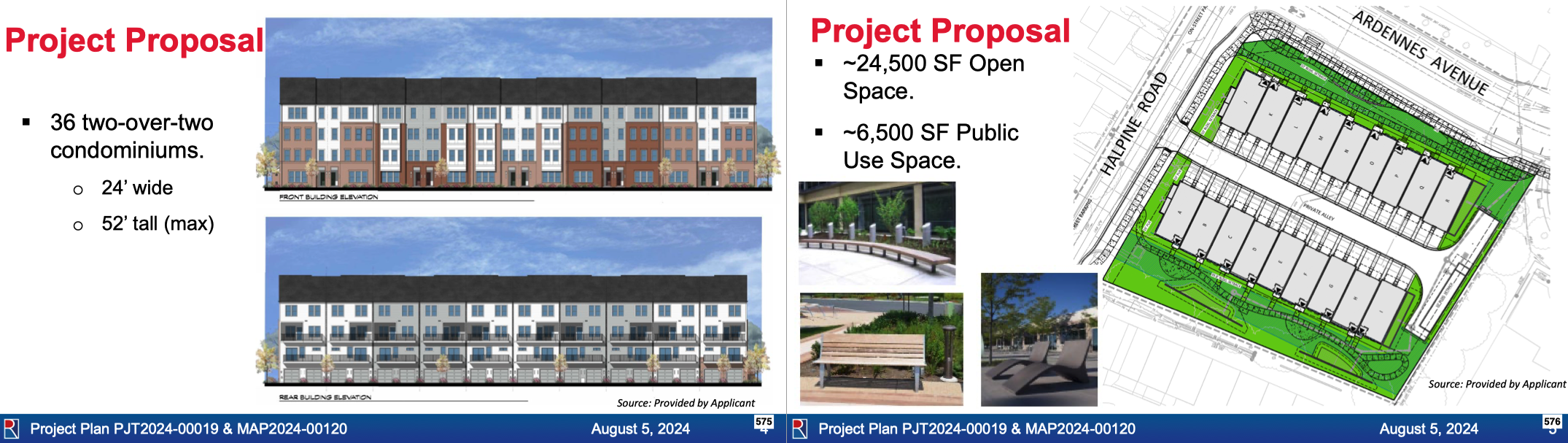
There’s something for everyone at the Monday, August 5, 2024 meeting of the Rockville Mayor and Council. They will discuss amendments to the Forest and Tree Preservation Ordinance; rezoning of 5906 Halpine Road to permit construction of residential units (with a floating zone amendment); a budget amendment; authorizing the sale of $27 million in bonds to fund capital improvements; and an acknowledgement of the lack of proper notice for the May 4, 2024 meeting. On the Consent Agenda (items approved without discussion) are subaward agreements, license agreements, a public art project in Town Center, MPDU Program Agreement for the Flats at Northside, and July 8 minutes approval (which was marked as having “explicit language”; I’ll have to see what that was about). The Mayor and Council will also receive reports on Vision Zero and from the Transportation and Mobility Commission.
In March 2023, Rockville’s Traffic and Transportation Commission was renamed the Transportation and Mobility Commission (TMC) with a broader focus on all transportation modes (p. 17+). The TMC provides guidance to the Mayor and Council on multimodal transportation, emphasizing economic development, sustainability, social activity, equity, and resilience. They’ve recommended budget priorities, intersection safety improvements, and updates to transportation plans. For 2024, they will focus on zoning ordinance recommendations, intersection improvements, and public communication. The TMC is committed to building an inclusive, equitable, and accessible transportation system for all Rockville residents.
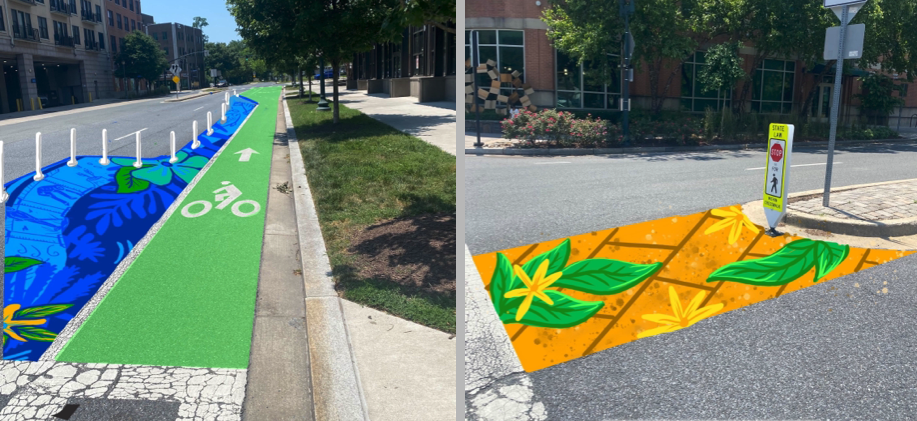
Rockville’s new Asphalt Art Project, funded by a $25,000 Bloomberg Philanthropies grant and an additional $15,000 from the city, aims to beautify Beall Avenue in the Town Center (187+). Set to start after summer roadway improvements, the project will feature artistic designs painted on the road surface between North Washington Street and Gibbs Street. The selected artists, Chalk Riot, will incorporate community survey results into their designs, highlighting local flora, fauna, and historical elements. The project not only aims to enhance aesthetic appeal but also to improve pedestrian safety and foster community pride. Completion is expected by late 2024.
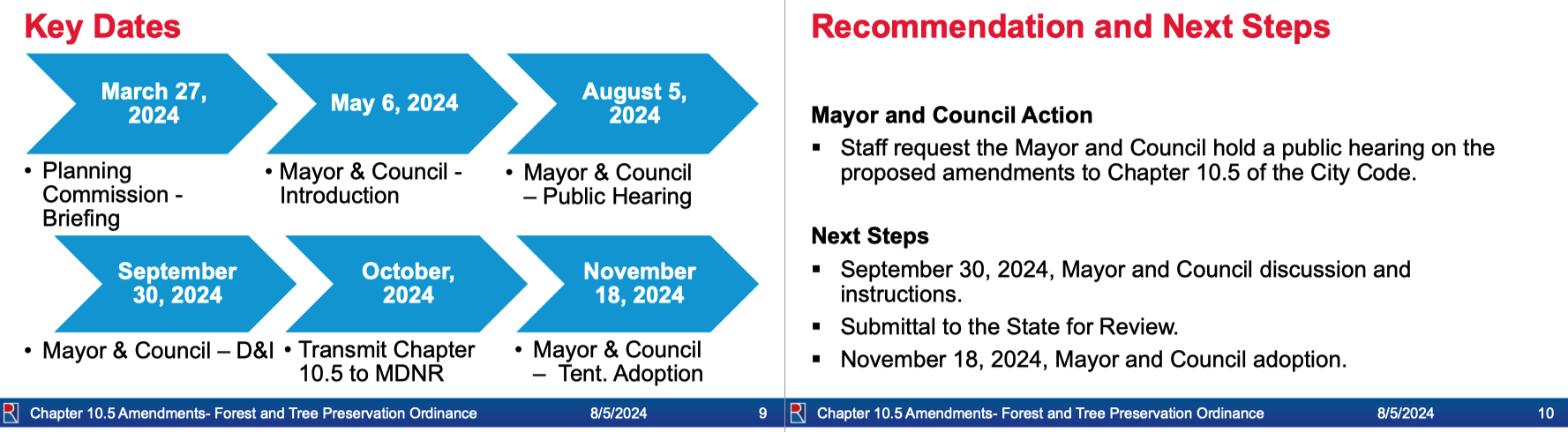
A public hearing will be held regarding proposed amendments to Chapter 10.5 of the City Code, the Forest and Tree Preservation Ordinance, to align with Maryland Senate Bill 526 and enhance local forestry practices (243+). These changes aim to increase tree canopy and streamline the ordinance’s administration. Key amendments include higher reforestation rates, expanded priority retention areas, and new public notice requirements for forest conservation plans. Additional updates involve improving the replacement standards for significant trees and expanding the use of fee-in-lieu funds for street tree plantings. The amendments support Rockville’s commitment to environmental stewardship and urban canopy preservation, promoting a greener, more resilient community.
In addition to need to align with state law, there are concerns about using non-native tree species in city planting projects. The Forest and Tree Preservation Ordinance currently prioritizes native trees for reforestation and afforestation, but staff flexibility allows for the use of non-native species when urban conditions necessitate. While native trees support local biodiversity and are well-adapted to the environment, they can present challenges in urban settings, such as maintenance issues and susceptibility to pests. Non-native trees are often better suited for urban conditions. If you have thoughts, share your thoughts for this public hearing in person or by email (see below).
The Mayor and Council are conducting hybrid meetings. If you wish to submit comments in writing for Community Forum or Public Hearings, please email the comments to MayorAndCouncil@RockvilleMD.gov by no later than 10:00 a.m. on the date of the meeting.
More details in the 663-page agenda packet are available at https://www.rockvillemd.gov/AgendaCenter/ViewFile/Agenda/_08052024-7248.
Unlawful Meeting: Rockville Mayor and Council Fails to Notify Public

Today the Maryland Open Meetings Compliance Board determined that the Rockville Mayor and Council violated the Open Meetings Act by failing to provide reasonable advance notice of the meeting held on Friday, May 24, 2024. During this ten-minute meeting, the City Council approved two significant items—an agreement related to the development of Twinbrook Commons and the appointment of an Acting City Manager—but had posted and altered the agenda just the day prior, deliberately omitting the appointment of the Acting City Manager.
The Compliance Board emphasized that the Mayor and Council [as well as any other city commission], “may not omit an item from the agenda that the body knows, at the time the agenda is made public, that the body will discuss at the meeting. Nor should a body deliberately delay its decisions about what items it will discuss at a meeting, in order to avoid disclosing those items to the public on an agenda.”
Back in May when this began, I was surprised by the meeting’s timing and the incomplete agenda. Shortly after, it became clear that the Council had appointed Barack Matite as Acting City Manager as a last-minute addition to the agenda, prompting me to file a complaint with the Open Meetings Compliance Board, as follows:
- Lack of Adequate Public Notice: The resolution to appoint a new City Manager was introduced at the meeting’s start, without being listed on the public agenda posted on May 23, 2024. This deprived residents of the opportunity to prepare for and engage in the decision-making process.
- Unusual Meeting Time: The meeting took place on a Friday morning, deviating from the regular Monday night sessions. This irregular timing likely hindered public participation, as many residents were either unaware or unable to attend due to work or other commitments.
- Delayed Posting of Revised Agenda: The revised agenda, which included the Acting City Manager’s appointment, was posted at 10:24 AM, after the meeting had ended. This delay violated principles of transparency and open governance by preventing timely public access to crucial information.
- Introduction of New Agenda Item: Mayor Monique Ashton introduced the resolution to appoint the Deputy City Manager as Acting City Manager during the meeting without prior public notice. The original agenda listed only one item, the Twinbrook Quarter development agreement, making the sudden addition a breach of transparency standards.
Given the City’s prior violations of the Open Meetings Act, it is crucial to remind the new Council of their responsibilities to voters and to set clear expectations for government transparency. Despite the presence of experienced members, including an attorney, community activist, and a federal government executive, these issues persist (and if you read the City’s response to my complaint, it seems that Mayor Ashton isn’t helping). Considering how many times violations have happened, someone keeps giving the Mayor and Council poor advice.
Moving forward, the Mayor is required to address this issue in a public meeting and outline measures to prevent future occurrences. I strongly urge all members of Council and City Commissions to review the Open Meetings Act to become personally familiar with the requirements and establish better policies and procedures. Additionally, there have been reports of unannounced “meetings before the meeting,” which are only permissible under specific conditions. On July 1, I requested further details under the Maryland Public Information Act to ensure compliance, but no response has been provided yet by the City.
For more details, please refer to the Open Meetings Commission’s decision dated July 29 and the City’s explanation on June 27.
A Call for Transparency to the Mayor and Council

Ensuring Open Governance in Rockville
As residents of Rockville, we take pride in our city’s vibrant community, exceptional services, and the transparent governance that supports our daily lives. However, a recent incident has raised concerns about the adherence to the Maryland Open Meetings Act, a vital law that ensures our local government operates openly and honestly. On Friday, May 24, 2024 at 10:00 am, the Rockville Mayor and Council appointed Barack Matite as Acting City Manager without providing adequate public notice, highlighting a significant breach of the principles of transparency and open governance.
What Happened?
On May 24, 2024, the Rockville Mayor and Council held a meeting that was not only unusual in its timing but also in its proceedings. Typically, the City Council meets on Monday nights, a schedule that allows residents to plan their attendance and participation. However, this meeting took place on a Friday morning, an unexpected and inconvenient time for many. The agenda initially posted on May 23, 2024, listed only one item: the Moderately Priced Dwelling Unit Rental Program Agreement for phase one of the Twinbrook Quarter development.
At the start of the meeting, Mayor Monique Ashton announced an additional agenda item—a resolution to appoint the Deputy City Manager, Barack Matite, as Acting City Manager, effective immediately. This resolution was introduced without prior notice to the public, preventing residents from being informed and prepared to discuss or contest the appointment. To further complicate matters, the revised agenda that included this crucial item was posted at 10:24 am, after the meeting had already begun.
Why It Matters
The Maryland Open Meetings Act exists to ensure that government decisions are made transparently and with public involvement. When decisions are made without adequate notice or opportunity for public input, it undermines trust in our local government and its commitment to representing our interests. The appointment of a new Acting City Manager is a significant decision that impacts the leadership and direction of our city. Residents have a right to be informed and involved in such important matters.
The Violations
Several key violations of the Open Meetings Act occurred during the May 24th meeting:
- Lack of Adequate Public Notice: The resolution to appoint the Acting City Manager was not listed on the agenda posted the day before the meeting, depriving residents of the opportunity to prepare and participate.
- Unusual Meeting Time: The meeting was held on a Friday morning, diverging from the regular Monday night schedule, which likely limited public attendance and participation.
- Delayed Posting of Revised Agenda: The revised agenda was posted after the meeting had started, further preventing residents from being aware of the new agenda item in a timely manner.
Moving Forward
Transparency and accountability are the cornerstones of good governance. To maintain public trust, it is essential that the City of Rockville adheres to the principles outlined in the Maryland Open Meetings Act. As residents, we must hold our local government accountable and demand adherence to these principles to ensure that our voices are heard and our interests are represented.
I urge all Rockville residents to stay informed and involved in our local government. Attend meetings, ask questions, and demand transparency. By doing so, we can help ensure that Rockville remains a city we are proud to call home, governed by the principles of openness and integrity.
Together, let’s advocate for a government that values our participation and upholds the trust we place in it. Transparency is not just a legal requirement—it’s a promise to the community that must be honored.

Rockville Reviews Twinbrook Quarter MPDU Rental Program Agreement—Today

Today at 10:00 am, the Mayor and Council reviewed a Moderately Priced Dwelling Unit (MPDU) Rental Program Agreement for Phase 1 of the Twinbrook Quarter development as a simple Consent item as a virtual-only meeting. These agreements are one of Rockville’s major ways to provide affordable housing within the city (the other is Rockville Housing Enterprises).
But why the rush? Today’s morning meeting was conducted outside of the regular Mayor and Council bi-monthly evening schedule and posted with less than 24 hours’ notice. Maryland’s Open Meetings Act requires “reasonable advance notice” of its meetings and that agendas are available in advance except in cases of emergency, but what’s “reasonable” or “in advance” is not defined. Two days? Two hours? Perhaps that’s something that the Mayor and Council should define for itself in the spirit of transparency.
Twinbrook Quarter is Saul Centers’ transit-oriented, mixed-use 18-acre development located along Rockville Pike and adjacent to the Twinbrook Metrorail Station. The project will include a mix of uses, with a focus on residential development and retail, complemented by two trophy office buildings to create a complete live/work/play environment. Phase I is underway with 450 residential units, a Wegman’s grocery store, shops and office spaces, and an extension of Chapman Avenue and is planned for completion this fall. Nearly 150,000 people live within three miles of this supersized development.
Twinbrook Quarters joins Saul Centers’ portfolio of huge ambitious projects such as Park Van Ness and Waycroft, but it holds many more modest commercial properties, such as a CVS and PartyCity at 1500-1582 Rockville Pike and two bank sites fronting Montrose Crossing Shopping Center at 12095 Rockville Pike.
The 50-page agenda (missing pages 3-4) is available at https://www.rockvillemd.gov/AgendaCenter/ViewFile/Agenda/_05242024-7206
Random Rockville Reports: January 28, 2024
Playing Musical Chairs and Three-Card Monte in Rockville City Hall
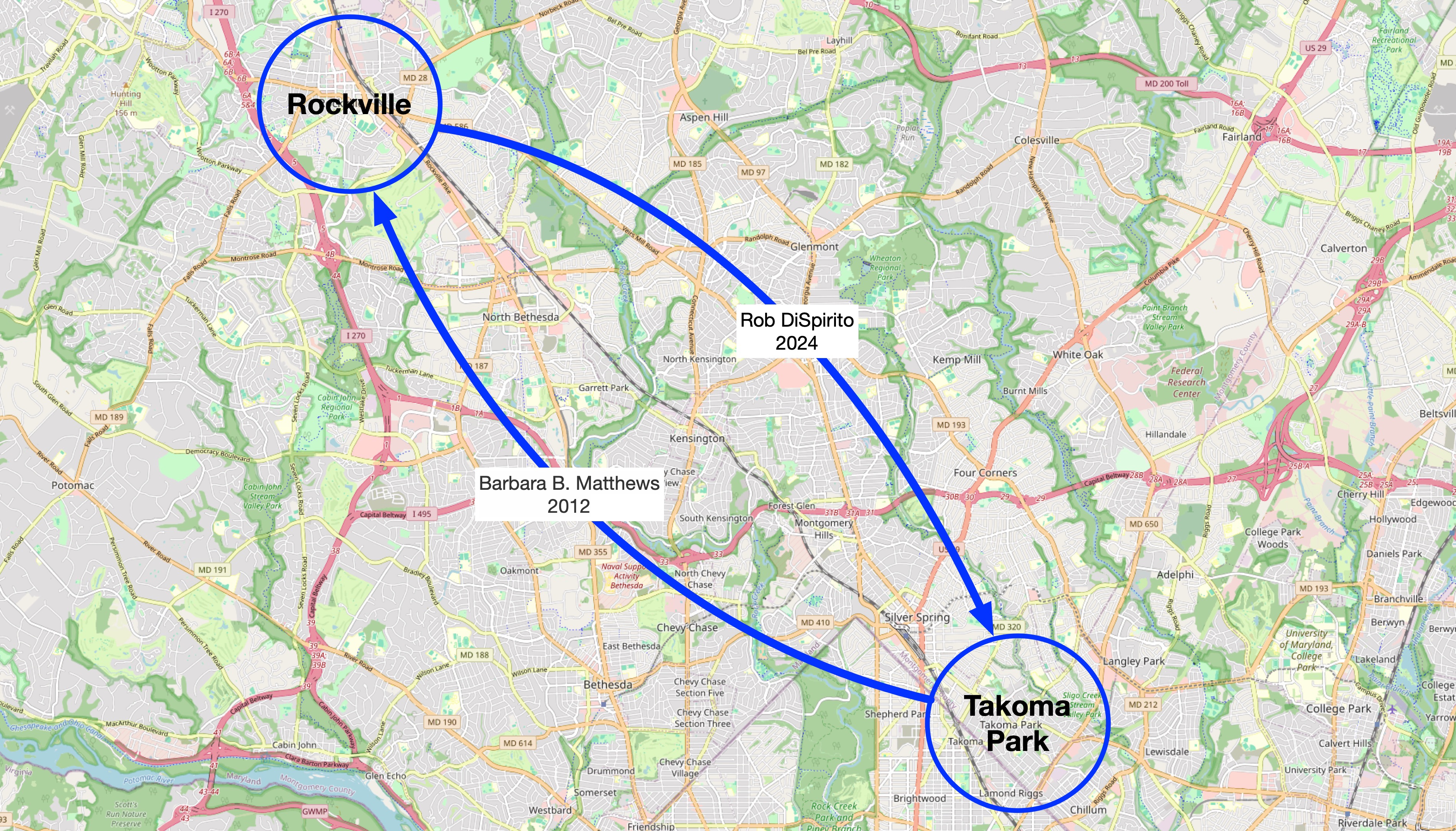
The Takoma Park City Council hired Robert DiSpirito as their new City Manager effective January 22, 2024. DiSpirito was City Manager of Rockville for seven years and by coincidence, his predecessor was Barbara Mathews, who was previously the City Manager of Takoma Park. They were also both hired and fired by the Rockville Mayor and Council, which both times included Mayor Bridget Newton and Councilmember Beryl Feinberg.
DiSpirito’s departure continues to be an embarrassment of poor management by the Mayor and Council. When he resigned at the conclusion of a Closed Session (aka “secret meeting”) of the Mayor and Council on August 17, he also received a $307,093 severance package (typically resignations don’t include severance). But figuring out what was going on was kept secret illegally for several months. According to Maryland’s Open Meetings Act, the Mayor and Council must provide minutes of a closed session at its next open session (3-306), which would have been September 11 but they failed to share the minutes. It wasn’t until October 23, 2023 (three regular meetings later) that the Mayor and Council approved the August 17 minutes (Agenda, page 218), keeping the public uninformed for more than two months. Furthermore, they played a trick in the meeting minutes. The Mayor and Council approved the official minutes of the September 11 meeting as if they included the Closed Session minutes of August 17 (watch the video of September 11 meeting and you’ll see the August 17 meeting was not discussed)–but it actually didn’t happen until October 23. Hmm, looks like the Mayor and Council is playing three-card monte with the public. Clearly, the Mayor and Council violated the Open Meetings Act but also acted unethically in the preparation of their official records.
More Pedestrians Struck in Rockville Than Reported
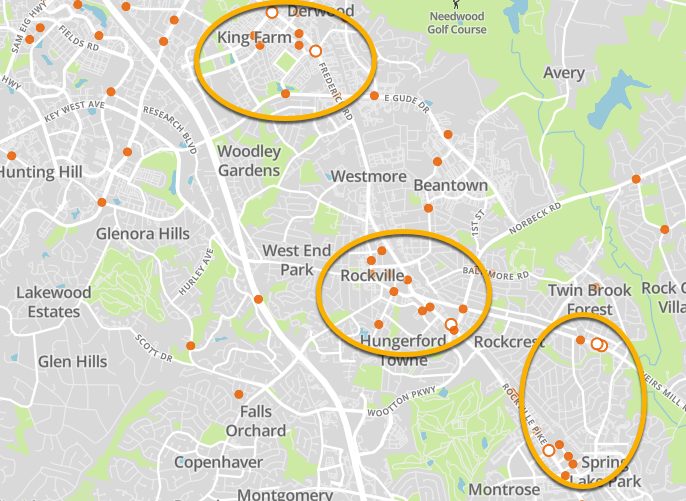
The recent death of a 70-year old pedestrian struck by two vehicles at Atlantic Avenue and Viers Mill Road prompted me to see if this a growing problem in Rockville. Data collected by Montgomery County suggests that many more pedestrians were injured or killed in Rockville in 2023 than the eight reported at the most recent Mayor and Council meeting. Not sure the cause of the discrepancy, but county data shows the greatest numbers of incidents occur in and near King Farm, downtown Rockville, and Twinbrook. Although these high incident areas all share major highways (MD Route 355 and 586), pedestrian injuries and deaths also occurred on smaller streets in these neighborhoods, which conflicts with the City’s conclusions. Both the City of Rockville and Montgomery County have adopted Vision Zero, but they don’t seem to be working from the same data. Should pedestrian safety be a higher priority for Rockville’s Transportation and Mobility Commission?
Unexpected Resignation: Rockville City Manager Rob DiSpirito Departs Post

Rockville City Manager Rob DiSpirito resigned yesterday on Thursday, August 17, effective at 5:00 pm. The Mayor and Council accepted his resignation and appointed Deputy City Manager Barack Matite as acting city manager, effective immediately. DiSpirito had served as Rockville’s city manager since January 2017. DiSpirito was interim senior manager of the Sarasota County (Florida) Planning and Development Department when appointed in December 2016 and previously served as the city manager of Dunedin, Florida for nine years and city manager of Oberlin, Ohio for 11 years. Barack Matite was previously City Manager of Eudora, Kansas (population 6,449) and holds a master’s in public administration from the University of Kansas.
It’s unclear what prompted the resignation, but we can assume it’s related to the Mayor and Council Closed Session meeting yesterday, which was to conclude the Performance Improvement Plan that the Mayor and Council instituted 90 days ago. Unfortunately, once again the Mayor and Council is unable to follow Maryland Open Meetings Act and failed to post the adjournment of the meeting, which was held exclusively on WebEx. In Maryland, “After a public body has met in a session closed under § 3-305, it must include a summary of the session in the minutes of its next public meeting. Public bodies may instead include the summary in the minutes of the public meeting held that day—that way, the public will see the summary sooner—but should follow a consistent practice or include a cross-reference in the later set of minutes so that the public knows where to look” (Chapter 6, OMA). I strongly recommend the latter approach to provide greater transparency to government, but so far, the Mayor and Council has been reluctant to go down this path. What are they trying to hide? Perhaps this an issue for the upcoming election.
The City Manager is the “executive officer and head of the administrative branch of the City” and one of three employees that report directly to the Mayor and Council (Chapter 2, Rockville City Code). City Manager Rob DiSpirito served six years. The previous City Manager, Barbara B. Matthews, served almost four years, when she was fired by the Mayor and Council in a contentious 3-2 vote (Mayor Bridget Newton and Councilmembers Beryl Feinberg and Virginia Onley voted to terminate her employment; Councilmembers Mark Pierzchala and Julie Palakovich Carr voted against). City Manager Scott Ullery retired in December 2011 after seven years following conflicts with Mayor Phyllis Marcuccio over the management of the City. Notice a pattern? Ironically, most of the current city council members have NO experience supervising employees at a management or executive level, yet make crucial decisions about hiring, supervising, and terminating these types of employees. Are management skills an increasingly important qualification for Mayor and Council?
Follow-up: On August 19, 2023, Barry Jackson, candidate for Rockville City Council, insisted that current Mayor and Council should not begin the search for the new City Manager but instead that the “newly elected Mayor and City Council hire a City Manager through a transparent and thorough process.”
Rockville City Manager Faces Performance Improvement Plan in Surprise Session

In an extraordinary last-minute Closed Session held on Thursday morning, May 11, 2023, the Rockville City Council put the City Manager Rob DiSpirito into a three-month Performance Improvement Plan (PIP) for reasons unknown. Improvement Plan (PIP) is a formal, structured process designed to help underperforming employees identify and overcome performance issues. It outlines specific goals, expectations, and timelines for improvement, along with support, resources, and regular progress evaluations to facilitate success and growth.
When the Council came out of Closed Session, Councilmember Monique Ashton quickly moved for the PIP and was supported by Councilmember Beryl Feinberg. Mayor Bridget Newtown rushed for a vote without a discussion, but was interrupted by Councilmember Mark Pierzchala to note that, “I don’t know how the sequence of events unrolled but I’m not going to vote for it. I think things have moved past the point where a performance improvement plan is going to be effective. So I’m gonna vote against it. I had asked to make the first motion but that was not allowed, apparently. I’m not sure where that came from. Thank you.” The motion passed 4-1 with Councilmember Pierzchala voting against. A brief three-minute video is available at https://youtu.be/fIu7e9cHhoo, but of course, the closed session portion is held in secret and it’s unclear how long they debated the issue.
I typically discourage Closed Sessions because they are secret and prevent voters from knowing what’s happening—and Closed Sessions usually deal with major issues. Fortunately, Maryland has an Open Meetings Act to keep council and board meetings available to the public so they can be “in the room where it happens.” A quick introduction is available as FAQs, but here are a fundamentals:
- The Maryland Open Meeting Act lists 15 topics that the City Counci) may choose to discuss behind closed doors under specific conditions. These topics or “exceptions,” include personnel discussions about particular individuals, the receipt of legal advice from the public body’s attorney, and subjects that must be kept confidential under other laws. A discussion on “the appointment, employment, assignment, promotion, discipline, demotion, compensation, removal, resignation, or performance evaluation of an employee over whom the Mayor and Council has jurisdiction” is an appropriate reason for the Closed Session on May 11.
- Public bodies must make an agenda available before each meeting, either when notice is posted, if the items of business are known then, or as soon as practicable, but no later than 24 hours before the meeting. There is an exception for meetings held in response to emergencies. This Closed Session was not publicized as an emergency and the the agenda was posted on the city website on May 10 at 5:20 pm, that’s less than 18 hours in advance, so is in violation of the Act. Furthermore, it was not sent out as an email to those who subscribe to the City Council’s agendas (thanks to a blog reader who alerted me to this meeting).
- This meeting was not publicized an emergency, so why the rush? Two councilmembers had difficulties attending in person. Councilmember Myles was absent at the start of the meeting and showed up virtually later. Councilmember Ashton started the meeting virtually and joined in-person by the end. How much of the Closed Session discussion did they miss? Councilmember Ashton didn’t even notice that the vote to go into Closed Session occurred.
Most management leaders will emphasize that employees are the organization’s most important assets so how well are these assets being managed in the City of Rockville? Most of the current councilmembers lack significant experience in supervising employees and the City Council has a poor record of managing its most senior staff. The City Manager, City Attorney, and City Clerk have each been dismissed during Mayor Newton’s tenure. After a while, the only common denominator to these problems is the City Council.
The City Council needs to provide a better explanation for this decision and how they handle Closed Sessions. Or it’s time to rethink their privilege to serve.
May 21, 2023: This post was corrected to show a vote of 4-1 in the caption of the photo.
When is the Next Council Meeting? Agenda Center Creates Confusion
In an effort to better align with the requirements of Maryland’s Open Meetings Act, the City of Rockville has revised the Agenda Center for Mayor and Council to included anything and everything that might be attended by one or more councilmembers. The City has violated the Open Meetings Act in previous years and new City Attorney is reviewing everything to assure compliance. The problem is that the Agenda Center is now a mishmash that makes it difficult to separate the wheat from the chaff. Can you easily locate the regular meeting of the Mayor and Council in this screenshot of the Agenda Center?
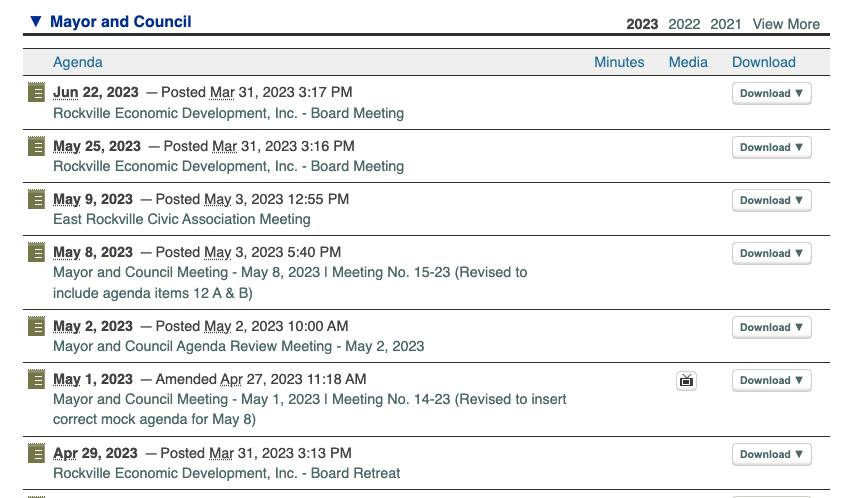
The confusion is caused by treating all meetings the same, when they’re not. Residents and businesses want to attend the meetings that have the most impact on them, which are the Mayor and Council meetings. While a councilmember may attend the East Rockville Civic Association or the Rockville Economic Development board meeting, the City Council is not making decisions about taxes or ordinances at those events. The next step is keep the audience in mind–who uses the Agenda Center? Who is it for primarily? Secondly, distinguish the meetings to highlight the meetings that are most important for the audience. Hire a good graphic designer to figure this out. Otherwise, it’s going to cause residents and business to be even more frustrated in their efforts to learn what their elected officials are doing (have you noticed that minutes aren’t available for about six weeks, which means you have to rewatch the entire council meeting for the latest news).
The latest annual report of the Maryland Open Meetings Compliance Board (which has no budget and no staff!) notes that it received 57 complaints concerning 95 separate entities, so ensuring that government operates transparently and openly is an ongoing concern. It also summarized the most common violations by city councils, boards, and commissions (emphasis mine):
“The overall number of complaints, and of those in which we found a violation, remains small in proportion to the total number of public bodies statewide. This fiscal year saw a significant increase in the number of opinions we issued (forty-eight), which is eighteen more than the previous year and the most we have issued in a single year since at least Fiscal Year 2013. But much of this increase may be attributable to COVID-19: Many complaints alleged violations of the Act based on practices that public bodies have adopted in light of the pandemic (for example, requiring the public to observe meetings virtually or limiting how many people may attend a meeting in person19), or alleged violations related to meetings (or alleged meetings) that involved topics of discussion directly related to the pandemic (for example, masking policies and other COVID-19 protocols).
“In any event, although we issued forty-eight opinions this year, we found violations in twenty-five opinions, a little over half the total number of opinions for FY 2022. Of those opinions involving one or more violations, fewer than half of the opinions (eleven)
involved a failure to provide reasonable notice of a meeting. The most common type of violation (found in eighteen opinions) involved some deficiency related to meeting minutes, either the failure to prepare or post them timely, or the failure to provide enough details. Thirteen opinions involved the failure to fully satisfy the Act’s procedural requirements for closing a meeting to the public. Eleven involved a violation of the Act’s general openness requirements, most often because a public body failed to make clear in its meeting notice that the body would be meeting in open session before entering closed session, or because a public body misapplied an exception in GP § 3-305(b) and discussed a matter in closed session that should have been open to the public.”
Three Ways the City of Rockville Can Improve Its Public Meetings
The Open Meetings Compliance Board of the State of Maryland has rendered another opinion that the City of Rockville once again failed to meet the Open Meetings Act. They determined that Rockville’s Board of Supervisors of Elections did not provide adequate notice for its meeting of February 6, 2016 and that it did not adopt minutes in a timely manner. In their official opinion, you can detect a sigh in their voice: we discussed similar issues back in May, we have nothing to add, so please Rockville, just get your act together.
With this second opinion from the State of Maryland, it’s clear that Rockville’s Boards and Commissions have difficulties achieving basic standards for transparency and accountability. This isn’t a one-time aberration or a difference of opinions, it’s an on-going problem that isn’t being resolved on its own and it’s caught the attention of the Attorney General’s office—again.
It’s time that the Mayor and Council stop forgiving the problem because commissioners are volunteers or they believe the work isn’t important. We should treat our twenty-seven boards and commissions professionally and regard them as a serious contribution to the City, otherwise, we should thank them for their service and close them up. Secondly, the Mayor and Council should stop shifting the blame. The Boards and Commissions report directly to the Mayor and Council, so they shouldn’t find a scapegoat among staff or point fingers at each other. They’ve appointed every member of every commission so if they don’t do their jobs correctly, the Mayor and Council needs to step in. Here are three ways to start: Continue reading →

 Max for Rockville