Rockville’s Neighborhoods: A Key Factor in Local Elections?
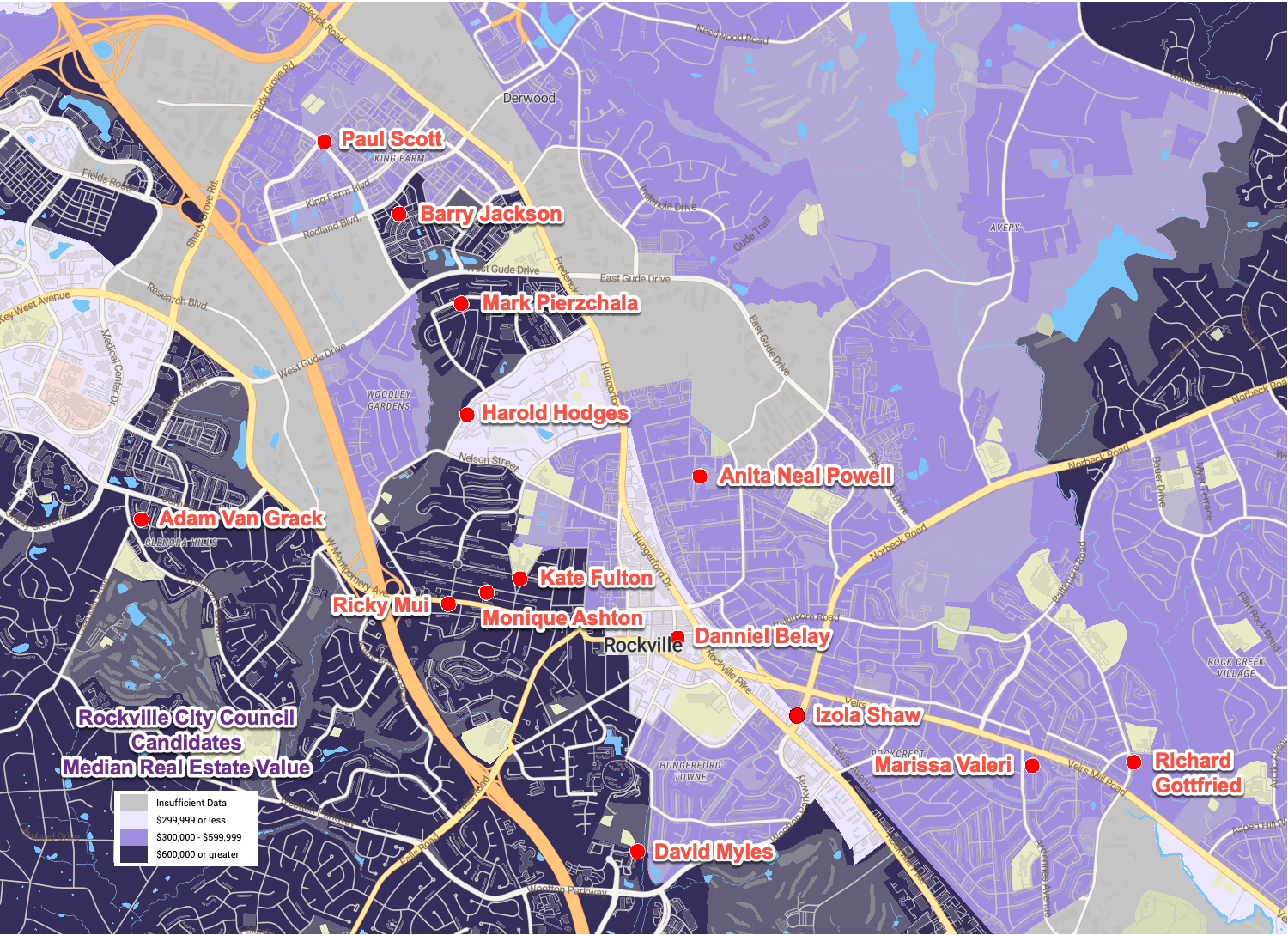
If you want to run for a spot on the Mayor and Council, you need to be at least 18, registered to vote, and have lived in Rockville for at least a year before the election (for this race, that means living here since November 7, 2022). But when people vote, they often pick candidates who they feel are like them and will represent what they care about. So, where a candidate lives can be really important, especially if they live in a neighborhood that’s similar to the voter’s.
Looking at the map, you can see Rockville is split into three parts by major highways. To the west of I-270 is the “wealthy west,” where the average house costs more than $600,000. Adam Van Grack is the only candidate from this part of Rockville. To the east of #355 (Rockville Pike/Hungerford Drive/Frederick Road—actually, the dividing line is Metro) are the “middleburbs,” where houses typically cost between $300,000 and $600,000 and is home to Anita Neal Powell, Izola Shaw, Marissa Valeri, and Richard Gottfried.
Right in the center of the city is the “mixing bowl,” where house prices vary the most and has the greatest number of candidates: Paul Scott, Barry Jackson, Mark Pierzchala, Harold Hodges, Kate Fulton, Monique Ashton, Ricky Mui, Danniel Belay, and David Myles.
In past elections, the richest neighborhoods usually had the most people voting. If we think they’ll vote for people who are like them or share their interests, we will likely see Barry Jackson, Adam Van Grack, Kate Fulton, Ricky Mui, and David Myles take five seats on the next city council. If we continue this logic, there is one more seat available on council so it will be a tight race between Paul Scott, Anita Neal Powell, Izola Shaw, Marissa Valeri, and Richard Gottfried. The contest for Mayor between Mark Pierzchala and Monique Ashton, who both live in wealthy neighborhoods, will be more complicated. Voters will likely consider additional factors like experience, background, personality, and age.
As for age, once again this council election attracted candidates that span at least three generations. The Millennial generation (born 1981-1996) is solely represented by Danniel Belay; Gen Xers (1965-1980) by David Myles, Monique Ashton, Ricky Mui, Izola Shaw, Kate Fulton, Barry Jackson, Marissa Valeri, Adam Van Grack, and Harold Hodges; and Boomers (1946-1964) by Paul Scott, Richard Gottfried, Mark Pierzchala, and Anita Neal Powell. Most people who vote in Rockville are from Generation X. If they vote for people who are like them, we might see a lot of candidates like David Myles, Monique Ashton, Ricky Mui, Izola Shaw, Kate Fulton, Barry Jackson, Marissa Valeri, Adam Van Grack, and Harold Hodges on the city council. But the people who vote the most are Baby Boomers, so Paul Scott, Richard Gottfried, Mark Pierzchala, and Anita Neal Powell could also have a good shot at winning.
The Rockville United campaign committee, which includes Monique Ashton, Kate Fulton, Paul Scott, Izola Shaw, and Marissa Valeri, could really shake things up in the city council if voters decide they want a big change. However, it’s hard to find information about this team online, and usually, people prefer to pick their candidates one by one. But remember, teams like Rockville United can be a great way to make the most out of limited resources.
Rockville Town Center Dominates Community Discussions in January-March 2023

Based on an analysis of the minutes of the Rockville City Council by ChatGPT, the top five most discussed topics in the community forums from January to March 2023 seem to be:
- Town Center Parking and Plan: This topic was mentioned multiple times—what’s the future hold for downtown after the recent seismic shifts in the economy and work?
- Streetlights and Roadway Pothole Repairs: These two topics are grouped together as they both pertain to infrastructure and public works issues.
- Charter Review Commission Recommendations: The possibility of ranked-choice voting, lowering the age to vote, and establishing council districts were discussed in two different forums.
- Diversity, Equity, and Inclusion: These topics were mentioned in different contexts, reflecting the community’s interest in social issues. The Supreme Court eliminated the use of affirmative action in college admissions—how should that affect decisions by the City of Rockville?
- Rent Stabilization and Accessory Dwelling Units: Housing is an ongoing issue in Montgomery County—what is Rockville’s role and responsibility?
We’ll be watching for these topics in the upcoming council election.
Please note that this is an interpretive summary and the actual prominence of topics may vary depending on the number of comments and the depth of discussion for each topic.

 Max for Rockville