Rockville’s Commission Appointment Process Reveals Flaws in Mayor and Council
A tense discussion late in the evening of the February 25, 2013 meeting of the Rockville Mayor and Council suggests that there are serious problems in the appointment process to boards and commissions, as well as in our elected officials. It was probably missed by most citizens because the chambers were nearly empty at 10:00 pm.
A sense of the troubles began hours earlier, when Mayor Phyllis Marcuccio nominated two residents to the Board of Supervisors of Elections, a city committee that recently lost three of its five members due to resignations. David Berthiaume’s nomination was approved with one councilmember abstaining and Andrew Powell’s nomination failed due to a lack of a second. With one of her nominations rebuffed, Mayor Marcuccio noted that, “I would like to point out that we are in need of a quorum for the Board of Supervisors of Elections and by appointing Mr. Berthiaume I think we have achieved that. But I am quite shocked that our Council does not choose to appoint my other suggestion.”
The issue was forgotten until Old/New Business, when it was raised again by Councilmember Newton (at 3:30 of the February 25, 2013 meeting):
Councilmember Newton: I was disappointed in the decision this evening on Mr. Powell and I would like to encourage this body to think long and hard about Continue reading →
Residential Segregation Trends Affect Rockville
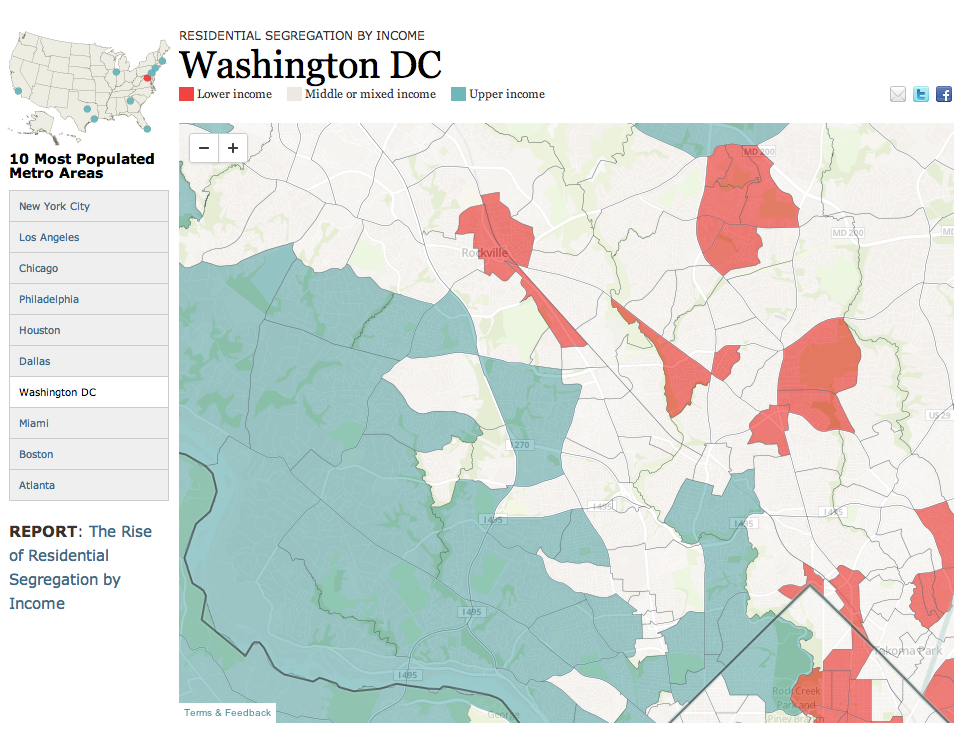
Income segregation by income in the Washington, DC region, based on a 2012 study by the Pew Research Center.
Residential segregation by income has increased during the past three decades across the United States and in 27 of the nation’s 30 largest major metropolitan areas, according to a new analysis of census tract and household income data by the Pew Research Center. Montgomery County, as one of the counties surrounding Washington, DC, is included in that study and shows that Rockville was at the bottom end of the spectrum. It’s primarily a result of a shrinking middle class: “These increases are related to the long-term rise in income inequality, which has led to a shrinkage in the share of neighborhoods across the United States that are predominantly middle class or mixed income—to 76% in 2010, down from 85% in 1980—and a rise in the shares that are majority lower income (18% in 2010, up from 12% in 1980) and majority upper income (6% in 2010, up from 3% in 1980).”
Pew didn’t provide details on the causes of this residential segregation, which could historical settlement patterns; local housing policies, zoning laws, real estate practices and migration trends; and the characteristics of the local economy and workforce. What it could mean for Rockville is that in the longterm, the types of city services and public amenities we’ve enjoyed may erode and disappear as the community’s ability to pay for them declines. Is the City Council looking far enough ahead to respond to this trend, or are they just looking at today?
For more details, see the interactive map or read, “The Rise of Residential Segregation by Income” and “The Middle Class Shrinks and Income Segregation Rises“, all available at the Pew Research Center.
Can Rockville’s 2013 Budget Avoid a Crossroads in 2014?
The Mayor and Council just closed public hearing on the upcoming $65 million budget and about twenty people had comments (mostly community service groups, such as Community Ministries, Sister City, Jefferson House, Scholarship Foundation, and Bike Advisory Committee). Out of nearly 70,000 residents, that doesn’t seem like very many people and I’m not sure if that means that residents don’t care, don’t understand it, or didn’t know about it, but considering it’s all about how their money is used, it’s surprising. The public record stays open until 5 pm on May 17 so there’s still time to submit comments before the budget is adopted on May 21 (although some members of the Council admitted they are drowning in budget information).
As many of you know, I’ve had ongoing concerns that there’s been a trend that revenues aren’t keeping up with expenses and although the Council has so far kept those lines from crossing, it may be impossible to avoid in the next couple years without some serious consequences. Of course, the City can’t run a deficit, so that means either increasing revenues (typically taxes) or reducing expenses (fewer city services). No politician likes that situation because voters don’t like those options. We prefer an imaginary world of more services and fewer taxes believing it’s possible by following platitudes like cutting fat, working smarter, and thinking outside the box (and incidents like the recent GSA conference only confirm those feelings). What really happens is that politicians will avoid tax increases on those who yell the most and the loudest (usually seniors because they understand the system and have time) and cut services to those don’t complain (people who don’t understand the system or don’t have time, such as children, families with kids, renters, recent immigrants, and the poor).
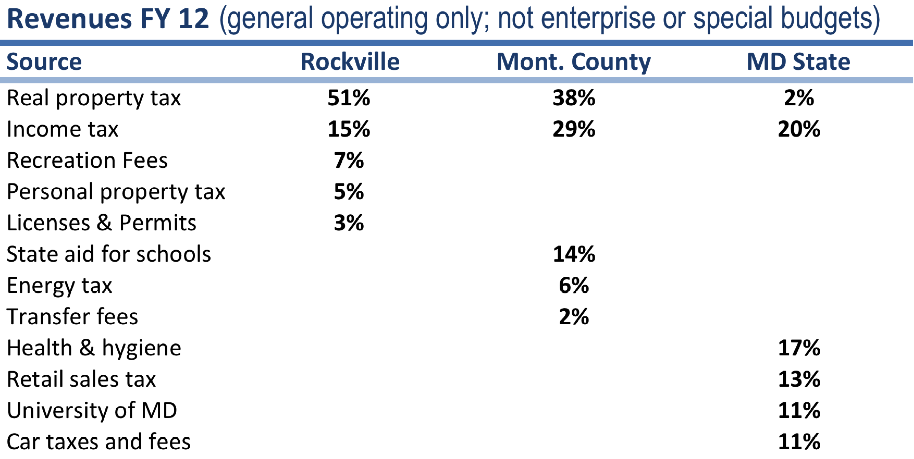
City, county, and state revenue sources in 2012. Click to enlarge.
For the Council’s deliberations on the budget for fiscal year 2013, rather than look at ways to cut expenses, I urged them to consider new or expanded sources of revenue to maintain and enhance existing city services (particularly the parks and recreation, historic preservation, and public art programs) that make Rockville a distinctive place to live and work. Of course we need good roads, a responsive police department, regular trash pickup, and clean water–those are basics but they don’t make Rockville distinctive and prevent the monotony that’s so much the norm of suburban living. A comparison of the top five revenue sources among the city, county, and state suggests Continue reading →
Bridget Newton at RCC
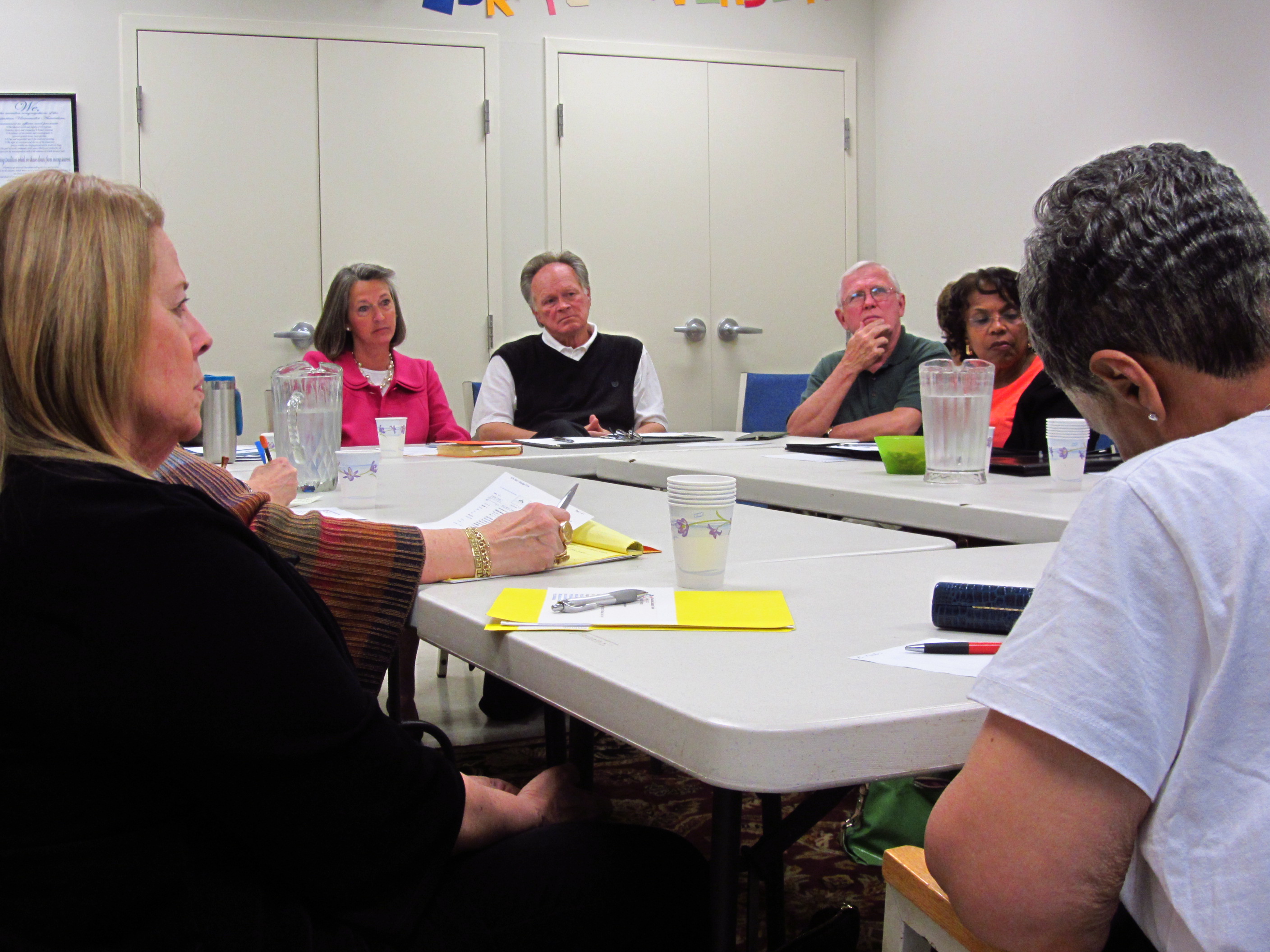
Councilmember Bridget Newton at Rockville Community Coalition meeting.
On May 3, 2012, Councilmember Bridget Newton joined the the quarterly Rockville Community Coalition meeting at the Unitarian Universalist Church to discuss various issues facing the City of Rockville, including:
Charter Review Commission: she supports opening the commission membership to applications from citizens and at the last Council meeting it was decided that each Councilmember could appoint one person and that together they would appoint another five, plus the Mayor would appoint the Chair. She doesn’t have any problems with the current charter, although she noted that a few years ago there were some discussions about whether to continue the Manager-Council form of government, but she had no issues with that. She also had no preconceived outcomes, such as a 7-member council, and wants the commission to be an independent group who would do their own research. She’s committed to holding a referendum on any changes to the Charter before Council makes a decision.
Council conflicts: she stated that her goal is to work together and there would no major/minority divisions. It’s not productive to have a divided Council and she looks forward to more 5-0 votes. Newton mentioned that when she first moved to Rockville, it seemed that despite the diverse perspectives and opinions, people got along but now discussions seem to be mean-spirited. She would like things to Continue reading →
Chamber of Commerce discussion at Rockville Community Coalition meeting
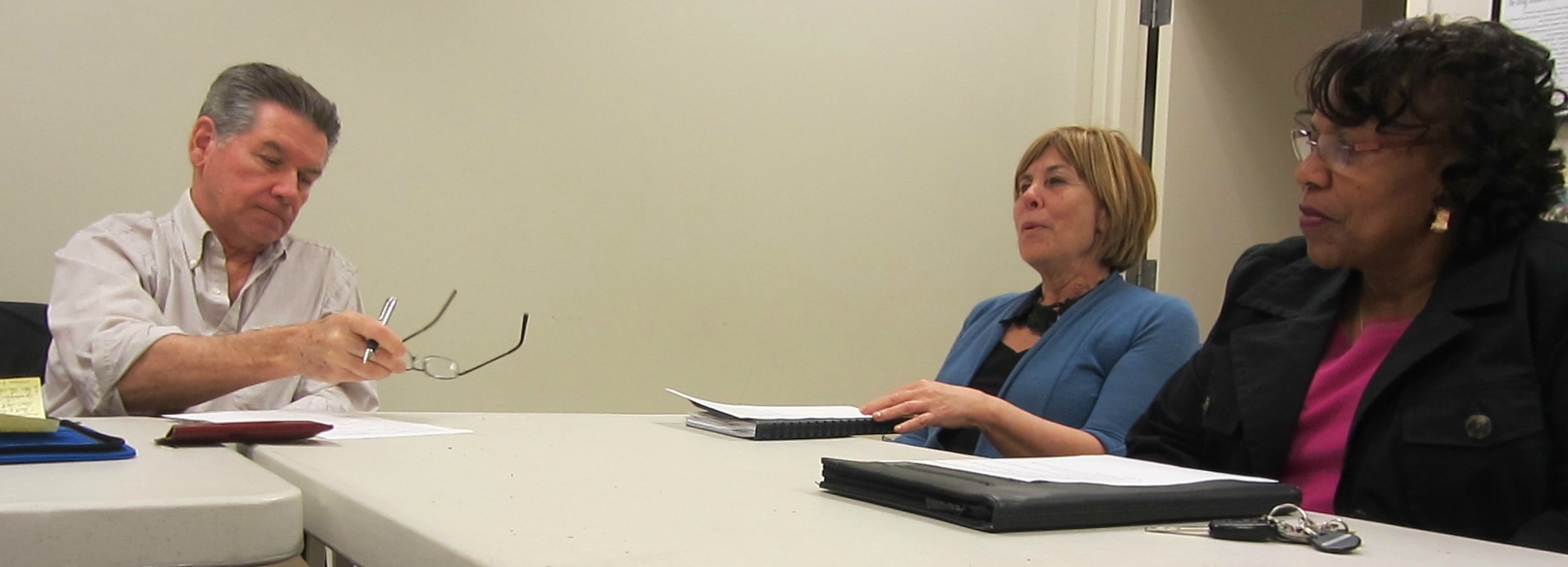
Andrea Jolly, executive director of the Rockville Chamber of Commerce (center) at the Rockville Community Coalition meeting.
At the April 5 meeting of the Rockville Community Coalition, Andrea Jolly shared that the Chamber of Commerce is becoming more active in local advocacy and that the Chamber cares as much about the community as it does business. She’s the executive director of the Rockville Chamber of Commerce, an organization that now claims 185 members, a dramatic turnaround from its nearly lifeless condition just a few years ago. As examples of their reinvigorated stature, she noted the public stand they’ve taken on behalf of Pumphrey’s; the support for environmental causes that affect the community as a whole (such as the bag tax and storm water management fees); and the sponsorship of the Rockville Economic Summit. She expressed her concerns that the community seems to be artificially divided between businesses and residents and while the Council claims to be business-friendly, their actions have indicated otherwise. Most members of the Chamber are small businesses that are locally owned and operated and rely heavily on local residents as both customers and employees. She also voiced a desire that there be good relationships throughout the community rather than irreconcilable differences–we may disagree at times, but we should always be willing to work together to solve shared issues.
During the discussion:
- she clarified the relationship with the Rockville Economic Development, Inc. (they attract and retain businesses but cannot advocate; Chamber provides ongoing services to its members and the current business community, can advocate for a business-friendly atmosphere). She also mentioned that REDI may have a new executive director in place in May.
- she was unaware that the City didn’t collect Continue reading →
2011 City Boards and Commissions Scorecard
Along with the City Council, the City of Rockville has 23 official boards and commissions to study, advise, and decide on a wide range of issues, from city planning to cultural arts, from human services to animal matters. In addition, there are at least ten other unofficial task forces or committees. All of these boards and commissions are composed of volunteers, usually residents (some include property or business owners who live elsewhere) and most members are nominated by the Mayor and appointed by City Council (a few have members elected in other ways, such as RSI).
Rockville has always encouraged and supported citizen involvement in its government, and used these board and commissions to keep the residents informed and part of the decision-making process. But how well informed are its citizens? All commission meetings are open to the public (I’m going to call them all “commissions” to keep things simple), but only three commissions–Planning Commission, Historic District Commission, and the Board of Appeals–have meetings that are regularly broadcast on Channel 11 and the City website (most likely because the City Council has granted them exclusive decision-making powers). For the other commissions, to find out what’s happening you have to attend the meeting, talk to one of the commissioners, or review the minutes. Obviously, the most convenient way is reviewing the minutes or notes of the meeting, so let’s see how we’ve done.
On January 20, 2012, I tallied the number of meetings and minutes posted on the City website for 2011 (cancelled meetings don’t count). By dividing the number of minutes by the number of meetings, I calculated a “public information score.” So if a commission had posted 9 minutes for 12 meetings, that would earn them a Minutes Score of 9/12 or 75%. The higher the score the better, and here’s how they fared: Continue reading →
Strategies for Engaging Voters
The City Council and community activists have often called for increased voter participation in Rockville’s elections with little success. Typical are the results from the November 2011 election, when 6,240 ballots were cast out of 36,840 registered voters in a city with 62,476 residents. If I pull out my calculator, that’s a voter turnout rate of 17 percent or put another way, ten percent of the residents are making the decisions for Mayor and Council. We may find that level of involvement low, but it’s much better than neighboring Gaithersburg, where the voter turnout rate is in the single digits. Nevertheless, every two years there’s a call to increase voter participation but not much happens.
Last night, I joined a committee of the Rockville Community Coalition to explore ways to actually work on this issue. We didn’t develop any strategies or start any campaigns, but we did identify that voters are motivated by issues, good candidates, and yes, money (the current Republican primaries are a great example). We’ll explore all three to see how this fledgling group can tackle these topics and we hope to be ready in plenty of time for the next City Council election!
Max For Rockville Now on Twitter
If you use Twitter to keep up with what’s happening, you can follow this blog @MaxforRockville. Every blog post is automatically shared on Twitter, plus I often use Twitter to report on immediate events in Rockville as I encounter them, such as traffic snarls and city meetings. If you’ve been following @MaxvanBalgooy, those tweets will now focus on my professional work in historic preservation, community engagement, and urban design.
2011 Rockville Election Analysis Available
Dr. Roald Schrack recently released his analysis of the city council election based upon a statistical breakdown of each voting precinct in the city. His observations include:
- About 17 percent of registered voters actually voted, continuing the trend of a low participation rate. [or to put it another way, less than 10 percent of the population (6,240 voters) decided the fate of the entire city (66,000 residents)] Kudos to District 9 (College Gardens and Woodley Gardens) for a highest participation rate of 23 percent (and what’s happening in District 6 (Montrose, North Farm) with only 8 percent?).
- Hot topics were the Red Gate Golf Course and resistance to urbanization.
- State officials associated with political parties actively joined campaigns for the first time, breaking the non-partisan nature of city elections.
- Endorsements by the Gazette, forums, and mailings were probably the tactics that most influenced voters.
- Absentee ballots were much higher than usual, perhaps due to the televised forums and the introduction of the City’s effort to assist residents in nursing homes with voting.
- Formal slates or informal allies among candidates are a clear advantage.
- Negative campaigning is effective in Rockville.
- Well-informed campaigns are much more effective in Rockville than in the county.
Roald provided a charts to compare the Mayoral races in 2009 and 2011, but didn’t provide any analysis. Comparing Marcuccio’s performance in both years seems to show that she maintained her appeal in the same precincts except for significant gains in districts 2 (West End) and 5 (Twinbrook) and significant losses in districts 4 (Twinbrook Forest, Silver Rock, Burgundy) and 7 (Potomac Woods, Fallsmead, Rockshire).
You’ll find more details (and lots of charts) in his 2011 Rockville Election Analysis (pdf). Thanks, Roald!
The Election is Over but Challenges Lie Ahead
The Rockville City Council elections are over and while the results aren’t official until certified, congratulations to Phyllis Marcuccio who will continue as Mayor, Bridget Newton and Mark Pierzchala who will continue on Council, Tom Moore who will be new on Council, and John Hall who will return to Council after a brief hiatus (and thanks to John Britton and Piotr Gajewski for their recent service on Council). No doubt everyone has already seen the election returns and noted that the Mayor’s race was not only heated but close–they were separated by 415 votes out of a total of 6113 votes. If 209 people (that’s 3 percent of those voting for Mayor) had voted differently, we’d have someone else as Mayor. It’s even closer in the Council race–Moore made it onto Council by just 51 votes. So if anyone thinks their vote doesn’t count, think again if you’re living in Rockville.
Although we know the election results for the entire city, Roald Schrack has broken it down by precinct which provides a clearer picture of what happened–and what it might mean for the governance of the city during the next two years:
- Voting followed two different clusters of candidates: Hall-Gottfried-Newton-Trahan vs Moore-Onley-Pierzchala. That suggests that the community has formed two different visions for its governance, and since the election resulted in an even split among these two “slates” on Council, we might have Continue reading →

 Max for Rockville