Is Candidate Richard Gottfried a DINO or RINO?
Once again, the 2023 campaign for Rockville’s Mayor and Council took another strange turn, this time from council candidate Richard Gottfried. Late last week, a letter arrived from him in our mailbox addressed to “Dear Twinbrook Voters,” urging residents to “vote strategically for your neighborhood candidates [Richard Gottfried and Marissa Valeri]” and that he is the “clear choice for Twinbrook.”
What he doesn’t tell us is that he sent a similar letter addressed to “Dear Republican Voter” which instead emphasized the ballot referenda questions on allowing non-citizens and 16-17 year old residents to vote. He states that he is a “conservative candidate who firmly believes that the answers to these two referenda questions should be NO” and that the “other candidates in this election are democrats with very progressive viewpoints.” He especially requests the votes of “republican voters that are registered, but may not take the time to vote in the City of Rockville’s non-partisan election.”
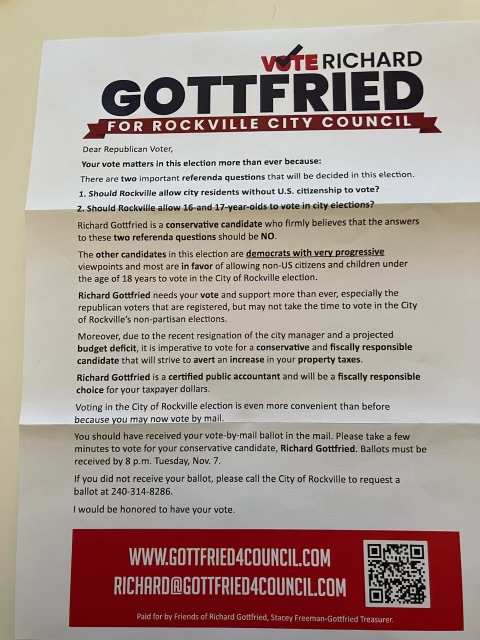
It’s fine that candidates tailor their messages for their audiences, even along party lines in a non-partisan election (although it is really stretching the bounds of traditional campaigning in Rockville). But if you care about a candidate’s values and how they will conduct themselves in office, these letters will be eye-openers. Democrats will be incensed that he’s campaigning in this manner. But Republicans will be as well, because in the 2019 election, Richard Gottfried was registered as a Democrat. I’m not sure if this makes him a DINO (Democrat in Name Only) or a RINO (Republican INcognitO).

Money Talks: Pierzchala, Jackson, Van Grack, and Fulton Lead in Rockville Election Funding
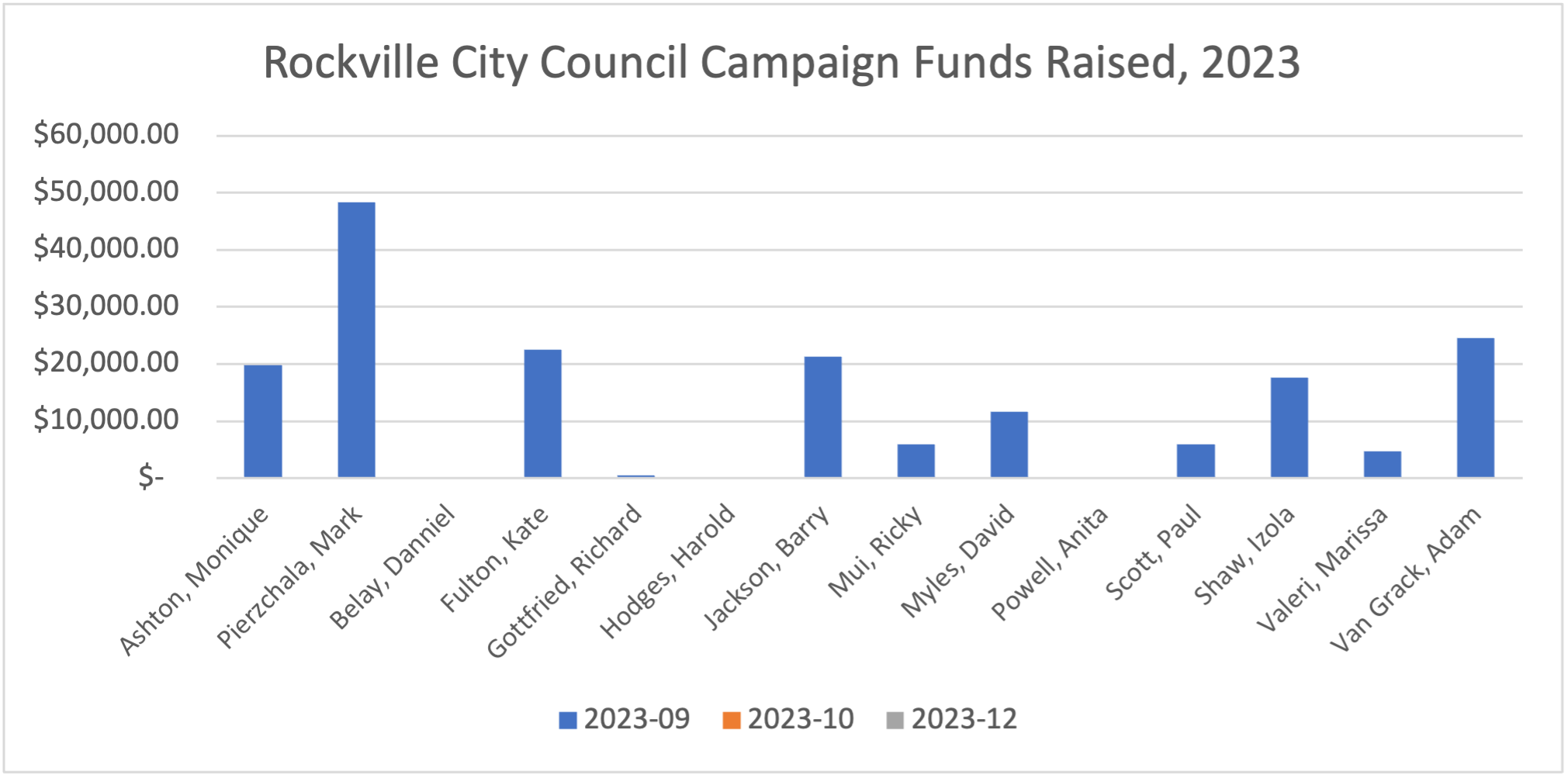
Who’s on top in the Rockville Mayor and Council race? If you based it on money, it would be Mark Pierzchala for Mayor and Barry Jackson, Adam Van Grack, and Kate Fulton for City Council (I suspect Izola Shaw is among them, however, she did not submit a financial report by the deadline). The status of the remaining candidates remain ambiguous, and even the initial insights from the financial reports for these four top-seated candidates warrant further examination.
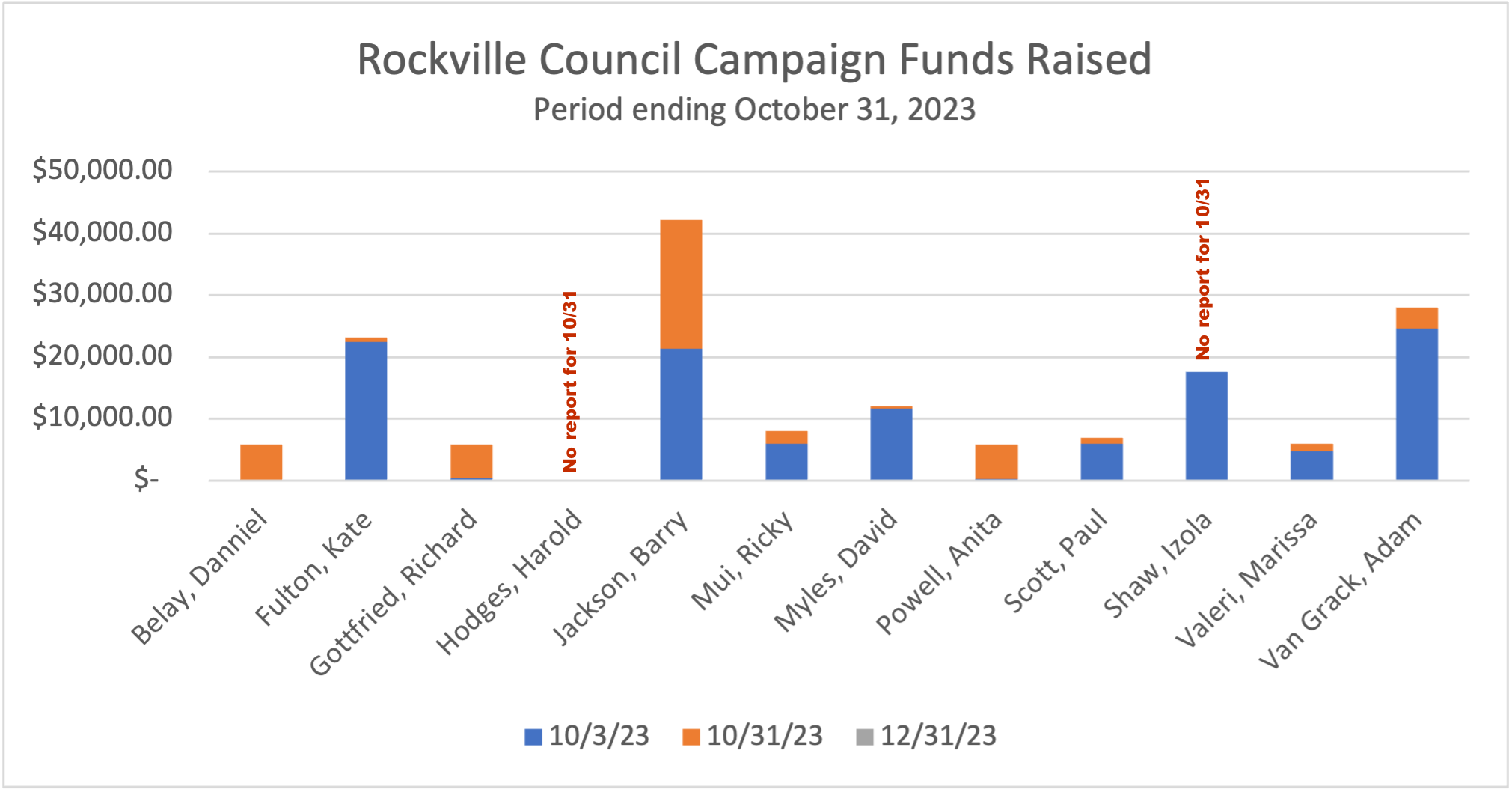
Among the Council candidates, Barry Jackson, Adam Van Grack, and Kate Fulton have each raised more than $20,000 to date, allowing them to run a well-rounded effective campaign. In the 2019 campaign, successful candidates raised about $15,000. To take the lead among Fulton and Van Grack, Jackson loaned himself $20,000. The remaining candidates have raised less than $10,000 to date, putting them on roughly equal footing (again, Harold Hodges did not submit reports so we can assume he is not an active candidate). Among the latest campaign finance reports were several surprises:
- Richard Gottfried attracted only two donors, including Art Stigile, the treasurer of Mark Pierzchala’s campaign.
- Danniel Belay posted an extraordinary growth in contributions from $0 by October 3 to $5,850 by the end of the month, but only one $50 donation came from a Rockville resident. The rest came from outside of the city, state, or United States.
- Ricky Mui raised just over $2,000 but spent more than $2,500 for catering and Chinese lion dancers at a fundraiser, so he actually fell behind. There’s also an unusual comment that his campaign owes Brigitta Mullican, a Rockville resident, $1,286 for 1200 printed mailers.
The Mayoral race contains the biggest surprises as both candidates have raised more than $65,000, overshadowing the council candidates: $67,303 for Monique Ashton and an extraordinary $146,677 for Mark Pierzchala. To achieve those record-setting numbers required loaning themselves record-setting amounts in this month: $35,143 for Monique Ashton and $90,000 for Mark Pierzchala. Combined with their loans for the previous periods (both are incumbents carrying loans from the 2019 campaign), Ashton has debts of $51,678 and Pierzchala has a whopping debt of $126,500. Many residents assume that the Mayor and Council are volunteers, but they are considered “part time” positions and given an “annual stipend” of $37,560 for the Mayor and $30,483 for council members. If Pierzchala wins, it will take more than three years of his four-year term to pay back this loan. Is it worth it? Evidently, it is for him.
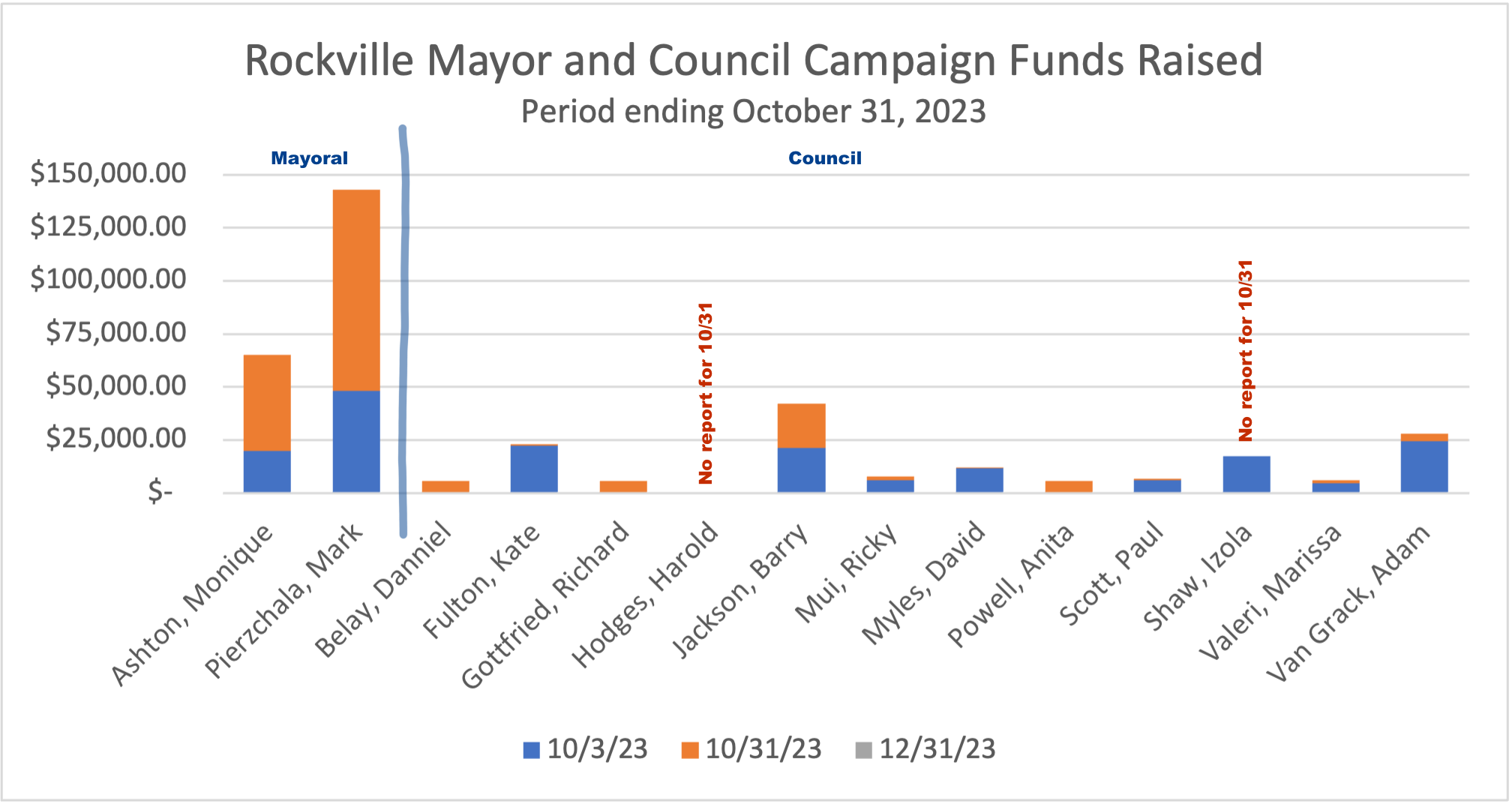
Compared to the 2019 campaign, the amounts raised for 2023 have reached new heights. Most of it is spent on printing and mailing campaign literatures to homes of Rockville residents, which seems to be the most effective way to connecting with voters. If the City changes from city-wide to campaign districts, it will make the cost to run for office much less expensive and open it up to more residents.
Financial Reports Reveal Top Contenders in Rockville Mayor and Council Race
UPDATE: This post was corrected and expanded to reflect the following: revision of funds raised in the mayoral race, charts clarifying loans and mayoral vs council candidates, and a minor error in Danniel Belay’s financial report.
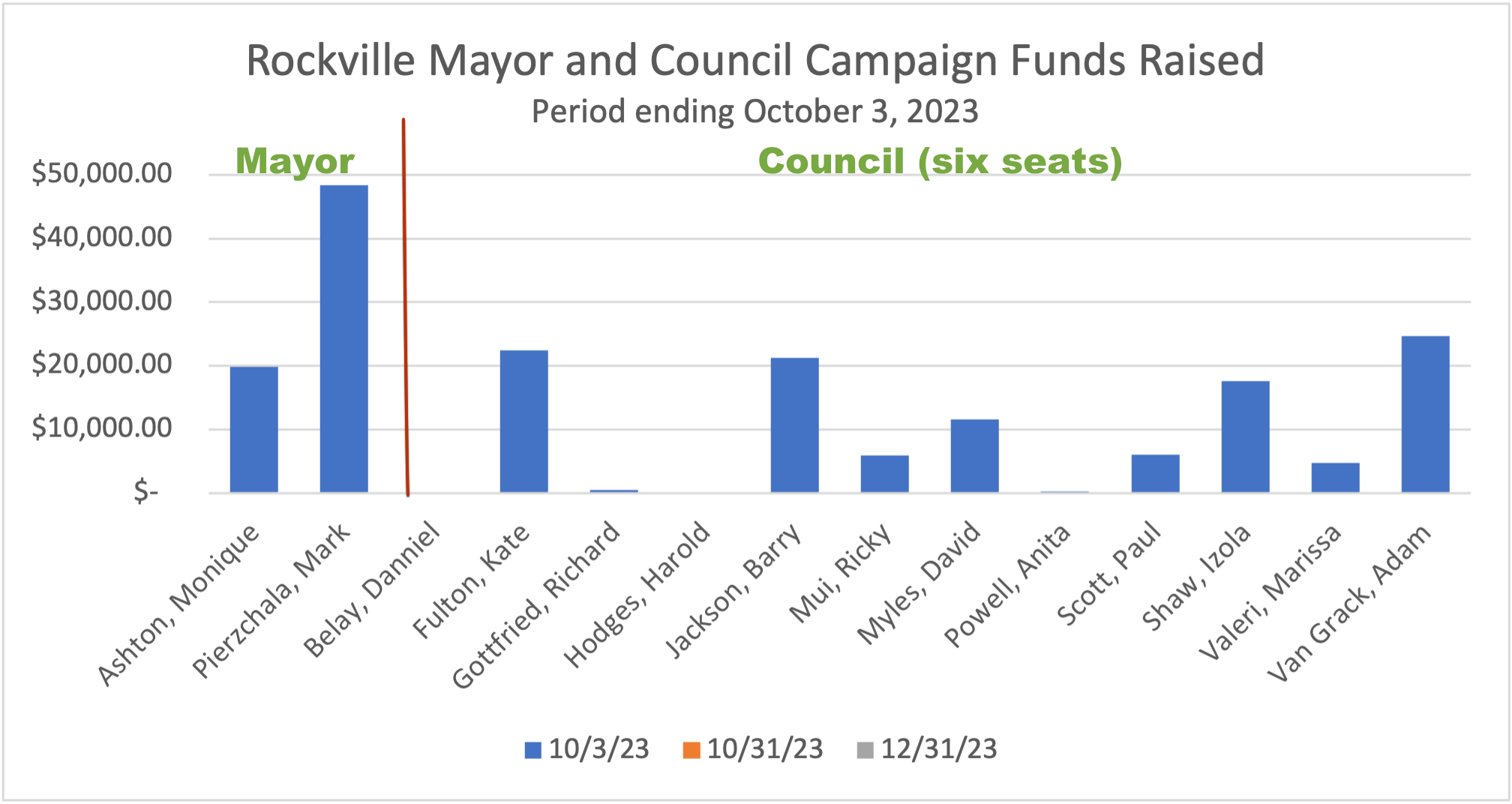
In the Rockville Mayor and Council race, the first round of financial reports, due on October 9, 2023, have begun to paint a picture of the candidates with the most substantial resources and support. As the race for the six council seats intensifies, the field appears to have narrowed from twelve to eight contenders: Kate Fulton, Barry Jackson, Ricky Mui, David Myles, Paul Scott, Izola Shaw, Marissa Valeri, and Adam Van Grack.
However, not all candidates are faring as well. Financial reports indicate that Danniel Belay, Anita Powell, and Richard Gottfried are trailing, each having raised less than $500, a sum considered insufficient to garner substantial voter support in Rockville. Harold Hodges, another candidate, appears to be even less active in the race, having not submitted a financial report.
The mayoral race in Rockville is shaping up to be a complex contest. Candidate Mark Pierzchala has raised an impressive $48,352, but with a self-loan of $33,160 this period, his effective fundraising total comes to $15,192 (ignoring funds and loans carried over from his 2019 campaign).
In contrast, Monique Ashton‘s fundraising efforts have yielded $19,836, a figure that not only falls short of her opponent’s total but also those of council candidates Kate Fulton, Barry Jackson, and Adam Van Grack. Ashton has loaned her campaign $8,224, leaving her with a net fundraising total of $11,612, (ignoring funds and loans carried over from her 2019 campaign). This places Ashton among the middle of all candidates in this election but an improvement compared to 2019, when she had raised nearly $8,000 by the end of September.
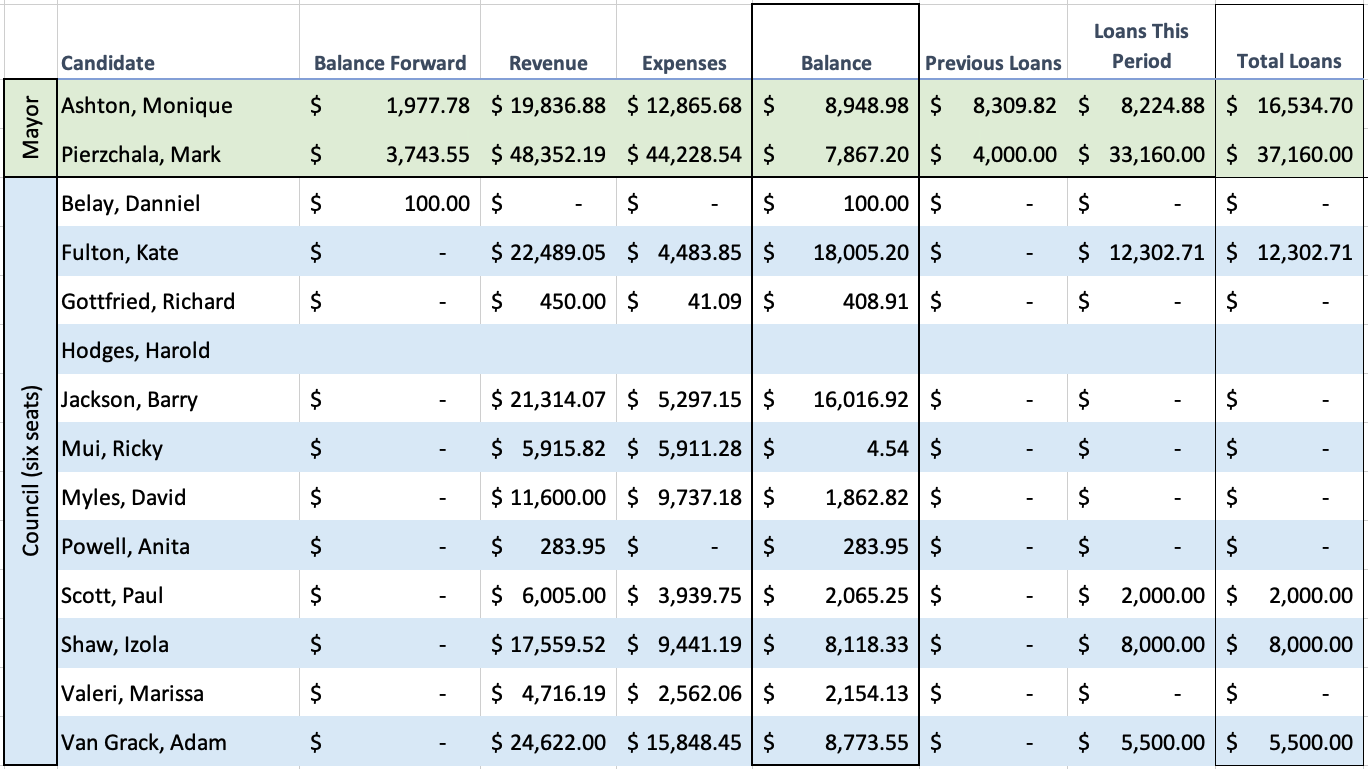
Contributors to campaigns offer revealing insights into financial influences and influencers, but it is different in smaller local races as in Rockville. Donor analysis typically shows many candidates receive support from family, such as Adam Van Grack. However, this election reveals an unusual trend: incumbents Monique Ashton, Mark Pierzchala, and David Myles have not garnered substantial support from local residents, which would be expected if they had significantly impacted residents’ lives. This raises questions about the perceived influence of the Mayor and Council. Are their actions going unnoticed, or are they not making a significant impact? Notably, current Mayor Bridget Newton and her husband are supporting Monique Ashton, Barry Jackson, and Paul Scott.
For your own analysis, here are the individuals who made contributions of $500 or more, all of whom are based in Rockville unless stated otherwise:
Ashton, Monique: Aaron Stallworth (DC, $500), Antonio Quirindongo (NY, $1,000), Joseph Song (CA, $500), Simon Francis (DC, $1,000), Bridget Newton ($750), Fred Newton ($750), Cyrus Allafi ($500)
Pierzchala, Mark: Norma Pierzchala ($1,000), Joel Martinez ($1,000), Paul O’Brien ($500), Janet Gallant ($1,000), Carl Pierzchala ($1,000), George and Barbara Felber ($500), Benjamin Ross (MD, $500), Ingrid Chua ($1,000), Eduardo Alueta ($1,000; returned)
Belay, Danniel: None over $500
Fulton, Kate: Joel Martinez ($1,000), Beverly McFarland (Delaware, $1,000), Bill Fulton (California, $500)
Gottfried, Richard: None over $500
Hodges, Harold: No report
Jackson, Barry: Elizabeth Bartz (Ohio, $500), James “Jack” Jackson (Washington, $1,000), Peter Fosselman ($750), John Killpack (California, $1,000), Bridget Newton ($750), Fred Newton ($750)
Mui, Ricky (DBA Communities Electing Ricky Mui & Supporters of Mui Ricky Fai): Jacob Miller (Washington, $500), Mark Pierzchala ($500), Michael O’Brien (Pennsylvania, $500)
Myles, David: Duncan Maru (NY, $1,000), Tommy Roberts (GA, $500)
Powell, Anita: None over $500
Scott, Paul: Christopher Cash ($1,000), Bridget Newton ($750), Fred Newton ($750)
Shaw, Izola: Steven Van Grack ($520.87), Michael Rubin (MD, $520.87), Kimberley Propeack (MD, $500), Quinton Zondervan (MA, $1,000)
Valeri, Marissa: None over $500
Van Grack, Adam: Steven Van Grack ($1,000), Brandon Van Grack ($1,000), Claire Bohenegel (DC, $1,000), Gail Van Grack-Aks ($1,000), Ryan Van Grack (MD, $1,000), Citizens for Brian Feldman (MD, $500), Terry Lierman (MD, $1,000).
The Board of Supervisors of Elections requires candidates to file their campaign financial statements on simple yet confusing forms (or are they simply confusing forms?) that always trip up candidates and require correction (to see how widespread this problem occurs, count the number of amended returns in 2019). For this round, there seem to be a couple errors that deserve closer scrutiny but do not seem to affect my overall conclusions:
- Rockville United lists an in-kind contribution of $200 to Paul Scott, which does not appear in Paul Scott’s report.
- Danniel Belay lists $100 as a balance forward, however, there is no previous campaign finance report. I suspect this was a self-contribution to open a bank account for the campaign and is recorded incorrectly.
- Anita Powell lists $283.95 in contributions as loans but they are actually campaign expenses.
Navigating Rockville’s Election: Tom Moore’s Endorsements for Mayor and Council
These endorsements for the current candidates for Mayor and Council are provided by Tom Moore, a whom I first met when we both ran for Council years ago. Even though we don’t always agree, he’s informed, thoughtful, and may help you with your ballot choices. He served two terms on the Rockville City Council from 2011 to 2015, then served as counsel and chief of staff to Commissioner Ellen L. Weintraub of the Federal Election Commmission. In June, he joined the Center for American Progress as a senior fellow on its Democracy team. He has lived in Rockville since 1997.
No matter what happens this November, the City of Rockville will enter a new era of leadership. We’ll have our first new mayor since 2013. And we’ll have six councilmembers, up from four – and at least five of them will be newcomers.
Given the scarcity of information about the election, I wanted to share my thoughts about those who are running. With just two exceptions, I will be saying positive things about the people I’m supporting, and not much about those I am not supporting. I hope you find it helpful.
First up: I will be proudly voting for Mark Pierzchala for Mayor. I have a tremendous amount of respect for, loyalty to, and affection for Mark. He and I served together on the Council during my first term (2011-13). I learned a lot from him about the issues, but, more importantly, he modeled for me how to vote your conscience fearlessly. He took on tough issues when popular sentiment went the other way. He championed good development and housing policies when it would have been easier – sometimes, much easier – to vote the other way. He has a good heart, good common sense, and is admirably careful about the City’s budget. Mark has been a terrific councilmember who has served his City well, and he will be a terrific Mayor.
As to the Council: I will be voting for (in alphabetical order by last name): Kate Fulton, Barry Jackson, Anita Neal Powell, Izola Shaw, Marissa Valeri, and Adam Van Grack.
Kate Fulton impressed me when she and I sat down so she could pick my brain on how to run and serve. I was just about to talk about how the City budget was intimidating to me when I was first elected (but that the City’s budget staff were very kind and patient in explaining it) when Kate mentioned that she’s COO of the Federal Reserve. Yeah, she gets budgets. She’ll be a good councilmember.
Similarly, Barry Jackson and I sat down for a marathon coffee session months ago when he was first thinking about running. He’s a solid guy with great experience running the King Farm Citizens Assembly. He and I clicked on a lot of issues, and he immediately erased my concern that a candidate who runs KFCA would only represent King Farm if elected. He’ll be a good councilmember.
Anita Neal Powell has served the City for many years. She has been an effective and tireless advocate for Lincoln Park, and I’m delighted that she’s offering to serve on the City Council. On a City Council that will be made up of newcomers, Anita will bring a badly needed breadth and depth of experience. She’ll be a good councilmember.
I met Izola Shaw when we were both advocating for the city-citizen ballot initiative (which I’m going to be writing about separately!). She served the City well on the most recent Charter Review Commission. I like her, I like her values, and I think she’ll be a terrific voice on the Council.
I met Marissa Valeri when she was on the national staff of Common Cause and I was serving on the board of Common Cause Maryland. Marissa devoted years as a fierce advocate for the Twinbrook neighborhood as head of the Twinbrook Community Association. I think she’ll be the kind of councilmember I strived to be – energetic, attuned to her constituents’ needs, forever unsatisfied with the status quo, and eager to stick her neck out to do the right thing. She’ll be a good councilmember.
I had not met Adam Van Grack before this election season, but I’ve known his dad (Steve) and one of this brothers (Brandon) for many years. Adam sat down with me and we chewed over some of the stickiest issues facing the City – among them development, crime, and the fate of the King Farm farmstead and the former Redgate golf course. What impressed me most about Adam was not how much he agreed with me, but how much he disagreed with me – and how he did so. He was well-prepared to address the issues (important) and respectful in how he addressed our differences (less important, but shows he was raised well). But even when we came to opposite conclusions on different issues, the core values Adam used to analyze the issues were similar to mine, which is the most important. He’ll be a good councilmember.
Those are the six I’m voting for, and I recommend them to you.
As to the rest of the field: I haven’t met four of the candidates – Danniel Belay, Harold Hodges, Ricky Mui, and Paul Scott – and I can’t say much about their candidacies. I will note, however, that Mui supported Dan Cox for governor in 2022, which I think puts him well outside Rockville’s political mainstream.
I am actively deciding to vote against the two remaining candidates – Rich Gottfried and David Myles – and would like to provide some context for this. I know both of them, and I like both of them personally, but I do not believe the City would be well-served with either of them on the Council for the next four years.
Rich Gottfried has run for Council several times over the past few cycles, sometimes dropping an eye-popping amount of money into his campaign coffers, without success so far. He’s used that money to run very unpleasant campaigns, attacking the good will of those who confronted the City’s growth issues. Does he have a right to do that? Sure. But it doesn’t speak well of his grasp of the issues and doesn’t speak well of his ability to work on the Council.
Incumbent councilmember David Myles, who was elected in 2019 as a member of the Team Rockville organization I helped start in 2013, was involved in a domestic incident this summer in which the police were called and he was arrested. I am not judging David’s candidacy on the incident itself, because I just don’t know enough about it. It appears to be a sad and complicated situation.
But David’s response, in the form of a lengthy e-mail he sent to members of the community immediately after the incident, gave me great cause for concern. It was all over the map, kind of claiming victimhood in one section and kind of trying to be a public-service announcement in another, and weirdly dodgy throughout. The only thing I got out of it for sure was that David’s personal life needs to take priority over his public service.
Rockville’s Neighborhoods: A Key Factor in Local Elections?
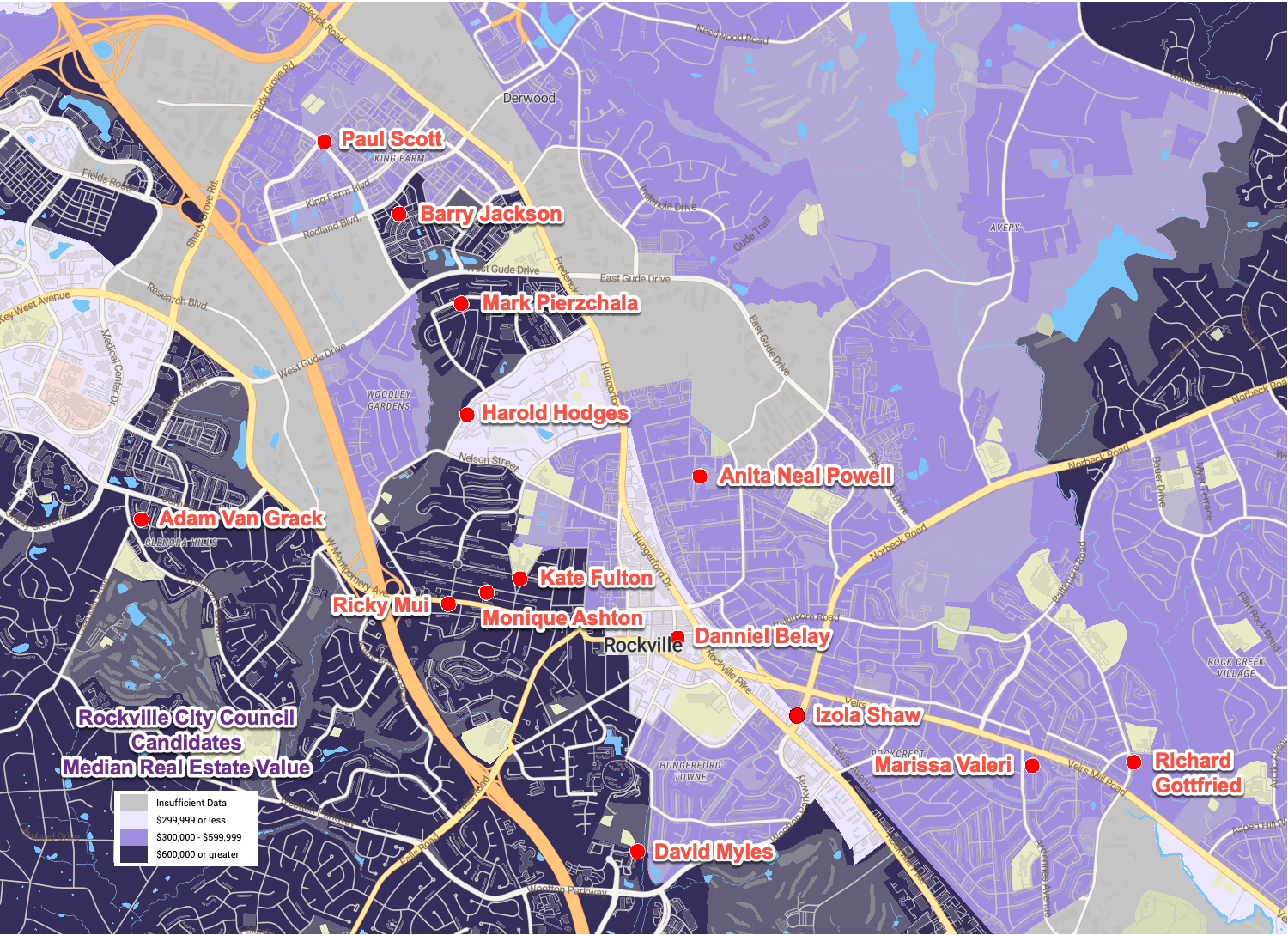
If you want to run for a spot on the Mayor and Council, you need to be at least 18, registered to vote, and have lived in Rockville for at least a year before the election (for this race, that means living here since November 7, 2022). But when people vote, they often pick candidates who they feel are like them and will represent what they care about. So, where a candidate lives can be really important, especially if they live in a neighborhood that’s similar to the voter’s.
Looking at the map, you can see Rockville is split into three parts by major highways. To the west of I-270 is the “wealthy west,” where the average house costs more than $600,000. Adam Van Grack is the only candidate from this part of Rockville. To the east of #355 (Rockville Pike/Hungerford Drive/Frederick Road—actually, the dividing line is Metro) are the “middleburbs,” where houses typically cost between $300,000 and $600,000 and is home to Anita Neal Powell, Izola Shaw, Marissa Valeri, and Richard Gottfried.
Right in the center of the city is the “mixing bowl,” where house prices vary the most and has the greatest number of candidates: Paul Scott, Barry Jackson, Mark Pierzchala, Harold Hodges, Kate Fulton, Monique Ashton, Ricky Mui, Danniel Belay, and David Myles.
In past elections, the richest neighborhoods usually had the most people voting. If we think they’ll vote for people who are like them or share their interests, we will likely see Barry Jackson, Adam Van Grack, Kate Fulton, Ricky Mui, and David Myles take five seats on the next city council. If we continue this logic, there is one more seat available on council so it will be a tight race between Paul Scott, Anita Neal Powell, Izola Shaw, Marissa Valeri, and Richard Gottfried. The contest for Mayor between Mark Pierzchala and Monique Ashton, who both live in wealthy neighborhoods, will be more complicated. Voters will likely consider additional factors like experience, background, personality, and age.
As for age, once again this council election attracted candidates that span at least three generations. The Millennial generation (born 1981-1996) is solely represented by Danniel Belay; Gen Xers (1965-1980) by David Myles, Monique Ashton, Ricky Mui, Izola Shaw, Kate Fulton, Barry Jackson, Marissa Valeri, Adam Van Grack, and Harold Hodges; and Boomers (1946-1964) by Paul Scott, Richard Gottfried, Mark Pierzchala, and Anita Neal Powell. Most people who vote in Rockville are from Generation X. If they vote for people who are like them, we might see a lot of candidates like David Myles, Monique Ashton, Ricky Mui, Izola Shaw, Kate Fulton, Barry Jackson, Marissa Valeri, Adam Van Grack, and Harold Hodges on the city council. But the people who vote the most are Baby Boomers, so Paul Scott, Richard Gottfried, Mark Pierzchala, and Anita Neal Powell could also have a good shot at winning.
The Rockville United campaign committee, which includes Monique Ashton, Kate Fulton, Paul Scott, Izola Shaw, and Marissa Valeri, could really shake things up in the city council if voters decide they want a big change. However, it’s hard to find information about this team online, and usually, people prefer to pick their candidates one by one. But remember, teams like Rockville United can be a great way to make the most out of limited resources.
Eligibility vs Participation: Three Rockville Council Candidates Didn’t Vote in 2019
October 7, 2023: I’ve been informed by a candidate for council that their voting record reported in this post is inaccurate. This information is this post is based on data provided by Montgomery County and the City of Rockville, so I am in the process of requesting further information from them to determine the source of the errors. My apologies to candidates affected by this blog post but I encourage all voters to ask about a candidate’s voting record to ensure they actively participate in our civic life and to ask the City of Rockville about the process for ensuring the accuracy of the voter database. More details at A Week of Surprises on Rockville’s Campaign Trail.
To run for a seat on the Mayor and Council, candidates must be 18 years old, a registered voter, and have lived in Rockville for at least one year prior to the election (that’s Nov. 7, 2022 for the current race). While you might be a registered voter, that doesn’t mean you vote. Indeed, in a review of voter records from Montgomery County and the City of Rockville shows that three candidates for City Council did not vote in the most recent 2019 City Council election: Danniel Belay, Ricky Mui, and Adam Van Grack. Perhaps they moved into Rockville after 2019, were sick, or out of town (although vote-by-mail was available), but it did make me wonder about the voting record of the other candidates. If you want to lead our little part of democracy, how active have you been in our democratic process? If you’re trying to convince people to vote, how convinced are you about the importance of voting?
Going back to the 2010 elections (I don’t have records for 2020 and 2022), four candidates voted in every election: Mark Pierzchala, Richard Gottfried, Anita Powell, and Marissa Valeri. That’s a 100% voting record. Voting less than half the time (50%) are Daniel Belay, Kate Fulton, Ricky Mui, Paul Scott, and Adam Van Grack. That doesn’t mean they should be automatically dismissed, but they should provide an explanation to voters (why should I vote for you when you didn’t vote most of the time?). The remaining field has a mixed record, although their voting record improved over time.
To see their voting records of the candidates at a glance, see the chart below. Green means they voted, red they didn’t vote, and yellow or ? is unknown. The date they registered to vote is important for evaluating their records—how long has the candidate been part of the democratic process? For example, Anita Powell has the longest record for Rockville, being a registered voter since 1975. On the other hand, Danniel Belay didn’t register until 2014 (I suspect he was under 18 until then), so he didn’t vote until 2014. Again, I don’t have records for 2020 and 2022 (the Montgomery County Board of Elections sells the list at a cost of a couple of hundred dollars), but the patterns are pretty clear from the data I have available.

Candidates for City Council Expands to 14
By September 7, the Board of Supervisors of Elections had certified two candidates for Mayor and twelve candidates for Council for the upcoming November 7, 2023 election. Danniel Belay, Richard Gottfried, and Anita Neal Powell are the latest additions, so if candidates were selected randomly, the chances of gaining a seat on Council decreased from 67 to 50 percent. But Councilmembers are not elected randomly and rely on their campaign strategies and voter motivation and preferences. Here’s the current list of candidates:
- Candidates for the Office of Mayor
- Monique Ashton
- Mark Pierzchala
- Candidates for the Office of Council
- Danniel Belay
- Kate Fulton
- Richard Gottfried
- Harold Hodges
- Barry Jackson
- Ricky Mui
- David Myles
- Anita Neal Powell
- Paul Scott
- Izola Shaw
- Marissa Valeri
- Adam Van Grack
Can You Buy Your Way onto City Council?
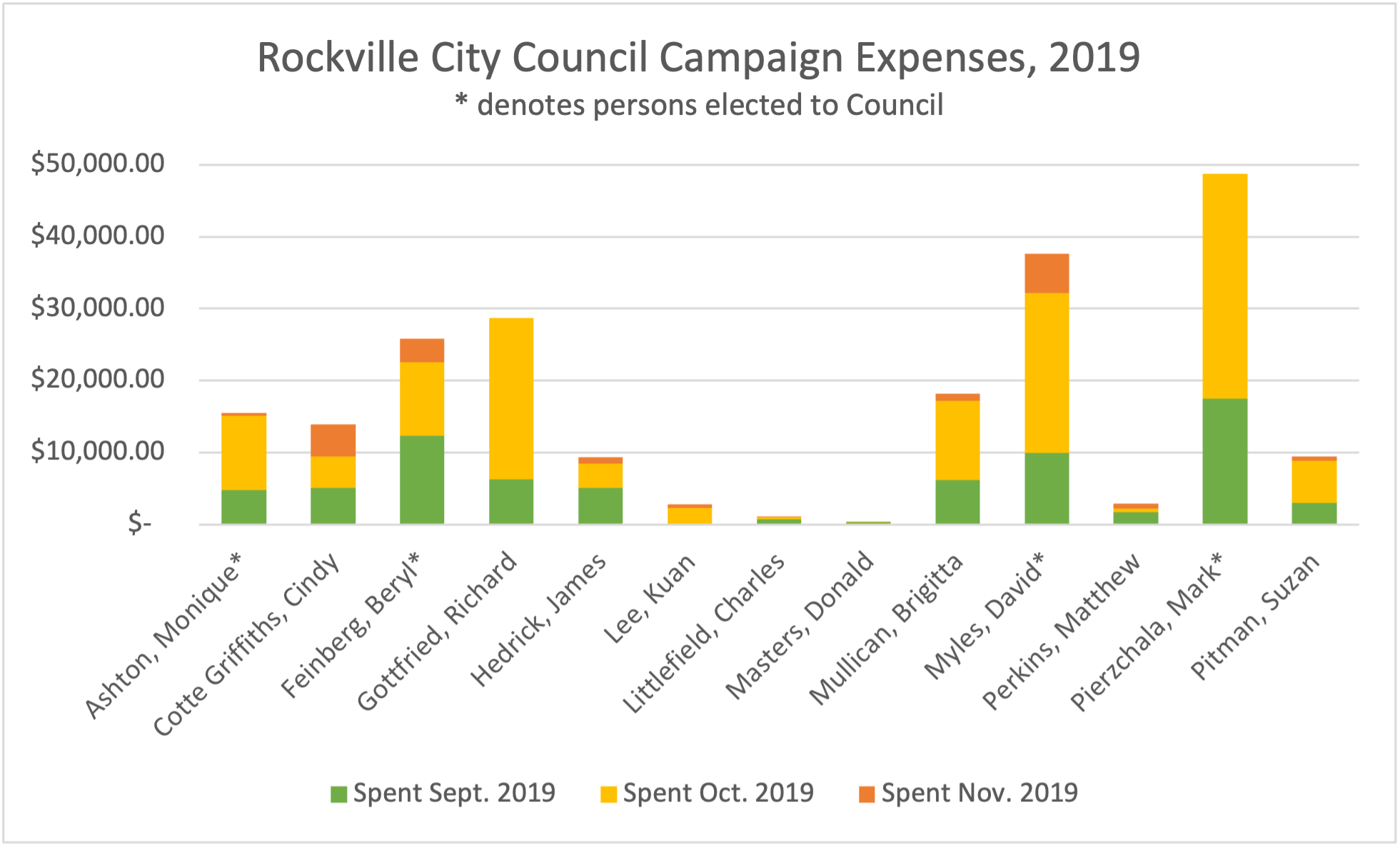
Election campaigns, even small local ones like Rockville City Council, require time and money. With the absence of a local newspaper to reach voters, candidates have to either spend most of their time walking door to door or most of their funds to print and mail campaign literature. In 2019—the last election for Mayor and Council—candidates for Council spent from $424 to $48,776 on their campaigns. Does money matter in local elections? Absolutely, under the right conditions.
As can be seen in the chart above, the candidates who spent the most money (Ashton, Feinberg, Myles, and Pierzchala) were elected to City Council—with one notable exception (Gottfried). The difference? Gottfried had less than a handful of individual contributors to his campaign; his campaign was mostly self-funded. The successful candidates had lots of money and contributors, and those who tended to spend less per vote had more Rockville residents as supporters. I suspect local supporters are more influential on the election than contributors who live out of town.
Looking more closely, successful candidates in 2019 needed at least 5,000 votes and spent between $3 to $10 per vote. In other words, to win a City Council election in Rockville required $15,000 to $50,000—mostly raised from local residents. If a candidate can’t raise those funds locally, they will need to put in a lot of their own money. At the other end of the spectrum, small campaigns who spent $500 to $5,000 didn’t have the capacity to gain sufficient support to cross the 5,000-vote threshold. If there are candidates you’d love to see on City Council, give them your financial support. A contribution of $25, $50, or $100 can make a big difference, especially in September.
The middle-sized campaign of $2 to $5 per voter ($10,000 to $20,000) seem to rely not only on the number of local contributors but also a thoughtfully-crafted campaign. To get out the vote, candidates have lots of ways to spend money (mail, literature, photography, videos, buttons, yard signs, t-shirts, social media, advertising) and time (parades, events, walking door to door, planning meetings, Community Forums, phone calls) but some are more effective than others. Campaigns of this size can’t shoot from the hip; they have to plan and manage carefully. Cotte Griffiths, Hedrick, Lee, Mullican, and Pitman fell into this nebulous and fraught category, so this year’s candidates may want to talk with a couple of them for advice. Perhaps the enlargement of the Council by two seats will allow more middle-sized campaigns to succeed. BTW, Kuan Lee’s expenses are low in the chart but he had over $10,000 in outstanding unpaid bills at the end of 2019, so his expenses are actually closer to $13,000.
The chart also shows that campaigns ramp up in September and at full-speed in October. November is very quiet by comparison because the election is held early in the month. I suspect that Labor Day will begin the campaign season in Rockville and it will include the usual craziness of mud-slinging and dirty tricks (yes, it unfortunately happens in Rockville).
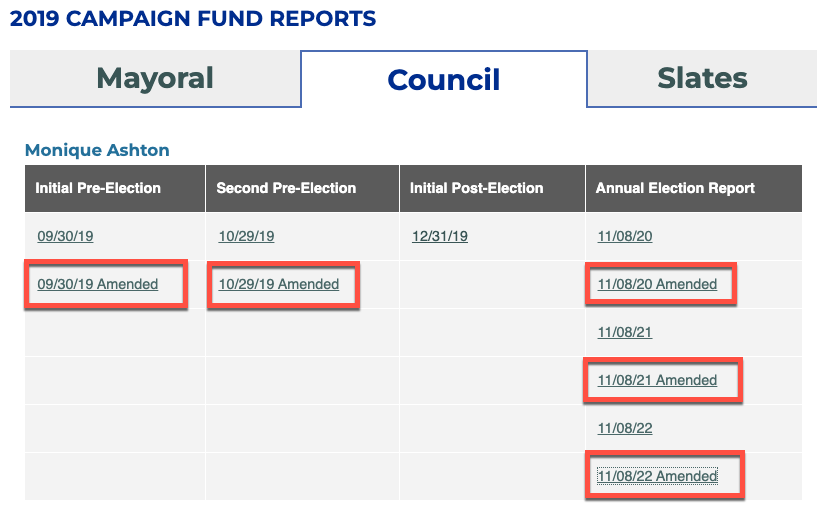
The data for the chart is derived from each candidate’s campaign finance report, which are submitted monthly during the height of the campaign season. Rockville developed its own campaign report forms and they desperately need to be revised because most candidates are unable to complete them properly and have to submit amendments regularly—some of them months later. Plus, key information can obscured because the forms allow candidates to reimburse themselves for expenses—the public can’t see where the cash is flowing, which is the primary purpose of campaign finance reports. The Board of Supervisors of Elections needs to revise the form and establish a standard of performance that no more than 25% of reports in any periods are amended.
A Most Unusual Election
This year’s Mayor and Council election in Rockville is extraordinary not only because Election Day has turned into Election Month due to vote-by-mail, but also because so many new, unusual, and strange campaigning is happening. You’ve probably noticed a few of them but when you bring them all together, you realize this election is very different from its predecessors.
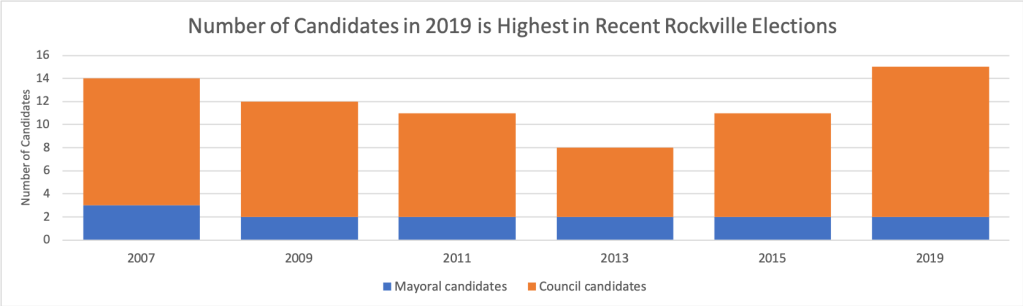
The number of candidates is the largest in recent memory and I’m not sure what’s prompting it. Running for office is grueling and costly. Maybe there’s a gut feeling that the city is being pulled in several directions and people are jumping in to influence the outcome or that there are two slates (which was common twenty years ago) plus the usual unaffiliated candidates.
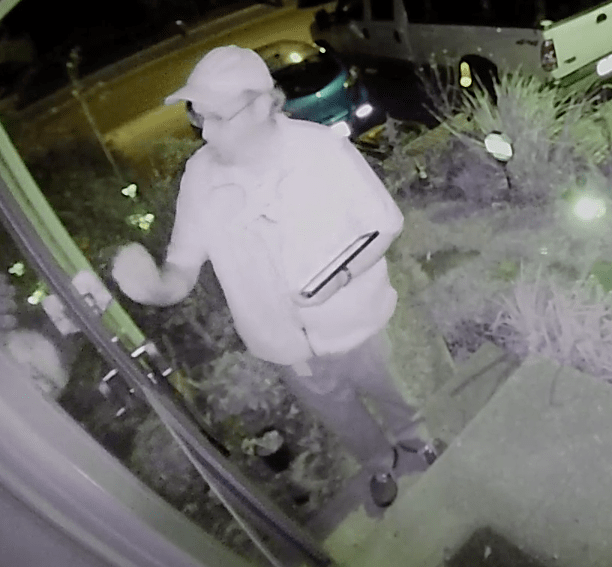
We’re now at the time of the campaign when yard signs become a point of contention. During the day, fanatics will confront homeowners who have signs of their opponents or in the dead of night, steal signs and blame it on teenagers. This election is different because many homes have motion-activated security cameras, making it easier to catch misbehavior on video. Recently posted on Twinbrook Neighbors, a camera caught a person tucking candidate literature into the door who also seemed to go through the resident’s mailbox. And he wasn’t a teenager.
Continue reading →2015 Campaign Finance Reports Shows Plenty of Holes in the System
January 15, 2016 was the deadline for the latest financial reports for the 2015 campaign for Mayor and Council in Rockville, which covers the week before the November 3 election through the end of the year. Although this includes the hottest period of the campaign, it’s also assumed to be the quietest financially because most contributions and expenses have already been made. For the 2015 campaign, however, that short period represented 19 percent of the revenues and 38 percent of the expenditures so it wasn’t a fallow period.
More than $17,000 in contributions arrived in candidates’ bank accounts after October 26, including last-minute donations between candidates and from planning commissioners, creating a few more connections that weren’t apparent earlier. Expenses exceeded $60,000, most of it concentrated in the mayoral race between Bridget Newton and Sima Osdoby and the council campaign of Richard Gottfried. Gottfried spent an additional $9,715 for a campaign total of nearly $50,000—by comparison, the other Council candidates spent an average of $6,812 and mayoral candidates averaged $25,416.
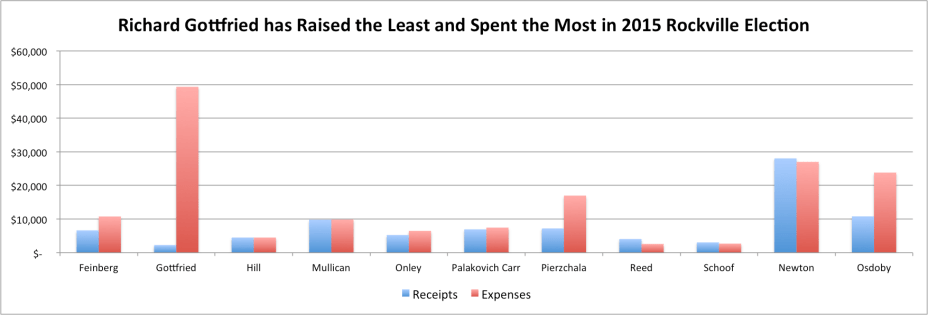
2015 Rockville Campaign Expenses for the period ending December 31, 2015. Patrick Schoof’s data is incomplete.
For the 2015 Mayor and Council race, the eleven candidates raised $88,615 and spent $161,550 in total. The averages in this election are thrown off by Gottfried’s extraordinary campaign, so if we exclude him and the mayoral race (which is always much higher), the average amount raised by Council candidates was Continue reading →

 Max for Rockville