What a Week–and It’s Not Over
I took this week off from work to devote my energies fulltime to the campaign. I spent five days walking precincts (I think I visited two thousand homes), attended three forums, and responded to questionnaires in the time remaining. I’m exhausted–I don’t know how the other candidates did it (Piotr Gajewski seemed incredibly peppy at the King Farm Forum, but perhaps that’s because he was on home turf). I was elated that it rained this afternoon and I forced off the streets.
Tomorrow is the penultimate forum, this time with Rockville Central at the new Thomas Farm Community Center on the west side of 270 starting at 9:30 am. From the description of format, it should be a bit unusual (at one point, we’ll draw names from a hat and ask another candidate a question–should I be nice or naughty?). The eighth and last forum for this election season will be next Thursday, October 29 at the Rockville Senior Center. They’ve all been well attended so if you haven’t been to one, you have two more chances.
Gazette Calls Max van Balgooy a Standout
The Gazette listed its endorsement for Rockville Mayor and City Council in today’s issue (October 21, 2009) and although I wasn’t among its finalists, it did recognize me as a “standout” (is that the same as “outstanding”?):
It is worthwhile to note two other standouts, Max van Balgooy and Virginia Onley. A Twinbrook resident and historic preservationist, van Balgooy believes it is critical to draw in residents to participate in government, especially with changing demographics. He also believes new technology should be used to effectively disseminate information.
I am delighted to be considered a serious candidate by the Gazette despite my underdog status and look forward to November 3 (and I suspect their endorsement will seriously color the rest of the campaign).
Responses to Gazette’s Questionnaire
The Gazette sent a questionnaire to the candidates and will be publishing in an upcoming issue, but I thought I’d share them with you now in case you wondered about my stance of these topics:
Q. What qualities and experiences distinguish you from the other candidates?
I have decades of experience in public service, giving me a broad understanding of city government. During my tenure on the Historic District Commission, we not only preserved historic places and protected property values, but also simplified processes for property owners, updated and expanded the commissioners’ handbook, promoted joint meetings with other commissions, and installed markers for African American historic sites–all of which required working with a variety of people within a complex system. Before moving to Rockville in 2001, I served on the City of Upland Planning Commission and Main Street Upland (a downtown business association), where I developed ordinances to allow sidewalk cafes and bed-and-breakfast businesses, crafted design guidelines for a major housing development, coordinated events that brought customers to downtown, and helped our business association achieve certification. Finally, I am the only candidate from the southern side of Rockville, which would ensure a diversity of perspectives on the Council.
Q. If you are an incumbent, how did you vote on the fiscal 2010 budget and why? If you are not an incumbent, how would you have voted and why?
Given that the past three years had incurred deficits and that are reserves at a minimum, I would have sought to build up reserves to create a “rainy day” fund until the worst of the economic storm had passed. If that proved too difficult to achieve, I would have prepared an alternative budget with a 5% cut in the event we had to make changes later in the year, allowing us to move ahead hoping for the best but prepared for the worst.
Q. How should the city proceed with RedGate Golf Course? If it continues to lose money, should the city continue to keep it open?
As a recreational facility, it should be reclassified from an Enterprise Fund into the General Fund and made part of other recreational facilities, such as the swim center. All recreational facilities, including the golf course, should be regularly evaluated to determine if they provide good value to the city and to its users.
Q. What role should the city have played in the negotiations between residents and Montgomery Housing Partnership, the nonprofit that wants to develop Beall’s Grant II? Was it a mistake not to move quicker with the process, which some say would have secured state funding sooner rather than later?
Since this was a controversial issue, the City should have had the meetings facilitated by a neutral, third party to ensure everyone’s views were heard and considered in a mutually respectful manner, as well as proceeding as quickly as possible, both for the sake of the property owner as well as the neighborhood. Secondly, the controversy revealed a weakness in the Zoning Code, since the use and design of Beall’s Grant II was approved by the Planning Commission. The Code should have been reviewed to determine how it could be improved or revised to avoid future problems.
Q. Did the city’s recent compromise with Town Square merchants provide an ample solution to the discussions on whether to extend the hours patrons should pay to park in the three city-owned garages? How can the city make up the money that it might have received if it extended the paid-parking hours as they had originally been proposed?
Town Square is based on a complex arrangement between the City and several partners which required that the City would have to build the garages. The cost of those garages added a $1.4 million expense to the City’s budget, but it was assumed it would be covered by the revenue from parking fees and special property taxes. We also recognized these fees and taxes would be insufficient in the initial years as the Town Center built momentum, and that shortfalls would need to be paid by the City.
We always hope to reach financial sustainability as quickly as possible, however, the downturn in the economy and delay in opening the grocery store has exacerbated the situation. We have a symbiotic relationship with the merchants and residents of Town Square: if they fail, we fail. It is in our best interest to ensure that the Town Center does not fail, but its success may lie far beyond parking fees. As a former boardmember of a downtown business association, we discovered that events (rather than free parking) were the best way to attract and retain customers. Secondly, rather than talking among ourselves, we conducted research to better understand what customers wanted. It frequently turned out to be things we had never considered, such as better landscaping, more trashcans, and public restrooms, as well as a different mix of stores.
Q. How well does the city (elected officials and staff) communication with its residents? Are there ways it can improve, and if so, how?
The City has dramatically improved its ability to distribute information to residents, but needs to improve its ability to accept information from residents. True communication works in both directions. There are both simple and sophisticated solutions, including:
- instituting email addresses for every board and commission so that the public can submit comments via email, not just mail or in person.
- creating a blog for city announcements and projects which would allow comments and discussion by residents.
- holding Mayor and Council workshops throughout the city primarily for the purpose of hearing from local residents about their concerns and interests.
- developing a central electronic calendar of events and activities for all civic associations and non-profit organizations operating in the city.
- preparing and distributing the Mayor and Council agenda at least five days before the meeting
Q. Many have complained that the council has lacked civility toward each other and the residents who come before it. How would you guarantee that civility becomes a priority in the next two years?
Mutual respect among councilmembers, the staff, and the public has been quite low in the last few years. Guaranteeing civility is difficult, but there are two things I would pursue. First, I would continually remind myself and others that we all share the same goal–a better Rockville–and thus we’re all on the same team, not opponents or competitors. Secondly, to gain respect, you must first give respect, which requires listening to other perspectives with sincerity and a willingness to change your mind. I’ve always taken this approach on the Historic District Commission (watch any meeting or ask any commissioner) and have already taken this approach with the city council candidates (I’ve met with several of them during the race so we can get to know each other better). However, citizens also play a role. In the event a councilmember is hostile, disrespectful, or abusive, it is our responsibility to remove him or her from office at the earliest opportunity.
FY 2009 Ended Better Than Expected (sort of)
At the October 12, 2009 meeting of the Mayor and Council, the Finance Department released its financial report for the fourth quarter (April-June) of 2009. The good news is that the staff was able to keep reserves (savings) above the 15% minimum with a $3 million cushion and the deficit has been reduced to -$1.8 million (was expected to be -$5.2 million). As a result, I’ve updated the chart to provide the latest information.
The bad news is we still have a deficit (now the third year in a row) and even worse, several members of the City Council still don’t recognize we’ve had deficits. I’m not sure how they’re confused, but it could be that they adopt a balanced budget at the beginning of the year and forget that as the months go by, actual revenues and expenses usually don’t follow the budget and it can be very different at the end of the year. It’s like making a New Year’s resolution that you’ll lose 15 pounds by summer, but when you weigh yourself on June 1, you’ve discovered you didn’t make it.
Responding to Diversity in Rockville
The deadline for the questionnaire for Community Ministries of Rockville passed on October 15, so I thought you’d be interested in my response (and their intriguing questions):
Question: Rockville is becoming increasingly diverse in its ethnic, racial and religious composition. What will you do to encourage effective assimilation, participation and celebration of their various gifts?
Answer: We must actively work today for the Rockville of the future and it is clear that it will be more culturally diverse in the next few decades. Unfortunately, we have made little progress in making other cultures feel welcome and indeed, some people are actually afraid and hostile to these new residents, reminding me of my parents’ experience when they moved to the United States after the war. We need to make greater efforts to reach out to them to the places where they live, work, and play, rather than expecting them to come to us. For example, more recreational activities, such as badminton, mahjongg, soccer, or cricket, or additional cultural events, such as Chinese New Year, that are specifically targeted to those groups. As they see that the community has developed an interest in them and shows that we value their cultures, they will reciprocate. Finally, we need to expand our Neighborhood Services staff to be able to adequately focus on these opportunities.
Follow-up: Diversity means different things to different people, including wealth, culture, ethnicity, religion, age, education, skills, and sexual orientation. Where does Rockville lack diversity and where is it exemplary?
Achieving Affordable Housing in Rockville
The deadline for the questionnaire for Community Ministries of Rockville passed on October 15, so I thought you’d be interested in my response (and their intriguing questions):
Question: Affordable housing is a top priority because it is good for business, it attracts younger people to an aging community, and it improves the quality of life for everyone. What do you propose be done during the next term to increase affordable housing in Rockville?
Answer: Diversity, including a range of incomes, is essential to a healthy community. However, I support the dispersion of affordable housing in every neighborhood rather than concentration in high density apartment dwellings. The City Code currently requires affordable housing units in large developments, but this does not go far enough. Because of the high cost of land and construction, I support in-fill housing in alternative formats, including granny apartments and duplex houses, as well as leveraging financial incentives available through historic preservation in older neighborhoods. Furthermore, I support property tax credits for persons with low and moderate income of any age, not just seniors.
Follow-up: “Affordable housing” is controversial because some people believe that it attracts crime and reduces property values. What do you think?
Questions for Candidates from Community Ministries
Community Ministries of Rockville, a coalition of 21 faith communities, have asked all the candidates to respond to a questionnaire, a tradition they’ve followed since 1980. They’re due today and will be distributed to their members the weekend before the election, but I thought you’d like to see their interests and concerns: Continue reading →
African American historic places highlighted in Rockville
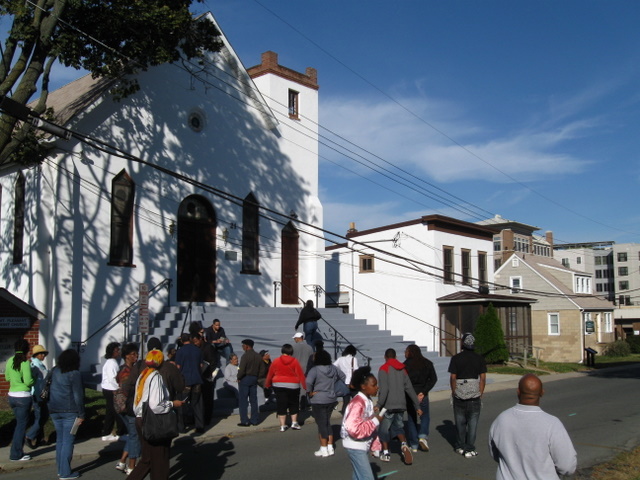
Tour of the Jerusalem Mt. Pleasant United Methodist Church
The City of Rockville has been working for nearly a decade to recognize the history of African American in the city and yesterday marked a major accomplishment with the installation of several interpretive markers in downtown. Many people who shop, work, and live in the Town Square don’t realize it was once a thriving African American community which was demolished during the 1960s and 1970s due to urban renewal. Today, very little remains and the plaques remind us of how much was lost–and also that African Americans have a long and distinguished history in Rockville.
Yesterday afternoon the City of Rockville hosted a tour on an incredibly beautiful fall day to visit some of these places and to see the new plaques, including Continue reading →

 Max for Rockville