Candidate Forums: The Heart of the Rockville City Council Race
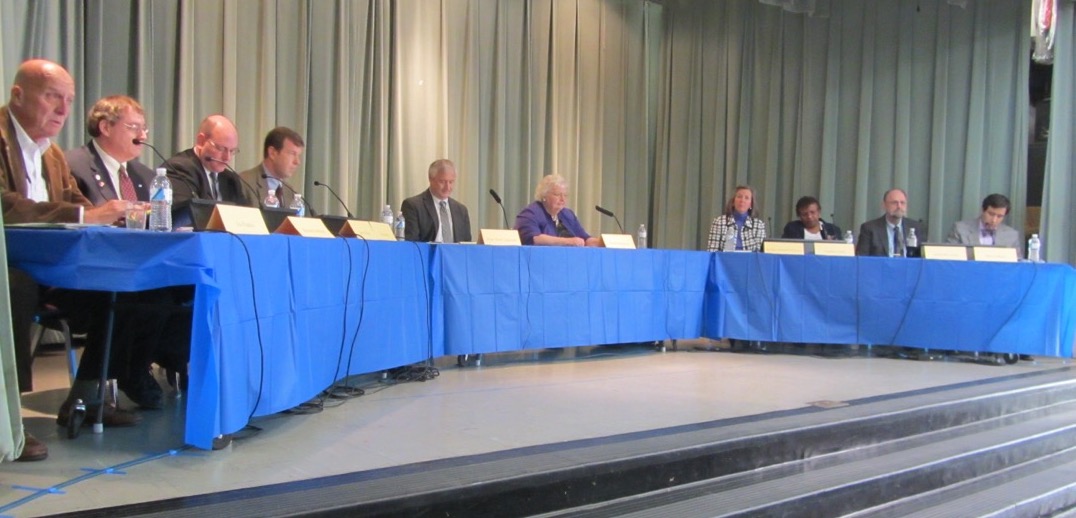
The race for Rockville City Council is gaining momentum, with candidate forums being among the most intriguing events. These forums provide an opportunity for each candidate to answer questions on various issues. While sometimes referred to as “debates,” they rarely involve direct exchanges between candidates or in-depth discussions. However, they do provide a platform for comparing candidates and understanding their stances. Their responses may be rough and awkward at times, yet this rawness often provides more insight into their true beliefs and intentions, unlike the polished and often vague statements we typically hear from elected officials in Congress.
The City of Rockville has selected the candidate forums that will be broadcast on Rockville 11 and YouTube, but everyone is welcome to attend in person:
Tuesday, September 26 from 2-3:30 pm at the Thomas Farm Community Center, hosted by the Greater Rockville Chamber of Commerce.
Thursday, October 5 from 7-8:30 pm at F. Scott Fitzgerald Theatre, hosted by Community Reach of Montgomery County with Rainbow Place Shelter.
Thursday, October 12 from noon to 1:30 pm at the Rockville Senior Center, hosted by the League of Women Voters of Montgomery County.
The hosting organization determines the format and questions, and obviously, each has a different interest so the topics will vary among the forums.
Other community organizations and neighborhood associations will host their own forums. Usually everyone is welcome and some will be broadcast, so look for announcements on a candidate’s or organization’s web sites or social media pages.
There are currently two candidates for mayor and nine candidates for council. If you are interested in serving, there is still time to get on the ballot. Petitions need to be signed by as least 100 registered voters who live in Rockville and submitted by this Friday, September 8. More details at Running for Office on the City web site.
Starting today until Election Day, I will close comments on this blog. Unfortunately, elections can bring out the worst in people and the blog comments become a place for slinging mud and venom. Question every fact and assertion from candidates, expect the stealing of yard signs, and know that impersonators will lurk on social media. Yes, in Rockville. Sigh.
Can You Buy Your Way onto City Council?
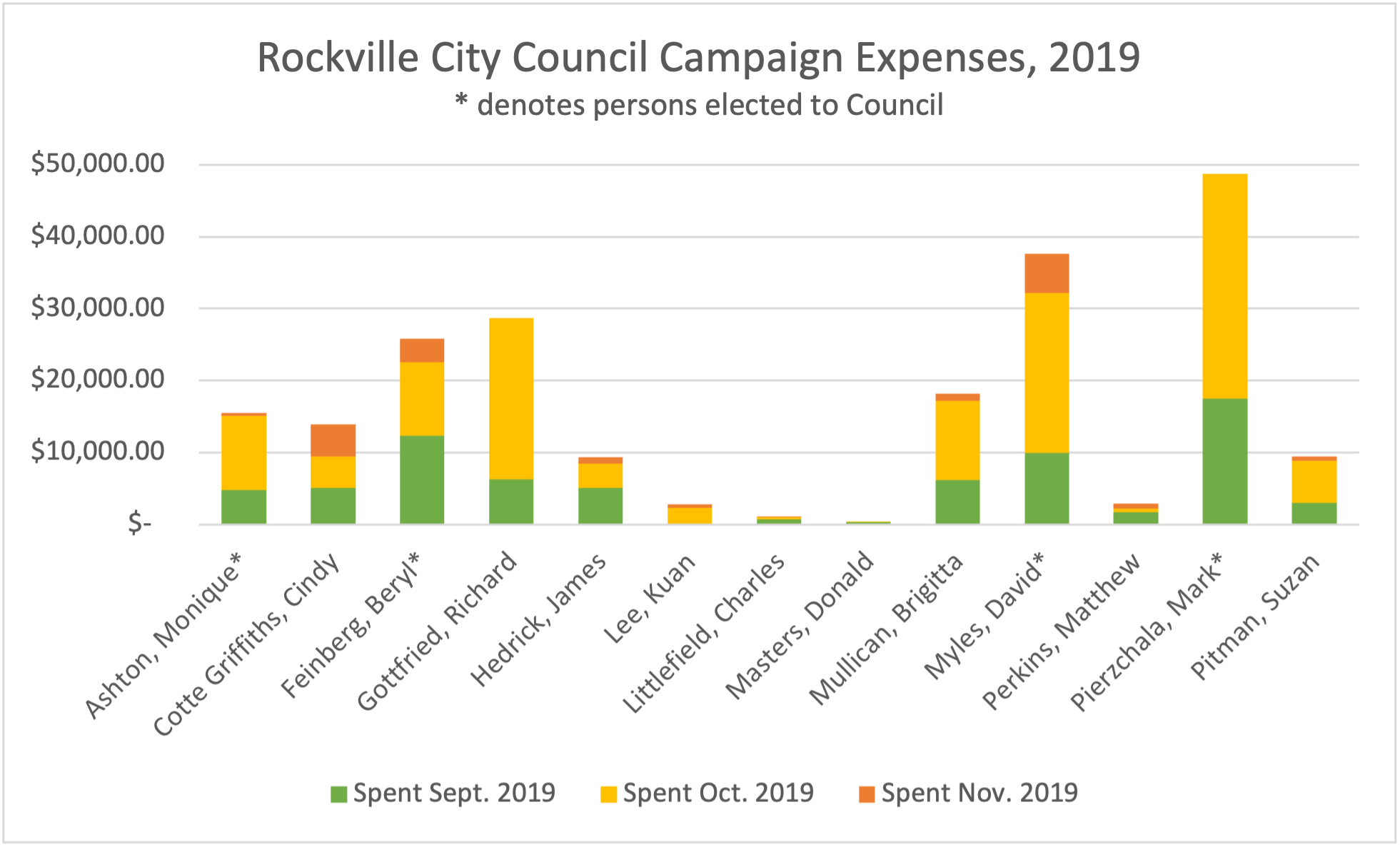
Election campaigns, even small local ones like Rockville City Council, require time and money. With the absence of a local newspaper to reach voters, candidates have to either spend most of their time walking door to door or most of their funds to print and mail campaign literature. In 2019—the last election for Mayor and Council—candidates for Council spent from $424 to $48,776 on their campaigns. Does money matter in local elections? Absolutely, under the right conditions.
As can be seen in the chart above, the candidates who spent the most money (Ashton, Feinberg, Myles, and Pierzchala) were elected to City Council—with one notable exception (Gottfried). The difference? Gottfried had less than a handful of individual contributors to his campaign; his campaign was mostly self-funded. The successful candidates had lots of money and contributors, and those who tended to spend less per vote had more Rockville residents as supporters. I suspect local supporters are more influential on the election than contributors who live out of town.
Looking more closely, successful candidates in 2019 needed at least 5,000 votes and spent between $3 to $10 per vote. In other words, to win a City Council election in Rockville required $15,000 to $50,000—mostly raised from local residents. If a candidate can’t raise those funds locally, they will need to put in a lot of their own money. At the other end of the spectrum, small campaigns who spent $500 to $5,000 didn’t have the capacity to gain sufficient support to cross the 5,000-vote threshold. If there are candidates you’d love to see on City Council, give them your financial support. A contribution of $25, $50, or $100 can make a big difference, especially in September.
The middle-sized campaign of $2 to $5 per voter ($10,000 to $20,000) seem to rely not only on the number of local contributors but also a thoughtfully-crafted campaign. To get out the vote, candidates have lots of ways to spend money (mail, literature, photography, videos, buttons, yard signs, t-shirts, social media, advertising) and time (parades, events, walking door to door, planning meetings, Community Forums, phone calls) but some are more effective than others. Campaigns of this size can’t shoot from the hip; they have to plan and manage carefully. Cotte Griffiths, Hedrick, Lee, Mullican, and Pitman fell into this nebulous and fraught category, so this year’s candidates may want to talk with a couple of them for advice. Perhaps the enlargement of the Council by two seats will allow more middle-sized campaigns to succeed. BTW, Kuan Lee’s expenses are low in the chart but he had over $10,000 in outstanding unpaid bills at the end of 2019, so his expenses are actually closer to $13,000.
The chart also shows that campaigns ramp up in September and at full-speed in October. November is very quiet by comparison because the election is held early in the month. I suspect that Labor Day will begin the campaign season in Rockville and it will include the usual craziness of mud-slinging and dirty tricks (yes, it unfortunately happens in Rockville).
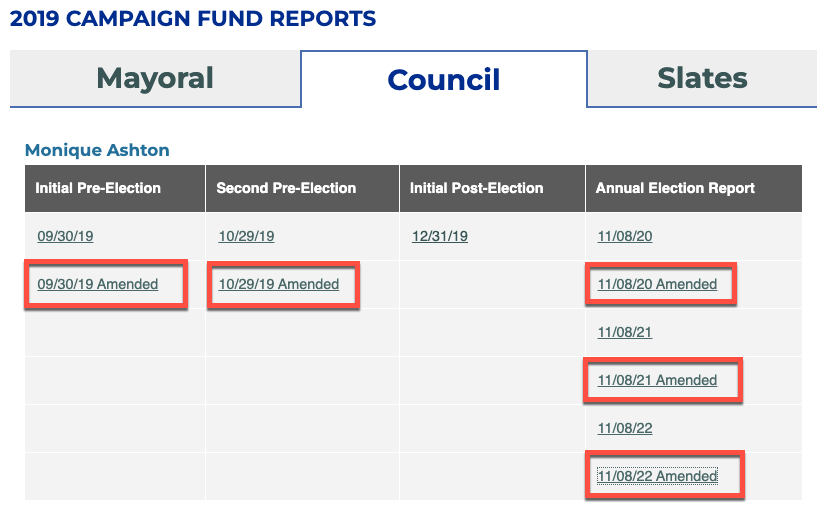
The data for the chart is derived from each candidate’s campaign finance report, which are submitted monthly during the height of the campaign season. Rockville developed its own campaign report forms and they desperately need to be revised because most candidates are unable to complete them properly and have to submit amendments regularly—some of them months later. Plus, key information can obscured because the forms allow candidates to reimburse themselves for expenses—the public can’t see where the cash is flowing, which is the primary purpose of campaign finance reports. The Board of Supervisors of Elections needs to revise the form and establish a standard of performance that no more than 25% of reports in any periods are amended.
City Council Campaign On Its Way with Ten Candidates
The 2023 campaign for Rockville Mayor and Council officially started on May 11 when the Board of Supervisors of Elections (BOSE) certified the petitions of Mark Pierzchala for Mayor and Izola Shaw for Council. As of May 25, there are currently two candidates for Mayor and eight candidates for Council—a total of ten people running for office.
- Candidates for the Office of Mayor
- Monique Ashton (currently on Council)
- Mark Pierzchala (currently on Council)
- Candidates for the Office of Council
- Kate Fulton
- Barry Jackson
- Ricky Mui
- David Myles (currently on Council)
- Paul Scott
- Izola Shaw
- Marissa Valeri
- Adam Van Grack
That’s low compared to 2019 (13 people) and 2015 (11 people), so I suspect more candidates will be added, especially with the number of seats on Council increasing from four to six. Indeed, Harold Hodges’ petition for Council is expected to be certified in June but I’m guessing that incumbents Bridget Newton or Beryl Feinberg won’t run again if they haven’t already submitted petitions. The deadline to submit petitions is Friday, September 8. If you want the latest information, the City Clerk’s office is maintaining a list online (BOSE meeting minutes and videos are not always available).
The big challenge for the candidates is getting the attention of voters. Yard signs and direct mail will be essential, but it is incredibly expensive (especially as postage rates increase on July 9) and can create a campaign budget that easily crosses the $10,000 line—which can discourage good candidates for office. Candidate for Council David Myles demonstrates the tenacity required when running for office nowadays. In the last election, he knocked on the doors of every voter at least twice. Last week, he already dropped off a brochure at my house.
The big challenge for voters is sorting through the candidates’ slogans and platitudes (lower taxes!, fight crime! end government waste! stop overcrowded schools!—if you hear any of these, choose someone else who understands the issues better). With no local newspaper covering Rockville on a regular basis to provide an independent perspective, voters will have to rely on what the candidates say (hmm, sounds mighty biased to me). It will be the candidate’s postcard in the mail, one of the three candidate forums, meeting candidates as they walk the neighborhood, the Rockville 11 special broadcast, or the City’s voter’s guide. I’ll try to do my part in navigating the noise, so check back regularly. Comments and suggestions are welcome.
The election for Mayor and six Councilmembers to four-year terms will be on Tuesday, November 7, 2023. Rockville will conduct its second vote-by-mail election with ballots mailed to all registered voters who live within Rockville city limits by October 13. Ballots must be returned via an official drop box, by mail to City Hall, or in person on Election Day at City Hall and Thomas Farm Community Center. All ballots must be received by 8 p.m. on Tuesday, November 7, 2023. More details at Voting and Elections on the city website.
Mayor and Council to Choose Earmarks and Decide Upcoming Election Changes
At its Monday, February 27, 2023 meeting, the Rockville Mayor and Council will discuss proposed earmarks for the FY24 federal budget, requests from the Board of Supervisors of Elections, and recommendations from the Charter Review Commission. On the Consent Calendar (items approved without discussion) are the preservation of public art, funding for the Rockcrest Ballet Center, Taste of Rockville agreement, and funding for the flood resilience master plan, among others. The Mayor and Council will also receive reports on operating budget and capital improvements budget for FY2024.
Yes, Congress is openly using earmarks again, “funds provided for projects or programs where the congressional direction (in bill or report language) circumvents the merit-based or competitive allocation process, or specifies the location or recipient.” For some, it’s simply another form of pork barrel politics but for others it’s a vital project. Perhaps the most famous earmark was by US Senator Ted Stevens to construct the Gravina Island Bridge or the “Bridge to Nowhere” for $250 million in 2002. But if you want federal funds for a specific project, the best way to ensure it is through earmarks. This year, the City of Rockville is considering several potential requests to Senator Cardin, Senator Van Hollen, and Congressman Raskin, including the emergency operations center at 6 Taft Court, police radio equipment ($1.4 million!), storm drain improvements in Potomac Woods, security for the water treatment plant, and water main or sewer main rehabilitation in an “equity focused area” (not identified but somewhere in southeast Rockville).
Preparations for the 2023 Mayor and Council election are underway and candidate information packets should be ready by May 1—however, there is still lots to be done. The Board of Supervisors of Elections is waiting for approval from the Mayor and Council on several changes to the City Charter and City Code in limbo; proposed translation of outreach materials in Spanish, Chinese, and French; adding a second vote center at Thomas Farm and placing ballot drop boxes in Montrose, Lincoln Park, and the Rockville Senior Center. Indeed, if the minimum voting age is lowered from 18 years to 16 years and the deadline for submitting nomination petitions is increased from 60 to 90 days prior to the election, the City may have already missed its ability to implement these changes for the November 2023 election.
Discussion of the 30 recommendations by the Charter Review Commission continues, this time on a more “precise, open, transparent, and definitive administrative process” for filling a vacancy on the city council after two years; adding a “none of the above” option on election ballots; increasing the size of the Board of Supervisors of Elections; increasing the number of ballot drop-off boxes; lowering the voting age to 16; and limiting the number of consecutive terms of council members to three four-year terms (but allowing a person to serve 12 years as a councilmember and 12 years as mayor—really? 12 years is plenty, give other people a chance!).
More details in the 450-page agenda packet are available at https://www.rockvillemd.gov/AgendaCenter/ViewFile/Agenda/_02272023-6820.
Election Month Ends Today
Maryland’s first vote-by-mail election ends today at 8:00 p.m. in Rockville in an effort to encourage more people to vote. Rockville’s voter turnout has declined regardless of the number of candidates or ballot questions, from 16.94% of registered voters in 2011 to 16.51% in 2013 and 15.87% in 2015, when the city held its first election to four-year terms. (Previously, Rockville’s elections were held every two years.)
In April 2018, Rockville’s Mayor and Council voted unanimously to follow the Board of Supervisors of Elections’ recommendation to implement vote-by-mail for the fall 2019 election. At least 22 states allow elections to be conducted by mail. Oregon, Washington, and Colorado, and some counties in California, hold elections entirely by mail.
Continue reading →A Most Unusual Election
This year’s Mayor and Council election in Rockville is extraordinary not only because Election Day has turned into Election Month due to vote-by-mail, but also because so many new, unusual, and strange campaigning is happening. You’ve probably noticed a few of them but when you bring them all together, you realize this election is very different from its predecessors.
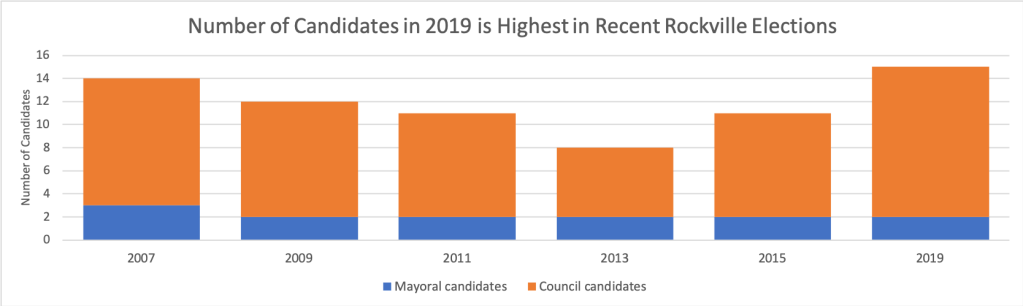
The number of candidates is the largest in recent memory and I’m not sure what’s prompting it. Running for office is grueling and costly. Maybe there’s a gut feeling that the city is being pulled in several directions and people are jumping in to influence the outcome or that there are two slates (which was common twenty years ago) plus the usual unaffiliated candidates.
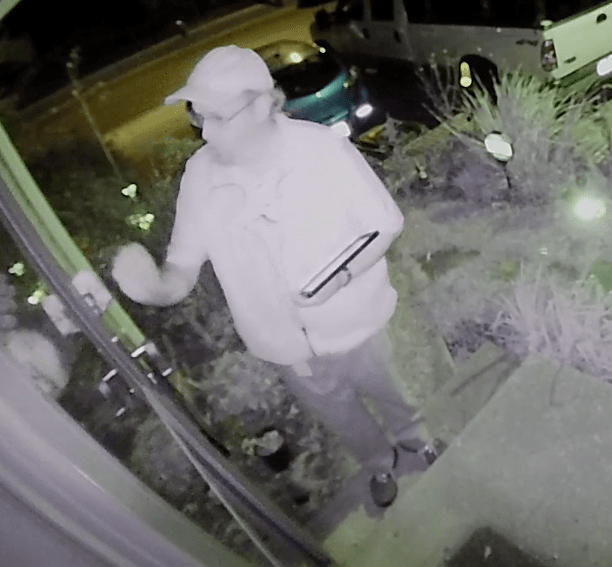
We’re now at the time of the campaign when yard signs become a point of contention. During the day, fanatics will confront homeowners who have signs of their opponents or in the dead of night, steal signs and blame it on teenagers. This election is different because many homes have motion-activated security cameras, making it easier to catch misbehavior on video. Recently posted on Twinbrook Neighbors, a camera caught a person tucking candidate literature into the door who also seemed to go through the resident’s mailbox. And he wasn’t a teenager.
Continue reading →Feinberg Feigns Diversity & Inclusion in Campaign Mailer

Beryl Feinberg is holding a sign opposing the widening of I-270, in Asian costume, with students holding certificates, cleaning up a stream, and talking with a Latino man and an African American woman. What do these images mean? That voters need to re-elect her to Rockville City Council because she’ll “preserve Rockville’s character” and “embrace Rockville’s future.” But her campaign postcard is deceiving.

Michelle Whittaker would know—she’s the African American woman shown in Feinberg’s mailer. She doesn’t support Feinberg’s candidacy for city council and ironically is the campaign manager for Virginia Onley for Mayor, one of her opponents. So why is she in the shown in Feinberg’s campaign literature?
Obviously, Feinberg used the photo to assure voters that she supports diversity and inclusion—gosh, look at all the people of color in her mailer! But we’re now aware it’s a dishonest portrayal. Indeed, it continues Feinberg’s insensitivity around diversity and inclusion. A year ago, the NAACP accused Feinberg of racism in her deliberations over the hiring of an African American woman for City Clerk.
Feinberg isn’t alone in her insensitivity around race and ethnicity. David Myles, a pediatrician, Navy veteran, and Yale graduate who is also running for City Council, has had Rockville residents call the police as he was walking door to door to meet voters. They probably couldn’t tell he was a pediatrician and Navy veteran, just that he was African American man in their white neighborhood. He was out of place, didn’t belong, a stranger. Yup, in 2019.
Continue reading →Dear Council Candidate…

Dear Candidate for Rockville City Council,
With thirteen people running for a city council seat in Rockville this year, it’ll be more crowded than ever. You’ll have to work harder to get your voice heard because voters will have difficulty telling you all apart (which one is Bridget Mullican?). My advice is to be distinctive and avoid the shallow promises to lower taxes, fight crime, be inclusive, preserve green space, attract business, or modernize city services. Yawn. Everyone will be saying those things, so learn about the particular needs and interests of the various communities in Rockville and how you will you go about addressing them. Solutions are nice, but often issues are so complex that a good process is more important (has anyone mentioned the APFO to you?).
Continue reading →Sister City Endorses Kuan Lee for Council?
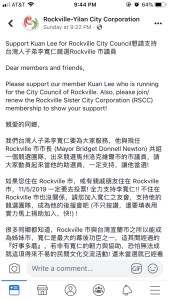
Facebook post endorsing Kuan Lee for City Council.
The message on Facebook asked readers to “Please support our member Kuan Lee who is running for the City Council of Rockville. Also, please join/renew the Rockville Sister City Corporation (RSCC) membership to show your support.”
What? Rockville Sister City is endorsing a candidate? Not only is RSCC part of the City of Rockville, it’s incorporated as a 501(c)(3) nonprofit organization—endorsing a candidate not only would sever its ties with the City but also jeopardize its status with the IRS.
RSCC President Drew Powell assured me that Rockville Sister City did NOT endorse Kuan Lee, nor would it endorse any candidate for elected office. It remains confusing, however, because Kuan Lee is a member of the RSCC board, the Facebook post urges support for RSCC, and Drew Powell is a longtime vocal supporter of Bridget Newton, Lee’s campaign colleague. RSCC can’t control what other people say or imply about them, but I suspect they will have a heated discussion to sort this out and clarify their role in the election and this debacle at their next meeting.
In the meantime, a closer look reveals that the Facebook post was made by the Rockville-Yilan City Corporation. Never heard of it? It was incorporated in Maryland in 2017 by…wait for it…Kuan Lee and operates from his home in Rockville. Yup, Kuan Lee endorsed himself in the disguise of a charitable organization.
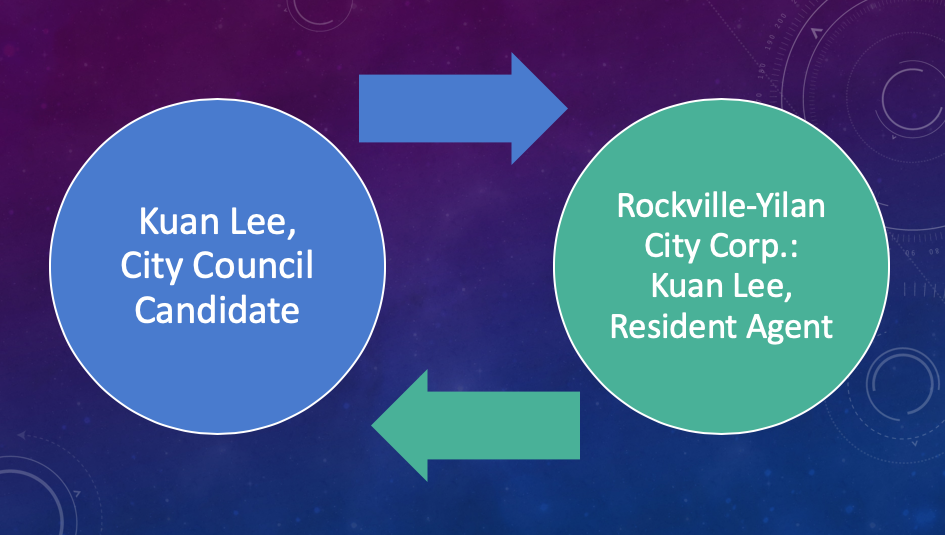
There are so many things wrong with this, but let’s just list a few that are most important to Rockville voters: Continue reading →
2015 Campaign Finance Reports Shows Plenty of Holes in the System
January 15, 2016 was the deadline for the latest financial reports for the 2015 campaign for Mayor and Council in Rockville, which covers the week before the November 3 election through the end of the year. Although this includes the hottest period of the campaign, it’s also assumed to be the quietest financially because most contributions and expenses have already been made. For the 2015 campaign, however, that short period represented 19 percent of the revenues and 38 percent of the expenditures so it wasn’t a fallow period.
More than $17,000 in contributions arrived in candidates’ bank accounts after October 26, including last-minute donations between candidates and from planning commissioners, creating a few more connections that weren’t apparent earlier. Expenses exceeded $60,000, most of it concentrated in the mayoral race between Bridget Newton and Sima Osdoby and the council campaign of Richard Gottfried. Gottfried spent an additional $9,715 for a campaign total of nearly $50,000—by comparison, the other Council candidates spent an average of $6,812 and mayoral candidates averaged $25,416.
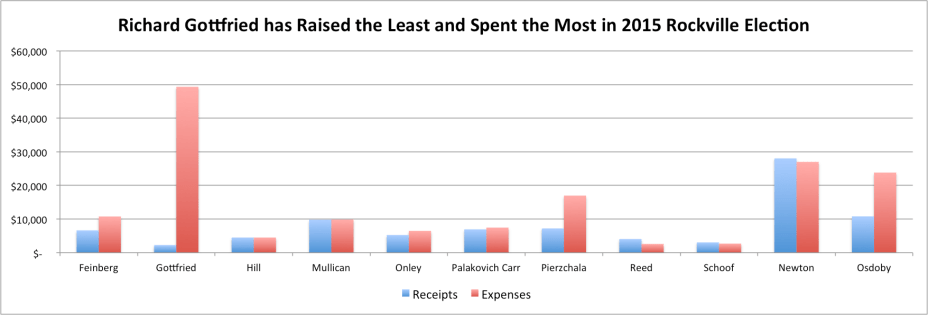
2015 Rockville Campaign Expenses for the period ending December 31, 2015. Patrick Schoof’s data is incomplete.
For the 2015 Mayor and Council race, the eleven candidates raised $88,615 and spent $161,550 in total. The averages in this election are thrown off by Gottfried’s extraordinary campaign, so if we exclude him and the mayoral race (which is always much higher), the average amount raised by Council candidates was Continue reading →


