Rockville Violated Open Meeting Law, Says State Board
 The Open Meetings Compliance Board for the State of Maryland has determined that the City of Rockville violated the Open Meetings Act, according to a seven-page opinion issued today to Lois Neuman, Chair of the Board of Supervisors of Elections in the City of Rockville:
We have concluded that the [Mayor and] Council and the Elections Board did not timely adopt meeting minutes for meetings in 2015, and we have noted that the City will be adding staff to enable these public bodies to do that more quickly. We have also concluded that the Elections Board’s practice of providing notice through its agendas did not always convey the required information reasonably in advance of each meeting.
All “public bodies” in Maryland, which includes most state, county, city, school, and other boards and commissions, should “hold their meetings in public, to give the public adequate notice of those meetings, and to allow the public to inspect meetings minutes” in order to “increase the public’s faith in government, ensure the accountability of government to the public, and enhance the public’s ability to participate effectively in our democracy.”
I’ve noted the inconsistency of minutes for city boards and commissions previously and it’s received attention at times by the City, but with the truly awful delays with the Board of Supervisors of Elections during an election year in 2015 (by the end of the year, missing minutes stretched back to March), I felt I needed to Continue reading →
Is Rockville Moving Towards or Away from Transparency?
This week the City of Rockville responsed to my complaint that the City held nearly two dozen meetings last year without documenting their decisions and sharing them with the public. Among my complaints was that the Board of Supervisors of Elections failed to post minutes on a regular basis since March 11, 2015 and the Mayor and Council failed to post minutes of a closed Executive Session on January 25, 2015.
The City approved most of the missing minutes last week, which meant that it’s taken more than a year to provide minutes for some meetings. (If you watched the March 21 Council meeting, you probably didn’t notice it because it was part of the Consent Agenda and approved with no discussion.) That’s probably unacceptable under Maryland’s Open Meetings Act, which requires that minutes be provided “as soon as practicable.” The issue is now in the hands of Open Meetings Compliance Board, who is expected to announce their opinion next month. Although the Board doesn’t have the ability to compel the City to follow the law, it is incredibly embarrassing because it publicly and independently confirms that the City isn’t meeting openly and transparently, which is the basis for a genuine democracy.
The City says it wasn’t able to prepare the minutes because the City Clerk’s office prepares the minutes for both the Mayor and Council and the Board of Supervisors of Elections and “the City Clerk’s Office has been extremely short staffed.” That begs the question, so why was the City Clerk’s office short staffed? It’s because Continue reading →
State Compliance Board Investigating City Meeting Records

Highlighted in red are meetings of the Board of Supervisors of Elections for 2015 that are missing minutes.
The Open Meetings Compliance Board of the State of Maryland is investigating Rockville’s Board of Supervisors of Elections (BOSE) for failing to maintain its meeting records in accordance with state law. BOSE is a five-member body appointed by the mayor with the approval of the council and charged with the conduct of all City elections, the registration of voters and the keeping of records in connection with these functions. The state’s Open Meetings Act requires that all city boards and commissions provide either written minutes or a video recording of their meetings so that the public is aware of their actions and decisions.
Other city boards and commissions have had a spotty record over the past few years, but BOSE is exceptional. BOSE did not maintain records for nearly half of its meetings last year, with missing minutes stretching back to March 12, 2015 and no minutes available after October 21, which was the most intense and competitive period of the last Mayor and Council election.
BOSE has until mid-March to provide a written response to the Compliance Board, at which point they will render an opinion. I’m not sure how BOSE will be able to review and approve so many minutes by the deadline, but even if they do, it suggests that the Supervisors of Elections need supervision as well. If you’re concerned, please let the Mayor and Council know at mayorcouncil@rockvillemd.gov.
Months of Meeting Minutes Missing for City of Rockville
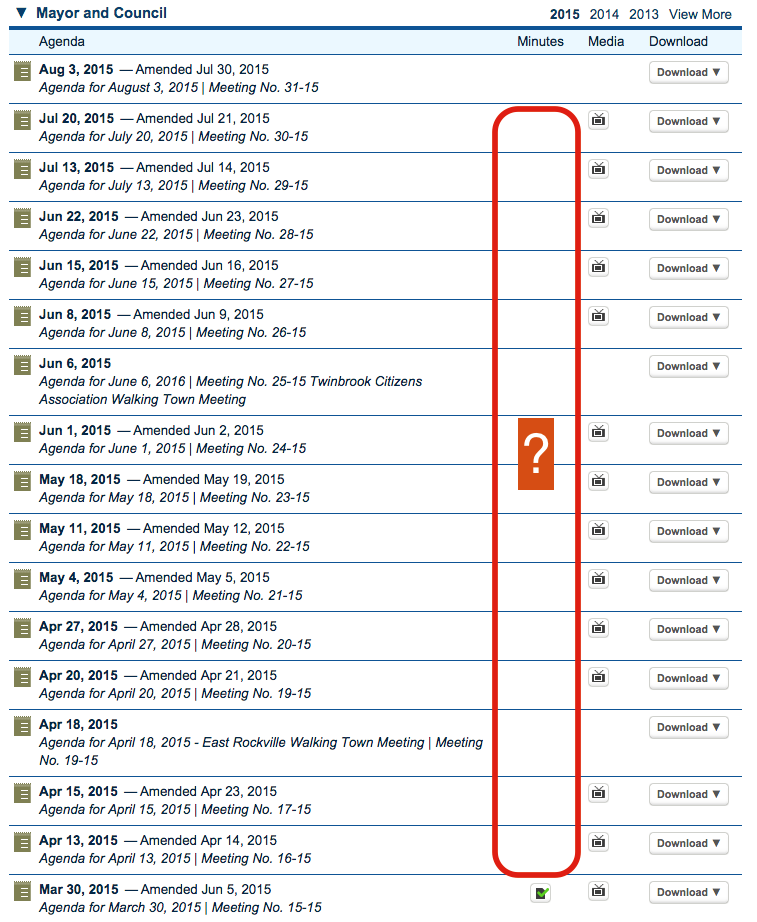
Rockville City Council meeting minutes missing since March 2015.
Years ago, the working of city council and major boards in the City of Rockville became more transparent with the broadcast of its meetings over cable channel 11 (Rockville 11) and online. This year, however, we’ve taken a big step back by failing to provide written minutes of meetings in a timely manner. The Mayor and Council haven’t provided minutes since March 2015 (about a dozen meetings) and the Planning Commission hasn’t provided minutes since May 2015 (about a half-dozen meetings).
That means if you want to know what’s being discussed or decided, you have to watch the meeting, which can last three to six hours. Reading the meeting minutes is a much faster way to find out what’s going on (you can scan minutes in minutes), plus it’s a better way to record decisions (no worries about interpreting inaudible words and paper survives much longer than digital recordings). You can rely on the local newspaper to report on what’s happening, but well, we really don’t have a local paper that provides that coverage reliably. Sounds like the old-fashioned way of producing written minutes of a meeting in time for the next meeting seems to look better and better.
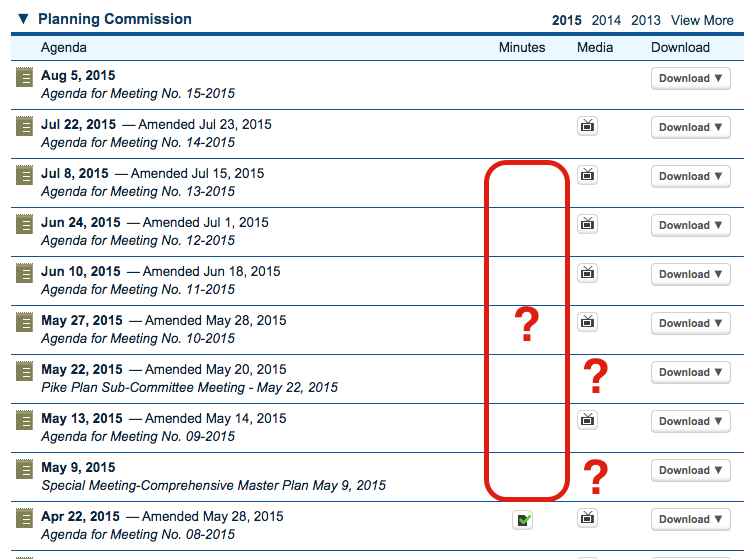
Rockville Planning Commission is missing minutes and video.
Strangely, the Open Meetings Act for the State of Maryland (excerpted below) allows local government to skip the written minutes if they provide video (although it looks like the Planning Commission failed on both counts because a few meetings weren’t recorded nor have minutes, so you really can’t know what happened). It’s a bad idea if the goal is opening up the workings of government, especially when the requirements for minutes is minimal (list each item considered, action taken, and votes). Secondly, local governments only need to retain minutes for a year, after which they can be tossed. Really? What business or organization in America operates this way? Obviously, the Open Meeting Act needs to be desperately revised if we want to fully understand what’s happening in government (looks like a job for Senator Cheryl Kagan). In the meantime, the City of Rockville should establish better standards and practices for providing minutes of its meetings of the Mayor and Council and its boards and commissions.
Annotated Code of the State of Maryland, § 3-306
(b) Minutes required. — Continue reading →

 Max for Rockville