Mayor and Council Gets Update on Proposed 36-Unit Condo in Twinbrook
At its Monday, February 12, 2024 meeting, the Rockville Mayor and Council will receive updates on a proposed 36-unit condominium at 5906 Halpine Road (Twinbrook) and new laws under consideration by the state (particularly Gov. Moore’s proposed Housing Expansion and Affordability Act). On the Consent Agenda (items approved without discussion) are construction of a storage structure ($500,000) and executing an amendment to Rockville Intermodal Access Project for Baltimore Road, among others. The Mayor and Council will also receive an annual report from the Board of Appeals.
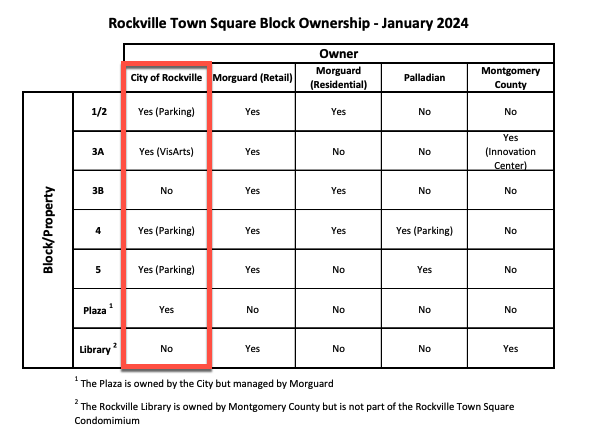
On the Consent Agenda, the City Council will be appointing Deputy Director of Community Planning
and Development Services Jenny Snapp as the City of Rockville Representative to the Town
Square Condominium Board, replacing Deputy Director of Public Works James Woods. The staff report provides some insight into the complex ownership and management of Town Square, explaining that it “consists of five blocks, each of which has a condominium association represented by the respective owners of each block. These owners must delegate a representative to the Rockville Town Square Master Condominium Board. The City owns portions of Block 1/2, Block 3A, Block 4 and Block 5. The City’s ownership of Block 1/2, Block 4 and Block 5 is limited to the Parking Garages. The City’s Block 3A ownership includes the Arts and Innovation Center where VisArts is located. Each block’s condominium association has an agreement delegating the management of common areas to Morguard. Several other agreements were established to delegate the management of the Plaza, the private sidewalks, and the Parking Garages to Morguard.” (page 101+)
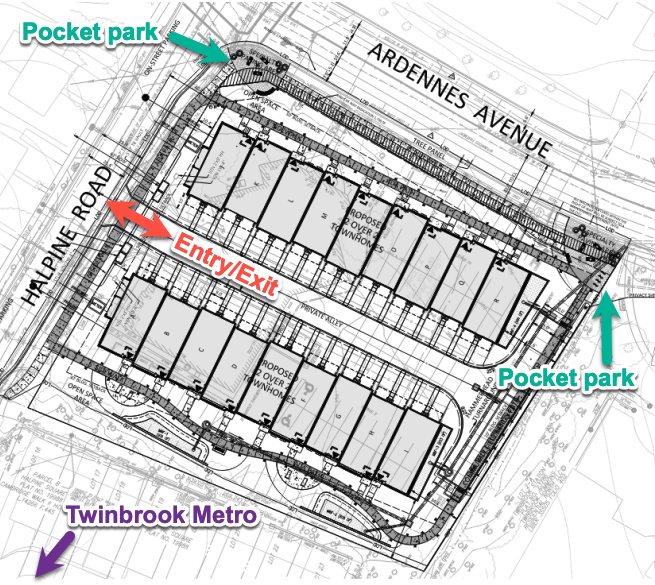
The City Council will receive a briefing on a request from Pulte Home Company to rezone a property at 5906 Halpine Road (Twinbrook) from R-60 (single unit detached residence) to RF-FZ (residential flexible-floating zone) to permit construction of 36 two-over-two stacked condominiums (page 104+). The “two-over-two stacked” dwelling type consists of 2 two-story townhouses which are stacked one on top of the other to create a four-story building. For comparison, the adjacent Cambridge Walk has 17 townhouses. At a community meeting on May 16, 2023, attendees voiced concerns about protecting of the existing adjacent forest conservation area as well as adequate visitor parking on site. Pulte will brief the Council about the proposal, including a project overview and review schedule and at a future meeting, the Mayor and Council will hold a public hearing and consider rezoning the property, approving the Project Plan, and authorizing waivers to the required side yard setback and layback slope for the project.
The Mayor and Council are conducting hybrid meetings. If you wish to submit comments in writing for Community Forum or Public Hearings, please email the comments to MayorAndCouncil@RockvilleMD.gov by no later than 10:00 a.m. on the date of the meeting.
More details in the 250-page agenda packet are available at https://www.rockvillemd.gov/AgendaCenter/ViewFile/Agenda/_02122024-7107.
Will Rockville Choose Diversity or Bureaucracy?
 WalletHub named Rockville as the one of America’s most diverse cities in 2016 based on social class, ethnicity, economics, and households. It ranked 14 out of 301, being bested by our neighbors in Gaithersburg (#1), Silver Spring (#4), Germantown (#5), and Frederick (#8), but ranked higher than places usually lauded for their diversity, such as San Francisco (#20), Alexandria, VA (#45), Denver (#67), San Antonio (#119), and Seattle (#149).
On Monday, March 6, the Rockville Mayor and Council will hold a public hearing on the role of the City Police in the enforcement of federal immigration laws. Will Rockville’s diversity be celebrated or feared? Will immigrants be threatened or welcomed? Will the answers be quickly forthcoming or will they become mired in bureaucracy? It’s uncertain where the City of Rockville will land and I suspect it will be a tense and difficult conversation.
It’s a conversation that started shortly after the Presidential election. Mayor Newton read a statement at the start of the City Council meeting on November 14, 2016 to recognize that Rockville’s strengths are Continue reading →
Rockville’s Government Transparency Score Earns Fs for Six Groups
 In 2012, I reviewed Rockville’s boards and commissions to assess how openly they conducted their meetings during the previous year. It was a miserable showing, with about half not providing agendas or minutes. Four years later, it has improved and yet six “public bodies” received failing grades, including the Mayor and Council.
On September 1, 2015, I tallied the number of meetings and minutes posted on the City website for 2015 (that’s nine months from January 1, 2015 to August 31, 2015). By dividing the number of minutes by the number of meetings (cancelled meetings don’t count), I calculated a “government transparency score.” So if a commission had posted 9 minutes for 12 meetings, that would earn them a Minutes Score of 9/12 or 75%. The higher the score the better and anything lower than 60% is an F. Here’s how they fared: Continue reading →
2011 City Boards and Commissions Scorecard
Along with the City Council, the City of Rockville has 23 official boards and commissions to study, advise, and decide on a wide range of issues, from city planning to cultural arts, from human services to animal matters. In addition, there are at least ten other unofficial task forces or committees. All of these boards and commissions are composed of volunteers, usually residents (some include property or business owners who live elsewhere) and most members are nominated by the Mayor and appointed by City Council (a few have members elected in other ways, such as RSI).
Rockville has always encouraged and supported citizen involvement in its government, and used these board and commissions to keep the residents informed and part of the decision-making process. But how well informed are its citizens? All commission meetings are open to the public (I’m going to call them all “commissions” to keep things simple), but only three commissions–Planning Commission, Historic District Commission, and the Board of Appeals–have meetings that are regularly broadcast on Channel 11 and the City website (most likely because the City Council has granted them exclusive decision-making powers). For the other commissions, to find out what’s happening you have to attend the meeting, talk to one of the commissioners, or review the minutes. Obviously, the most convenient way is reviewing the minutes or notes of the meeting, so let’s see how we’ve done.
On January 20, 2012, I tallied the number of meetings and minutes posted on the City website for 2011 (cancelled meetings don’t count). By dividing the number of minutes by the number of meetings, I calculated a “public information score.” So if a commission had posted 9 minutes for 12 meetings, that would earn them a Minutes Score of 9/12 or 75%. The higher the score the better, and here’s how they fared: Continue reading →

 Max for Rockville