Rockville’s Mayor and Council meets Monday, October 12, 2026, with housing dominating much of the agenda. The city will review its homeownership assistance program, consider converting most of the Sheraton Hotel in King Farm into apartments, and spend an hour discussing how to make accessory dwelling units and other forms of small-scale housing easier to build. (Rockville Agenda 2026-10).
Taken together, these discussions point to a larger problem: Rockville has already made some important zoning changes to allow more housing, but legalizing housing does not necessarily make it affordable to build. The homeownership numbers explain why this matters.
A $774,000 Median Home
According to the city, the median sales price of a Rockville home during the first half of 2026 was $774,258. Under the assumptions used in the staff report, a household would need an annual income of about $222,880 to afford that home—more than $80,000 above Rockville’s median household income of $142,536. Rockville Agenda Packet 2026-10…
Rockville’s Homeownership Assistance Program is intended to help first-time and first-generation buyers, as well as city employees, with down payments and closing costs. Demand has been strong. The city spent all $437,252 available in FY2026, making 14 loans, and all $250,000 available for FY2027 has already been spent or reserved. New applicants are being placed on a waiting list. Thirteen of the first 14 borrowers purchased Moderately Priced Dwelling Units rather than market-rate homes.
That tells us something important. Down-payment assistance can help individual households, but it cannot by itself solve a housing market in which many middle-income households cannot afford prevailing prices.
Increasing supply therefore matters—but so does figuring out how to create housing at a cost people can actually afford.
ADUs Are Legal. Now Comes the Hard Part.
Monday’s most important housing discussion may be the Mayor and Council worksession on Accessory Dwelling Units and Small-Scale Development.
Rockville has already taken significant steps to legalize ADUs and other small-scale housing. ADUs are now allowed in single-family neighborhoods, and the recently adopted zoning rewrite provides for additional residential infill types. City staff has been studying what it would take to move from merely allowing these buildings to actually getting them constructed.
That distinction is essential.
Changing zoning may be the easy part. A homeowner can have the legal right to construct an ADU and still discover that architectural and engineering fees, permits, financing, site work, utility connections, and increasingly demanding building-code requirements make the project financially impractical.
The city’s research reaches a similar conclusion. Staff notes that zoning reform alone will not create a functioning small-scale housing market. It also requires lower design and permitting costs, accessible financing, and an ecosystem of homeowners, contractors, lenders, and small developers able to carry projects through.
The Mayor and Council is being asked to provide direction on three ideas: developing pre-approved plans for ADUs and perhaps other small-scale housing; creating a pilot financing program through the Housing Opportunities Fund; and helping establish a stronger network of small-scale developers and lenders.
Of the three, the pre-approved plans may offer especially interesting possibilities.
Why Pre-Approved Plans Matter
In the cities studied by Rockville staff, one of the largest obstacles to small-scale housing was not zoning but the cost and uncertainty of designing and permitting each project individually.
A pre-approved plan turns that process around. Instead of every homeowner hiring an architect to design a completely new building that must then undergo a complete municipal review, the city approves a set of designs in advance. A homeowner who chooses one of those designs can move through a more predictable permitting process.
According to the staff report, such programs can reduce design costs, shorten timelines, and reduce risk and uncertainty for homeowners and small builders. Rockville is considering developing a catalog of pre-approved ADUs and perhaps eventually other residential infill types.
That could also be an opportunity to improve design. A catalog need not consist of a single generic backyard box. Rockville could approve several architectural families suited to different neighborhoods, with choices of roof forms, siding, windows, porches, and finishes. That would give homeowners options while giving the city confidence that basic issues of safety, scale, and neighborhood compatibility have already been addressed.
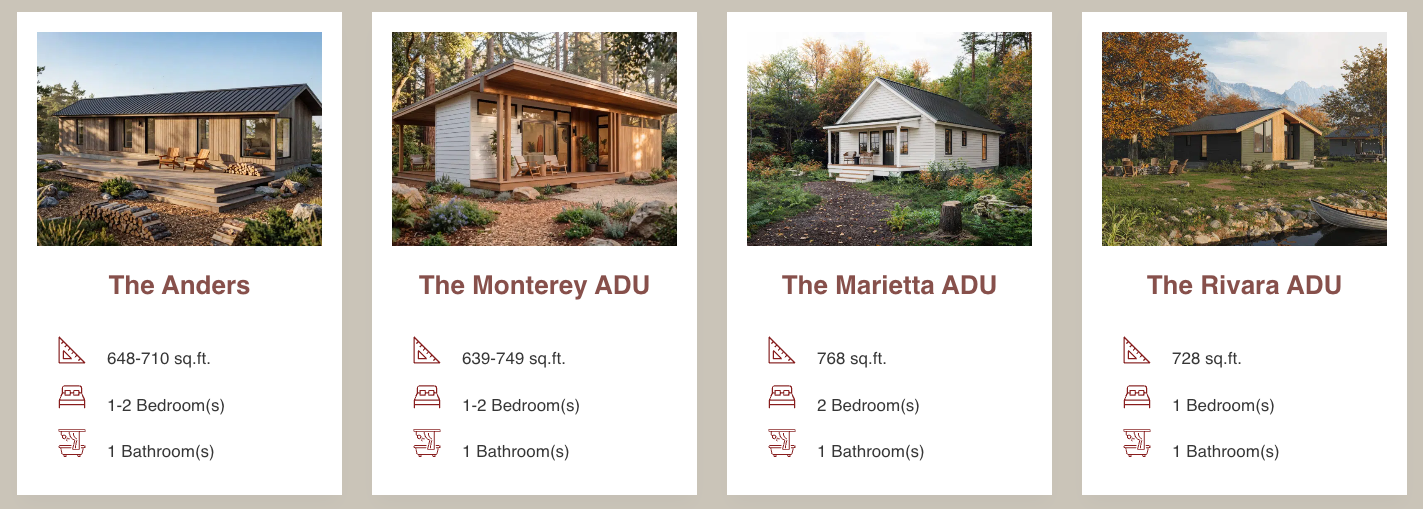
There is another possibility that does not appear in the current city proposal but deserves consideration: prefabricated or factory-built ADUs.
Prefab Does Not Mean “Trailer Park”
Mention manufactured housing and many people still picture a long, boxy trailer parked behind a house. That stereotype is badly out of date.
Companies such as Zook Cabins now offer purpose-built ADUs in a wide variety of forms, including conventional gabled cottages, modern designs, A-frames, and other small homes that could easily be mistaken for site-built construction. Their current catalog includes multiple dedicated ADU models as well as modular and factory-built homes.
A recent House Beautiful survey likewise shows how broad the prefab market has become, with compact cottages, contemporary studios, Scandinavian-inspired designs, and other small houses that bear little resemblance to the stereotype of a mobile-home coach.
Factory construction will not magically make housing inexpensive. Foundations, utility connections, site preparation, transportation, permits, and code compliance still cost money. But building repeated designs in a controlled environment can potentially reduce some labor uncertainty, material waste, weather delays, and construction variation.
More importantly for Rockville, combining pre-approved plans with factory-built construction could create a repeatable housing product rather than requiring every ADU to begin as a one-off experiment. The city could know in advance what the building looks like and how it is constructed. Homeowners could have a clearer idea of price and schedule. Contractors and lenders could become familiar with a limited set of designs. And neighborhoods could gain attractive, code-compliant housing rather than an unpredictable assortment of improvised additions. That is worth exploring.
Financing May Be the Remaining Barrier
Even a streamlined and standardized ADU can still require a substantial upfront investment. City staff identifies financing as one of the most persistent barriers, particularly for lower- and moderate-income homeowners. Traditional lenders may regard ADUs as unfamiliar projects, while appraisers may have difficulty finding comparable properties. Those problems can make construction loans or home-equity financing harder to obtain.
Staff is therefore suggesting that Rockville explore a pilot financing program using the Housing Opportunities Fund. Assistance could take the form of gap financing, low-interest loans, or similar support, potentially coupled with incentives for homeowners who agree to rent the new unit at an affordable rate.
That combination makes sense conceptually: zoning removes a legal barrier; pre-approved plans reduce design and permitting uncertainty; factory construction could potentially reduce production uncertainty; and financing assistance addresses the capital problem. Whether the numbers actually work will depend on the details.
King Farm Sheraton Could Become 143 Apartments
The second major housing story Monday is a much larger form of adaptive reuse. ORI Real Estate Acquisitions proposes converting 143 of the existing 155 rooms in the Sheraton Hotel at 920 King Farm Boulevard into apartments while retaining 12 units for hospitality use. The project would reuse the existing building rather than construct a new apartment building from the ground up. About 22 units would be Moderately Priced Dwelling Units, and the developer has indicated that the final number could exceed the city’s 15% minimum requirement.
Staff estimates that 143 apartments could produce roughly 361 new Rockville residents, who would shop locally, use local services, and contribute to the city’s economy. Staff therefore describes the overall fiscal impact as uncertain while anticipating some positive economic-development effects from having permanent residents rather than temporary hotel guests.
The Sheraton conversion and the ADU initiative operate at very different scales, but they share an underlying principle: some of Rockville’s future housing supply may come not from building large projects on vacant land, but from finding more productive ways to use buildings and properties that already exist.
Meanwhile, the Financial Advisory Board Raises Some Warning Flags
Housing will probably attract most of the attention Monday night, but the Financial Advisory Board’s annual report also deserves notice. The overall picture is not one of financial distress. The Board says most revenues and expenditures are tracking expectations, and the city continues to maintain a stable property-tax rate. But it also warns that recent spending growth and reserve use require continued discipline.
The Board questions the practice of using unspent personnel funds to cover weather-related and similar expenses, asking whether that is the best approach to financial planning. It also identifies several matters to watch in the FY2027 budget, including General Fund support for the Parking Fund and the Speed Camera Fund’s trajectory toward a possible negative fund balance.
None of these issues represents an immediate fiscal crisis, but they are useful warning lights. New programs—whether for housing, transportation, recreation, or other city priorities—eventually have to fit within sustainable spending and reserve policies.
The Larger Question
For years, housing debates have often focused on zoning: allow more density, permit ADUs, reduce minimum lot sizes, or allow more types of housing in more places. Those reforms matter.
But Monday’s discussion reveals the next problem. A zoning map can give someone permission to build a home. It cannot make that home economical to build. If Rockville wants ADUs and small-scale infill to become meaningful parts of its housing strategy, it will have to pay as much attention to construction costs, standardized designs, financing, and implementation as it has to zoning. Pre-approved plans are a promising start. Prefabricated and factory-built housing deserves a closer look as well.
The Mayor and Council meeting begins at 6:30 p.m. Monday, October 12. The ADU and small-scale development worksession is currently scheduled for approximately 8:40 p.m.; the King Farm Sheraton public hearing is scheduled for 7:50 p.m., followed by Council action. The agenda and meeting materials are available from the City of Rockville.
This analysis was prepared with the assistance of ChatGPT to review and summarize the City’s agenda materials (142 pages!) and related sources. I selected the issues to highlight, developed the analysis and recommendations, and reviewed and edited the final post.


