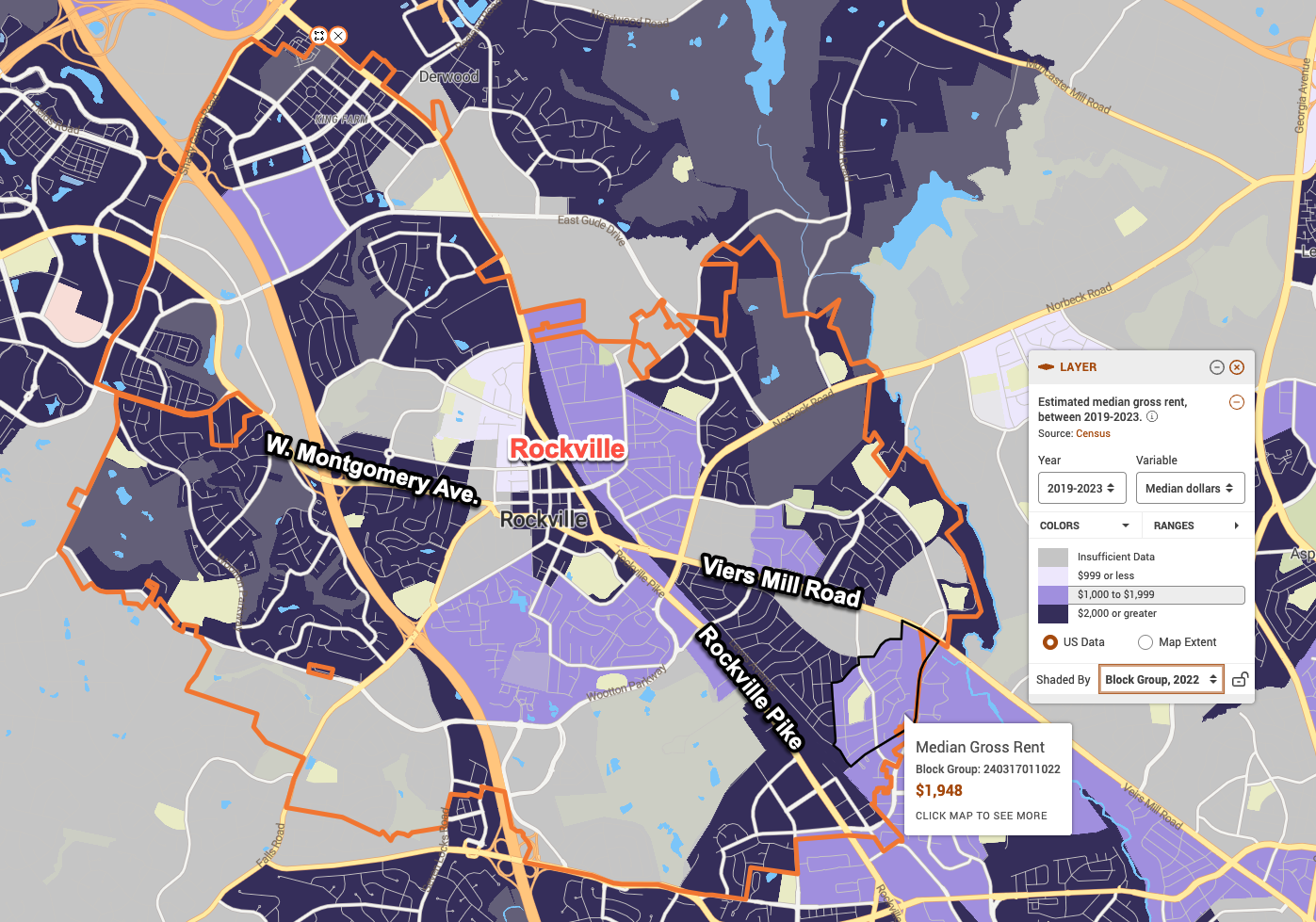
At a recent Community Forum, Rockville residents spoke out about rising rents, neglected apartments, and fears of being pushed out of the city they call home. Their stories were powerful—and familiar. For many, housing costs are rising faster than wages, and longtime residents are finding it harder to stay in Rockville.
What’s encouraging is that the City is listening and acting, despite what renters are claiming. Behind the scenes, Rockville has been working on two major initiatives:
- A complete rewrite of the city’s zoning ordinance to allow more housing in key areas.
- A growing toolkit of housing affordability strategies, many of which are already in motion.
These efforts reflect a larger truth: there’s no single solution to Rockville’s housing challenges. Instead, the city is starting to take a systems approach, linking land use, renter protections, affordability programs, and partnerships into a broader vision. Affordable housing was not a priority of previous Mayors and candidates who ran on this issue were not elected (e.g., Mayor Newton opposed the acquisition of Fireside Apartments by Rockville Housing Enterprises at the March 19, 2019 meeting). Here’s what you need to know:
Zoning Reform: Making Room for More Homes
Rockville’s zoning rewrite, which we’ve previously summarized here, is a once-in-a-generation update. The city’s March and May staff reports lay out ambitious goals to:
- Encourage more mixed-use development in Downtown and Twinbrook.
- Allow a wider range of housing types, from townhouses to accessory units.
- Simplify permitting, reduce parking minimums, and promote walkable neighborhoods.
The goal is to increase housing supply and support diverse, connected communities. But zoning reform is a long game. Even with these changes, it may take years before new, affordable housing comes online.
Pairing Zoning with Housing Affordability Tools
The good news is that Rockville isn’t relying on zoning alone. According to the May 5, 2025 Mayor and Council meeting, the City is actively developing housing strategies to:
- Require affordable units in new developments (inclusionary zoning).
- Preserve older, lower-cost rental housing (known as Naturally Occurring Affordable Housing, or NOAH).
- Partner with Montgomery County and nonprofits to fund housing initiatives.
- Explore rental assistance, tenant protections, and improved code enforcement.
These strategies are designed to make a difference sooner—especially for households at risk of being priced out or displaced.
What Can Be Done Now: Immediate Solutions
While long-term policies take shape, the City can also take short-term actions to protect renters and stabilize communities. These include:
- Rent stabilization: Temporarily capping how much landlords can raise rents annually. Montgomery County’s law, effective July 23, 2024, limits annual rent increases for most apartments built in 2002 or earlier to the lesser of CPI + 3% or 6%, currently 5.7% for July 2025–June 2026, based on a 2.7% CPI plus 3% cap. The policy has been in place for less than one year, so it is too early to draw firm conclusions about its long-term impact.
- Tenant education and legal support: Helping renters understand their rights and avoid wrongful evictions.
- Targeted code enforcement: Holding landlords accountable for safe, habitable housing.
- Emergency rental assistance: Providing short-term financial support to keep people in their homes. The City already provides financial assistance, but it is limited and cumbersome.
These tools are already in use in other jurisdictions—and could be adapted quickly in Rockville. These immediate solutions won’t reduce rents or solve affordability alone; new housing is still needed.

The Role of Rockville Housing Enterprises (RHE)
A key player in all of this is Rockville Housing Enterprises (RHE), the city’s public housing agency since 1955 (strangely, board meeting agendas and annual reports haven’t been posted since 2023). RHE provides housing support to hundreds of low- and moderate-income residents through:
- Public housing units such as David Scull Courts.
- Administration of Housing Choice Vouchers (Section 8).
- Development and ownership of affordable and mixed-income housing.
- Partnerships with developers to create long-term affordability in new projects.
RHE is uniquely positioned to:
- Acquire or preserve at-risk apartment buildings to prevent displacement.
- Expand access to vouchers that subsidize rents in the private market.
- Lead or co-develop new affordable units, especially on public land or in public-private partnerships.
- Engage with tenants to support stability, education, and advocacy.
If the City wants to act quickly and equitably, expanding RHE’s capacity and partnerships is one of the most direct, proven steps it can take (and yet, no one at Community Forum mentioned RHE).
Seeing the Bigger Picture
The takeaway? Rockville’s housing challenges aren’t just about zoning, or rents, or code enforcement. They’re about all of those things—together.
Housing is part of a larger system. When rents rise, so do commuting distances. When older buildings are redeveloped, existing tenants may be forced out. When housing becomes unaffordable, businesses lose workers, schools lose students, and neighborhoods lose their sense of continuity.
That’s why a systemic response matters. And for the first time in a long time, Rockville is moving toward that kind of comprehensive strategy.
What Comes Next?
Expect more public discussions this year as the city finalizes the zoning rewrite and refines its housing affordability policies. In the meantime, residents can:
- Stay engaged by attending council meetings and speaking at forums. Don’t be a single-issue advocate but recognize that affordable housing has to be addressed on multiple fronts. Don’t frame issues as “us vs them”–we’re living in this community together, so if you are part of the community, use “we.”
- Support housing initiatives that balance growth and equity.
- Ask city leaders to link zoning decisions to clear, measurable affordability outcomes. What should residents and property owners know, feel, or do if we’re successful?
Because whether you’re a renter, homeowner, business owner, or commuter—Rockville’s housing future affects us all.


