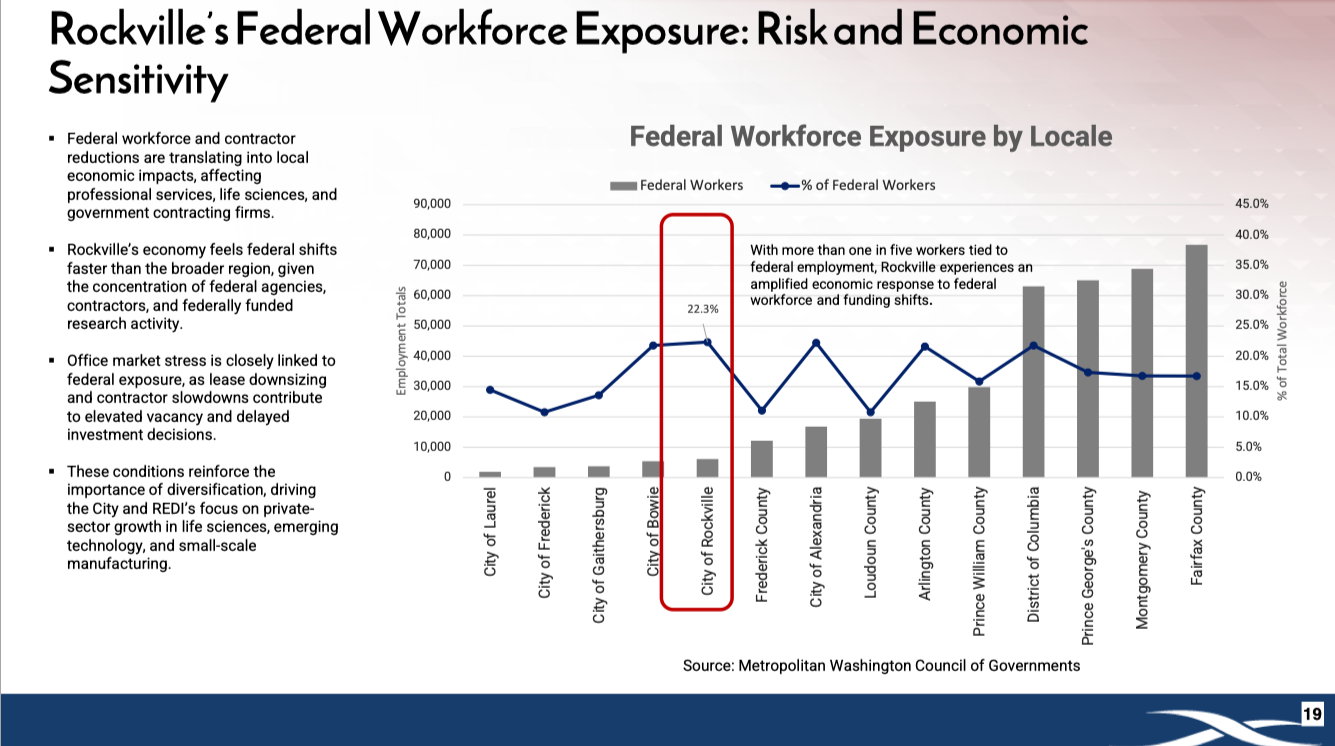
The Rockville Mayor and Council met on February 9, 2026, when Rockville Economic Development, Inc. (REDI) presented a major economic briefing about how federal policy changes are affecting the city. The full reports — including the Economic Impact presentation and supporting materials — are available in the Council agenda packet posted on the city website. Together they paint a clear picture: Rockville’s economy is stable today, but entering a period of structural transition.
City officials reviewed a detailed economic report showing Rockville is highly exposed to federal employment and contracting. Roughly one-fifth of local workers depend on federal jobs or funding. Layoffs and reduced contracting increased unemployment and softened consumer spending. Office vacancies remain high as contractors shrink their footprints, while housing listings have risen across the region. The economy is not collapsing — but it is shifting away from federal-driven growth toward a more uncertain private-sector future. Note: This post is based on the reports provided by REDI in the Council agenda packet; in a future post I hope to share the City Council’s reaction.
Economic Impact of Federal Changes
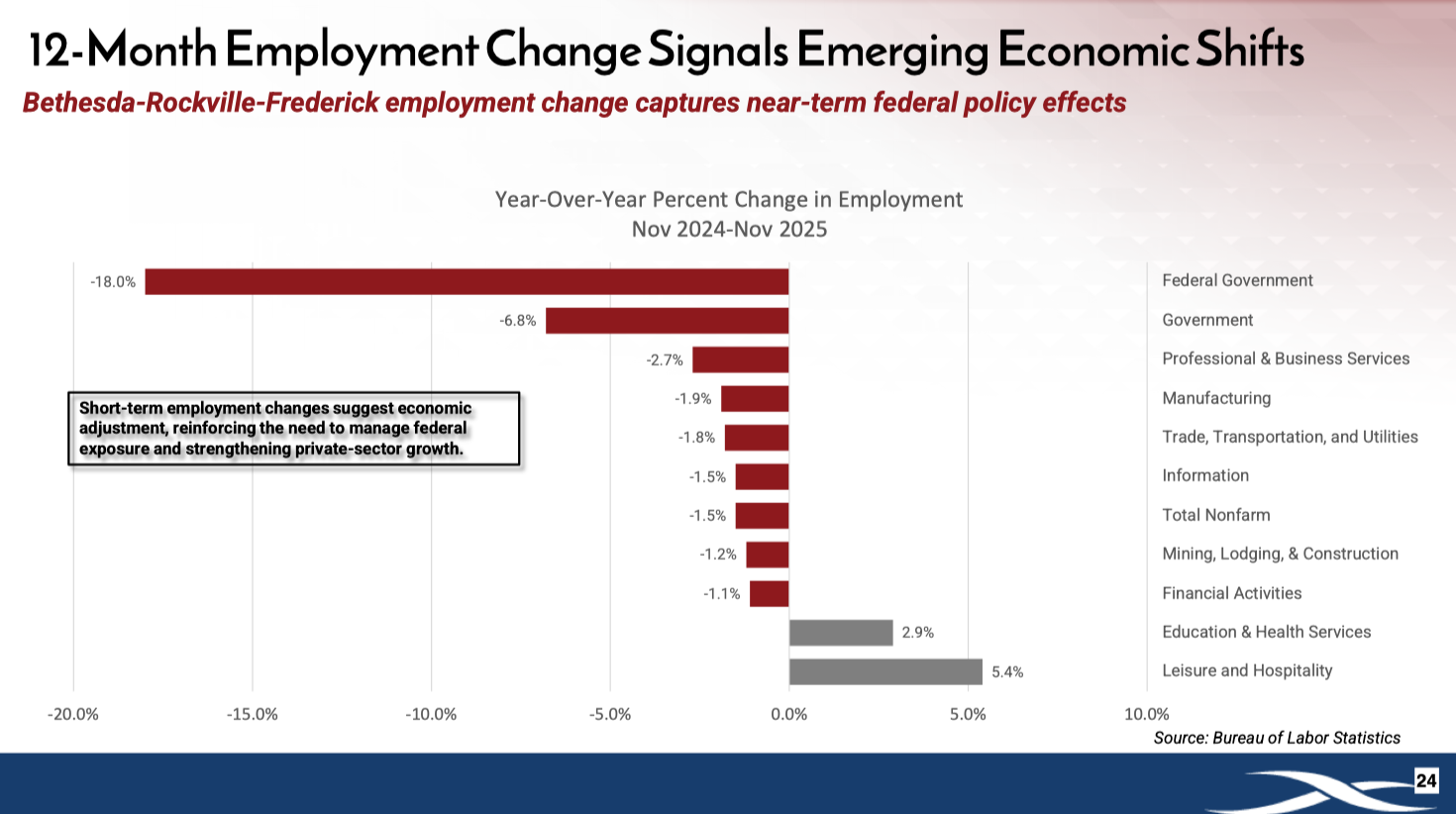
City officials reviewed new economic data showing Rockville’s unusually high dependence on federal employment and contracting. Layoffs and procurement slowdowns have nudged unemployment upward and softened local spending. Office vacancy remains elevated at 25% as federal contractors reduce space, and housing listings across the region have increased by 64% from 2024 to 2025. The report emphasized that Rockville is not entering a recession — instead, it is adjusting to a structural shift in how the federal government operates and how the regional workforce is organized.
The report quietly delivered a significant message: Rockville’s challenge is not economic collapse but economic gravity. Federal activity has long acted as the city’s stabilizer, and its reduction now reveals how much local commerce depends on it — especially restaurants, services, and smaller retailers. The data suggests resilience in the short term but vulnerability in the long term. If federal employment continues shrinking, the city may experience a slow erosion rather than a sudden downturn, which is often harder for governments to detect and address early.
Rockville’s Diversification Strategy: Biotech, AI, and Manufacturing
REDI outlined an economic strategy centered on attracting biotechnology firms, emerging technology companies (including AI), and small-scale manufacturing to offset federal losses. Rockville already hosts a major life sciences cluster, and officials hope to build on that foundation while expanding private-sector employment, and industrial zones in Twinbrook and East Rockville could be priorities for small manufacturers. Workforce transition efforts are intended to retain residents and prevent talent from leaving the region as federal hiring contracts.
The strategy reflects logical thinking — but also a subtle gamble. By leaning into biotech and advanced technology, the city is pursuing industries that match its workforce and regional identity. Yet many of these sectors still depend on federal research funding and contracts. In effect, Rockville may be diversifying within the same ecosystem rather than beyond it. The plan could succeed if private investment accelerates, but it risks replacing one form of federal dependence with another, more indirect version.
Commercial Real Estate and the Future of Offices
REDI acknowledged persistent office vacancies caused by reduced contractor demand and hybrid work patterns. Officials noted the issue appears structural rather than cyclical, meaning traditional recovery\ies may not occur even during economic growth. Older office buildings (built before 1987) face particular challenges.
This may be the most consequential issue discussed — even if it received the least public attention. Rockville’s fiscal health relies heavily on commercial property values. If office demand never fully returns, the question becomes land use rather than leasing: what should these buildings become? Cities across the country are confronting this same transition, and those that adapt zoning and redevelopment policies early tend to stabilize faster. The economic strategy will ultimately succeed or fail based on how the city reshapes physical space, not just which companies it recruits.
What the City May Still Be Missing
The presentation focused primarily on employers — understandable for an economic briefing — but residents experience change through housing costs, storefront occupancy, and neighborhood vitality. The risk is not that Rockville’s strategy is wrong, but that it is incomplete. Economic diversification alone does not guarantee community stability. The next phase of policymaking may need to shift from recruitment to urban design: how people live, shop, and move within the city after the federal era gradually recedes.
The next meeting on February 23 will be broadcast live on Rockville 11 and streamed on the city’s website. Residents can share opinions by emailing City Council or speaking during Community Forum.

 Max for Rockville