Navigating Rockville’s Election: Tom Moore’s Endorsements for Mayor and Council
These endorsements for the current candidates for Mayor and Council are provided by Tom Moore, a whom I first met when we both ran for Council years ago. Even though we don’t always agree, he’s informed, thoughtful, and may help you with your ballot choices. He served two terms on the Rockville City Council from 2011 to 2015, then served as counsel and chief of staff to Commissioner Ellen L. Weintraub of the Federal Election Commmission. In June, he joined the Center for American Progress as a senior fellow on its Democracy team. He has lived in Rockville since 1997.
No matter what happens this November, the City of Rockville will enter a new era of leadership. We’ll have our first new mayor since 2013. And we’ll have six councilmembers, up from four – and at least five of them will be newcomers.
Given the scarcity of information about the election, I wanted to share my thoughts about those who are running. With just two exceptions, I will be saying positive things about the people I’m supporting, and not much about those I am not supporting. I hope you find it helpful.
First up: I will be proudly voting for Mark Pierzchala for Mayor. I have a tremendous amount of respect for, loyalty to, and affection for Mark. He and I served together on the Council during my first term (2011-13). I learned a lot from him about the issues, but, more importantly, he modeled for me how to vote your conscience fearlessly. He took on tough issues when popular sentiment went the other way. He championed good development and housing policies when it would have been easier – sometimes, much easier – to vote the other way. He has a good heart, good common sense, and is admirably careful about the City’s budget. Mark has been a terrific councilmember who has served his City well, and he will be a terrific Mayor.
As to the Council: I will be voting for (in alphabetical order by last name): Kate Fulton, Barry Jackson, Anita Neal Powell, Izola Shaw, Marissa Valeri, and Adam Van Grack.
Kate Fulton impressed me when she and I sat down so she could pick my brain on how to run and serve. I was just about to talk about how the City budget was intimidating to me when I was first elected (but that the City’s budget staff were very kind and patient in explaining it) when Kate mentioned that she’s COO of the Federal Reserve. Yeah, she gets budgets. She’ll be a good councilmember.
Similarly, Barry Jackson and I sat down for a marathon coffee session months ago when he was first thinking about running. He’s a solid guy with great experience running the King Farm Citizens Assembly. He and I clicked on a lot of issues, and he immediately erased my concern that a candidate who runs KFCA would only represent King Farm if elected. He’ll be a good councilmember.
Anita Neal Powell has served the City for many years. She has been an effective and tireless advocate for Lincoln Park, and I’m delighted that she’s offering to serve on the City Council. On a City Council that will be made up of newcomers, Anita will bring a badly needed breadth and depth of experience. She’ll be a good councilmember.
I met Izola Shaw when we were both advocating for the city-citizen ballot initiative (which I’m going to be writing about separately!). She served the City well on the most recent Charter Review Commission. I like her, I like her values, and I think she’ll be a terrific voice on the Council.
I met Marissa Valeri when she was on the national staff of Common Cause and I was serving on the board of Common Cause Maryland. Marissa devoted years as a fierce advocate for the Twinbrook neighborhood as head of the Twinbrook Community Association. I think she’ll be the kind of councilmember I strived to be – energetic, attuned to her constituents’ needs, forever unsatisfied with the status quo, and eager to stick her neck out to do the right thing. She’ll be a good councilmember.
I had not met Adam Van Grack before this election season, but I’ve known his dad (Steve) and one of this brothers (Brandon) for many years. Adam sat down with me and we chewed over some of the stickiest issues facing the City – among them development, crime, and the fate of the King Farm farmstead and the former Redgate golf course. What impressed me most about Adam was not how much he agreed with me, but how much he disagreed with me – and how he did so. He was well-prepared to address the issues (important) and respectful in how he addressed our differences (less important, but shows he was raised well). But even when we came to opposite conclusions on different issues, the core values Adam used to analyze the issues were similar to mine, which is the most important. He’ll be a good councilmember.
Those are the six I’m voting for, and I recommend them to you.
As to the rest of the field: I haven’t met four of the candidates – Danniel Belay, Harold Hodges, Ricky Mui, and Paul Scott – and I can’t say much about their candidacies. I will note, however, that Mui supported Dan Cox for governor in 2022, which I think puts him well outside Rockville’s political mainstream.
I am actively deciding to vote against the two remaining candidates – Rich Gottfried and David Myles – and would like to provide some context for this. I know both of them, and I like both of them personally, but I do not believe the City would be well-served with either of them on the Council for the next four years.
Rich Gottfried has run for Council several times over the past few cycles, sometimes dropping an eye-popping amount of money into his campaign coffers, without success so far. He’s used that money to run very unpleasant campaigns, attacking the good will of those who confronted the City’s growth issues. Does he have a right to do that? Sure. But it doesn’t speak well of his grasp of the issues and doesn’t speak well of his ability to work on the Council.
Incumbent councilmember David Myles, who was elected in 2019 as a member of the Team Rockville organization I helped start in 2013, was involved in a domestic incident this summer in which the police were called and he was arrested. I am not judging David’s candidacy on the incident itself, because I just don’t know enough about it. It appears to be a sad and complicated situation.
But David’s response, in the form of a lengthy e-mail he sent to members of the community immediately after the incident, gave me great cause for concern. It was all over the map, kind of claiming victimhood in one section and kind of trying to be a public-service announcement in another, and weirdly dodgy throughout. The only thing I got out of it for sure was that David’s personal life needs to take priority over his public service.
Rockville’s Neighborhoods: A Key Factor in Local Elections?
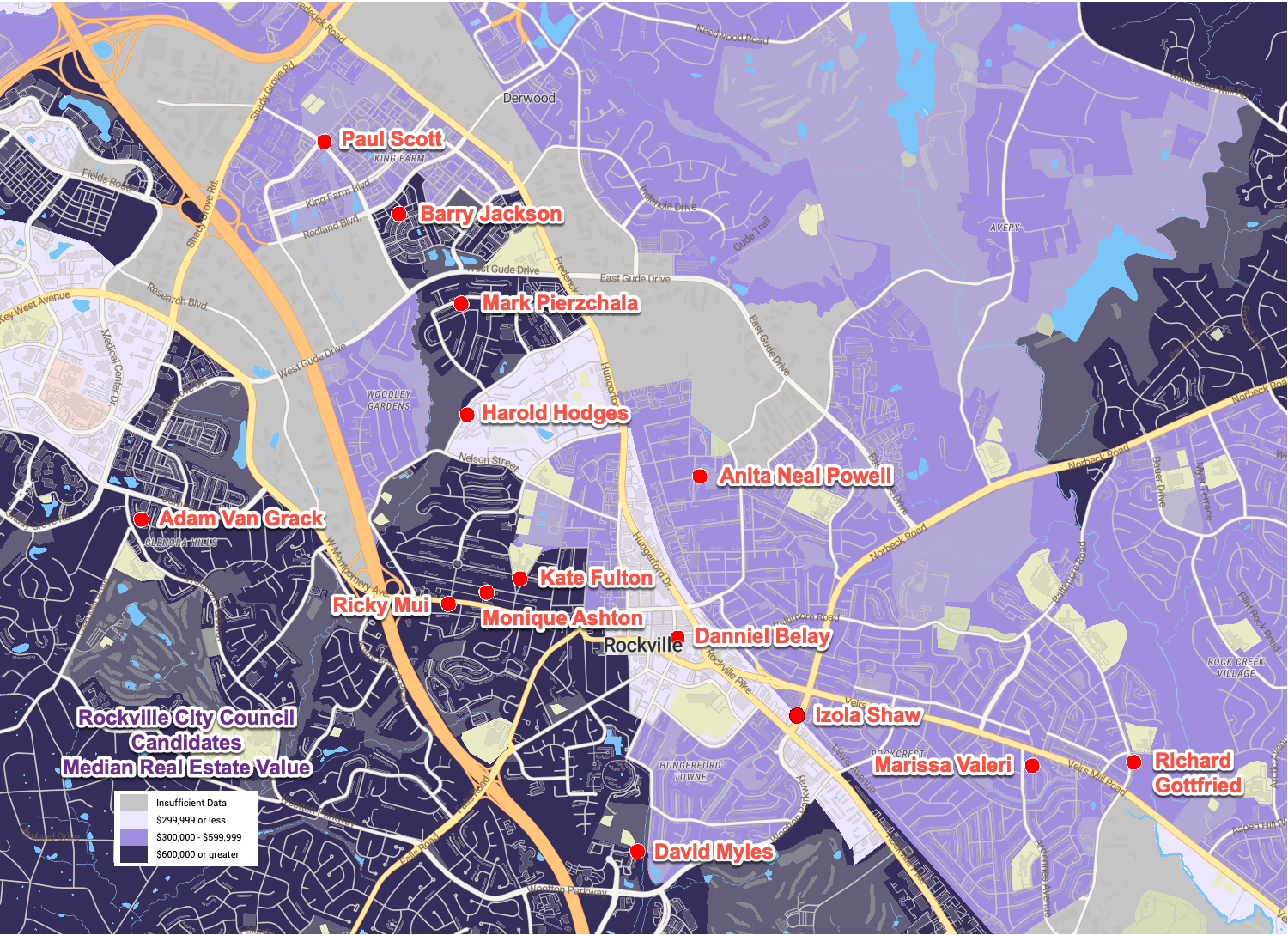
If you want to run for a spot on the Mayor and Council, you need to be at least 18, registered to vote, and have lived in Rockville for at least a year before the election (for this race, that means living here since November 7, 2022). But when people vote, they often pick candidates who they feel are like them and will represent what they care about. So, where a candidate lives can be really important, especially if they live in a neighborhood that’s similar to the voter’s.
Looking at the map, you can see Rockville is split into three parts by major highways. To the west of I-270 is the “wealthy west,” where the average house costs more than $600,000. Adam Van Grack is the only candidate from this part of Rockville. To the east of #355 (Rockville Pike/Hungerford Drive/Frederick Road—actually, the dividing line is Metro) are the “middleburbs,” where houses typically cost between $300,000 and $600,000 and is home to Anita Neal Powell, Izola Shaw, Marissa Valeri, and Richard Gottfried.
Right in the center of the city is the “mixing bowl,” where house prices vary the most and has the greatest number of candidates: Paul Scott, Barry Jackson, Mark Pierzchala, Harold Hodges, Kate Fulton, Monique Ashton, Ricky Mui, Danniel Belay, and David Myles.
In past elections, the richest neighborhoods usually had the most people voting. If we think they’ll vote for people who are like them or share their interests, we will likely see Barry Jackson, Adam Van Grack, Kate Fulton, Ricky Mui, and David Myles take five seats on the next city council. If we continue this logic, there is one more seat available on council so it will be a tight race between Paul Scott, Anita Neal Powell, Izola Shaw, Marissa Valeri, and Richard Gottfried. The contest for Mayor between Mark Pierzchala and Monique Ashton, who both live in wealthy neighborhoods, will be more complicated. Voters will likely consider additional factors like experience, background, personality, and age.
As for age, once again this council election attracted candidates that span at least three generations. The Millennial generation (born 1981-1996) is solely represented by Danniel Belay; Gen Xers (1965-1980) by David Myles, Monique Ashton, Ricky Mui, Izola Shaw, Kate Fulton, Barry Jackson, Marissa Valeri, Adam Van Grack, and Harold Hodges; and Boomers (1946-1964) by Paul Scott, Richard Gottfried, Mark Pierzchala, and Anita Neal Powell. Most people who vote in Rockville are from Generation X. If they vote for people who are like them, we might see a lot of candidates like David Myles, Monique Ashton, Ricky Mui, Izola Shaw, Kate Fulton, Barry Jackson, Marissa Valeri, Adam Van Grack, and Harold Hodges on the city council. But the people who vote the most are Baby Boomers, so Paul Scott, Richard Gottfried, Mark Pierzchala, and Anita Neal Powell could also have a good shot at winning.
The Rockville United campaign committee, which includes Monique Ashton, Kate Fulton, Paul Scott, Izola Shaw, and Marissa Valeri, could really shake things up in the city council if voters decide they want a big change. However, it’s hard to find information about this team online, and usually, people prefer to pick their candidates one by one. But remember, teams like Rockville United can be a great way to make the most out of limited resources.
Eligibility vs Participation: Three Rockville Council Candidates Didn’t Vote in 2019
October 7, 2023: I’ve been informed by a candidate for council that their voting record reported in this post is inaccurate. This information is this post is based on data provided by Montgomery County and the City of Rockville, so I am in the process of requesting further information from them to determine the source of the errors. My apologies to candidates affected by this blog post but I encourage all voters to ask about a candidate’s voting record to ensure they actively participate in our civic life and to ask the City of Rockville about the process for ensuring the accuracy of the voter database. More details at A Week of Surprises on Rockville’s Campaign Trail.
To run for a seat on the Mayor and Council, candidates must be 18 years old, a registered voter, and have lived in Rockville for at least one year prior to the election (that’s Nov. 7, 2022 for the current race). While you might be a registered voter, that doesn’t mean you vote. Indeed, in a review of voter records from Montgomery County and the City of Rockville shows that three candidates for City Council did not vote in the most recent 2019 City Council election: Danniel Belay, Ricky Mui, and Adam Van Grack. Perhaps they moved into Rockville after 2019, were sick, or out of town (although vote-by-mail was available), but it did make me wonder about the voting record of the other candidates. If you want to lead our little part of democracy, how active have you been in our democratic process? If you’re trying to convince people to vote, how convinced are you about the importance of voting?
Going back to the 2010 elections (I don’t have records for 2020 and 2022), four candidates voted in every election: Mark Pierzchala, Richard Gottfried, Anita Powell, and Marissa Valeri. That’s a 100% voting record. Voting less than half the time (50%) are Daniel Belay, Kate Fulton, Ricky Mui, Paul Scott, and Adam Van Grack. That doesn’t mean they should be automatically dismissed, but they should provide an explanation to voters (why should I vote for you when you didn’t vote most of the time?). The remaining field has a mixed record, although their voting record improved over time.
To see their voting records of the candidates at a glance, see the chart below. Green means they voted, red they didn’t vote, and yellow or ? is unknown. The date they registered to vote is important for evaluating their records—how long has the candidate been part of the democratic process? For example, Anita Powell has the longest record for Rockville, being a registered voter since 1975. On the other hand, Danniel Belay didn’t register until 2014 (I suspect he was under 18 until then), so he didn’t vote until 2014. Again, I don’t have records for 2020 and 2022 (the Montgomery County Board of Elections sells the list at a cost of a couple of hundred dollars), but the patterns are pretty clear from the data I have available.

Candidates for City Council Expands to 14
By September 7, the Board of Supervisors of Elections had certified two candidates for Mayor and twelve candidates for Council for the upcoming November 7, 2023 election. Danniel Belay, Richard Gottfried, and Anita Neal Powell are the latest additions, so if candidates were selected randomly, the chances of gaining a seat on Council decreased from 67 to 50 percent. But Councilmembers are not elected randomly and rely on their campaign strategies and voter motivation and preferences. Here’s the current list of candidates:
- Candidates for the Office of Mayor
- Monique Ashton
- Mark Pierzchala
- Candidates for the Office of Council
- Danniel Belay
- Kate Fulton
- Richard Gottfried
- Harold Hodges
- Barry Jackson
- Ricky Mui
- David Myles
- Anita Neal Powell
- Paul Scott
- Izola Shaw
- Marissa Valeri
- Adam Van Grack
Will Rockville Choose Diversity or Bureaucracy?
 WalletHub named Rockville as the one of America’s most diverse cities in 2016 based on social class, ethnicity, economics, and households. It ranked 14 out of 301, being bested by our neighbors in Gaithersburg (#1), Silver Spring (#4), Germantown (#5), and Frederick (#8), but ranked higher than places usually lauded for their diversity, such as San Francisco (#20), Alexandria, VA (#45), Denver (#67), San Antonio (#119), and Seattle (#149).
On Monday, March 6, the Rockville Mayor and Council will hold a public hearing on the role of the City Police in the enforcement of federal immigration laws. Will Rockville’s diversity be celebrated or feared? Will immigrants be threatened or welcomed? Will the answers be quickly forthcoming or will they become mired in bureaucracy? It’s uncertain where the City of Rockville will land and I suspect it will be a tense and difficult conversation.
It’s a conversation that started shortly after the Presidential election. Mayor Newton read a statement at the start of the City Council meeting on November 14, 2016 to recognize that Rockville’s strengths are Continue reading →

 Max for Rockville