Exploring Rockville’s Downtowns on May 7
I’ll be leading a 1.5-hour walking tour of Rockville’s downtowns for Peerless Rockville on Saturday, May 7 at 10 am. Wear comfortable shoes, be prepared for the weather, and consider enjoying lunch afterwards (unfortunately, some of the tour is not accessible to persons with limited mobility). Space is limited so please register in advance with Peerless Rockville.
A Great Day at the Homes and Hospitality Tour
New Year Opens in Rockville with a Peerless Brunch
 |
| Peerless Rockville Brunch 2010 |
The Peerless Rockville New Year’s Day Brunch at Glenview Mansion was the first official event celebrating the 150th anniversary of the City of Rockville and everyone enjoyed a beautiful day, a nice mix of members and friends, and of course, lots of good food. Although it’s a holiday, the event always draws a good crowd of community leaders, including State Senator Forehand; State Delegates Barve, Simmons, and Gilchrist; Rockville Mayor Marcuccio; Rockville Councilmembers Gajewski, Newton, and Pierzchala; and City Clerk Funkhouser. This year’s event invited people to wear something vintage and among the standouts were Bill Forehand (with a Civil War sailor’s uniform) and Cindy Cotte Griffiths (with an amazing vintage dress–satin and velvet?). Peerless also encouraged everyone to submit their nominations for Places That Matter in Rockville (standing or not) and Peerless will be using it as a guide for events and activities for the upcoming year (Phyllis Marcuccio was actively supporting the Pump House). Glenview Mansion is an ideal place to hold the brunch–it’s almost perfectly suited to this type of event–and it was wonderfully decorated for the holidays. Rockville is very fortunate to have such a marvelous historic venue for community events (so much better than a high school gym!). If you want to see a photoalbum from the day, click on the picture or caption.
Walking Tour of African American Places in Rockville
In October, the City of Rockville unveiled the new markers for the historic places around downtown associated with African American history. It was a beautiful day and a long trail of people followed along to visit the many sites, so if you missed it, Channel 11 now has it available online (it won’t be the same as doing it yourself, but you can get a sense of the fun we had that day).
African American historic places highlighted in Rockville
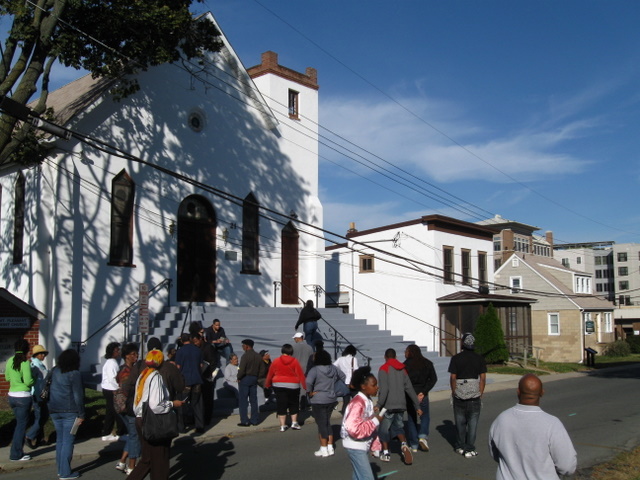
Tour of the Jerusalem Mt. Pleasant United Methodist Church
The City of Rockville has been working for nearly a decade to recognize the history of African American in the city and yesterday marked a major accomplishment with the installation of several interpretive markers in downtown. Many people who shop, work, and live in the Town Square don’t realize it was once a thriving African American community which was demolished during the 1960s and 1970s due to urban renewal. Today, very little remains and the plaques remind us of how much was lost–and also that African Americans have a long and distinguished history in Rockville.
Yesterday afternoon the City of Rockville hosted a tour on an incredibly beautiful fall day to visit some of these places and to see the new plaques, including Continue reading →
Stepping Stones Shelter hosts VIPs and Volunteers
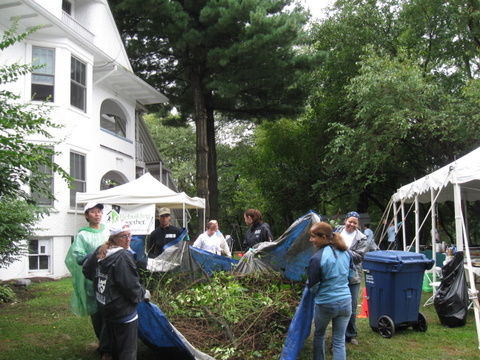
Volunteers clearing brush at Stepping Stones Shelter
Despite the rainy weather, more than one hundred volunteers came to the Stepping Stones Shelter in the Jefferson Square/Hungerford section of Rockville today as part of the National Day of Service commemorating 9-11. When I arrived at 1 pm, it was buzzing with people. They had removed carpet from the house exposing the original oak floors, were fixing radiator covers on the front porch, clearing LOTS of brush from the woods, and refinishing picnic tables in the back yard to make the historic house a more attractive and enjoyable place for its residents and staff. The project in Rockville launched a three-year partnership between Continue reading →
Today’s Issues
Tonight the Historic District Commission held its regular meeting and encountered a few issues that touch the larger community:
1. The new “Green” section of the Building Code has been long overdue but as a result, should be easily adopted. Indeed, it probably doesn’t go far enough. The code has different levels of expectations (e.g, Rockville Certified, Rockville Silver) based on the number of points scored on a menu of tasks (e.g., if you install solar panels, you get X points). To achieve the “certified” level, you must have a minimum number of total points, and for “silver” it’s a bit higher. What level you need to achieve is based on the size of the building. What’s odd is that non-residential (aka, commercial) and multi-family (aka, apartments) need to achieve “certified” if they’re larger than 7,000 sf. Low rise residential (aka, single family homes) must “certified” no matter the size. Actually, certified shouldn’t be that hard to reach, especially if you have any interest in saving energy. For me, all new construction–residential or commerical–should reach the lowest “certified” level no matter the size. Why are small office, retail, and apartment buildings exempt? Aren’t we all supposed to be good citizens and save energy? If you have comments, send them to the City by the end of May so they can be incorporated into the next draft in June.
2. We recommended that a home at 224 Elizabeth Avenue in Lincoln Park be designated historic. It wasn’t a unanimous decision and I predict that the Mayor and Council will have a difficult time deciding this one. However, what did come up was that the Zoning Code allows churches in every zone of the city, including residential. Coming from California, this is a strange notion. My former hometown only allowed churches in residential zones as conditional uses because of the traffic and parking lots–it really disrupted a neighborhood, especially on weekends. In Rockville, I’ve become accustomed to churches tucked in neighborhoods and it seems to be a good thing. But once they reach a certain size (say, over a capacity of 100-200), they really need to move to a more suitable location on a highway or in a non-residential zone that can handle the traffic and parking, or receive a conditional use permit to demonstrate they won’t have an adverse impact on nearby homes. Right now, churches can buy adjacent houses and turn them into parking lots, or simply grow in size on their existing lot and leave the parking on the streets. That doesn’t seem right. (And just to confirm, I’m not opposed to churches, just excessive traffic, noise, and congestion in residential neighborhoods.)
3. The historic Pump House in East Rockville is finally being rehabilitated into a proper community center. There will be very few changes to the exterior but many improvements inside to allow it to be used for meetings, workshops, and classes for the neighborhood. Historic buildings can often be reused for new purposes rather than demolished, and this distinctive industrial building provides a great example. Isn’t this much better than constructing a concrete block box with steel windows for a community center?
And I’ll make my apologies now. The story of the community coming together to provide a home for a single mother, her eight children, a nephew, and a grandmother in the 1950s (this is the house at 224 Elizabeth) was remarkable, and I went so far to say that you don’t see that today. I was wrong. Actually, it does happen all the time, but usually not as dramatically as the moving of a house. In Twinbrook, neighbors get together to clean up the parks and streams, work on community plans and policies, lobby for neighborhood improvements, and much more. And it happens throughout Rockville as well.

 Max for Rockville