Rockville’s Taxes Too Hot? Too Cold? Just Right?
When people about taxes and city services, you often hear:
- Our taxes are too high. Why can’t the Mayor and Council lower the tax rate?
- We pay a lot in taxes. We deserve to have trash picked up twice a week. Why haven’t they fixed my sidewalk?
- Our taxes are fine, but why does the money always get spent on the west side of town?
and so on. I’ve never heard anyone say their taxes are too low.
Taxes are certainly one of those topics that will bring nearly any citizen to a frenzy so I try to avoid it whenever possible except to say that Continue reading →
Stepping Stones Shelter hosts VIPs and Volunteers
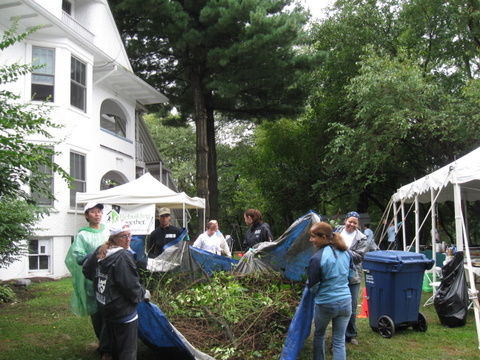
Volunteers clearing brush at Stepping Stones Shelter
Despite the rainy weather, more than one hundred volunteers came to the Stepping Stones Shelter in the Jefferson Square/Hungerford section of Rockville today as part of the National Day of Service commemorating 9-11. When I arrived at 1 pm, it was buzzing with people. They had removed carpet from the house exposing the original oak floors, were fixing radiator covers on the front porch, clearing LOTS of brush from the woods, and refinishing picnic tables in the back yard to make the historic house a more attractive and enjoyable place for its residents and staff. The project in Rockville launched a three-year partnership between Continue reading →
Petition for City Council Certified
I am delighted to announce that my candidacy for Rockville City Council is official! I submitted my papers with a petition of 100 registered Rockville voters this morning and the City Clerk’s office certified them this afternoon. This Web site will change over the weekend as I move from the “exploration” to “candidate” stage. In the meantime, thanks to everyone who has encouraged me to run, gave me sober advice, and signed my petition.
A Very Long HDC Meeting
Last Thursday the Historic District Commission held its regular monthly meeting and if anyone was watching to the end, you may have noticed that the clock was nearing midnight. We usually try to finish at 10 pm but we had an ambitious agenda, including:
1. A joint meeting with the Environment Commission, which included three Planning Commissioners. The City has about two dozen commissions and boards but they rarely, if ever, talk with each other, even if they share some common goals or are tackling the same issue. This past year the HDC has requested meetings with other commissions but it’s been slow because finding mutual agreeable times is difficult and sometimes, I regret to say, the Chair of the other commission refused to respond to emails or phone calls to meet (what’s that about??). So far, we’ve met with the Planning Commission and this month with the Environment Commission. These meetings are just an hour so no decisions are made, but they provide introductions and we learn a bit more about each other to discover areas of mutual interest. It’s obvious that the Environmental Commission and the HDC both want to encourage Continue reading →
The Proposed Green Building Regulations: Can We Do More?
On May 21, the City of Rockville provided an update on the revisions to the Building Code, including the new Green Building Regulations, to the Historic District Commission and Recreation and Parks Committee.
I am delighted that this action is finally taking place, indeed, I sense it will be adopted with few objections because so many of these ideas have been already accepted by the community with our growing awareness that the nation’s resources are limited and our current ways of living are no longer sustainable. I especially appreciate that the City is following the standards of LEED from the US Green Building Council, while providing a less costly alternative through “Rockville Certified” and “Rockville Silver” ratings.
However, I urge the Mayor and Council to be more visionary and adopt higher standards than proposed, as follows:
1. Ensure that the City Code is aligned with the latest LEED rating system. I believe the proposed code is based on LEED 2 (released in 2000), however, the US Green Building Council adopted LEED 3 (aka LEED 2009) in April 2009 and all new projects must be certified under LEED 3 after June 27, 2009. Builders and property owners should not be required to meet two different standards and it will only result in opposition to green building practices in Rockville.
2. Require that all new construction, no matter the size, meet the Green Building Code. Continue reading →
New Urbanism video includes Rockville Town Square
Built to Last recently won first prize in the Congress for the New Urbanism video contest. It’s a three-minute video explaining how the principles of New Urbanism – density, design and walkability – can effectively respond to the current environmental challenges that we face. It may be a bit controversial in suburban Rockville but if you watch closely, you’ll see our Town Square flit by as an example (perhaps New Urbanism is already here?).
Hometown Holidays
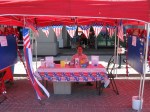 For both days of Hometown Holidays, the annual street fair in downtown Rockville held over the Memorial Day weekend, I manned a booth to publicly declare my candidacy for City Council. I was the only candidate or elected official at any level (city, county, or state) with a booth and one of two booths related to politics (next door was the Republican Womens Association).
The days were long and hot, but it was a great way to meet lots of people, even though the booth was a bit off the main axis of activity (I was one of two booths on Montgomery Avenue in front of the Regal Movie Theater; most booths lined Maryland Avenue). When I wasn’t chatting with people, I was being entertained by live music from the “Montgomery Stage,” each day bringing three great bands (I was expecting at least one band that would cause me to grind my teeth for an hour, but really every band was top notch).
Here’s what I learned: Continue reading →
Today’s Issues
Tonight the Historic District Commission held its regular meeting and encountered a few issues that touch the larger community:
1. The new “Green” section of the Building Code has been long overdue but as a result, should be easily adopted. Indeed, it probably doesn’t go far enough. The code has different levels of expectations (e.g, Rockville Certified, Rockville Silver) based on the number of points scored on a menu of tasks (e.g., if you install solar panels, you get X points). To achieve the “certified” level, you must have a minimum number of total points, and for “silver” it’s a bit higher. What level you need to achieve is based on the size of the building. What’s odd is that non-residential (aka, commercial) and multi-family (aka, apartments) need to achieve “certified” if they’re larger than 7,000 sf. Low rise residential (aka, single family homes) must “certified” no matter the size. Actually, certified shouldn’t be that hard to reach, especially if you have any interest in saving energy. For me, all new construction–residential or commerical–should reach the lowest “certified” level no matter the size. Why are small office, retail, and apartment buildings exempt? Aren’t we all supposed to be good citizens and save energy? If you have comments, send them to the City by the end of May so they can be incorporated into the next draft in June.
2. We recommended that a home at 224 Elizabeth Avenue in Lincoln Park be designated historic. It wasn’t a unanimous decision and I predict that the Mayor and Council will have a difficult time deciding this one. However, what did come up was that the Zoning Code allows churches in every zone of the city, including residential. Coming from California, this is a strange notion. My former hometown only allowed churches in residential zones as conditional uses because of the traffic and parking lots–it really disrupted a neighborhood, especially on weekends. In Rockville, I’ve become accustomed to churches tucked in neighborhoods and it seems to be a good thing. But once they reach a certain size (say, over a capacity of 100-200), they really need to move to a more suitable location on a highway or in a non-residential zone that can handle the traffic and parking, or receive a conditional use permit to demonstrate they won’t have an adverse impact on nearby homes. Right now, churches can buy adjacent houses and turn them into parking lots, or simply grow in size on their existing lot and leave the parking on the streets. That doesn’t seem right. (And just to confirm, I’m not opposed to churches, just excessive traffic, noise, and congestion in residential neighborhoods.)
3. The historic Pump House in East Rockville is finally being rehabilitated into a proper community center. There will be very few changes to the exterior but many improvements inside to allow it to be used for meetings, workshops, and classes for the neighborhood. Historic buildings can often be reused for new purposes rather than demolished, and this distinctive industrial building provides a great example. Isn’t this much better than constructing a concrete block box with steel windows for a community center?
And I’ll make my apologies now. The story of the community coming together to provide a home for a single mother, her eight children, a nephew, and a grandmother in the 1950s (this is the house at 224 Elizabeth) was remarkable, and I went so far to say that you don’t see that today. I was wrong. Actually, it does happen all the time, but usually not as dramatically as the moving of a house. In Twinbrook, neighbors get together to clean up the parks and streams, work on community plans and policies, lobby for neighborhood improvements, and much more. And it happens throughout Rockville as well.
Preparing for Hometown Holidays
I’ll be filling a booth at Hometown Holidays on Memorial Day weekend so I can meet people and gather signatures for my petition to get on the ballot as a candidate for Rockville City Council. By itself, that can be a pretty boring activity for a booth, so I’m bringing a couple “talk-back” boards (a pre-blog/Facebook technique used in museums to encourage interaction with an exhibit) to allow people to share ideas and concerns about Rockville. Plus, I’ll bring my postcards of Rockville, which I’ll be giving away (but encouraging a donation to Peerless Rockville). Hope to see you then!
Campaign papers pulled
On Friday, May 1, I arrived at Rockville when it opened and was the first person to pull their papers for candidacy for council for the City of Rockville. Candidates receive a 3″ notebook with extensive information on the rules and regulations for campaigning in the city, along with a book of official receipts for donations and a Rockville pencil! Now on to master the rules and obtain one hundred signatures from registered voters for my petition to be placed on the ballot.
Today I established this Web site and blog to introduce the community to me and keep them informed about the campaign (plus I’ll include my opinions from time to time–and welcome yours as well).


