County Gets Largest Share of Property Tax. Is It Worth It?

The annual “Real Property Consolidated Tax Bill” is hitting mailboxes in Rockville and while most residents and businesses will be grumbling about the bites taken by state and local government, it’s also a time to reflect on the value we receive as a community in exchange. After all, taxes largely support police, fire protection, schools, libraries, parks, recreation, sidewalks, and roads—aspects of everyday life that make it safer and better. There’s lots more behind the scenes that we don’t notice until we need them, such as building safety inspections, animal control, voting, utility payment assistance, and affordable housing.
That’s all good but we should also consider how much each government agency receives and if we are getting our money’s worth. For Rockville residents and businesses, the lion’s share of property tax is taken by Montgomery County and the least by the State of Maryland, yet I more often see complaints about services directed at the City of Rockville and rarely at the County. Indeed, for most of Rockville, Montgomery County is invisible even though it’s headquartered in Rockville.
It’s time that Rockville ask more of Montgomery County and ensure we are receiving adequate and satisfactory services for the incredible amount of tax money we send their way. We especially need to make our needs, interests, and expectations known to the Councilmember Sidney Katz (who represents Rockville) and Councilmembers Gabe Albornoz, Evan Glass, Will Jawando, and Laurie-Anne Sayles (the four At-Large representatives). These are fulltime positions with a salary of $156,284, so we can easily expect a lot from them.
Councilmember Sid Katz is perhaps the least active of the 11-member board, spending most of his time at ribbon-cuttings, photo ops, and groundbreaking ceremonies. Even his “Sidney in the News” section of his website is moribund with only one news item for 2021, one for 2022, and none for 2023. Sigh.

Increased Property Taxes? Who’s to Blame?
 For homeowners in Rockville, July brings the annual property tax bill. I’m guessing that most people simply look at the bottom line and grumble that it’s higher than last year, blaming it on the government. But we’re the government, so we can and should tell our elected officials when it’s okay to be taxed and how we want those funds spent. Which elected officials should we blame? That’s where it can get confusing and far too often I’ve seen the wrong people blamed for the actions of others. Indeed, the Rockville Mayor and Council too often is unfairly blamed for high taxes, when it’s usually the fault of the Montgomery County Council. Take a look at the breakdown for my property taxes, which will be roughly equivalent to all other homes in Rockville because we pay the same percentage of taxes according to the assessed value of the property. As you can see in the pie chart, Montgomery County collects nearly two-thirds of the property tax (blue), Rockville about a quarter (orange), and the State of Maryland about ten percent (green). Rockville collects another ten percent for trash and stormwater management (light orange) but Continue reading →
Are Rockville’s Taxes Going Up, Down, or Staying Flat?
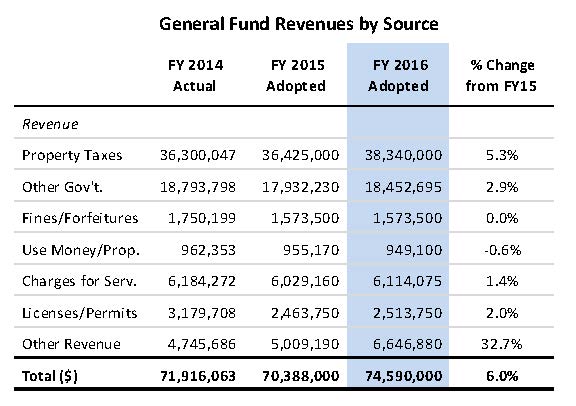
General Fund Revenues by Source, FY 2016 Adopted Budget, City of Rockville, page 9.
In elections, taxes are often a hot-button issue and that’s no different in the current Rockville Mayor and Council campaign. Taxes are are the largest source of government revenue and directly affect most residents and businesses, but they aren’t the only source. For Rockville, those sources include fees, permits, fines, licenses, investments, and overhead. As you can see in the chart from the City’s FY2016 adopted budget, property taxes contribute 51 percent and “Other Gov’t” (which consists of highway user taxes and income taxes) is 25 percent.
Property taxes not only represent the largest share of general fund revenues at $38 million but they are also expected to grow more than 5 percent in 2016 compared to last year. That’s not because of increased rates, but increased property values. Although I always grumble when I receive my property tax bill, I’m slightly mollified by knowing that the value of my house has also increased (and that I’m helping pay for those things I value in my community, such as roads, parks, police, libraries, schools, etc. etc.). In chatting with others in the community, they also grumble about property taxes but place most of the blame on the City of Rockville, but it should actually be aimed at Continue reading →

 Max for Rockville